Arizona Walnut (Juglans major)
Juglans major, the Arizona Walnut, is a handsome native deciduous tree found in the mountain canyons, hillsides, and streambanks of the Sonoran and Chihuahuan desert regions of Arizona, New Mexico, Texas, Colorado, Utah, and Oklahoma. A member of the Juglandaceae (walnut) family, this rugged tree thrives where many others cannot — surviving on dry rocky slopes while providing irreplaceable ecological services to desert wildlife. Its large, fragrant, pinnately compound leaves, deeply furrowed bark, and round edible nuts make it one of the most distinctive native trees of the American Southwest.
Arizona Walnut typically grows as a medium-sized tree reaching 40 to 50 feet tall, often with a broad, rounded canopy that provides welcome shade in the desert landscape. Both male catkins and small female flowers appear on the same tree (monoecious) each spring, eventually producing the small, thick-husked walnuts that are prized by wildlife and humans alike. The nuts, though smaller and harder to crack than commercial walnuts, are richly flavored and edible — Indigenous peoples and early settlers have harvested them for generations.
Despite its association with arid lands, Arizona Walnut prefers moderate to high moisture and is typically found along canyon streams, at higher elevations, and in riparian zones where subsurface water is available. As a landscape tree, it offers tremendous value: massive wildlife food production, excellent shade, attractive form, and strong drought tolerance once established. Its deep root system helps anchor streambanks and hillsides against erosion, making it an ideal species for habitat restoration in the Southwest.
Identification
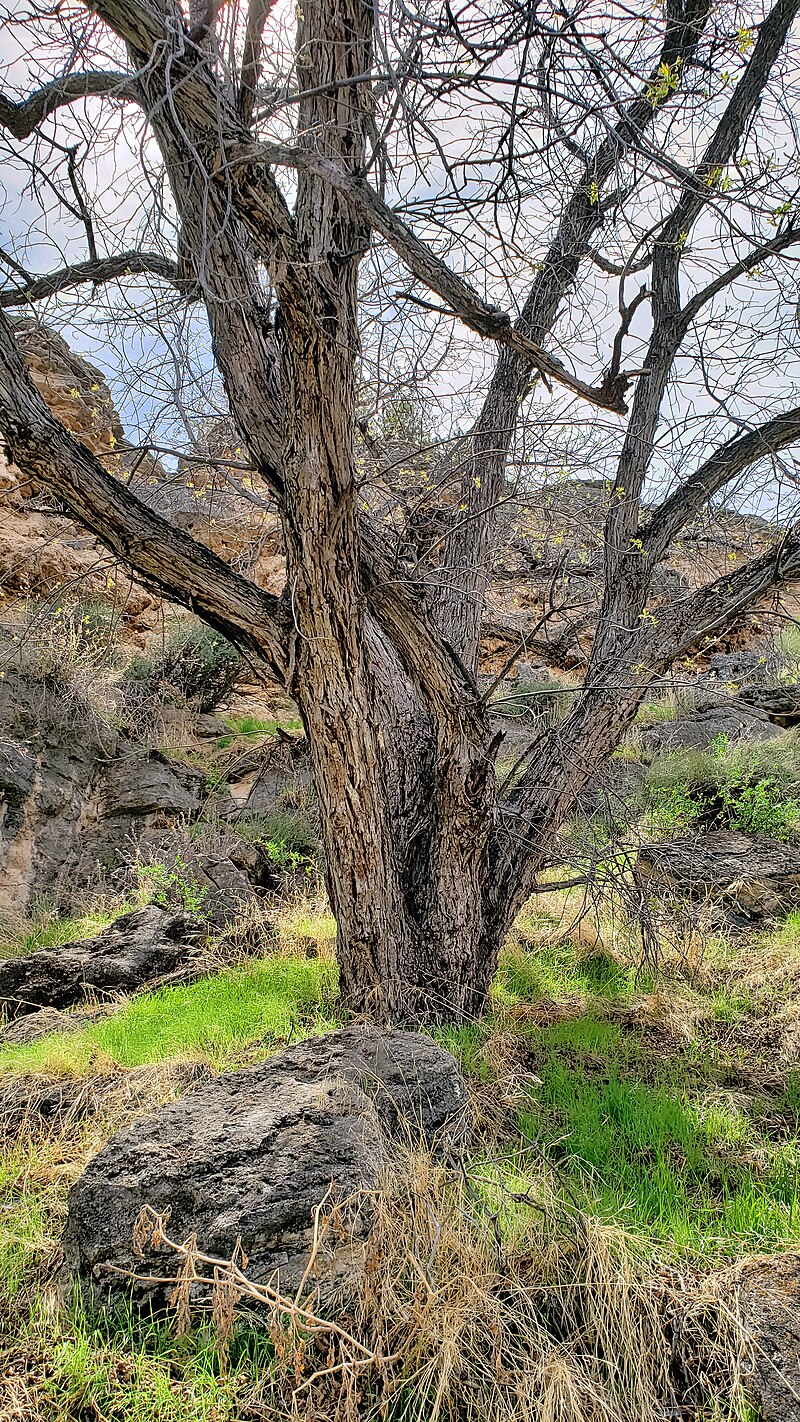
Arizona Walnut is a medium to large deciduous tree with a broad, spreading crown. The trunk is typically straight with deeply furrowed, dark gray-brown bark that becomes increasingly ridged with age. Like all true walnuts, it produces a distinctive yellow-brown dye from its husks and leaves that can stain hands and fabric.
Bark & Trunk
The bark of mature Arizona Walnut is dark grayish-brown, deeply furrowed with interlacing ridges that give the trunk a rugged, textured appearance. Young stems are gray-brown and bear the leaf scars characteristic of walnuts — large, heart-shaped to three-lobed scars with distinctive chambered pith. The wood is hard, close-grained, and valuable as a small-scale lumber source. When cut, the inner wood reveals the beautiful dark brown coloring typical of walnut species.
Leaves
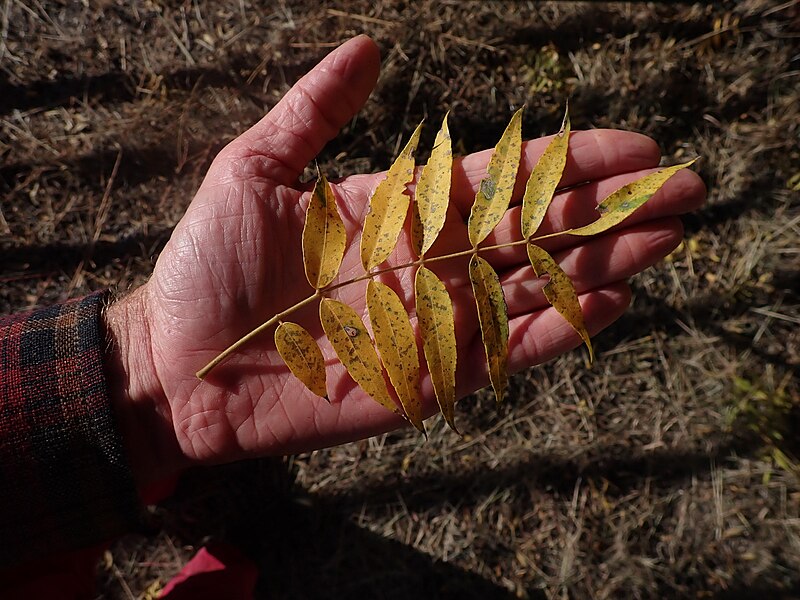
The leaves are large and pinnately compound, typically 9 to 15 inches (23–38 cm) long, with 9 to 15 lance-shaped to ovate leaflets arranged along a central stem. Each leaflet is 2 to 3 inches long, with a serrated margin and a pointed tip. The upper surface is dull green; the underside is slightly paler and hairy. The leaves are aromatic when crushed, releasing a characteristic walnut scent. In autumn, the foliage turns yellow before dropping, making this one of the more colorful fall trees in the Arizona highlands.
Flowers & Fruit
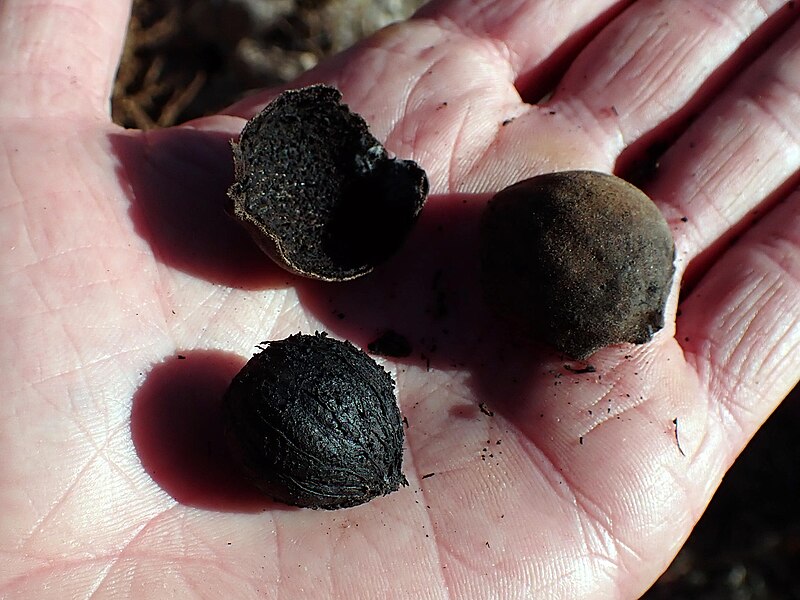
Arizona Walnut is monoecious — it bears both male and female flowers on the same tree. Male flowers appear as pendulous, drooping catkins (3–5 inches long) in spring, while small female flowers appear in clusters of 1–3 at the tips of current-year shoots. The flowers emerge with or slightly after the leaves in April and May. The fruit is a round drupe, 1 to 1.5 inches in diameter, with a thick, greenish husk that turns black and falls in autumn, enclosing a deeply ridged, round walnut shell. The nuts are edible but smaller and harder-shelled than the commercial English walnut, with a rich, distinctive flavor prized in regional cooking.
Quick Facts
| Scientific Name | Juglans major |
| Family | Juglandaceae (Walnut) |
| Plant Type | Deciduous Tree |
| Mature Height | 40–50 ft |
| Sun Exposure | Full Sun |
| Water Needs | Moderate to High |
| Bloom Time | April – May |
| Flower Color | Yellow-green catkins (male); tiny red pistillate flowers (female) |
| Fruit | Round edible walnut, 1–1.5 in diameter |
| Notes | Male & female flowers on same tree. Deciduous. |
| USDA Hardiness Zones | 6–9 |
Native Range
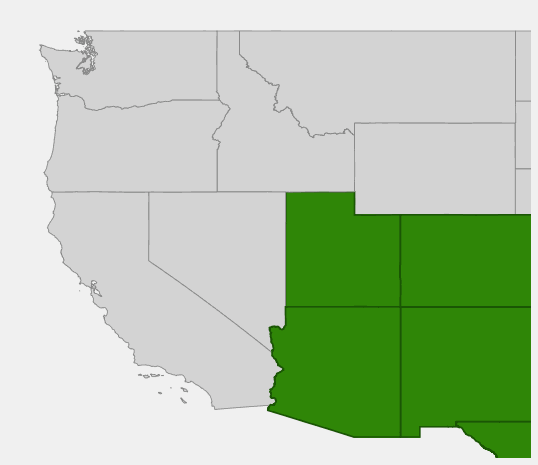
Arizona Walnut is native to the mountain and foothill regions of the American Southwest and northern Mexico. In the United States, its range extends from central and southeastern Arizona through New Mexico and western Texas, with outlying populations reaching southern Colorado, Utah, and Oklahoma. The species most commonly occurs at elevations between 4,000 and 7,500 feet, where temperatures are somewhat cooler and moisture more consistent than on the lowland desert floor.
Within Arizona, Arizona Walnut is a signature tree of the Sky Islands — the isolated mountain ranges such as the Rincons, Santa Ritas, Huachucas, and Chiricahuas — where it grows in the transition zone between desert grassland and oak woodland. It is commonly found in canyon bottoms and along intermittent streams where subsurface water provides reliable moisture even during dry seasons. These canyon habitats support extraordinary biodiversity, and the walnut is a keystone species within them, providing food and shelter for dozens of wildlife species.
The Arizona Walnut also forms mixed woodlands with Emory Oak (Quercus emoryi), Arizona Sycamore (Platanus wrightii), and Velvet Ash (Fraxinus velutina) at mid-elevations, creating a rich, multi-layered forest structure that is increasingly rare and threatened by climate change and development pressure in the Southwest.
📋 Regional plant lists featuring Arizona Walnut: Arizona
Growing & Care Guide
Arizona Walnut is a rewarding long-term investment in the native landscape. Once established, it is relatively tough and self-sufficient, requiring minimal care beyond adequate irrigation during its first few years.
Light
Arizona Walnut demands full sun for best performance. Plant it in the most open, sunny location on your property — at least 6 to 8 hours of direct sunlight per day. Shaded trees grow slowly, produce fewer nuts, and are more prone to structural weakness. In the wild, this species grows in sunny canyon corridors and open hillsides where light is plentiful.
Soil & Water
Although Arizona Walnut grows in canyon environments with more moisture than surrounding desert, it is surprisingly adaptable to a range of soils including rocky, well-drained substrates. It does not tolerate waterlogged conditions. Young trees benefit from regular watering (weekly during summer) until established — typically 2 to 3 years. Mature trees are more drought-tolerant but perform best with deep, infrequent irrigation that mimics canyon stream conditions. The moderate to high water needs reflect its preference for more moisture than typical desert natives, particularly at higher elevations.
Planting Tips
Plant Arizona Walnut in fall or early spring to allow root establishment before summer heat. Dig a hole 2–3 times as wide as the root ball but no deeper. Amend heavy clay soils with coarse gravel or sand to improve drainage. Space trees at least 30 feet from structures — the extensive root system and nut litter can be problematic close to buildings. Be aware that walnuts produce juglone, a natural chemical that can inhibit growth of some nearby plants, particularly tomatoes, apples, and rhododendrons.
Pruning & Maintenance
Arizona Walnut requires minimal pruning. Remove dead or crossing branches in late winter while dormant. Avoid heavy pruning as the tree bleeds sap readily when cut during the growing season. The hulled nuts create dark staining where they fall, so consider placement carefully if the area below will be used as a patio or walkway. Fallen nuts left on the ground may germinate, providing an easy source of seedlings for transplanting.
Landscape Uses
- Shade tree — provides excellent large canopy in sunny spaces
- Wildlife garden centerpiece — nut crop draws squirrels, jays, and other wildlife
- Riparian restoration — excellent along canyon streams and washes
- Edible landscaping — nuts are harvested for food
- Erosion control — deep root system stabilizes slopes and streambanks
Wildlife & Ecological Value
Arizona Walnut is among the most wildlife-valuable native trees of the Southwest. Its nuts are a critical high-fat food source for many species in the lean months of fall and winter, and the tree’s large canopy, deeply furrowed bark, and nut litter create a complex micro-habitat supporting an exceptional array of life.
For Birds
Many bird species depend on Arizona Walnut, particularly for its insects and nuts. Acorn Woodpeckers, Mexican Jays, and Steller’s Jays actively cache the nuts for winter food reserves. Yellow-billed Cuckoos nest in the dense canopy along canyon streams. The tree’s bark hosts abundant insect activity that attracts woodpeckers, nuthatches, and Brown Creepers year-round.
For Mammals
Squirrels — especially Rock Squirrels and Arizona Gray Squirrels — are among the most significant consumers and dispersers of Arizona Walnut seeds, caching nuts throughout the canyon landscape and inadvertently planting new trees. White-tailed Deer browse young foliage and shoots. Javelina, black bears, and coatis also consume fallen nuts when available. The dense canopy provides thermal cover and nesting habitat for various bat species that roost in mature cavities.
For Pollinators
While wind-pollinated (as with all walnuts), Arizona Walnut provides substantial support for pollinators indirectly. Its aromatic leaves and the dense insect community associated with its bark and leaf litter attract native bees, beetles, and other beneficial insects. Caterpillars of several moth and butterfly species feed on walnut foliage, including the Walnut Sphinx moth (Amorpha juglandis) and various underwing moths.
Ecosystem Role
As one of the largest and longest-lived trees of Madrean canyon ecosystems, Arizona Walnut plays a structural role that few other species can fill. Its large canopy moderates temperatures along canyon streams, reducing water evaporation and maintaining cooler, moister microclimates that benefit the entire riparian community. Fallen leaves decompose relatively quickly, enriching canyon soils with organic matter and nutrients essential to the entire woodland community.
Cultural & Historical Uses
Arizona Walnut has been an important resource for Indigenous peoples of the Southwest for thousands of years. Apache, Navajo, and various Pueblo peoples harvested the small but nutritious nuts as a staple food source, often grinding them into a rich paste or using the nut meat in traditional recipes. The nuts are high in fat and protein — important calorie sources in desert environments where food could be scarce during winter months.
Beyond nutrition, Arizona Walnut provided important materials for toolmaking. The hard, dense wood was used for bows, tool handles, and digging sticks. The dark brown dye extracted from walnut hulls — juglone — was used by Navajo and other weavers to produce distinctive black-brown tones in wool. This same chemical that gives walnut its legendary dyeing properties is the juglone that inhibits the growth of many nearby plants, an allelopathic effect that Indigenous farmers would have observed and worked around in their agricultural plots.
Spanish colonial settlers and later Anglo-American settlers also valued Arizona Walnut for its wood, which they used for furniture, gunstocks, and fence posts. The nuts were gathered seasonally by pioneer families in Arizona and New Mexico, and the tree’s association with reliable canyon water sources made it a landmark on early travel routes. Today, Arizona Walnut continues to be cultivated and restored, and increasing recognition of its ecological and cultural value has made it a priority species in Southwestern conservation efforts. Modern woodworkers prize the lumber for its beautiful grain and rich color, comparable to black walnut but in smaller dimensions.
Frequently Asked Questions
Are Arizona Walnut nuts edible?
Yes — Arizona Walnut nuts are edible and have been eaten by Indigenous peoples for thousands of years. They are smaller and harder-shelled than commercial English walnuts, but the nut meat is rich and flavorful. Cracking them requires some effort; a sturdy nutcracker or even a rock works. The nuts are nutritious and high in fat and protein.
Does Arizona Walnut produce juglone?
Yes. Like all true walnuts, Arizona Walnut produces juglone — a chemical compound in its roots, husks, leaves, and bark that inhibits the growth of many plants. Keep Arizona Walnut away from vegetable gardens with tomatoes, peppers, and potatoes, as well as plants like apples, blueberries, and rhododendrons that are juglone-sensitive. Many native Southwestern plants are naturally juglone-tolerant.
How big does Arizona Walnut get?
In its native canyon habitat, Arizona Walnut typically reaches 40 to 50 feet tall with a broad spreading canopy. Growth rate is moderate — expect 1 to 2 feet of height gain per year under favorable conditions with adequate moisture.
Can Arizona Walnut grow in the low desert?
Arizona Walnut is naturally adapted to higher elevations (3,500–7,500 ft) with cooler temperatures and more moisture. It can be grown at lower elevations with supplemental irrigation, but may struggle with extreme heat. It performs best above 3,000 feet in the Phoenix/Tucson region.
Is Arizona Walnut drought tolerant?
Mature Arizona Walnut trees have moderate to high water needs compared to many desert natives, but they are more drought tolerant than riparian species like cottonwood. Deep, infrequent irrigation mimicking canyon stream conditions is ideal. Young trees need regular water during the first 2–3 years to become established.

Looking for a nursery that carries Arizona Walnut?
Browse our native plant nursery directory: Arizona