
Balsam Poplar (Populus balsamifera)
Populus balsamifera, commonly known as Balsam Poplar, is one of North America’s most cold-hardy and widespread deciduous trees — a defining feature of the boreal forest and subarctic river valleys that cover vast stretches of Alaska and northern Canada. Towering at 60 to 80 feet tall with a straight columnar trunk and rounded crown, this impressive poplar is immediately recognizable by its large, resinous buds that release one of the most distinctive and evocative fragrances in the northern forest: a sweet, balsamic scent so penetrating it can perfume the air for hundreds of yards, especially in early spring when the buds break open.
Named for its famously sticky, fragrant buds — balsamifera means “balsam-bearing” in Latin — Balsam Poplar is a pioneer species of extraordinary ecological importance. It colonizes glacial outwash plains, riverbanks, flood-disturbed terrains, and forest clearings with remarkable speed, growing up to 5 feet per year under ideal conditions. Its cottony seeds, produced in catkins each spring, drift on the wind in enormous quantities, giving the species an almost mythical ability to appear wherever conditions allow. The soft, fibrous wood decays rapidly, feeding decomposer communities and enriching the soil, while the living tree provides food, shelter, and nesting habitat for hundreds of species of birds, mammals, and insects.
In Alaska, Balsam Poplar is foundational to the ecology of floodplain forests along the Yukon, Tanana, Kuskokwim, and Susitna Rivers. It grows alongside White Spruce (Picea glauca), Balsam Fir, Paper Birch, and various willows in a complex succession that defines the region’s riparian landscape. For Indigenous peoples of Alaska and northern Canada — including the Athabascan, Dena’ina, and many First Nations peoples — every part of the tree has been used: the resinous buds for medicine, the inner bark as emergency food, the wood for firewood and construction, and the aromatic resin for waterproofing and wound treatment.
Identification
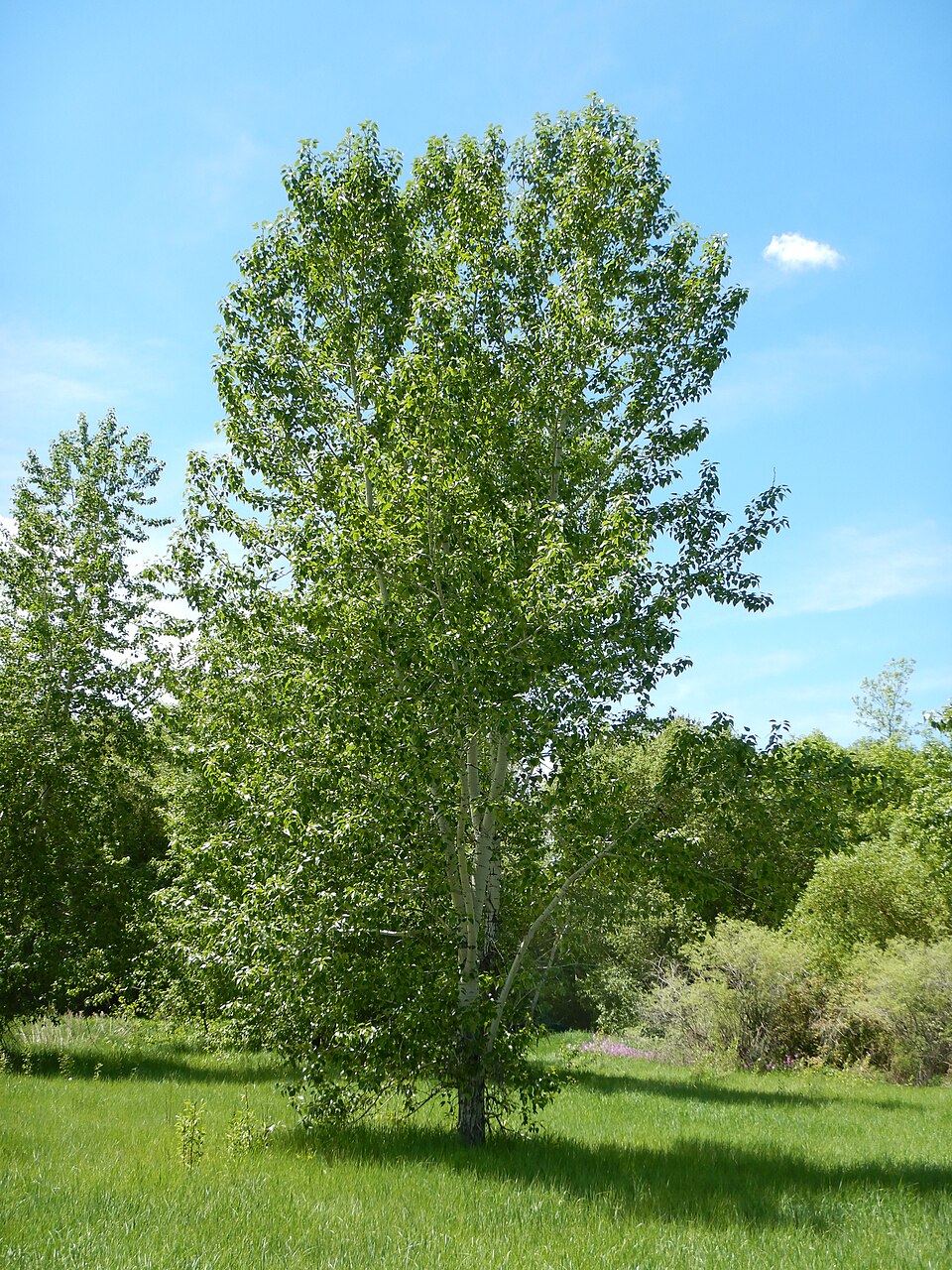
Balsam Poplar is a large, fast-growing deciduous tree that reaches 60 to 80 feet (18–24 m) in height, with exceptional specimens in sheltered river valleys reaching over 100 feet. The trunk is straight and cylindrical, with a broadly rounded to irregular open crown that becomes more ragged and picturesque with age. The tree’s overall appearance is stately but somewhat rough-textured — coarser than its close relative the Quaking Aspen.
Bark
On young trees and branches, the bark is smooth, shiny, and greenish-gray, with characteristic lenticels (elongated pores). With age, the bark becomes dark grayish-brown, deeply furrowed with interlacing flat-topped ridges — very different from the smooth white bark of aspens. This textured, dark older bark is one of the easiest ways to distinguish Balsam Poplar from other poplars at a distance. The inner bark has a pale yellowish to orange-tinged color and a faint balsamic scent.
Leaves
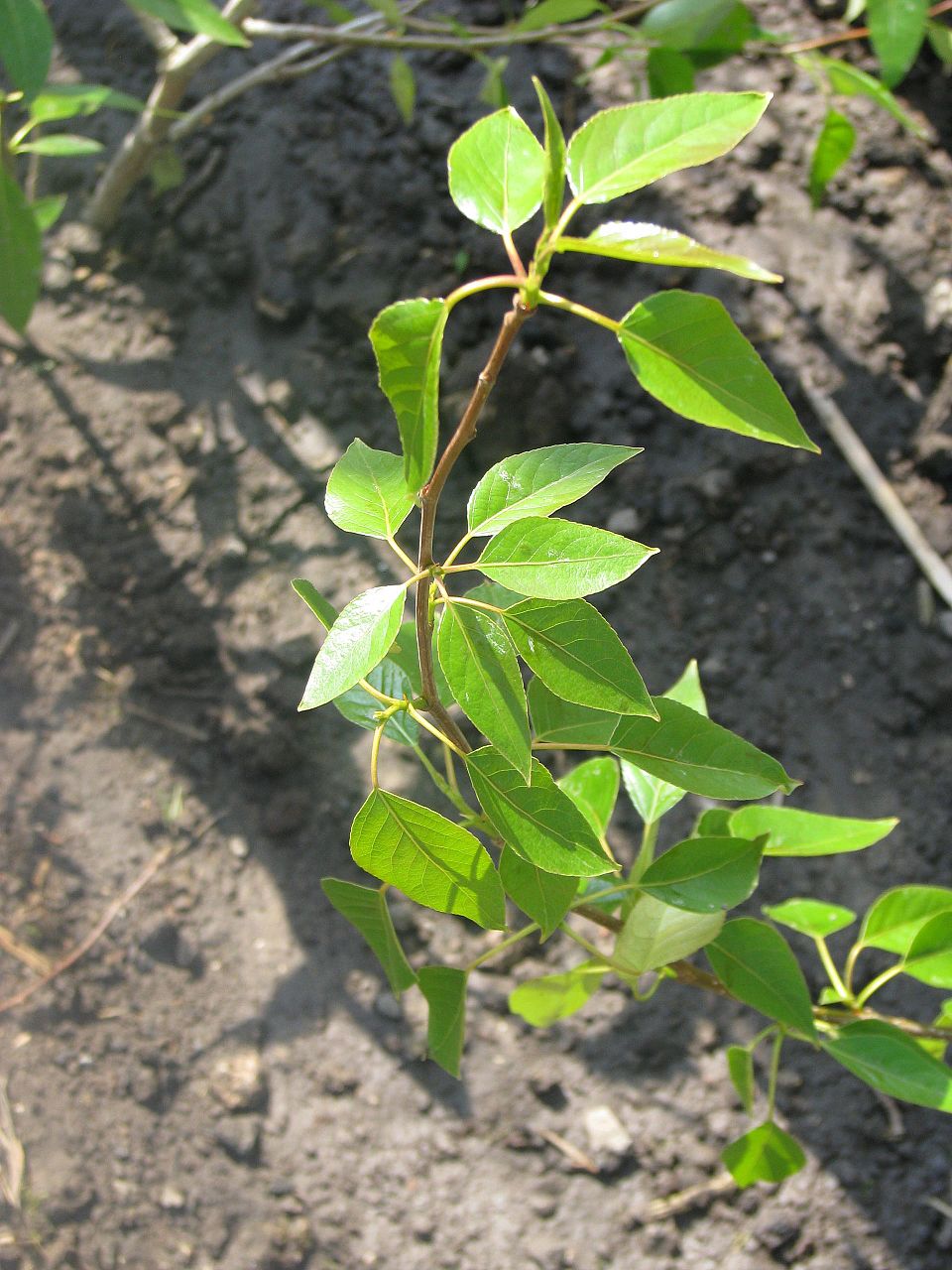
The leaves are a standout feature: ovate to ovate-lanceolate, 3 to 5 inches (7.5–13 cm) long, with a pointed tip and heart-shaped or rounded base. The leaf surface is dark, shiny green above and distinctly pale — sometimes whitish or silvery — on the underside, often with a rusty or orange tinge near the midrib. The margins are finely toothed. Petioles (leaf stems) are round in cross-section, a key distinction from Quaking Aspen and other poplars that have flattened petioles. In autumn, the foliage turns a clear, bright yellow, creating spectacular riverine color displays.
Buds & Flowers
The winter buds are the species’ most memorable feature: large (up to 1 inch long), sharply pointed, and coated in a sticky, amber-colored resin that gives them their unmistakable fragrance — sweet, balsamic, slightly medicinal, and irresistibly pleasant. Flowers appear in early spring before the leaves, in long drooping catkins: male catkins 2–3 inches long, female catkins up to 6 inches when mature. After fertilization, female catkins produce capsules that split open to release cotton-tufted seeds in late spring to early summer — giving rise to the common sight of “poplar cotton” drifting through the air.
Quick Facts
| Scientific Name | Populus balsamifera |
| Family | Salicaceae (Willow) |
| Plant Type | Deciduous Tree |
| Mature Height | 60–80 ft |
| Sun Exposure | Full Sun |
| Water Needs | High |
| Bloom Time | March – May (before leaf-out) |
| Flower Color | Greenish-yellow catkins |
| USDA Hardiness Zones | 2–6 |
Native Range
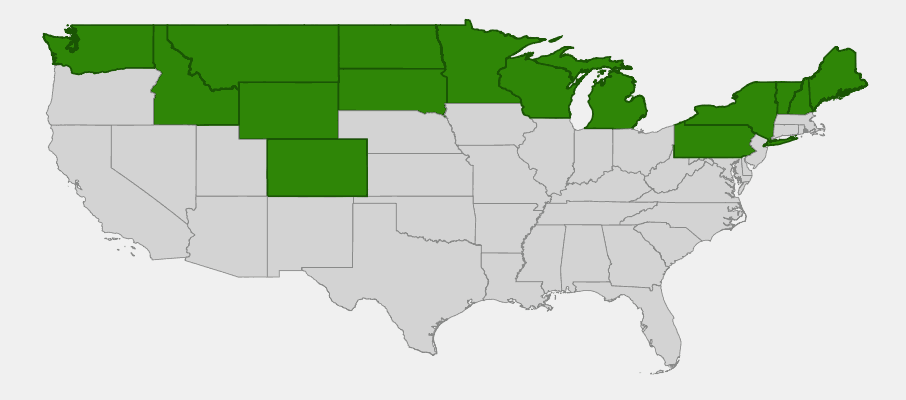
Balsam Poplar holds one of the most extensive native ranges of any North American tree, spanning the entire boreal forest zone from Alaska to Newfoundland. In Alaska, it is among the most widespread broadleaf trees, growing along virtually every major river drainage system from the Brooks Range south to the Kenai Peninsula and eastward through the Interior. Its ability to colonize glacially disturbed substrates and annually flooded riverbanks makes it among the first woody plants to establish after disturbance throughout its range.
Across the contiguous United States, Balsam Poplar reaches south into northern Montana, Idaho, Wyoming, Minnesota, Wisconsin, Michigan, and the northeastern states including New York, Vermont, New Hampshire, and Maine. It typically occurs at lower elevations near water: along streams, lake shores, wetland margins, and in moist valley bottoms. The species extends east across the Great Lakes region into New England, where it often hybridizes with Eastern Cottonwood (Populus deltoides) to produce the widespread Tacamahac Poplar (Populus ×jackii).
Throughout its range, Balsam Poplar is intimately associated with disturbance regimes — particularly flooding. The tree thrives on river bars, floodplains, and outwash plains where periodic scouring and sediment deposition eliminate competition. Its light seeds disperse hundreds of miles via wind and water, allowing rapid colonization of newly exposed substrates. In subarctic Alaska, Balsam Poplar forests represent climax communities in many lowland settings, growing alongside White Spruce in stable, mature river terrace forests.
📋 Regional plant lists featuring Balsam Poplar: Alaska
Growing & Care Guide
Balsam Poplar is a vigorous, fast-growing tree best suited to large landscapes where its size and suckering habit can be accommodated. In the right setting — particularly near water or in moist, open areas — it establishes readily and grows with impressive speed, making it valuable for quick naturalization, wildlife habitat creation, and riparian restoration.
Light
Balsam Poplar is a true sun-lover, requiring full sun for optimal growth. In shaded conditions, it becomes spindly and slow-growing. Site it in open areas away from buildings, powerlines, and other large trees. Its natural habitat along open river banks and flood plains reflects its need for bright, unobstructed light throughout the growing season.
Soil & Water
True to its riparian origins, Balsam Poplar thrives in moist to wet soils and tolerates seasonal flooding exceptionally well. It performs best in deep, fertile, well-drained to poorly-drained alluvial soils along streams and wetland margins. It does not thrive in dry upland conditions. Sandy or gravelly soils near water are ideal — mimicking the river bar and outwash plain habitats where this species naturally dominates. Regular irrigation will be needed if planted away from natural water sources.
Planting Tips
Plant in early spring or fall. Balsam Poplar is easily propagated from cuttings — simply cut 10–12 inch sections of dormant wood and press them directly into moist soil. This ease of vegetative propagation makes it extremely economical for large-scale riparian restoration. Space trees 20–30 feet apart for a naturalistic grove effect, or 40+ feet apart for individual specimens. Avoid planting near septic systems, water mains, or building foundations, as the roots are aggressive water-seekers.
Pruning & Maintenance
Balsam Poplar requires minimal pruning in a naturalistic setting. Remove dead or storm-damaged branches in late winter. The tree spreads via root sprouts (suckers) that can form thickets — desirable in wildlife plantings and riparian buffers, but potentially invasive in small gardens. Mow around the base to control suckering if needed. The wood is soft and brittle; some branch breakage in ice or wind storms is normal. The tree is generally pest-resistant, though it can be affected by Poplar canker, aphids, and Poplar-willow borers — all manageable in vigorous, well-sited specimens.
Landscape Uses
- Riparian buffer planting along streams, rivers, and wetlands
- Floodplain restoration — one of the best native trees for annually flooded sites
- Windbreak or shelterbelt in cold northern climates
- Wildlife habitat creation on large properties
- Phytoremediation — poplars are known to uptake and detoxify soil contaminants
- Carbon sequestration plantings — fast growth captures carbon rapidly
Special Considerations
The cottony seeds produced in late spring can be considered a nuisance in urban settings — they clog screens, pile up in corners, and drift like snow. For urban plantings, consider using male clones (which do not produce seeds) if available from specialty nurseries. Note that Balsam Poplar is not a tree for small yards — its ultimate size, aggressive root system, and suckering habit make it best suited to acreage, restoration sites, and large naturalistic landscapes.
Wildlife & Ecological Value
Balsam Poplar is a keystone species in boreal and subarctic ecosystems, providing critical food and habitat resources for an extraordinary range of wildlife.
For Birds
The large, mature Balsam Poplar trees are irreplaceable for cavity-nesting birds. Pileated Woodpeckers excavate large cavities that are subsequently used by Boreal Owls, Common Goldeneyes, Bufflehead, Wood Ducks, and many species of songbirds. Yellow-bellied Sapsuckers drill characteristic rows of sapwells in the bark, attracting hummingbirds, warblers, and insects. Warbling Vireos, American Redstarts, and numerous warbler species nest in the canopy. In Alaska, Bald Eagles and Osprey frequently nest in the tallest Balsam Poplars along major river systems.
For Mammals
Moose are among the most significant consumers of Balsam Poplar throughout Alaska, browsing heavily on saplings and young shoots in winter. Beavers are intensely attracted to Balsam Poplar and will travel considerable distances to harvest it for food and dam construction — a behavior that, in turn, creates wetland habitat beneficial to countless other species. Snowshoe Hares browse bark and twigs. Porcupines eat the inner bark. Black Bears consume buds and catkins in early spring, and the resinous buds are occasionally gathered by bees to make propolis.
For Pollinators
While wind-pollinated, Balsam Poplar provides significant early-season resources for pollinators. The sticky bud resin is collected by bees for propolis — the antimicrobial compound used to seal beehives. Early-emerging queen bumblebees and native bees visit catkins for pollen in early spring when few other resources are available. The foliage supports numerous moth and butterfly caterpillars, including several Sphinx Moths and the spectacular Viceroy butterfly, whose caterpillars specialize on Salicaceae (willows and poplars).
Ecosystem Role
As a pioneer species, Balsam Poplar initiates forest succession on disturbed or newly exposed land, creating shade and organic matter that allows other species to establish. Its leaf litter is more easily decomposed than conifer needles, enriching soil organic matter and supporting diverse invertebrate communities. The rapid growth and subsequent senescence of individual trees creates standing dead wood (snags) and fallen logs that are disproportionately valuable for biodiversity — supporting fungi, insects, cavity nesters, and small mammals through decades of decomposition.
Cultural & Historical Uses
Balsam Poplar has been one of the most important trees for the Indigenous peoples of northern North America, with a rich history of use that spans thousands of years across dozens of Athabascan, Algonquian, and other First Nations cultures. In Alaska, the Dena’ina Athabascan people called the tree ts’ił and used virtually every part of it. The inner bark (cambium) was eaten raw or cooked as a famine food — scraped from the trunk in spring when it is sweetest and most nutritious. The nutritional value of poplar cambium has been recognized across the circumpolar world as an important emergency carbohydrate source.
The aromatic resin of the buds — known historically as “balm of Gilead” — was among the most important medicines in the Indigenous pharmacopeia of northern North America. Collected by simmering the sticky buds in fat or water, this resin was applied topically to treat cuts, burns, skin infections, joint pain, and frostbite. European settlers quickly adopted these uses, and “Balm of Gilead” ointments and salves became staples of folk medicine throughout Canada and the northern United States. The resin contains salicin and other anti-inflammatory compounds that provide genuine medicinal activity — making this one of many cases where traditional Indigenous plant knowledge anticipated modern pharmacology.
Beyond medicine and food, Balsam Poplar provided practical materials for daily life. The soft, light wood was split and used for firewood (it burns readily but quickly), snowshoe frames, sled components, and small household items. Bark sheets were used as containers and for building temporary shelters. In modern times, Balsam Poplar wood is harvested commercially for pulp and paper production, oriented strand board (OSB), and biomass energy — making it one of the most important commercial tree species of the Canadian boreal forest.
Today, Balsam Poplar is gaining recognition in the ecological restoration community as an invaluable tool for revegetating disturbed lands, stabilizing riverbanks, and sequestering carbon in northern landscapes. Its ease of propagation from cuttings, extreme cold hardiness, and fast growth make it one of the most practical tools available for large-scale reforestation efforts across Alaska and the northern tier of North America.
Frequently Asked Questions
What makes Balsam Poplar smell so good?
The distinctive sweet, balsamic fragrance comes from the resinous buds, which contain a complex mixture of volatile compounds including flavonoids, cinnamic acid esters, and terpenes. The scent is most intense in early spring when buds break open, and can perfume the air for considerable distances. Many people describe it as one of the most beautiful natural scents of the northern spring.
Is Balsam Poplar invasive in gardens?
Balsam Poplar is not invasive in the traditional sense (it does not escape cultivation and displace native ecosystems), but it can be aggressive in the landscape. The tree spreads via root sprouts (suckers) that can emerge 20–30 feet from the parent tree, and the roots are vigorous water-seekers that can damage pipes and foundations. It is best suited to large properties, riparian restoration sites, and naturalistic plantings where these qualities are assets rather than problems.
How fast does Balsam Poplar grow?
Balsam Poplar is one of the fastest-growing trees in northern North America, capable of growing 3–5 feet per year in ideal conditions (moist soil and full sun). This rapid growth makes it extremely valuable for quick habitat creation, riparian restoration, and windbreak establishment, though it also contributes to a relatively short lifespan — most trees live 70–150 years.
Can I plant Balsam Poplar near water?
Absolutely — Balsam Poplar is one of the best native trees for wet sites, riverbanks, and seasonally flooded areas. It naturally grows on river bars and floodplains subject to annual inundation, and tolerates extended flooding far better than most trees. It is an excellent choice for stream bank stabilization and riparian buffer planting.
Is Balsam Poplar the same as Cottonwood?
Balsam Poplar and Cottonwood are closely related but distinct species. Cottonwood most commonly refers to Eastern Cottonwood (Populus deltoides) or Black Cottonwood (Populus trichocarpa). Balsam Poplar (Populus balsamifera) is distinguished by its fragrant resinous buds, round-sectioned petioles, pale leaf undersides, and more northern distribution. The two species hybridize where their ranges overlap.
Looking for a nursery that carries Balsam Poplar?
Browse our native plant nursery directory: Alaska