
Alaska Cedar (Chamaecyparis nootkatensis)
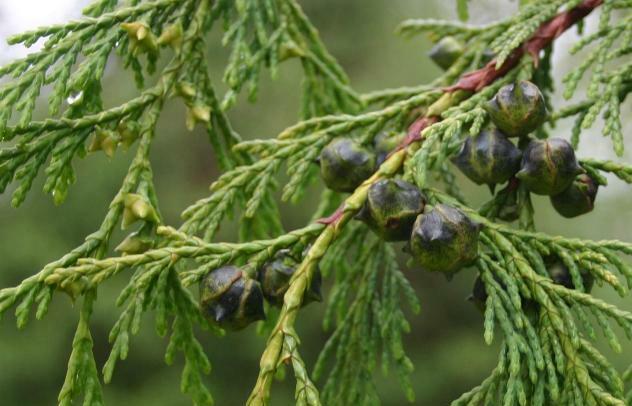
Chamaecyparis nootkatensis, commonly known as Alaska Cedar, Yellow Cedar, Nootka Cypress, or Alaska Yellow Cypress, is one of the most distinctive and longest-lived conifers of the Pacific Northwest and coastal Alaska. This ancient evergreen — a member of the Cupressaceae (cypress) family — can survive for well over a thousand years, forming gnarled, silvered sentinels in the alpine and subalpine zones of coastal mountains. Its common name honors the Nootka Sound on Vancouver Island, British Columbia, near where the species was first formally described by European botanists.
Alaska Cedar is immediately recognizable by its strongly weeping, pendulous branch tips, which hang in graceful, rope-like sprays of flattened, blue-green to gray-green scale-like foliage. Unlike most trees of its range, the branchlets droop so dramatically that experienced foresters and hikers can identify it from great distances. The bark is gray-brown, thin, and fibrous, often shredding in strips with age. The trees produce small, rounded, berry-like cones that ripen from blue-green to woody brown. Crushed foliage releases a pungent, raw-potato or turpentine-like odor that is quite unlike any other local conifer — another reliable field mark.
In Alaska and the Pacific Northwest, Alaska Cedar is a foundational forest species with deep ecological and cultural importance. Its extraordinarily dense, fine-grained, decay-resistant heartwood was prized by Indigenous peoples of the coast — the Haida, Tlingit, and others — for canoes, paddles, totem poles, bows, and other implements requiring strength and longevity. The wood is still highly valued today for outdoor construction, siding, boat building, and fine woodworking. For wildlife gardeners and restoration practitioners, Alaska Cedar provides irreplaceable habitat value in high-elevation and coastal ecosystems where few other conifers can thrive.
Identification
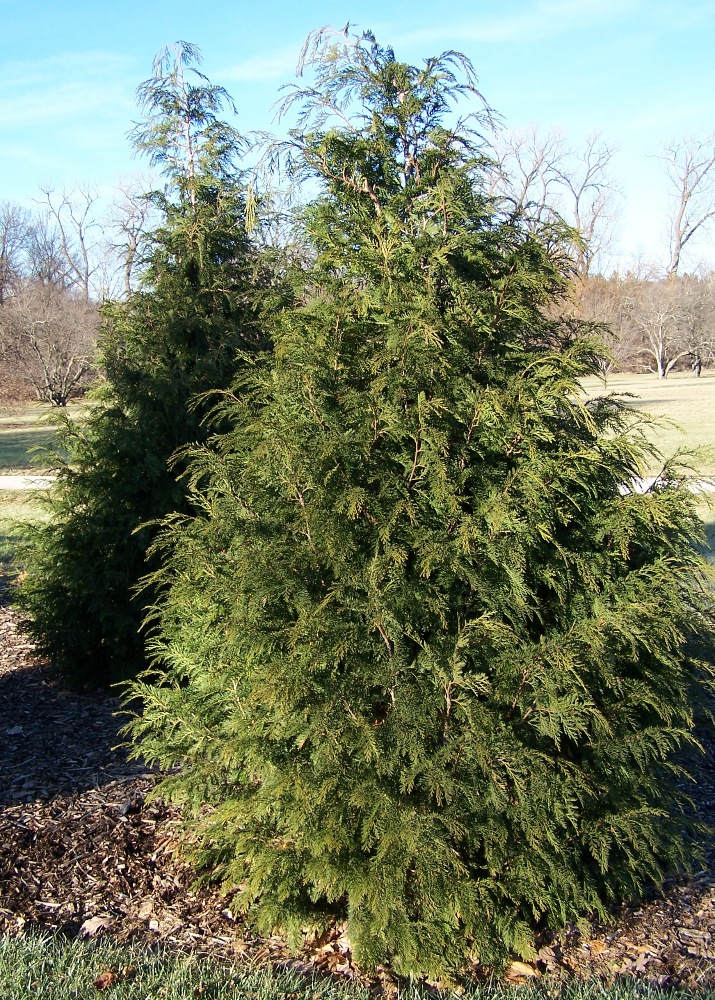
Alaska Cedar typically grows as a medium to large tree, reaching 25 to 100 feet (8–30 m) tall, with trunk diameters of 2 to 6 feet (60–180 cm) on mature specimens. In exposed alpine sites, it may grow as a low krummholz shrub. The strongly weeping branch tips are the most reliable field characteristic — even at a distance, the pendulous, rope-like sprays distinguish it from all other regional conifers.
Bark
The bark is gray-brown to reddish-gray, relatively thin, and has a fibrous, shredding texture that becomes more pronounced with age. On old-growth trees, the bark may be deeply furrowed and twisted. On standing dead trees and snags — which Alaska Cedar produces abundantly — the silver-gray bleached wood can persist for centuries and is highly sought after by craftspeople. The inner wood is bright yellow when freshly cut (hence “yellow cedar”), turning darker with air exposure.
Leaves
The foliage consists of tiny, overlapping scale-like leaves arranged in four ranks on flattened, fan-like branchlets. The branchlets themselves hang in long, pendulous, rope-like sprays — this drooping habit is dramatically more pronounced than in related species like Western Red Cedar. Color is blue-green to grayish-green, with a somewhat waxy, glaucous cast. When crushed, the foliage produces a distinctive, acrid, pungent odor often compared to raw potatoes or turpentine — a reliable identification feature in the field.
Cones & Seeds
The seed cones are small — just ½ to ¾ inch (12–20 mm) in diameter — rounded, and composed of 4 to 6 woody, pointed scales arranged in opposite pairs. They require two years to mature, ripening from blue-green to brown. Each scale typically bears 2 to 4 seeds. The pollen cones are tiny, reddish, and appear in spring. Cone production varies considerably from year to year, with heavy seed years occurring at irregular intervals.
Quick Facts
| Scientific Name | Chamaecyparis nootkatensis (syn. Cupressus nootkatensis) |
| Family | Cupressaceae (Cypress) |
| Plant Type | Evergreen Coniferous Tree |
| Mature Height | 25–100 ft |
| Sun Exposure | Part Shade to Full Sun |
| Water Needs | High |
| Bloom Time | April – May (pollen release) |
| Flower Color | Reddish pollen cones; blue-green seed cones |
| USDA Hardiness Zones | 4–8 |
Native Range
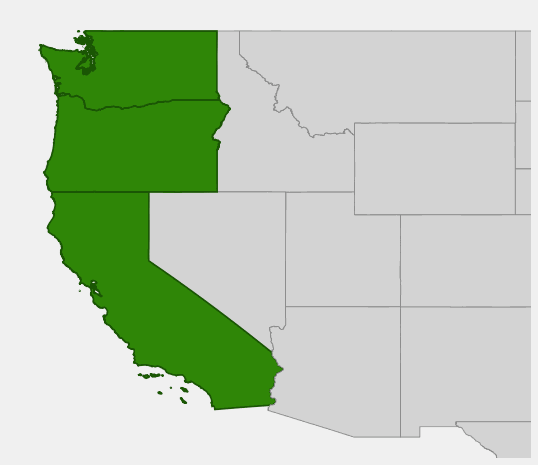
Alaska Cedar is native to the coastal mountains of the Pacific Northwest and Alaska, forming a nearly continuous distribution from Seward, Alaska, south through coastal British Columbia, western Washington, and Oregon, with isolated populations in the Klamath Mountains of northern California. The species is essentially a maritime-montane conifer, closely tied to the high-precipitation, cool-summer climates of coastal mountains and fog zones.
In Alaska, Alaska Cedar is found from the Kenai Peninsula southward through southeastern Alaska (the Tongass National Forest), where it is a major component of old-growth coastal rainforest alongside Sitka Spruce (Picea sitchensis), Western Hemlock (Tsuga heterophylla), and Mountain Hemlock (Tsuga mertensiana). It grows at elevations from sea level to timberline, but is most common at middle to upper elevations where it forms open, parkland-like forests on shallow, rocky, or boggy soils that other species cannot tolerate.
Researchers have recently identified a significant population decline of Alaska Cedar across much of its range — particularly in areas where snowpack has decreased due to climate change. Alaska Cedar roots are remarkably cold-hardy but vulnerable to freeze-thaw cycles in shallow soils, and reduced snow insulation has led to increased root damage and tree mortality in lower-elevation stands. This “Alaska Cedar decline syndrome” is considered one of the most dramatic early impacts of climate change on a North American conifer.
📋 Regional plant lists featuring Alaska Cedar: Alaska
Growing & Care Guide
Alaska Cedar is a stately, long-lived conifer that thrives in cool, moist climates with consistent precipitation or irrigation. While it is most at home in the maritime Northwest and Alaska, it can be successfully grown across a much wider range given adequate moisture and well-drained, cool soils.
Light
Alaska Cedar grows best in partial shade to full sun. Younger trees benefit from some afternoon shade protection, especially in warmer, drier climates at the southern edge of its range. In its natural habitat, it often grows in the partial shade of larger Sitka Spruce or Western Hemlock. Mature trees become increasingly sun-tolerant and develop their best weeping form in open, full-sun conditions where the characteristic pendulous branches can develop fully.
Soil & Water
This species requires consistently moist soil — it naturally grows in high-rainfall coastal environments and does not tolerate prolonged drought once established. It adapts well to acidic, peaty, or rocky soils that are too wet or nutrient-poor for other conifers. While high moisture is essential, the soil must also drain well enough to prevent prolonged waterlogging around the root crown. In cultivation, supplemental irrigation through dry summers is important, particularly for young trees. Mulching with 3–4 inches of organic material helps retain soil moisture and moderate soil temperature.
Planting Tips
Plant Alaska Cedar in spring or fall to allow establishment before summer heat or winter freeze. Select a site with some shelter from desiccating winds, particularly in drier inland areas. Space trees at least 15–20 feet apart to allow the graceful weeping form to develop without crowding. Container-grown stock is widely available at Pacific Northwest native plant nurseries. Avoid sites with reflected heat from paved surfaces — this species prefers the cool, humid conditions of its coastal rainforest origins.
Pruning & Maintenance
Alaska Cedar requires minimal pruning and is generally best left to develop naturally. Remove dead or damaged branches in late winter. Avoid topping or heavy structural pruning, as the species heals slowly and the weeping architecture is the tree’s most ornamental feature. In garden settings, it is essentially pest- and disease-free, though it may develop fungal issues in poorly drained or excessively hot conditions. The tree’s longevity and slow growth make it a true multi-generational planting.
Landscape Uses
Alaska Cedar’s dramatic weeping form makes it one of the most ornamentally striking native conifers available for Pacific Northwest gardens:
- Specimen tree — the weeping habit is architecturally dramatic year-round
- Windbreak and screening — dense evergreen foliage provides year-round privacy
- Riparian and bog margins — thrives in moist, poorly-drained soils
- Wildlife corridors and restoration plantings in coastal forests
- Large woodland gardens as an understory or canopy tree
- Erosion control on cool, moist slopes
Cold Hardiness
Alaska Cedar is exceptionally cold-hardy for a Pacific coast conifer — surviving temperatures to -30°F (-34°C) or below in its northern range. It is reliably hardy to USDA Zone 4 and performs well in cold, snowy climates where adequate moisture is available. Paradoxically, its vulnerability to climate change comes not from cold, but from the loss of insulating snowpack in winter — leaving roots exposed to damaging freeze-thaw cycles.
Wildlife & Ecological Value
Alaska Cedar is a keystone species in the coastal rainforests of the Pacific Northwest and Alaska, providing structural complexity, food, and habitat for numerous wildlife species across all seasons.
For Birds
The dense, drooping foliage provides exceptional year-round nesting and roosting habitat for many bird species. Varied Thrushes, Hermit Thrushes, and Townsend’s Warblers use the dense inner canopy for nesting and thermal cover in winter. Chickadees, nuthatches, and Brown Creepers forage for invertebrates in the shredding bark. The small seeds produced in cone years are consumed by crossbills, Pine Siskins, and other finches. Large old-growth specimens provide essential snag and nest-cavity habitat for old-growth-dependent species including Marbled Murrelets, which nest on broad limbs of old-growth conifers in coastal Alaska.
For Mammals
In Alaska, the dense low-growing form of Alaska Cedar provides critical winter thermal cover and bedding areas for Sitka Black-tailed Deer, which also browse the foliage during deep snow events. Mountain Goats use rocky outcrops with Alaska Cedar stands as year-round habitat. Small mammals including voles, shrews, and squirrels shelter in the dense root mats and fallen wood of old-growth stands. Black Bears use Alaska Cedar habitat extensively during berry and salmon seasons in coastal Alaska.
For Pollinators
While Alaska Cedar is wind-pollinated, its spring pollen release contributes to the pollen resource available for early-emerging native bees. The tree’s dense canopy structure creates microclimatic refugia — patches of stable humidity and temperature — that support specialized invertebrate communities including many rare insects associated only with old-growth coastal forest habitat.
Ecosystem Role
Alaska Cedar’s extraordinarily decay-resistant heartwood creates persistent structural elements in the forest long after the tree dies. Fallen Alaska Cedar logs can persist for 500 years or more, providing habitat for salamanders, fungi, invertebrates, and specialized moss communities that depend on stable, long-lived woody debris. The species is a major contributor to the biological legacy — the dead wood and structural complexity — that distinguishes old-growth coastal rainforest from younger stands and drives much of its exceptional biodiversity.
Cultural & Historical Uses
Alaska Cedar holds a position of tremendous cultural importance to the Indigenous peoples of the Pacific Northwest Coast and Alaska. For the Haida, Tlingit, Tsimshian, and many other nations, Alaska Cedar was a primary material for constructing canoes, paddles, bows, arrows, masks, totem poles, bentwood boxes, and a wide range of household implements. The wood was particularly prized for its exceptional combination of light weight, extreme decay resistance, straight grain, and ease of working with stone and bone tools. Alaska Cedar canoes — carved from single logs — were among the finest watercraft constructed by Indigenous peoples anywhere in North America.
The inner bark and roots of Alaska Cedar were woven into baskets, mats, clothing, and rope by coastal peoples across its entire range. Cedar bark clothing — including rain capes, skirts, and blankets — was the primary textile of the Northwest Coast peoples, and the fine, soft inner bark strips were used for baby diapers, bedding, and ceremonial purposes. The aromatic heartwood was burned for spiritual purification and used to smoke fish and meats. This multi-dimensional cultural relationship with Alaska Cedar has persisted continuously for thousands of years and remains vital to Indigenous identity and practice in coastal Alaska and British Columbia today.
In Euro-American commerce, Alaska Cedar has been prized since the late 1800s for its extraordinary rot resistance, dimensional stability, and fine, even grain. “Yellow cedar” lumber commands premium prices in the boat building, marine construction, and outdoor furniture industries — often exceeding the value of Western Red Cedar. The wood machines exceptionally smoothly, holds detail for carving, and resists checking and warping even when repeatedly wet and dried. Contemporary craftspeople and woodworkers continue to seek Alaska Cedar for high-value applications including saunas, hot tubs, exterior siding, musical instrument parts, and fine furniture.
The species has also entered the horticultural world through numerous cultivated varieties, including the popular ‘Pendula’ and ‘Van den Akker’ weeping cultivars found in parks and botanical gardens worldwide. The dramatic architecture of these trees has made Alaska Cedar a favorite of landscape architects and gardeners who want a bold evergreen statement in moist, cool-climate gardens.
Frequently Asked Questions
What is the difference between Alaska Cedar and Western Red Cedar?
Alaska Cedar (Chamaecyparis nootkatensis) and Western Red Cedar (Thuja plicata) are related but distinct conifers. Alaska Cedar has strongly drooping branch tips, smaller cones, and a pungent acrid odor when crushed; Western Red Cedar has flatter, horizontally-spreading branches, larger cones, and a sweet, pleasant aroma. Alaska Cedar’s wood is denser and lighter yellow; Western Red Cedar’s wood is softer and more distinctly reddish. Both are exceptionally rot-resistant.
How fast does Alaska Cedar grow?
Alaska Cedar is a slow-growing tree, typically adding 6 to 12 inches of height per year under good conditions. In its natural subalpine habitat, growth may be far slower — old-growth trees just 2 feet in diameter can be several hundred years old. In lowland cultivation with adequate moisture, growth is faster. Its slow growth and longevity — individuals living 1,000 to 3,500 years — make it a true legacy planting.
Why is Alaska Cedar declining in some areas?
Alaska Cedar decline is primarily linked to climate change — specifically, the reduction of deep winter snowpack in coastal mountains. Alaska Cedar roots are extremely cold-hardy but vulnerable to freeze-thaw damage when exposed (not insulated by snow). As winters have become warmer and snowpack shallower, roots experience more damaging freeze events. This “Alaska Cedar decline syndrome” is killing trees across thousands of acres, particularly at lower elevations in southeast Alaska and western British Columbia.
Can I grow Alaska Cedar in my garden?
Yes — Alaska Cedar is an excellent garden tree for the Pacific Northwest, coastal British Columbia, and other cool, moist climates (USDA Zones 4–8). It tolerates partial shade, thrives in moist or boggy soils, and is remarkably deer-resistant due to its pungent foliage. Ornamental weeping cultivars are widely available at Pacific Northwest nurseries. Provide consistent moisture, especially in summer, and choose a site away from reflected heat.
What wildlife does Alaska Cedar support?
Alaska Cedar supports diverse wildlife including Marbled Murrelets (rare seabirds that nest on old-growth limbs), crossbills and siskins that eat the seeds, Sitka Black-tailed Deer that browse the foliage in winter, and a rich community of old-growth invertebrates that depend on the long-lasting decay-resistant logs. In southeast Alaska, it is a cornerstone species of the temperate rainforest ecosystem.

Looking for a nursery that carries Alaska Cedar?
Browse our native plant nursery directory: Alaska