
Yaupon Holly (Ilex vomitoria)
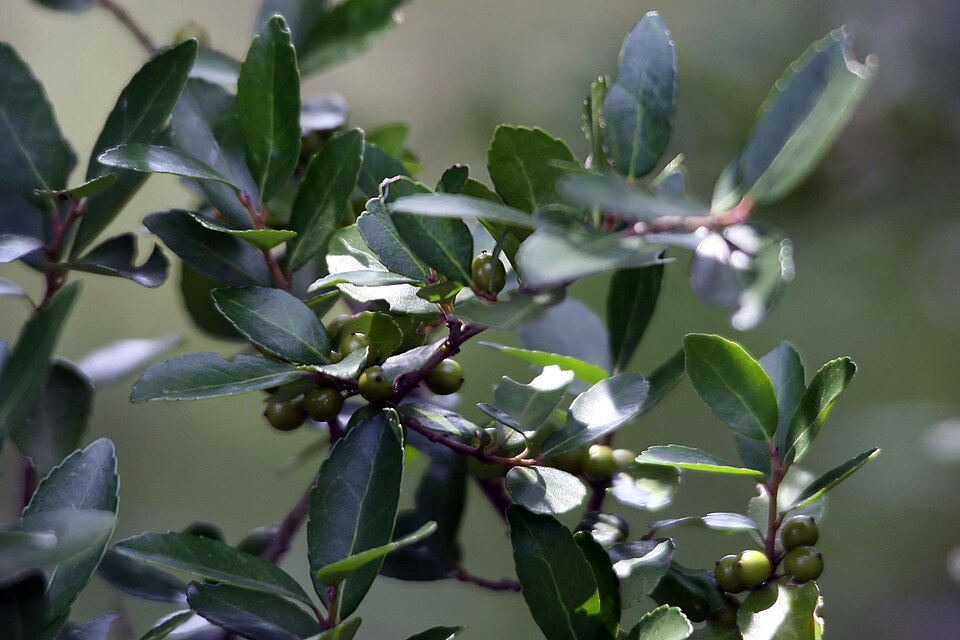
Ilex vomitoria, commonly known as Yaupon Holly, is a native evergreen shrub or small tree of the southeastern United States that is, quite simply, one of the most ecologically and culturally significant native plants of the entire Gulf and South Atlantic region. Despite bearing the least appealing scientific name in the native plant lexicon — vomitoria, referring to the historic use of large quantities of the leaves in ritualized purging ceremonies — Yaupon Holly is one of the most valuable, adaptable, and wildlife-productive native shrubs available for gardens throughout the Southeast. It is also the only native North American plant known to contain caffeine, making it the subject of considerable recent interest as a potential native tea crop.
A member of the holly family (Aquifoliaceae), Yaupon Holly is a medium to large evergreen shrub or small multi-stemmed tree growing 10 to 30 feet tall, with a naturally dense, multi-branching structure, small glossy dark-green leaves, and (on female plants) brilliant clusters of translucent red berries that persist on the plant from late summer through winter — one of the most colorful and wildlife-sustaining berry displays available from any native plant. The berries are relished by more than 40 species of birds, making Yaupon Holly the most bird-productive of any common southeastern native shrub.
Perhaps most remarkably, Yaupon Holly combines this extraordinary ecological value with near-unmatched landscape adaptability: it tolerates full sun to fairly deep shade; wet soils, seasonally flooded conditions, average soils, and significant drought once established; salt spray and coastal exposure; urban heat and pollution; and poor, infertile, sandy soils. This combination of ecological productivity, ornamental value, and site adaptability makes Yaupon Holly a foundational plant for native gardens throughout Zones 7–11 in the Southeast and Gulf states — a plant that every southeastern gardener should know and grow.
Identification
Yaupon Holly is a dense, multi-stemmed evergreen shrub or small tree, typically growing 10 to 30 feet tall and 10 to 15 feet wide in natural settings, though it can be maintained at any size with pruning. The branching pattern is dense and twiggy, with many small lateral branches giving the plant a naturally fine-textured, somewhat formal appearance. Female plants bear the distinctive red berries that make the plant so ornamentally and ecologically valuable.
Bark & Stems
The bark is thin and smooth on young stems, pale gray to white-gray in color — one of the paler-barked hollies, which contributes to the plant’s somewhat ghostly attractiveness in winter when the white-gray branches contrast with the dark green foliage and brilliant red berries. Older trunks develop slightly rougher, gray-brown bark with a few shallow fissures. The twigs are slender, gray-green to gray-white, and densely pubescent (hairy) when young. The plant may develop suckers from the roots, gradually forming a colony of connected stems in undisturbed settings.
Leaves
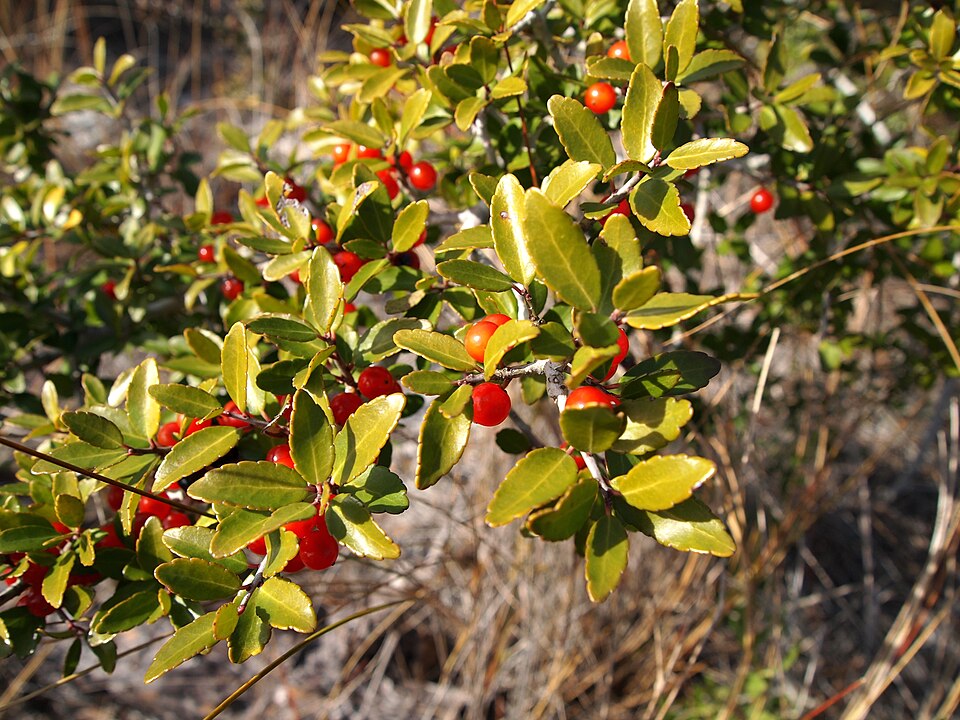
The leaves are a key identification feature: small, elliptic to ovate, ½ to 1½ inches long, with a somewhat rounded tip and a crenate (scallop-toothed) margin — not sharply spiny like most hollies. This non-spiny leaf margin is one of the features that makes Yaupon Holly extremely useful and safe in garden settings where contact with prickly plants is undesirable. The upper surface is glossy, dark to medium green; the underside is paler and matte. Leaves are arranged alternately and persist year-round, creating the dense evergreen coverage that makes Yaupon Holly such a valuable screening plant.
Flowers & Fruit
Yaupon Holly is dioecious — male and female flowers are borne on separate plants. Both sexes must be present within pollinator range for berries to form. The flowers are tiny — about ⅛ inch across — with 4 white petals, inconspicuous individually but produced in small clusters along the previous year’s stems in spring (April–May), attracting bees and other small pollinators. The fruit is a small spherical drupe, about ¼ inch in diameter, brilliant red (occasionally yellow in some cultivars), produced in dense clusters along the full length of the stems. The berries ripen in late summer through early fall and persist through winter — sometimes well into the following spring if not consumed by wildlife. This extended persistence makes Yaupon Holly an outstanding winter food source for birds and other wildlife.
Quick Facts
| Scientific Name | Ilex vomitoria |
| Family | Aquifoliaceae (Holly) |
| Plant Type | Evergreen Shrub / Small Tree |
| Mature Height | 30 ft |
| Sun Exposure | Full Sun to Part Shade |
| Water Needs | High to Low (extremely adaptable) |
| Bloom Time | April – May |
| Flower Color | White (tiny; inconspicuous) |
| Fruit | Brilliant red berries (persistent through winter) |
| Special Features | Non-spiny leaves; only N. American caffeinated plant; extraordinary wildlife value |
| USDA Hardiness Zones | 7–11 |
Native Range
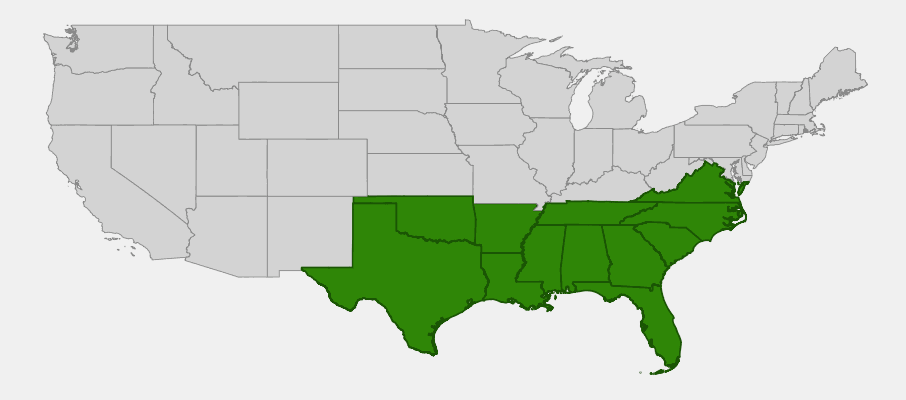
Yaupon Holly is native to the southeastern and south-central United States, with a range spanning from southeastern Virginia south through the Carolinas, Georgia, and Florida, westward through Alabama, Mississippi, Louisiana, and Texas, and northward into Arkansas, Tennessee, and Oklahoma. In Texas, it is abundant along the Gulf Coast and in the eastern third of the state. The species is essentially restricted to the warm-temperate and subtropical regions of the South, with natural populations limited by winter cold — it does not survive temperatures much below 0°F for extended periods.
Within its native range, Yaupon Holly shows extraordinary ecological versatility. It grows in maritime shrub thickets and dune stabilization zones along the Atlantic and Gulf coasts; in pine flatwoods, scrub, and sandhill understories; along stream margins and bay forest edges; in maritime forest and maritime live oak hammocks; and as a common understory shrub in virtually any moist to dry woodland throughout the Coastal Plain. It tolerates salt spray, sand, seasonal flooding, intense drought, coastal wind, heavy shade, and full sun — a combination of tolerances virtually unmatched among woody native plants of the Southeast.
In disturbed areas and forest edges, Yaupon Holly can form dense thickets through root suckering — a characteristic that makes it simultaneously excellent for erosion control and wildlife cover and potentially aggressive in some garden settings where uncontrolled spread is undesirable. Its spread by wildlife-distributed seeds also means it can naturally colonize suitable sites beyond its initial planting location, which is generally viewed positively in native plant contexts.
📋 Regional plant lists featuring Yaupon Holly: Alabama, Georgia & Mississippi
Growing & Care Guide
Yaupon Holly is one of the most adaptable and versatile native shrubs available for southern gardens. Its tolerance for an extraordinary range of light, soil, and moisture conditions makes it useful in situations that would challenge or kill most other native shrubs. Once established, it is essentially self-sufficient in most southeastern garden conditions.
Light
Yaupon Holly grows well in full sun to part shade, and tolerates fairly deep shade, though fruiting is significantly reduced in shaded conditions. For maximum berry production and the most compact, dense form, site the plant in full sun. In partial shade, the plant grows more openly and produces fewer berries. The plant is suitable for both exposed, sunny site and as an understory shrub beneath open pines or oaks.
Soil & Water
The soil and water adaptability of Yaupon Holly is truly exceptional — it is one of the broadest of any native southeastern shrub. It grows in dry, sandy, acidic soils (dunes, sandhill uplands); average garden loam; heavy, poorly drained clay soils; and seasonally flooded bottomland soils. It tolerates both significant drought once established and seasonal flooding. It is one of the few native plants that performs well in both the dry uplands and wet lowlands of the Coastal Plain. Salt tolerance is high, making it one of the premier choices for seaside and coastal landscapes. Soil pH tolerance spans from strongly acid (4.5) to slightly alkaline (7.5).
Planting Tips
Plant in fall or spring. Space plants 6–15 feet apart depending on desired density and the ultimate size of your selection. For reliable berry production, plant at least one male plant for every 3–5 female plants; male and female plants must be within reasonable pollinator range (100–200 feet). Multiple named cultivars are available with compact (3–4 ft), intermediate (6–8 ft), and full-size (15–20 ft) mature heights. Several weeping and pendulous forms are available for ornamental use. The species transplants readily from container stock and establishes quickly.
Pruning & Maintenance
Yaupon Holly can be maintained at virtually any size through regular shearing — it tolerates very heavy pruning and is one of the most shear-tolerant native shrubs available. It can be pruned into formal hedges, topiary forms, or maintained as informal naturalistic screens. Prune in late winter to shape before spring growth. Remove root suckers if you wish to maintain a single-stemmed tree form or prevent colony spread. The plant is essentially pest- and disease-free in native landscapes.
Landscape Uses
- Wildlife garden anchor — persistent red berries sustain over 40 bird species through winter
- Evergreen screen or hedge — dense foliage provides year-round privacy when maintained
- Coastal and seaside garden — outstanding salt tolerance for maritime settings
- Rain garden and wet site planting — tolerates periodic flooding
- Drought-tolerant planting — once established, very drought-tolerant for upland sites
- Foundation and mass planting — multiple cultivars available for virtually any scale
- Topiary and formal garden — takes shearing extremely well
- Erosion control — root-suckering habit stabilizes slopes and disturbed banks
Wildlife & Ecological Value
Yaupon Holly is arguably the most wildlife-productive native shrub in the entire southeastern United States. The combination of persistent winter berries, dense evergreen cover, and abundant spring flowers makes it a year-round resource for birds and other wildlife in a way that very few plants can match.
For Birds
The red berries are consumed by more than 40 bird species — one of the highest totals for any native shrub in the region. American Robins, Hermit Thrushes, Cedar Waxwings, Northern Mockingbirds, Gray Catbirds, Brown Thrashers, Eastern Bluebirds, Yellow-rumped Warblers, and many other species consume the berries eagerly from fall through late winter. The dense evergreen structure provides outstanding year-round nesting habitat, thermal cover, and protection from predators. In coastal areas, Yaupon Holly thickets are among the most important stopover habitats for migratory birds along the Atlantic and Gulf coast flyways, providing both food and cover during long migratory flights.
For Mammals
White-tailed deer browse the foliage and young stems; raccoons and foxes consume the fruit. Black bears eat the berries where ranges overlap. The dense, thorny (in some cases) and impenetrable structure of Yaupon Holly thickets provides important escape cover and bedding habitat for rabbits, foxes, and many small mammals. In coastal areas, Yaupon Holly thickets are important cover habitat for a wide range of terrestrial mammals.
For Pollinators
The spring flowers, though small and inconspicuous individually, are produced in extraordinary abundance along the full length of every stem — potentially thousands of flowers per plant. They attract native bees, honeybees, bumblebees, and a wide variety of smaller native bee species. The timing in April–May fills an important mid-spring nectar and pollen gap in the pollinator year. Areas with abundant Yaupon Holly are highly productive for native bee populations.
Ecosystem Role
Yaupon Holly is a foundational plant of many southeastern coastal plain plant communities. In maritime shrub thickets, it is often the dominant species that stabilizes coastal soils and provides structural habitat for the entire community of coastal birds and mammals. In pine flatwoods, it forms an essential component of the shrub layer that supports fire-adapted communities and the wildlife they sustain. Its ability to resprout vigorously after fire makes it resilient to and actually dependent on the natural fire regimes of the coastal plain, where it thrives in frequently burned landscapes that exclude many less resilient species.
Cultural & Historical Uses
Yaupon Holly has one of the most extraordinary cultural histories of any native North American plant. For centuries — perhaps millennia before European contact — Indigenous peoples of the southeastern United States used a tea brewed from Yaupon Holly leaves as a ceremonial and medicinal beverage. The Black Drink (as it was known to early European observers) was a central element of religious and diplomatic ceremonies among southeastern nations including the Muscogee (Creek), Cherokee, Catawba, Timucua, and many others. The beverage contains caffeine, theobromine, and other biologically active compounds — making it genuinely stimulating and pharmacologically similar to tea and coffee.
The scientific name vomitoria refers to the ritualized use of large quantities of the tea to induce vomiting during specific purification ceremonies — a practice of spiritual, not medicinal, significance that was deliberately performed to achieve a purified state before important events. However, this use required consuming far larger quantities than normal drinking — regular consumption of moderate amounts of Yaupon tea produces no emetic effects whatsoever. Early European observers unfortunately focused on the purification ceremony rather than the ordinary use of the plant as a pleasant caffeinated beverage, leading to the unfortunate scientific name that has hampered commercial interest in the plant ever since.
In recent years, there has been a significant revival of interest in Yaupon Holly as a native North American tea crop. Small specialty producers in Georgia, North Carolina, Texas, and Florida are now harvesting and processing Yaupon leaves into a range of teas — green, roasted, and blended — that are receiving positive reviews from tea connoisseurs and food writers. As the only caffeinated plant native to North America north of the tropics, Yaupon Holly represents a unique opportunity to develop a truly native American tea industry, reducing dependence on imported tea and coffee while supporting the cultivation and conservation of a remarkably valuable native plant.
Frequently Asked Questions
Are Yaupon Holly berries poisonous to humans?
Yes — while birds can consume Yaupon Holly berries safely, the berries are mildly toxic to humans and most mammals, containing saponins and other compounds that cause nausea and vomiting if consumed in significant quantities. Do not eat the berries. The leaves, however, when properly processed, are safe for making tea (the caffeine-containing beverage used by Indigenous peoples for thousands of years).
Does Yaupon Holly really contain caffeine?
Yes — Yaupon Holly is the only plant native to North America north of the tropics that contains significant caffeine. The leaves contain caffeine (and its related compound theobromine), making a tea brewed from them genuinely stimulating in a similar manner to conventional tea (Camellia sinensis) or coffee. Several specialty producers now sell processed Yaupon tea commercially, and interest in it as a native American tea crop is growing rapidly.
How do I get berries on my Yaupon Holly?
Only female plants produce berries, and they require a male pollinator nearby. When purchasing Yaupon Holly, ask specifically for female plants if you want berries, and ensure at least one male plant is within 100–200 feet. Many named cultivars (like ‘Nana’) are female. If your plant has been in the ground several years without berries, you may have only male plants, or no male plant close enough to provide pollen.
Is Yaupon Holly invasive outside its native range?
Within its native range (Southeast and Gulf Coast states), Yaupon Holly is a native species and not invasive. Outside its native range, it may spread aggressively and should be planted with caution or not at all. In its native range, the spread of Yaupon Holly by bird-dispersed seeds is a natural and ecologically beneficial process that helps restore native shrub cover in disturbed areas.
What is the difference between male and female Yaupon Holly plants?
Male plants produce flowers with functional pollen-bearing stamens but no fruit. Female plants produce flowers with a central pistil that, when pollinated, develops into the red berries. Both sexes produce similar-looking flowers, making visual distinction difficult without close examination. The most reliable way to identify the sex of your plant is to wait until it flowers or fruits — a plant with red berries is definitively female. If unsure when purchasing, ask your native plant nursery to confirm the sex of the plant.
Looking for a nursery that carries Yaupon Holly?
Browse our native plant nursery directory: Alabama · Georgia · Mississippi