
Wild Hyacinth (Camassia scilloides)
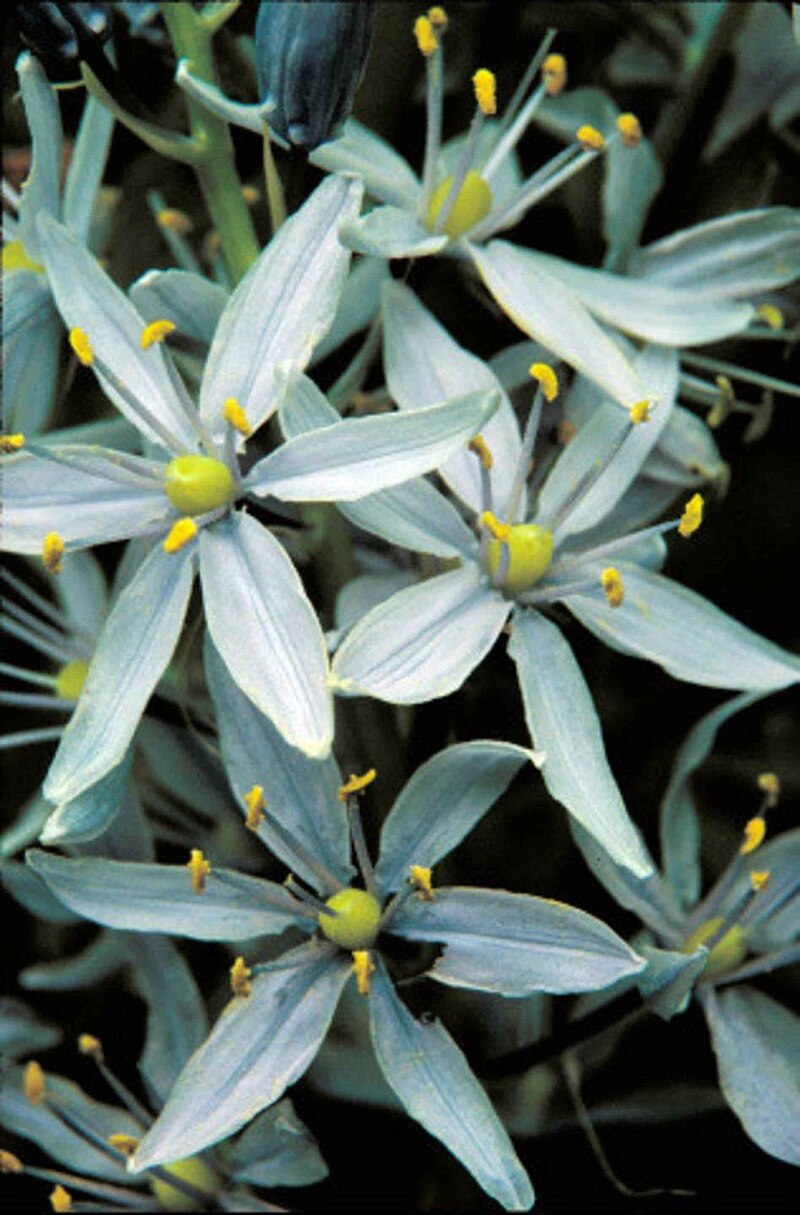
Camassia scilloides, known as Wild Hyacinth, Atlantic Camas, or Eastern Camas, is a native spring-blooming bulb that transforms open prairies, meadows, and moist woodland clearings across a broad swath of central and eastern North America into seas of soft blue and lavender from March through May. A member of the Asparagaceae family (formerly placed in Hyacinthaceae), it grows from a true bulb that sends up strap-like basal leaves and a graceful flowering spike in spring, then retreats entirely underground by early summer — a classic “spring ephemeral” strategy that allows it to exploit spring sunlight before taller plants shade it out.
The genus Camassia — from the Nez Perce word “qém’es” meaning sweet — was one of the most economically significant food plants of Native American peoples across North America. While the more western species (C. quamash) was the primary food plant on the Pacific Coast, the eastern Wild Hyacinth (C. scilloides) was similarly valued by Indigenous peoples of the Central Plains and eastern forests, whose populations depended on the starchy, protein-rich bulbs as a critical spring and summer food source. The bulbs were roasted in pit ovens, boiled, dried for storage, and ground into a sweet flour used in various preparations.
For modern gardeners, Wild Hyacinth is a delightful spring bulb that naturalizes readily in lawns, meadows, and woodland edges throughout its broad range from Minnesota and Wisconsin south to Georgia, Alabama, and Mississippi, and west to Nebraska and Kansas. Its light blue to lavender flowers — perfectly sized and colored for the spring garden palette — appear reliably from year to year once established, gradually increasing in number as the bulbs multiply underground. It thrives in the moist, fertile soils of floodplain meadows and open woodlands and is a valuable companion plant for other spring natives, filling the landscape with color just as spring arrives.
Identification
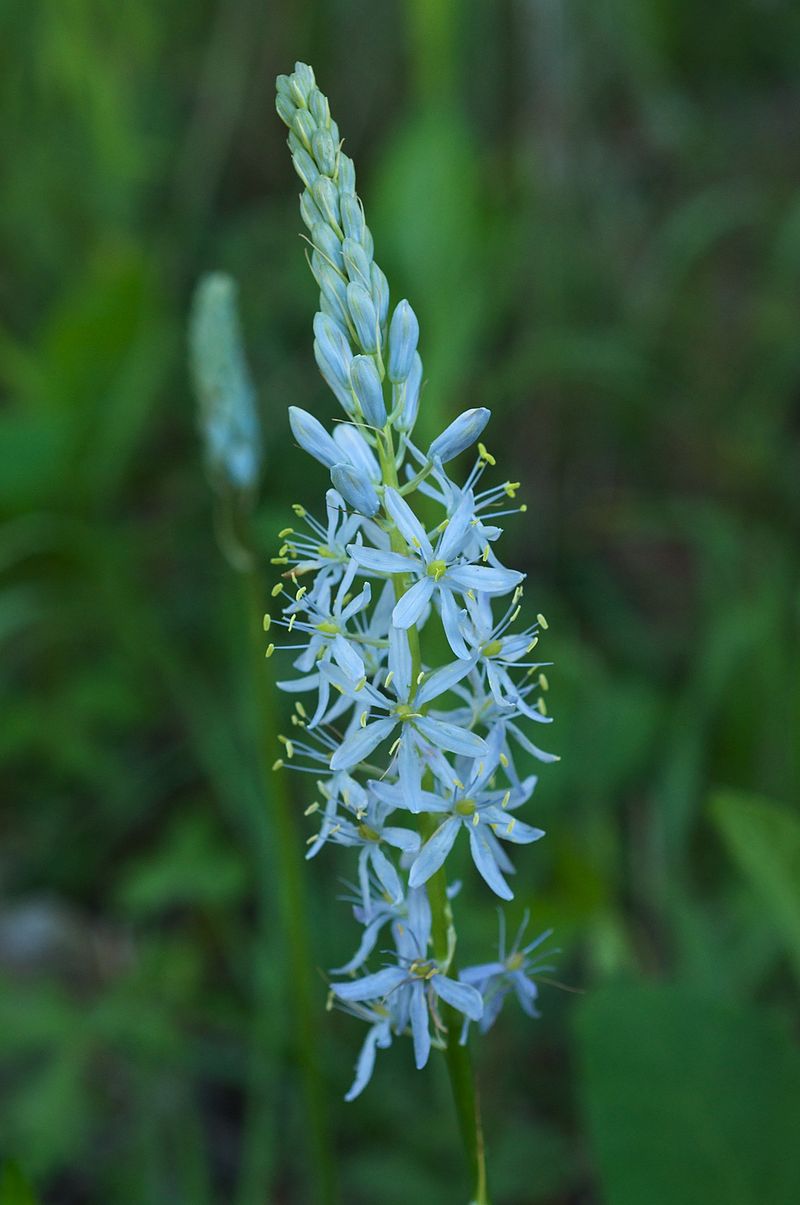
Wild Hyacinth is a bulbous perennial herb, emerging from a rounded, onion-like bulb ½ to 1 inch in diameter with a papery brown outer coat. In spring, it produces a rosette of 3 to 7 basal leaves that are grass-like or strap-shaped, 8 to 24 inches long and ½ to ¾ inch wide, with a prominent midvein and smooth, slightly keeled surface. The leaves often have a slightly bluish-green cast. The flower stalk rises from the center of the leaf cluster, typically reaching 12 to 24 inches (occasionally taller in rich soils), bearing the flowers in an elongated raceme at its tip.
Flowers
The flowers are the defining feature — they are borne in loose, elongated racemes of 15 to 40 individual flowers that open progressively from the bottom upward over a period of 2 to 3 weeks, extending the bloom display considerably compared to plants where all flowers open simultaneously. Each flower is about ½ to ¾ inch across, with 6 tepals (3 petals + 3 sepals, all similar in appearance) in a star-like arrangement. Color ranges from pale lavender-blue to light violet-blue to nearly white, with the most vivid blue forms often the most visually striking. Each flower has 6 prominent yellow anthers that contrast beautifully with the blue tepals. The flowers are mildly fragrant and attract native bees, bumblebees, and various flies.
Bulb & Dormancy
After flowering and seed set in May and June, the above-ground portions of Wild Hyacinth die back completely and the plant enters summer dormancy. This characteristic makes it important to mark bulb locations or pair it with later-emerging plants that will fill the space left by the dying foliage. The bulbs are edible (see Cultural Uses section) and are covered in a papery brown tunic similar to a hyacinth or onion bulb. They multiply slowly by offsets and by seed, gradually forming clumps over many years.
Seeds
The fruit is a three-celled capsule, about ½ inch long, that ripens in late May and June. When ripe, the capsules split open to release small, shiny black seeds. The seeds germinate in fall with adequate moisture and the seedlings form tiny bulblets in their first year, taking 3 to 5 years to reach flowering size. Wild Hyacinth self-seeds reliably in suitable conditions, gradually spreading to form colonies when soil disturbance is minimized.
Quick Facts
| Scientific Name | Camassia scilloides |
| Family | Asparagaceae |
| Plant Type | Spring-Blooming Perennial Bulb |
| Mature Height | 1.5 ft |
| Sun Exposure | Part Shade to Full Sun |
| Water Needs | Moderate to Low |
| Bloom Time | March – May |
| Flower Color | Light blue to lavender-violet |
| Dormancy | Summer dormant; dies back completely by June |
| USDA Hardiness Zones | 4–8 |
Native Range
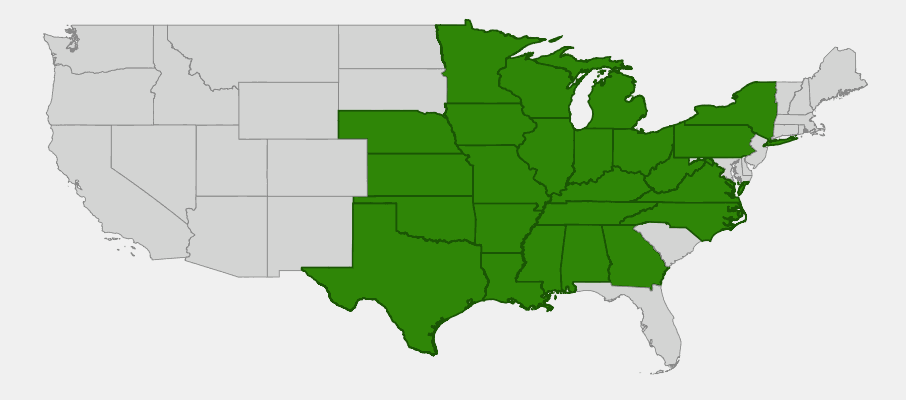
Wild Hyacinth has one of the broadest ranges of any eastern spring bulb, ranging from Wisconsin, Michigan, and southern Minnesota east through Ohio, Pennsylvania, and New York, south through the Appalachians to Georgia and Alabama, and west through Tennessee, Kentucky, Missouri, Arkansas, Oklahoma, Kansas, and Nebraska. It reaches into the Gulf Coastal Plain of Mississippi and Louisiana at the southern edge of its range. Throughout this vast area, it is associated with the rich, moist soils of floodplain meadows, moist prairies, open woodlands, and glades.
Wild Hyacinth is most abundant in the Interior Low Plateaus, Ozark Highlands, and Mississippi Embayment regions, where moist, calcareous (limestone-influenced) soils support dense populations in open woodlands and glades. It was historically much more common on the tallgrass prairie and forest-prairie borders of the Midwest, where periodic burning maintained the open, grassy habitats it prefers. In the east, it is more scattered, occurring in isolated populations in moist meadows, floodplain prairies, and woodland edges. In the South (Georgia, Alabama, Mississippi), it tends to grow in richer upland sites and moist prairie remnants rather than in typical Coastal Plain habitats.
Populations of Wild Hyacinth have declined significantly across much of its range due to the conversion of moist prairie and open woodland habitats to agriculture, development, and forest succession resulting from fire suppression. In many Midwest states, it is now found mainly in remnant prairies, nature preserves, and old cemeteries — sites that were never plowed or that retained the management (mowing, burning) that keeps the habitat open. Conservation efforts focused on tallgrass prairie restoration are helping to maintain and restore populations in the Great Plains states.
📋 Regional plant lists featuring Wild Hyacinth: Alabama, Georgia & Mississippi
Growing & Care Guide
Wild Hyacinth is one of the easiest native bulbs to grow, tolerating a wide range of conditions as long as it receives adequate spring moisture and sun, and is not disturbed during its brief above-ground period. Its summer dormancy makes it a flexible companion plant that can share space with summer-growing perennials that will take over the space when Wild Hyacinth disappears below ground in June.
Light
Wild Hyacinth grows in part shade to full sun, reflecting its natural habitat in open woodlands and prairie openings. In full sun (open meadow or prairie conditions), it flowers most prolifically and the bulbs multiply most rapidly over time. In part shade (under a deciduous canopy that leafs out after the plant blooms), it still flowers well because its bloom period (March–May) occurs before most trees are fully leafed out. Avoid heavy shade under evergreens, where too little spring light reaches the plant.
Soil & Water
Wild Hyacinth prefers fertile, moist, well-drained to moderately moist soils — heavier clay soils that retain moisture are actually often preferred over sandy soils that dry out quickly in spring. Good spring moisture is critical during the brief growth and bloom period. Soil pH adaptability is good — the plant tolerates slightly acidic to neutral soils (pH 5.5–7.5), including the calcareous soils common in its Ozark and limestone glade habitats. Amend very sandy soils with compost to improve moisture retention. Once summer dormancy begins, the plant’s underground bulbs tolerate dry soils quite well.
Planting Tips
Plant bulbs in fall, 3 to 4 inches deep and 4 to 6 inches apart, in clusters of 10 or more for visual impact. Mark the location well — like all spring ephemeral bulbs, the planting site becomes invisible after the foliage dies down in early summer. Pair with summer-growing plants that will fill in the space: prairie dropseed, little bluestem, wild bergamot, or native sedges are all excellent companions. Wild Hyacinth also naturalizes beautifully in lawns — it will bloom in March before the grass needs mowing, and the foliage will have disappeared before the first mowing of the season.
Pruning & Maintenance
Wild Hyacinth requires virtually no maintenance once established. Allow the foliage to die back naturally after blooming — this period of post-bloom photosynthesis is essential for the bulb to store energy for the following year’s bloom. Do not cut the foliage until it has yellowed and collapsed on its own. To encourage naturalization by seed, allow some seed capsules to ripen and self-sow before cutting the spent flower stalks. Division of established clumps in late summer (when the bulbs are dormant) can be done every 5 to 7 years if clumps become overcrowded.
Landscape Uses
- Spring meadow and prairie planting — naturalizes beautifully in open areas
- Native lawn alternative — blooms before mowing season begins
- Woodland edge planting — thrives under deciduous trees in spring sun
- Spring pollinator garden — early nectar source for native bees
- Companion to summer prairie plants — disappears just as summer plants emerge
- Native bulb garden — pairs with trout lily, Virginia bluebells, spring beauty
Wildlife & Ecological Value
Wild Hyacinth provides important early-season ecological services, particularly as a nectar and pollen source for native bees and other pollinators at a time when few other plants are in bloom. Its role in the spring floral sequence of open woodlands and prairies is disproportionate to its modest stature.
For Birds
Wild Hyacinth’s seeds are consumed by some ground-foraging sparrows and other seed-eating birds. The plant’s value to birds is primarily indirect: by supporting native bee populations through its flowers, it contributes to the insect food web that insectivorous birds depend on for feeding their nestlings. The clumping growth habit, with its grass-like foliage, provides modest ground cover for nesting birds in open meadow settings.
For Mammals
The bulbs of Wild Hyacinth are edible for humans and were historically consumed by bears, deer, gophers, and other mammals. Gophers and voles sometimes excavate and eat the bulbs in garden settings — a minor nuisance that can be addressed with bulb cages if necessary. White-tailed deer may occasionally browse the emerging foliage in spring when other green growth is scarce.
For Pollinators
Wild Hyacinth is an important spring nectar and pollen source for native bees, particularly queen bumblebees emerging from winter dormancy, early mining bees (Andrena spp.), and sweat bees. The blue-violet flowers are particularly attractive to bees that can perceive UV light, which highlights nectar guides invisible to human eyes. Butterflies including Spring Azure, Cabbage White, and early-flying swallowtails also visit the flowers. As one of the first mass-flowering spring plants in open woodland habitats, it provides a critical early-season resource before the main spring bloom season is underway.
Ecosystem Role
Wild Hyacinth is a characteristic component of the diverse spring ephemeral community in eastern North American woodlands and prairie margins. This community — which includes Virginia Bluebells, Trout Lily, Spring Beauty, Dutchman’s Breeches, and Blood Root — has co-evolved with the spring sunlight window that exists before tree canopies close in May. Wild Hyacinth contributes to this community by supporting the pollinators that service all the other spring ephemerals, and by contributing organic matter to the soil as its foliage decays. In prairie settings, its bulbs store nutrients in a form that persists through periodic fire, making it fire-adapted and a reliable component of diverse prairie plant communities.
Cultural & Historical Uses
Wild Hyacinth and its western relatives have one of the most significant histories of any North American native plant as a food source. In the eastern half of the continent, Camassia scilloides was an important food resource for numerous Indigenous nations. The Cherokee called it “wild hyacinth” and used the bulbs as a food source, eating them boiled or roasted. The Osage, Potawatomi, Ojibwe, and other Great Lakes and Plains nations ate the bulbs raw, boiled them in soups, or roasted them in underground ovens. The cooked bulbs have a sweet, somewhat mucilaginous texture similar to a sweet potato or roasted garlic, and a distinctive flavor that was prized as a pleasant change from the starchy foods dominant in winter diets.
The closely related western Camas (Camassia quamash) was so important to the Nez Perce, Shoshone, Bannock, and other Columbia Plateau nations that control of the prime camas prairies of Idaho and Oregon was a matter of profound political and military significance. Disputes over access to Camas Prairie were a factor in several conflicts between tribes and between Native peoples and European settlers in the 1870s. The Camas Prairie in Idaho takes its name from the plant, reflecting the depth of its importance to the local Indigenous economy.
One critical historical note: Death Camas (Zigadenus spp. and Anticlea spp.) grows in similar habitats and has similar-looking foliage to Wild Hyacinth, but is highly toxic. Indigenous peoples who harvested Camas bulbs had detailed knowledge of how to distinguish the two plants — primarily by examining the flowers (Wild Hyacinth has blue-violet flowers; Death Camas has white or yellowish flowers) and bulb characteristics. Harvesting must always be done during the flowering period when positive identification is possible. Today, most people appreciate Wild Hyacinth for its ornamental rather than culinary value, though foragers with proper identification skills still harvest the bulbs in appropriate quantities.
Frequently Asked Questions
Can I eat Wild Hyacinth bulbs?
Yes — the bulbs of Camassia scilloides are edible when cooked (boiled or roasted) and were an important food source for many Indigenous peoples. However, extreme caution is essential: Death Camas (Zigadenus spp.), which is highly toxic, can grow in similar habitats and has similar foliage. ONLY harvest Camassia bulbs during the flowering period when you can definitively identify the blue-violet flowers. Never harvest bulbs based on foliage alone. When in doubt, leave it.
My Wild Hyacinth plants disappeared after flowering. Is something wrong?
No — summer dormancy is completely normal and expected. Wild Hyacinth is a spring ephemeral; it completes its entire above-ground growth and reproduction cycle from March through May or June, then retreats completely underground until the following spring. The disappearing foliage is a sign of a healthy, well-adapted plant. Mark the location with a small stake or plant label and fill the empty space with summer-growing companions.
How do I get Wild Hyacinth to spread?
Wild Hyacinth spreads by two mechanisms: vegetative multiplication (bulb offsets) and seed. To encourage seed spreading, allow some flower stalks to go to seed and self-sow — do not deadhead all spent flowers. Plant in areas of minimal soil disturbance where self-sown seedlings can establish without being disturbed. Division of established clumps every 5 years and replanting the divisions throughout the garden also spreads the planting quickly.
Does Wild Hyacinth work in a lawn?
Wonderfully well, actually. Wild Hyacinth blooms in March–April before lawn grass typically needs mowing for the first time, and its foliage dies back completely by June. This timing means the plant is essentially invisible during normal mowing season. Naturalizing it in a lawn — especially a low-mow or “freedom lawn” — creates a beautiful spring meadow effect with no maintenance required beyond delaying the first mowing until after the Camassia foliage has completely died back.
What is the difference between Wild Hyacinth and true Hyacinth?
True hyacinths (Hyacinthus orientalis) are Old World bulbs native to the Mediterranean region and are not native to North America. Wild Hyacinth (Camassia scilloides) is a completely different plant — a true North American native — that simply received the common name “hyacinth” from early European settlers who noted the superficial resemblance of its flower spikes to those of the familiar cultivated hyacinth. The two plants are distantly related through both being in the Asparagaceae family, but Wild Hyacinth is ecologically appropriate for native plant gardens while true hyacinth is not.

Looking for a nursery that carries Wild Hyacinth?
Browse our native plant nursery directory: Alabama · Georgia · Mississippi