
Swamp Chestnut Oak (Quercus michauxii)
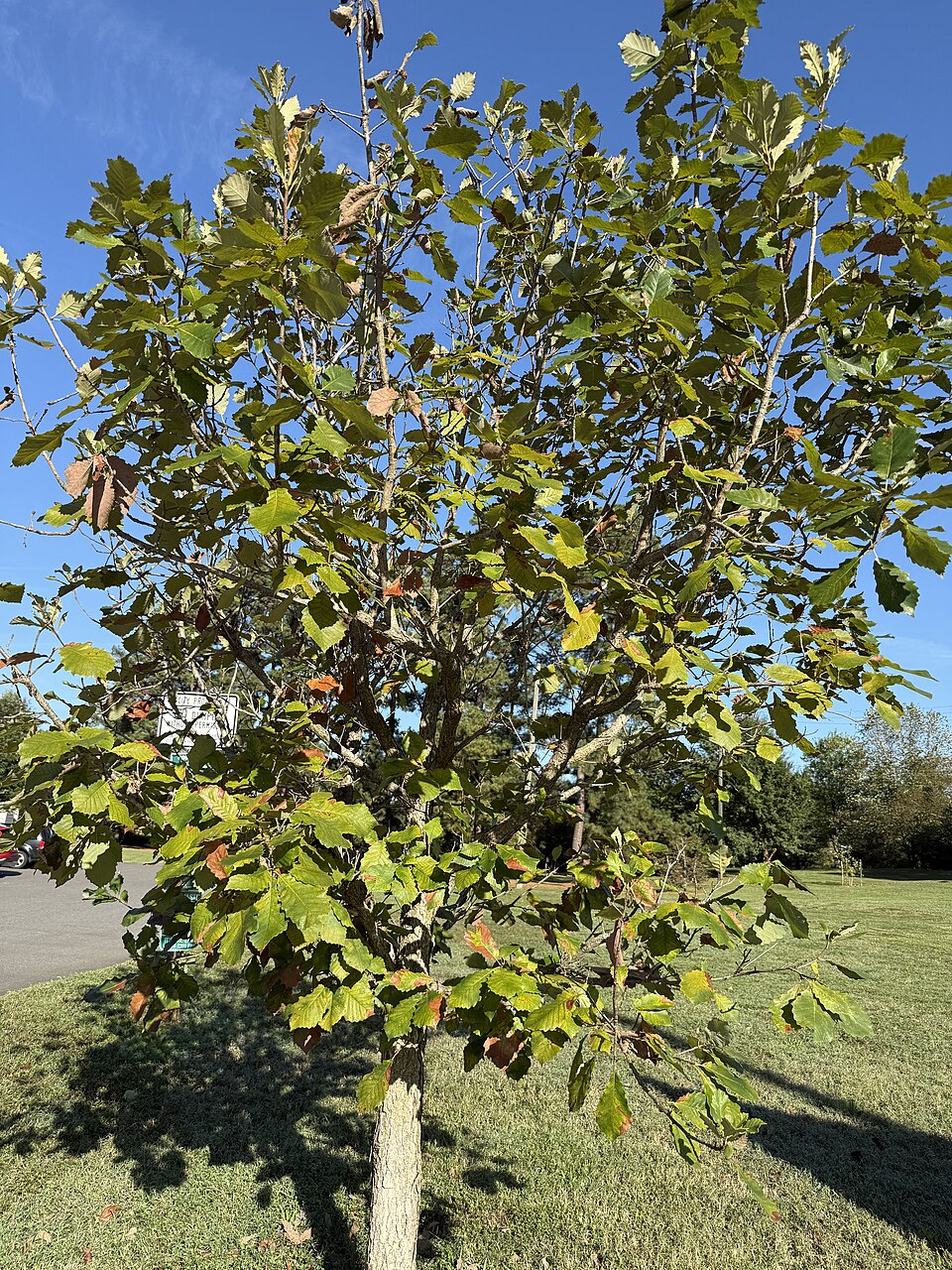
Quercus michauxii, commonly known as Swamp Chestnut Oak, Basket Oak, or Cow Oak, is a magnificent native deciduous tree of the southeastern United States — one of the great oaks of the bottomland hardwood forest, combining impressive size, stunning autumn color, wildlife-sustaining acorn crops, and a naturally elegant form with distinctive light gray, flaky bark. Named in honor of the French botanist André Michaux (1746–1802) who explored the forests of the southeastern United States, Swamp Chestnut Oak is a dominant canopy species in rich bottomland forests, moist slopes, and well-drained floodplain terraces from New Jersey south to Florida and west to Texas and Oklahoma.
Growing to 80 to 95 feet tall with a broad, rounded crown and trunk diameters up to 3–4 feet, Swamp Chestnut Oak is one of the larger white oak group members — a true canopy giant that forms the upper story of many southeastern bottomland forests alongside Shumard Oak, Cherrybark Oak, and Water Hickory. Its large, obovate leaves — similar in shape to Chestnut Oak (Q. montana) leaves — turn a reliable, attractive wine-red to deep red in autumn, providing one of the most consistent fall color displays of any oak species in the Southeast. This reliable red color, contrasting beautifully with the species’ characteristically pale, light gray, somewhat loosely-scaled bark, makes Swamp Chestnut Oak an exceptionally handsome ornamental tree as well as a magnificent wildlife tree.
Perhaps most importantly from an ecological standpoint, Swamp Chestnut Oak produces large, sweet acorns — among the largest and most palatable of any oak species — that are consumed by white-tailed deer, wild turkeys, wood ducks, squirrels, and numerous other wildlife species. The acorns are sweet enough that domesticated cattle eagerly consume them (earning the tree the colloquial name “Cow Oak”), and the acorn meal was historically an important food source for Indigenous peoples and wildlife alike. Few trees contribute as much to the bottomland food web as a mature Swamp Chestnut Oak in a good mast year.
Identification
Swamp Chestnut Oak is a large, deciduous tree typically reaching 80 to 95 feet tall at maturity — occasionally taller in ideal bottomland conditions. The crown is broadly oval to rounded, becoming wide-spreading and majestic in open-grown specimens. Young trees are more upright and conical. The combination of large, obovate chestnut-like leaves, very pale gray flaky bark, and bottomland habitat makes identification straightforward.
Bark
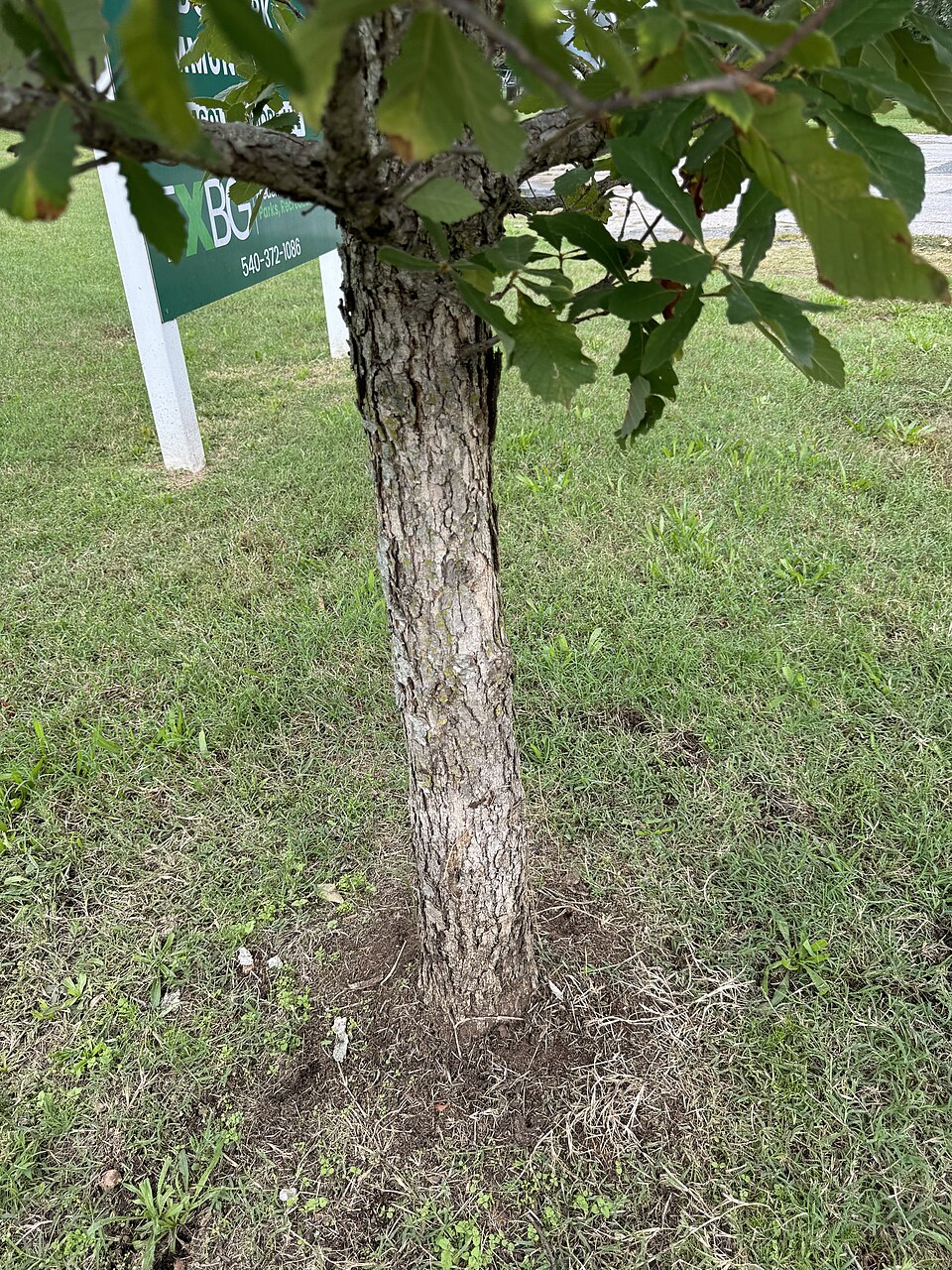
The bark is one of the most visually distinctive features of Swamp Chestnut Oak: light gray — considerably paler than most oaks — and loosely plated to somewhat shaggy-flaky, with broad, flat, irregularly interlacing ridges that tend to lift slightly from the trunk on their edges, giving the bark a distinctly rough, shaggy appearance. This light gray, somewhat flaky bark is a reliable field identification character that separates Swamp Chestnut Oak from the dark, deeply furrowed bark of most other large oaks in the bottomland forest. The bark’s pale color contrasts beautifully with the deep green summer foliage and brilliant red fall color.
Leaves
The leaves are large — 5 to 9 inches long — obovate (widest near the tip), with a rounded to somewhat wedge-shaped base and 10 to 16 pairs of rounded lobes along the margins that recall the leaf shape of American Chestnut (Castanea dentata) — hence the common name. The upper surface is dark, glossy green; the underside is pale to whitish-green with a soft, slightly velvety texture. The leaves typically turn a deep wine-red to red-burgundy in autumn — one of the most consistent and attractive fall color displays of any southeastern oak. The large size of the leaves creates bold texture in the summer canopy.
Acorns
The acorns are large, oval-round, up to ¾ to 1 inch long and ½ to ¾ inch wide — among the largest acorns of any oak in the eastern United States. They are produced singly or in pairs, ripening in late September through October of their first year (a white oak group characteristic). The acorn cap (cupule) covers about half the nut with thin, somewhat loose, hairy scales. The acorns are sweet and low in bitter tannins — palatable enough to eat raw and eagerly consumed by virtually all wildlife that encounters them. They are among the most nutritious and desirable acorns available in the southeastern forest.
Quick Facts
| Scientific Name | Quercus michauxii |
| Family | Fagaceae (Beech) |
| Plant Type | Deciduous Tree |
| Mature Height | 80–95 ft |
| Sun Exposure | Full Sun to Part Shade |
| Water Needs | Moderate to High |
| Bloom Time | April – May (inconspicuous catkins) |
| Fall Color | Reliable red to wine-red |
| Acorns | Large, sweet; matures in one season |
| Bark | Distinctive pale light gray, loosely-plated |
| USDA Hardiness Zones | 5–9 |
Native Range
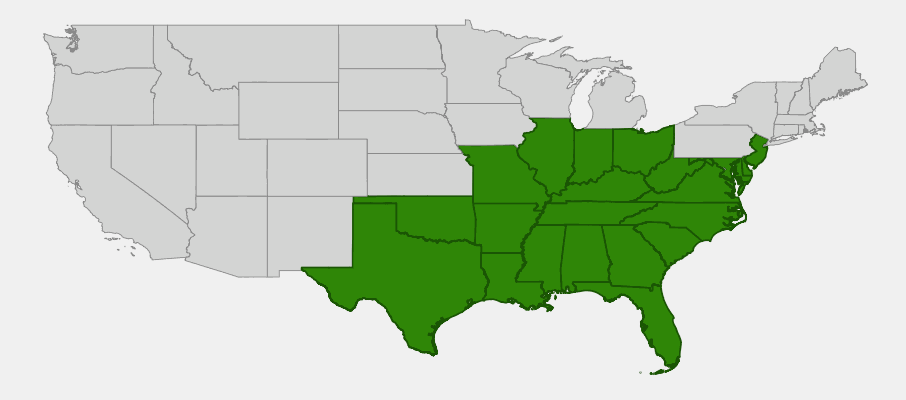
Swamp Chestnut Oak is native to the eastern United States, ranging from southern New Jersey and Delaware south through the mid-Atlantic states, the Carolinas, Georgia, and Florida, and westward through Alabama, Mississippi, Tennessee, and Kentucky into southern Indiana and Illinois, Missouri, Arkansas, Louisiana, and east Texas, extending into eastern Oklahoma. This broad distribution makes it one of the more widely ranging oaks of the white oak group in the eastern United States.
Within its range, Swamp Chestnut Oak is characteristic of rich, moist bottomland hardwood forests on well-drained to somewhat poorly drained floodplain terraces, moist lower slopes, and rich mesic uplands adjacent to streams and rivers. Despite the “swamp” in its common name, it does not grow in true swamps — it prefers the well-drained to moderately moist soils of bottomland terraces and rich flats rather than the permanently or deeply flooded soils occupied by Bald Cypress and Water Tupelo. It grows alongside Cherrybark Oak, Shumard Oak, Water Hickory, Pecan, American Elm, and Green Ash in the richest bottomland hardwood forest communities.
Swamp Chestnut Oak is a long-lived, slow-to-moderate-growing tree that contributes to the stable, diverse, and highly productive bottomland hardwood ecosystems of the Southeast. As these forests have been extensively cleared and converted to agriculture, urban development, and pine plantation over the past two centuries, Swamp Chestnut Oak and the entire bottomland forest community have declined significantly. Restoration of bottomland hardwood forests using native species including Swamp Chestnut Oak is a conservation priority throughout much of the species’ range.
📋 Regional plant lists featuring Swamp Chestnut Oak: Alabama, Georgia & Mississippi
Growing & Care Guide
Swamp Chestnut Oak is a rewarding but patient tree to grow — slow-growing in its early years but increasingly magnificent as it matures, ultimately becoming a long-lived landscape and ecological anchor that outlasts multiple human generations. With appropriate siting and minimal care, it requires virtually no maintenance beyond basic formative pruning in the first decade.
Light
Full sun to light partial shade produces the best growth, strongest form, and most vivid fall color. Swamp Chestnut Oak is moderately shade-tolerant as a seedling and sapling, allowing it to establish beneath an existing canopy in naturalistic plantings. However, it ultimately needs good light exposure to develop its characteristic full, rounded crown. Trees reaching for light in dense shade develop weaker, more open canopies than open-grown specimens.
Soil & Water
Swamp Chestnut Oak prefers deep, fertile, well-drained to moderately moist, slightly acidic to neutral soils (pH 5.5–7.0). It performs best in loamy bottomland soils with good organic content but is adaptable to a range of soil types including moderately heavy clays, provided they drain adequately and do not remain waterlogged for extended periods. Regular moisture during the establishment period (first 2–3 years) is important; once established, the deep root system provides significant drought tolerance.
Planting Tips
Plant in fall or early spring. Container-grown or balled-and-burlapped stock establishes well. Dig the planting hole at least 3 times the diameter of the root ball. Space trees at least 40–50 feet apart to allow for full crown development at maturity. Mulch generously (3–4 inches of wood chips in a wide ring away from the trunk) to conserve soil moisture and encourage root establishment during the critical first few years. Do not fertilize heavily — gradual natural development is preferable for long-term structural strength.
Pruning & Maintenance
Formative pruning in the first 10–15 years is the most important investment you can make in a Swamp Chestnut Oak. Maintain a single central leader and gradually remove competing upright branches and low limbs to develop a strong, storm-resistant trunk and main scaffold. Once the primary structure is established, maintenance pruning is minimal — remove dead branches and any crossing or rubbing limbs as needed. Swamp Chestnut Oak is relatively resistant to oak wilt, though proper pruning wound practices (avoiding pruning from April through July in high-risk areas) are advisable.
Landscape Uses
- Large specimen shade tree — a magnificent anchor tree for spacious residential or park landscapes
- Wildlife garden centerpiece — sweet acorns sustain extraordinary diversity of wildlife
- Bottomland restoration — a priority species for restoring southeastern bottomland hardwood forest
- Rain garden adjacent planting — tolerates periodically moist conditions
- Street and park tree — large caliper trees increasingly used for boulevard planting
- Arboretum and nature preserve planting — long-term ecological investment
Wildlife & Ecological Value
Swamp Chestnut Oak is one of the most ecologically important trees in the entire southeastern United States. Its large, sweet acorns, massive canopy structure, and long lifespan create habitat and food resources that sustain an extraordinary diversity of wildlife across all seasons.
For Birds
The large sweet acorns are consumed by Wood Ducks (a primary food source), Wild Turkeys, Red-headed Woodpeckers, Blue Jays, Common Grackles, and numerous other birds. The dense canopy hosts breeding populations of Red-eyed Vireos, Baltimore Orioles, Scarlet Tanagers, and many warblers. The deep bark furrows of mature trees shelter roosting Brown Creepers and Carolina Wrens in winter, while natural cavities and broken branches become nesting sites for Wood Ducks, Barred Owls, and various woodpeckers.
For Mammals
White-tailed deer are major consumers of Swamp Chestnut Oak acorns — the sweet, low-tannin nuts are preferred over the more bitter acorns of most other oaks. Gray and Fox Squirrels harvest and cache acorns extensively; Flying Squirrels glide between mature trees at night to collect acorns and use tree cavities as nest sites. Black bears consume acorns where ranges overlap. The massive root system provides important structure and stability to streambanks and bottomland soils, creating diverse microhabitats for moles, voles, salamanders, and soil invertebrates.
For Pollinators & Insects
Oaks support more species of caterpillars and other insects than virtually any other native tree genus in North America — research by Dr. Doug Tallamy found that native oak species support over 500 species of Lepidoptera (moths and butterflies) in the eastern United States. These caterpillars are the critical food source for breeding songbirds during the spring nesting period. Swamp Chestnut Oak is among the largest caterpillar-supporting trees in the bottomland forest, making it a foundational species for the entire insect-to-bird food web.
Ecosystem Role
As a dominant canopy tree in southeastern bottomland hardwood forests, Swamp Chestnut Oak is a keystone species in the fullest sense — its presence structures entire ecological communities. The massive acorn crop in good mast years sustains populations of large vertebrates from bear to deer to turkey. The canopy structure provides habitat for hundreds of species at multiple trophic levels. The deep root system stabilizes streambanks, reduces flood erosion, and maintains the hydrological function of bottomland ecosystems. Few trees in the Southeast equal Swamp Chestnut Oak in total ecological contribution.
Cultural & Historical Uses
Swamp Chestnut Oak has an extensive history of human use that reflects both its large, edible acorns and its high-quality timber. The common name “Basket Oak” reflects one of the most important historical uses: the flexible wood splits very cleanly into thin, pliable strips ideal for weaving baskets. Indigenous peoples of the Southeast — particularly Muscogee (Creek), Choctaw, Cherokee, and other southeastern nations — were expert basket weavers who used Swamp Chestnut Oak splints for everything from storage baskets to fish traps to burden baskets for carrying agricultural products. The tradition of oak basket weaving using this species has been maintained by southeastern Native American communities for centuries and continues today as a living craft tradition.
The large, sweet acorns — low in bitter tannins compared to most other oaks — were an important food source for Indigenous peoples and early European settlers alike. They could be eaten with minimal processing compared to the bitter acorns of red oak group species, which required extensive leaching to remove tannins. Ground acorn meal was used in breadmaking, porridges, and other traditional preparations. The common name “Cow Oak” reflects the traditional practice of allowing cattle to graze beneath mast-producing trees to fatten on the abundant, sweet acorns each fall.
The timber of Swamp Chestnut Oak is classified commercially as “white oak” and commands premium prices for its strength, durability, and attractive grain. It was historically used for wagon wheel felloes, agricultural implements, and heavy construction. The wood’s ability to hold water without leaking — due to the tyloses that fill the large pores — made it ideal for wine and whiskey barrels, a use that continues today. Modern uses include flooring, furniture, cabinetry, and millwork. Several states in the Southeast have designated Swamp Chestnut Oak as a regionally significant timber species.
Frequently Asked Questions
How is Swamp Chestnut Oak different from regular Chestnut Oak?
Both species have similar leaf shapes, but Swamp Chestnut Oak (Q. michauxii) has distinctly paler gray, looser bark compared to the very dark, deeply ridged bark of Chestnut Oak (Q. montana). Swamp Chestnut Oak prefers moist bottomland soils in the Coastal Plain and lower Piedmont; Chestnut Oak prefers dry, rocky upland ridges and slopes in the Appalachians and Ridge and Valley. Their ranges overlap in parts of the mid-Atlantic and Appalachian foothills.
Why is it called “Swamp” Chestnut Oak if it doesn’t grow in swamps?
The “swamp” in the name is somewhat misleading — the tree actually grows on well-drained to moderately moist bottomland terraces, not in standing-water swamps. The name reflects its occurrence in moist, low-lying bottomland habitats adjacent to streams and rivers (which were historically referred to loosely as “swampy” areas) rather than the droughty uplands where Chestnut Oak grows. It is more accurately described as a “bottomland” oak.
How long does it take a Swamp Chestnut Oak to produce acorns?
Swamp Chestnut Oak typically begins producing acorns at 20–25 years of age, with significant mast production beginning at 30–40 years. The trees produce acorns in one season (a characteristic of the white oak group), meaning current-year flowers produce acorns by fall of the same year. Mast production is variable from year to year, with major mast years typically occurring every 3–5 years when conditions align favorably.
Is Swamp Chestnut Oak suitable for urban planting?
Yes, with appropriate site selection. Swamp Chestnut Oak is increasingly used as a premium native shade and boulevard tree in parks and spacious residential landscapes. It requires adequate rooting space (at least 40–50 feet in all directions from competitors), moist well-drained soil, and full sun. It is not suitable for restricted urban tree pits or sites with severe soil compaction and drought stress. Given space, it is a magnificent and long-lived urban tree with outstanding fall color and wildlife value.
What is the lifespan of Swamp Chestnut Oak?
Swamp Chestnut Oak is very long-lived — trees 300–400 years old are known, and specimens in protected bottomland forest conditions may exceed 500 years. The massive, deep root system, strong wood, and resistance to many oak pathogens contribute to its longevity. Planting a Swamp Chestnut Oak is a genuine multi-generational investment in the landscape and in local wildlife habitat.

Looking for a nursery that carries Swamp Chestnut Oak?
Browse our native plant nursery directory: Alabama · Georgia · Mississippi