
American Beech (Fagus grandifolia)
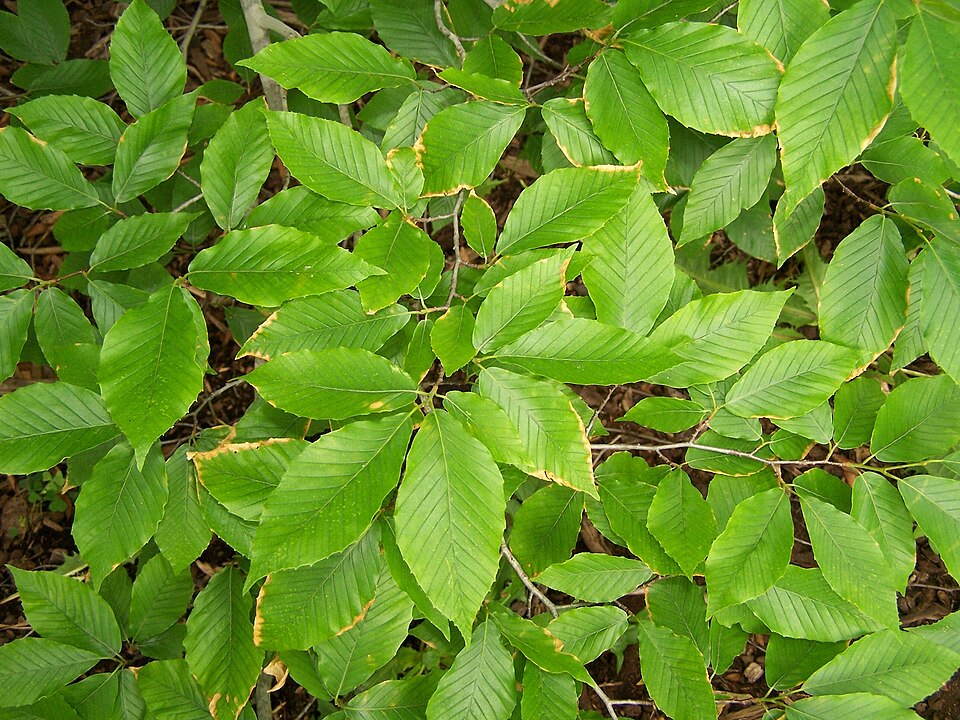
Fagus grandifolia, commonly known as American Beech, stands as one of the most magnificent and ecologically important deciduous trees of eastern North American forests. This majestic species, reaching heights of 50 to 100 feet with trunk diameters that can exceed 3 feet, creates cathedral-like groves that have inspired naturalists and forest lovers for centuries. With its distinctive smooth, steel-gray bark, prominent parallel-veined leaves, and triangular beechnuts enclosed in spiny husks, American Beech is both unmistakable in appearance and irreplaceable in its ecological role.
Native to the rich, well-drained soils of eastern deciduous forests from Nova Scotia to northern Florida, American Beech thrives in the partial shade of forest understories, though it can adapt to various light conditions as it matures. The species is renowned for its exceptional longevity, with specimens commonly living 200-300 years and some ancient trees documented to exceed 400 years. This longevity, combined with its tendency to reproduce through root suckers, allows American Beech to form extensive colonies that can persist for thousands of years.
Beyond its impressive stature and longevity, American Beech serves as a cornerstone species in eastern forests, providing essential food and habitat for countless wildlife species. Its sweet, oil-rich nuts feed everything from squirrels and chipmunks to black bears and wild turkeys, while its dense canopy and smooth trunk offer nesting sites and shelter. For gardeners and landscapers, American Beech offers unparalleled four-season interest, from its fresh spring foliage and summer shade to its golden fall color and distinctive winter silhouette adorned with persistent bronze leaves.
Identification
American Beech is easily identified by its combination of distinctive features that remain consistent throughout its range. The tree typically develops a broad, rounded crown with slightly drooping branches, creating an elegant architectural form that makes it instantly recognizable in the landscape.
Bark
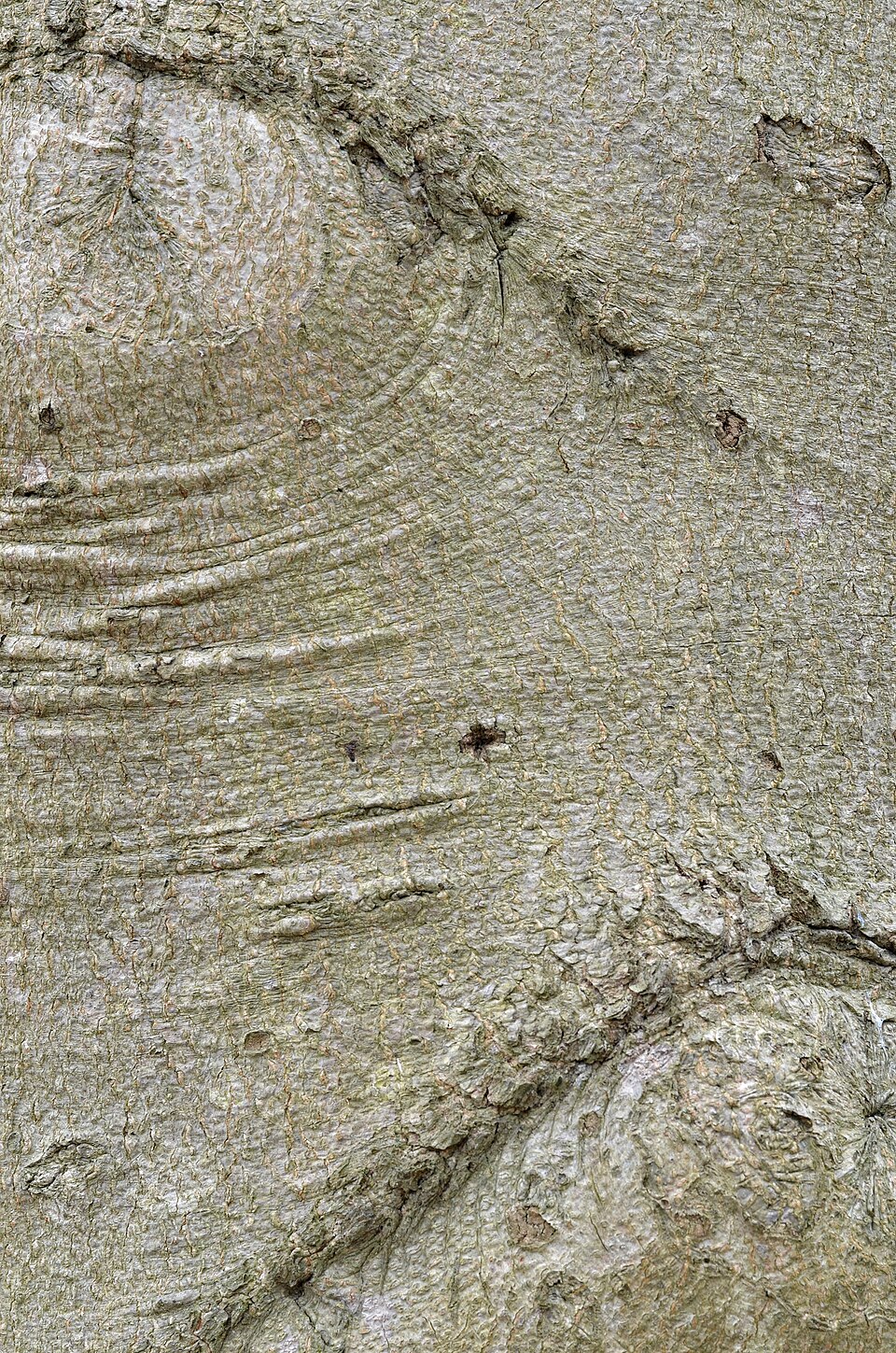
The bark is perhaps American Beech’s most distinctive feature – smooth, thin, and steel-gray to blue-gray in color, remaining relatively smooth even on mature trees. Unlike most large forest trees that develop deeply furrowed bark with age, American Beech retains its characteristic smooth texture throughout its life, though older specimens may develop some shallow ridges or slight roughening. This smooth bark makes the tree particularly susceptible to carving damage, and many old beeches bear the scars of initials and messages carved decades ago. The bark is thin enough that even minor damage can allow entry for pathogens and insects.
Leaves
The leaves are oval to elliptical, 3-5 inches long and 1.5-3 inches wide, with a distinctive pattern of straight, parallel veins that run from the midrib to the toothed leaf margin. Each vein terminates in a sharp tooth, creating the characteristic serrated edge. The leaves are simple, alternate, and have a papery texture with a slight sheen. They emerge in spring with a fresh light green color, mature to dark green in summer, and turn a brilliant golden-bronze in fall. One of American Beech’s most charming characteristics is that many leaves persist on the tree through winter in a dried, bronze state (marcescence), rustling softly in winter winds.
Flowers & Fruit
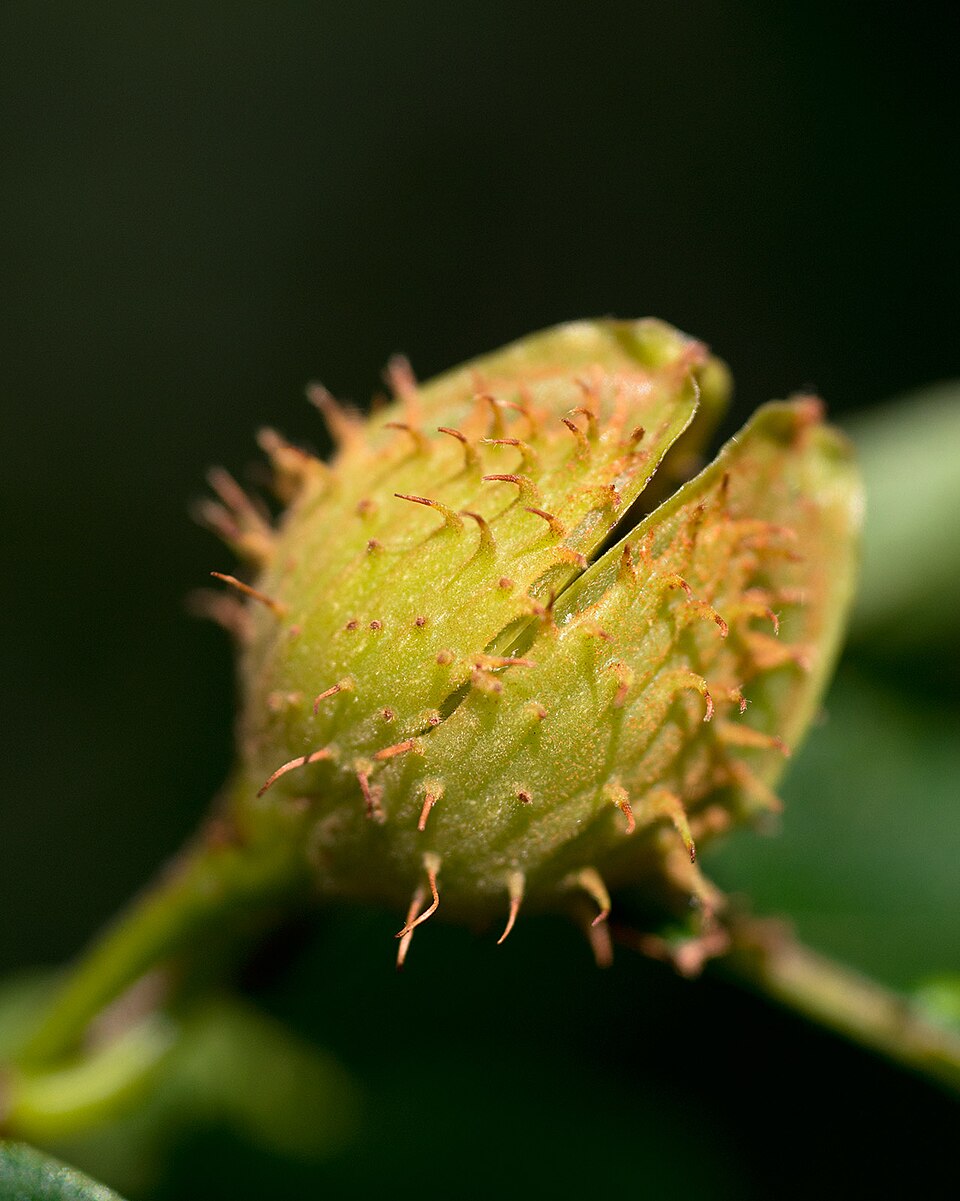
American Beech is monoecious, producing both male and female flowers on the same tree in spring. Male flowers appear as drooping, yellowish catkins about 1 inch long, while female flowers are small, inconspicuous, and appear in clusters. The fruit is perhaps the tree’s most recognizable feature – triangular, shiny brown nuts (beechnuts) enclosed in pairs within a spiny, four-valved husk. These husks split open in fall to release the sweet, edible nuts, which are about ½ inch long and rich in oil and protein. Trees typically begin producing nuts at 40-60 years of age, with mast years occurring every 2-8 years when nut production is particularly abundant.
Quick Facts
| Scientific Name | Fagus grandifolia |
| Family | Fagaceae (Beech) |
| Plant Type | Deciduous Tree |
| Mature Height | 50–80+ ft |
| Sun Exposure | Part Shade |
| Water Needs | Moderate |
| Bloom Time | April – May |
| Flower Color | Yellowish-green |
| USDA Hardiness Zones | 4–9 |
Native Range
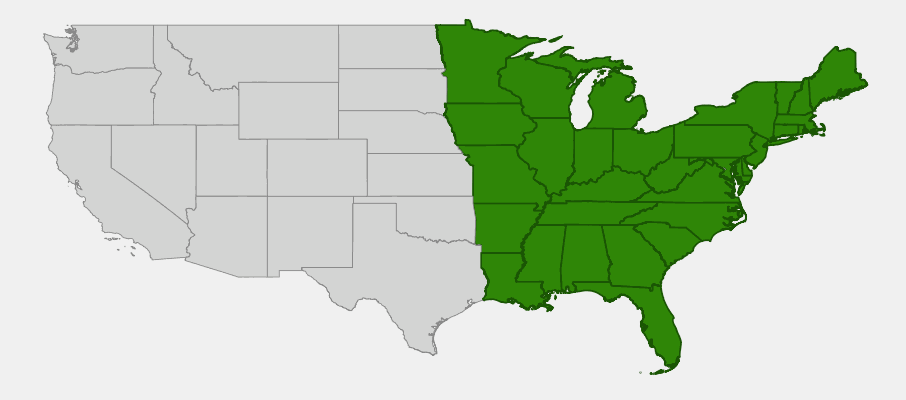
American Beech enjoys one of the most extensive native ranges of any tree in eastern North America, stretching from Nova Scotia and southern Quebec west to southern Ontario and eastern Wisconsin, and south to northern Florida and eastern Texas. This broad distribution reflects the species’ adaptability to varied climate conditions, from the cool, humid forests of the north to the warm, subtropical regions of the Gulf Coast. Throughout this range, American Beech is most abundant in areas with rich, well-drained soils and moderate to high humidity levels.
The species reaches its greatest abundance and largest size in the mixed hardwood forests of the Appalachian Mountains and the Great Lakes region, where it often forms pure stands or co-dominates with other hardwoods like Sugar Maple, Yellow Birch, and Eastern Hemlock. In these optimal habitats, American Beech can comprise 50-80% of the canopy cover, creating the magnificent beech-maple forests that are characteristic of much of the northeastern United States. The tree is particularly well-adapted to the rich, slightly acidic soils derived from glacial deposits and decaying organic matter.
Historically, American Beech was even more widespread and abundant, but European settlement brought significant changes to its populations. Large-scale logging in the 19th and early 20th centuries removed most old-growth beech forests, while agricultural clearing eliminated beech from vast areas of its former range. Today, beech scale disease and beech bark disease complex continue to threaten populations, particularly in the northern portions of the range. Despite these challenges, American Beech remains common throughout most of its range and continues to play vital ecological roles in eastern forests.
📋 Regional plant lists featuring American Beech: North Carolina & South Carolina
Growing & Care Guide
American Beech can be a challenging but rewarding tree to grow in the landscape, requiring patience and specific conditions to thrive. Its slow growth rate and particular soil requirements make it unsuitable for quick-result landscaping, but for those willing to invest in the long term, few trees offer such majestic presence and ecological value.
Light
While American Beech is quite tolerant of shade, especially when young, it performs best in partial shade to partial sun conditions. Young trees can survive in deep shade for many years, slowly growing toward available light, but they will achieve their best form and fastest growth in areas that receive morning sun and afternoon shade, or dappled sunlight throughout the day. In full sun locations, the tree may struggle with leaf scorch during hot summers, particularly in southern regions of its range.
Soil & Water
American Beech is quite particular about soil conditions and performs best in rich, well-drained soils with a slightly acidic to neutral pH (5.5-7.0). The soil should be deep, fertile, and high in organic matter – think of the rich forest soils where beech naturally thrives. Good drainage is essential, as the tree is susceptible to root rot in waterlogged conditions. Once established, American Beech has moderate drought tolerance, but it performs best with consistent moisture, especially during its slow establishment phase that can take several years.
Planting Tips
American Beech is notoriously difficult to transplant, particularly as larger specimens. Plant only small, young trees (under 6 feet tall) in early spring or fall, and be prepared for a very slow establishment period. The tree’s taproot makes transplanting challenging, and it may take 3-5 years for a newly planted beech to show significant growth. Choose the planting location carefully, as mature trees can reach substantial size and live for centuries. Space trees at least 40-50 feet apart to accommodate their eventual mature spread.
Pruning & Maintenance
American Beech requires minimal pruning and generally maintains its natural shape without intervention. Remove any dead, damaged, or crossing branches in late winter while the tree is dormant. Avoid unnecessary pruning, as the wounds heal slowly and can provide entry points for diseases. The tree’s smooth bark is easily damaged by lawn mowers, string trimmers, and foot traffic, so maintain a protective mulched area around the base. Young trees may benefit from protection against deer browsing in areas with high deer populations.
Landscape Uses
American Beech serves several important landscape functions:
- Specimen tree — outstanding focal point for large properties and parks
- Shade tree — provides dense, cool shade for summer comfort
- Wildlife habitat — exceptional food source and shelter for native animals
- Naturalistic landscapes — essential component of native forest restoration
- Seasonal interest — four-season appeal with spring foliage, summer shade, fall color, and winter character
- Erosion control — extensive root system helps stabilize slopes
- Legacy planting — long-lived tree for future generations to enjoy
Wildlife & Ecological Value
American Beech stands among the most ecologically valuable trees in eastern North American forests, serving as a keystone species that supports an enormous diversity of wildlife. Its role in forest ecosystems extends far beyond its impressive size and longevity, creating habitat structure and food resources that countless species depend upon for survival.
For Birds
Over 40 bird species regularly consume beechnuts, including Wild Turkey, Ruffed Grouse, Wood Duck, Blue Jay, Tufted Titmouse, White-breasted Nuthatch, and various woodpeckers. The nuts are particularly important for birds preparing for fall migration or winter survival, as they are rich in fats and proteins. The tree’s broad crown and multiple branching patterns provide excellent nesting sites for canopy-dwelling species like Scarlet Tanagers, Wood Thrushes, and various vireos. Cavity-nesting species such as Pileated Woodpeckers, Wood Ducks, and flying squirrels utilize hollow beech trees for nesting and roosting.
For Mammals
American Beech nuts are a crucial food source for numerous mammals, particularly during mast years when nut production is abundant. Black Bears rely heavily on beechnuts for fall fattening before hibernation, and the availability of beech mast directly affects bear population dynamics and reproduction success. Squirrels, chipmunks, and mice cache beechnuts for winter food, inadvertently aiding in seed dispersal. White-tailed Deer browse young beech saplings and fallen nuts, while larger mammals like Wild Boar (where present) root for fallen nuts and disturb forest floor communities.
For Pollinators
While American Beech is wind-pollinated, its spring flowers do attract some beneficial insects, including various flies and small beetles. More importantly, the tree supports a diverse community of leaf-eating insects that serve as crucial food sources for insectivorous birds during the breeding season. Over 100 species of butterflies and moths use American Beech as a host plant, including the beautiful Early Hairstreak butterfly and several species of prominent moths.
Ecosystem Role
American Beech functions as a foundation species in many eastern forest communities, particularly in beech-maple forests where it can comprise the majority of canopy trees. The tree’s dense canopy creates specific understory conditions that favor certain plant communities, including spring ephemeral wildflowers that bloom before the leaves fully emerge. Fallen beech leaves decompose relatively quickly, contributing nutrients to forest soils and supporting soil invertebrate communities. The tree’s tendency to reproduce through root suckers creates genetic clones that can persist for millennia, providing long-term forest stability and habitat continuity.
Cultural & Historical Uses
American Beech holds a special place in North American cultural history, serving both practical and symbolic roles in human society from pre-Columbian times to the present day. Indigenous peoples throughout the tree’s range recognized the value of beech forests and developed numerous uses for the tree’s various parts, many of which continued to be important to European settlers and their descendants.
Native American tribes, including the Iroquois, Cherokee, and various Algonquian peoples, utilized beechnuts as an important food source, often grinding them into flour or pressing them for their oil. The nuts were typically processed to remove their slightly bitter tannins, then used in breads, soups, and other dishes. Beech bark was used medicinally by several tribes – the Cherokee used it to treat burns and frostbite, while the Iroquois prepared bark decoctions for lung ailments and dysentery. The smooth bark also served as a natural writing surface, used for temporary messages and record-keeping.
European colonists quickly recognized the value of American Beech, both for its nuts and its high-quality wood. Beechnuts were fed to livestock, particularly swine, and “beech mast” years were celebrated as bonanza times for pig farmers. The nuts were also gathered for human consumption, though they required processing to remove bitterness. Beech wood became highly prized for its hardness, uniform grain, and ability to take a smooth finish. It was extensively used for flooring, furniture, tool handles, and food containers, as it imparts no taste or odor to stored foods.
In the 19th and early 20th centuries, American Beech played important roles in several industries. The wood was used to make clothespins, shoe lasts, cutting boards, and wooden kitchen utensils. Beech sawdust and wood chips were used for smoking meats, imparting a mild, sweet flavor. The smooth bark made beech trees popular as “message trees” – travelers and lovers carved initials, dates, and messages that would remain visible for decades as the bark healed around the cuts.
Today, American Beech continues to hold cultural significance as a symbol of permanence, wisdom, and natural beauty. Many historic “Constitution Trees” and “Treaty Trees” were American Beeches, chosen for their longevity and impressive presence. The tree features prominently in American literature and poetry, often representing strength, endurance, and connection to the land. Conservation efforts increasingly recognize American Beech as a keystone species essential for maintaining the integrity of eastern forest ecosystems.
Frequently Asked Questions
Why is my American Beech growing so slowly?
American Beech is naturally one of the slowest-growing major forest trees, often adding only 12-18 inches per year even under optimal conditions. Young trees may grow even more slowly as they establish their extensive root systems. This slow growth is compensated by exceptional longevity – your beech may live for centuries once established. Ensure proper soil conditions and be patient.
Can I eat American Beechnuts?
Yes, American Beechnuts are edible and were historically an important food source. However, they can be quite bitter due to tannins and are best when processed or roasted. The small size and bitter taste mean they require considerable effort to harvest and prepare. Wildlife depends heavily on these nuts, so consider leaving them for the animals unless you have a large tree with abundant production.
Will American Beech damage my foundation or driveway?
American Beech develops a moderately aggressive root system, but it’s less problematic than many other large trees. The main concerns are the tree’s eventual size (which requires proper spacing from structures) and its tendency to produce root suckers, which can emerge considerable distances from the parent tree. Plant at least 30-40 feet from structures and be prepared to manage suckers if they appear.
How can I tell if my beech tree is diseased?
Watch for signs of beech bark disease, which appears as white, woolly patches on the bark (beech scale insects) followed by cankers, dead bark areas, and declining foliage. Other concerns include leaf spotting diseases, which cause brown or black spots on leaves but are usually not serious. Consult a certified arborist if you notice significant bark damage, unusual cankers, or rapid decline in tree health.
Is American Beech suitable for small yards?
Generally no, American Beech is best suited for large properties, parks, or naturalized areas where it has room to reach its full size potential. The tree can eventually reach 80+ feet tall with a spread of 50-70 feet, and it may live for centuries. Additionally, its slow growth means it won’t provide quick landscape impact. Consider smaller native alternatives like American Hornbeam or Serviceberry for smaller spaces.

Looking for a nursery that carries American Beech?
Browse our native plant nursery directory: North Carolina · South Carolina