Bigberry Manzanita (Arctostaphylos glauca)
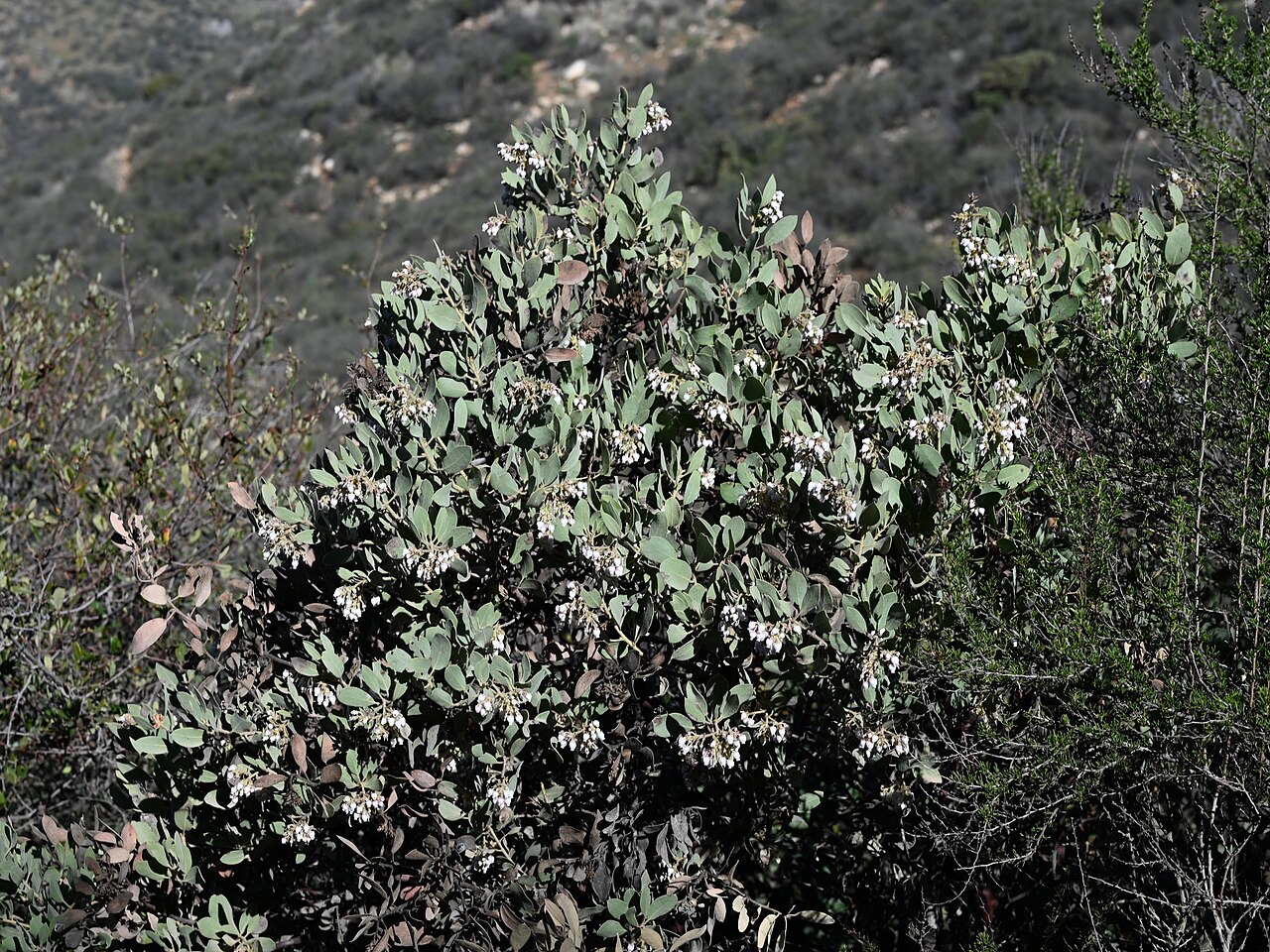
Arctostaphylos glauca, known as bigberry manzanita, is the largest and most tree-like of California’s many manzanitas, often towering over its chaparral neighbors as a small, gnarled evergreen tree with mahogany-red bark. A member of the heath family (Ericaceae), it earns its common name from its unusually large berries — nearly twice the size of those on most other California manzanitas — and its species name glauca, Latin for “gray” or “pale blue,” refers to the distinctive dusty, blue-gray cast of its foliage.
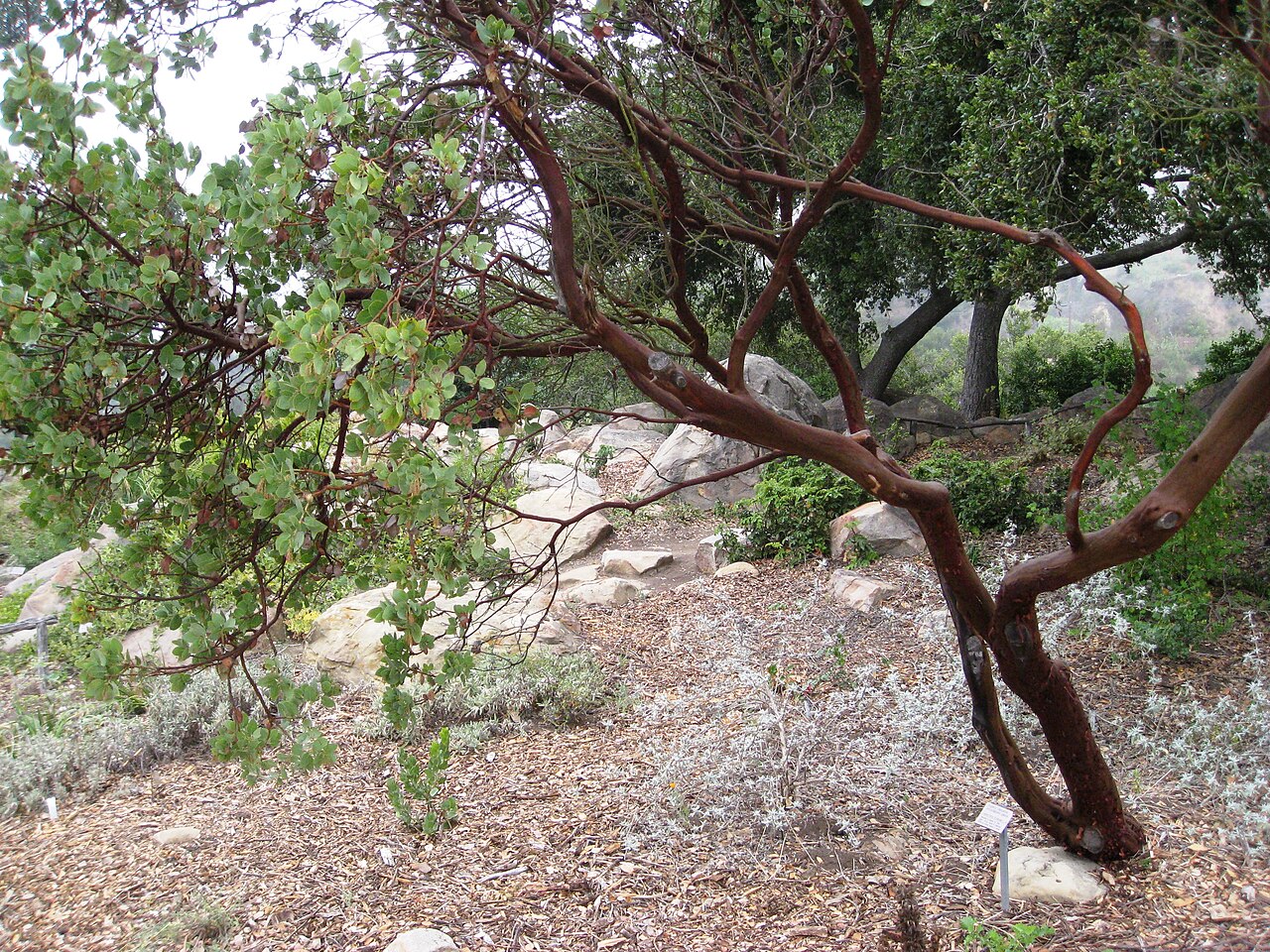
Bigberry manzanita is a defining species of cismontane Southern and Central California chaparral, often forming the tallest, most dominant shrub layer on dry, south-facing slopes where little else grows. Mature plants can reach 20 feet, developing the smooth, polished, deep red-purple bark and sculptural, twisting branch architecture that make manzanitas instantly recognizable even from a distance.
Long-lived and extremely drought-tolerant, bigberry manzanita asks almost nothing of a garden once established, rewarding patient gardeners with winter-to-spring flowers, striking year-round bark, and a magnet for hummingbirds and native bees. It is a slow grower compared to many chaparral shrubs, which is part of why specimens with real trunk character are so valued in native landscaping.
Identification
Bigberry manzanita grows as a large, rounded to irregular evergreen shrub or small tree, typically 6 to 20 feet tall, occasionally taller on favorable sites. Old specimens develop thick, twisted trunks and an open, picturesque branching structure that sets them apart from shrubbier manzanita species.
Bark & Stems
The bark is one of the species’ most striking features: smooth, polished, and deep mahogany-red to purplish-red on mature wood, peeling in thin curls to reveal fresh greenish bark beneath. Young twigs are often glandular-hairy and reddish, becoming smooth as they age. The sculptural, often leaning or twisting trunk form is prized by native-plant gardeners and bonsai enthusiasts alike.
Leaves
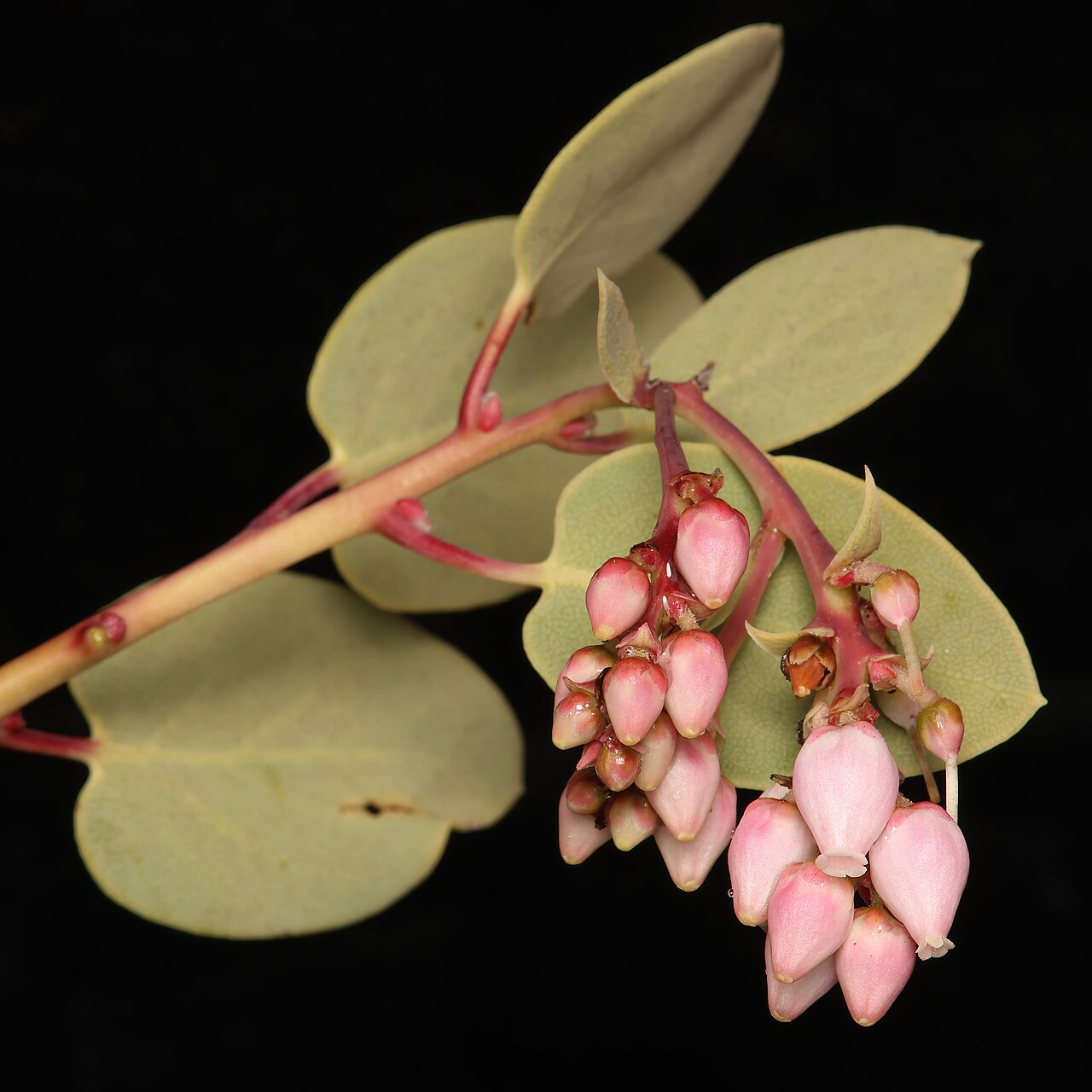
Leaves are evergreen, thick and leathery, oval to elliptic, 1 to 2 inches long, and distinctly pale blue-gray to gray-green — a waxy coating (glaucous bloom) gives the foliage its characteristic dusty appearance and helps reduce water loss in the dry chaparral summers. Leaves are arranged alternately and stand somewhat upright on the stem, an adaptation that reduces direct sun exposure at midday.
Flowers
Small, urn-shaped flowers, white to pale pink, bloom in drooping clusters (racemes) at the branch tips from December through March — among the earliest chaparral shrubs to flower each year. Each flower is about ¼ inch long with the classic upside-down-vase shape typical of the heath family, providing an essential nectar source for hummingbirds and native bees during the lean winter months.
Fruit & Seeds
The fruit is a sticky, berry-like drupe about ½ inch across — noticeably larger than the fruit of most other California manzanitas, hence the common name. Berries ripen from green to reddish-brown through summer and are an important food source for wildlife. The hard, bony seeds require scarification, usually from passing through an animal’s digestive tract or exposure to fire, to germinate.
Quick Facts
| Scientific Name | Arctostaphylos glauca |
| Family | Ericaceae (Heath) |
| Plant Type | Evergreen Shrub / Small Tree |
| Mature Height | 6–20 ft |
| Mature Spread | 8–15 ft |
| Growth Rate | Slow |
| Sun Exposure | Full Sun |
| Water Needs | Very Low once established |
| Soil Type | Rocky, sandy or decomposed granite; excellent drainage essential |
| Soil pH | 5.5–7.0 (acidic to neutral) |
| Bloom Time | December – March |
| Flower Color | White to pale pink |
| Fall Color | None (evergreen) |
| Fruit | Large reddish-brown berries, ~½ in |
| Deer Resistant | Yes, generally |
| USDA Hardiness Zones | 8–10 |
Native Range
Bigberry manzanita is native to California, where it ranges from Mount Diablo in the Bay Area south through the South Coast, Transverse, and Peninsular ranges to the Mexican border, continuing into the interior mountains of northern Baja California. It also reaches into the western foothills of the southern Sierra Nevada. Within this range it is one of the most conspicuous shrubs of cismontane chaparral, often dominating dry, rocky, south- and west-facing slopes below about 5,000 feet.
Bigberry manzanita typically grows alongside chamise, scrub oak, toyon, and other manzanita species in mixed chaparral, as well as in the understory and margins of oak woodland and closed-cone pine forest. It favors well-drained, often rocky or decomposed-granite soils and is notably intolerant of summer irrigation or heavy, poorly drained ground.
The species is not native to Nevada, Arizona, or any state outside California within the United States; its range extends south of the border only into northern Baja California, Mexico. Gardeners in those adjoining states should look to locally native manzanita species instead.
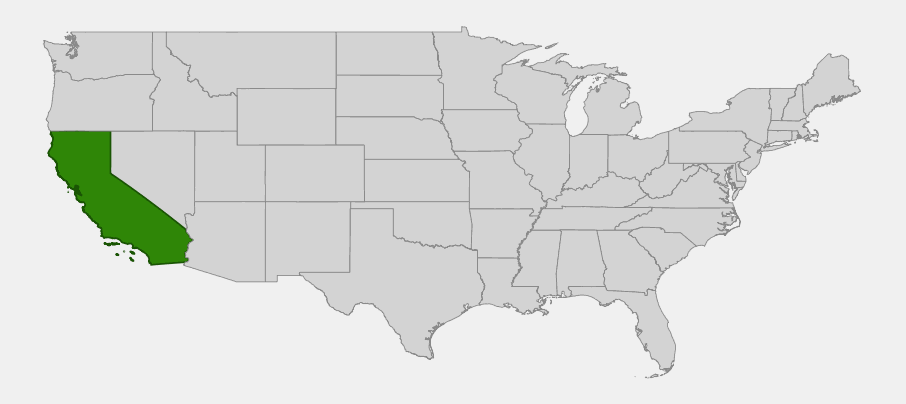
📋 Regional plant lists featuring bigberry manzanita: California and Nevada
Growing & Care Guide
Bigberry manzanita rewards a hands-off approach. It is a classic example of a chaparral native that struggles under conventional garden care and thrives when planted and essentially left alone.
Light
Full sun is essential. In its native habitat it grows on fully exposed slopes, and shaded garden sites tend to produce leggy, weak specimens prone to disease.
Soil & Water
Excellent drainage is the single most important requirement — rocky, sandy, or decomposed-granite soils mimic its native chaparral ground. Water deeply but infrequently the first year or two to establish roots, then stop supplemental irrigation almost entirely; mature bigberry manzanita is extremely sensitive to summer water and root-rot pathogens like Phytophthora, which are the most common cause of death in cultivation. If planted near a lawn or regularly irrigated bed, root rot is nearly guaranteed within a few years.
Planting Tips
Plant small container stock in fall, just before the rainy season begins — bigberry manzanita transplants poorly as larger specimens because of its sensitive root system. Choose a well-drained slope or raised area away from irrigated lawns and beds. Mulch lightly with coarse gravel or leaf litter rather than heavy wood chips, which can hold too much moisture against the root crown.
Pruning & Maintenance
Minimal pruning is best; remove only dead wood, and do so in late summer or fall when fungal disease pressure is lowest. Avoid cutting live wood, since manzanitas generally do not resprout well from major cuts. Given time and no supplemental water, mature plants develop the dramatic sculptural bark and form that make the species so prized.
Landscape Uses
Bigberry manzanita’s architectural form and toughness suit several garden roles:
- Specimen plant showcasing its red bark and sculptural branching
- Dry slope and erosion control on sites too steep or dry for turf
- Fire-wise, low-water landscaping in chaparral-adjacent communities
- Wildlife and pollinator gardens for winter hummingbird nectar
- Native chaparral restoration plantings
Wildlife & Ecological Value
As one of the largest and most widespread manzanitas in Southern and Central California chaparral, bigberry manzanita anchors food webs through a long season of bloom and fruit.
For Pollinators
Winter-to-spring flowering fills a critical gap when few other chaparral plants are in bloom, making bigberry manzanita an important early nectar source for native bees, bumblebees, and other pollinators emerging in late winter.
For Birds
Hummingbirds, including Anna’s hummingbird, rely heavily on manzanita flowers during the winter months when little else is blooming. The large berries that follow are eaten by a range of birds, including California thrashers, towhees, and scrub-jays, which help disperse the hard seeds across the landscape.
For Mammals
Coyotes, gray foxes, and black bears (where present) consume the berries, and the dense branching of mature shrubs provides cover and denning sites for smaller mammals. Mule deer occasionally browse the foliage, though established plants are generally considered deer-resistant.
Ecosystem Role
Bigberry manzanita is a foundational shrub of mature, long-unburned chaparral, where its large size and dense canopy create structural diversity and shade that supports understory species unable to tolerate full sun. Like other manzanitas, it is killed by fire (an “obligate seeder”) and depends on fire-scarified or animal-scarified seed to regenerate, making it both a casualty and a beneficiary of the chaparral fire cycle over the long term.
Cultural & Historical Uses
Indigenous peoples throughout bigberry manzanita’s range, including Chumash, Tongva, and Cahuilla communities, gathered the ripe berries as a food source, most often soaking or grinding them to make a tart, cider-like beverage, since the raw fruit is mealy and astringent. The berries were also dried and stored for later use, and the hard wood was occasionally worked into small tools and implements given its density and durability.
Manzanita — Spanish for “little apple” — is a name settlers gave broadly to this genus for the apple-like look of the fruit, and bigberry manzanita’s unusually large berries made it a recognizable namesake species among early California botanists and ranchers. This page does not describe any medicinal use of the plant; historical food use by Indigenous communities is noted here as cultural history rather than a dietary recommendation.
Today bigberry manzanita is valued chiefly for restoration and native landscaping, prized in particular for the dramatic, long-lived bark and form that only develop after years of slow, undisturbed growth — qualities that have made older specimens something of a status plant among California native-garden enthusiasts.
Frequently Asked Questions
Why does my bigberry manzanita keep dying after a year or two?
The most common cause is summer irrigation. Bigberry manzanita is adapted to bone-dry chaparral summers, and regular watering — especially near the root crown — invites root-rot fungi that quickly kill the plant. Water deeply only to establish the plant, then stop.
How big do bigberry manzanita berries actually get?
About ½ inch across, noticeably larger than the berries of most other California manzanita species, which is the origin of the common name. They ripen from green to reddish-brown over summer.
Is bigberry manzanita native to Arizona or Nevada?
No. It is native only to California and northern Baja California, Mexico. Gardeners in Arizona or Nevada should choose a manzanita species native to their own region instead.
How long does it take for the bark to turn red?
The dramatic deep red-purple bark develops gradually as stems mature, typically becoming prominent after several years of growth. Because the species is slow-growing, patience is part of the reward — older, undisturbed plants have the most striking bark.
Do hummingbirds really visit manzanita flowers in winter?
Yes. Bigberry manzanita blooms from December through March, exactly when few other California natives are flowering, making it one of the most important winter nectar sources for resident hummingbirds like Anna’s hummingbird.

Looking for a nursery that carries bigberry manzanita?
Browse our native plant nursery directory: California