Cardinal Flower (Lobelia cardinalis)
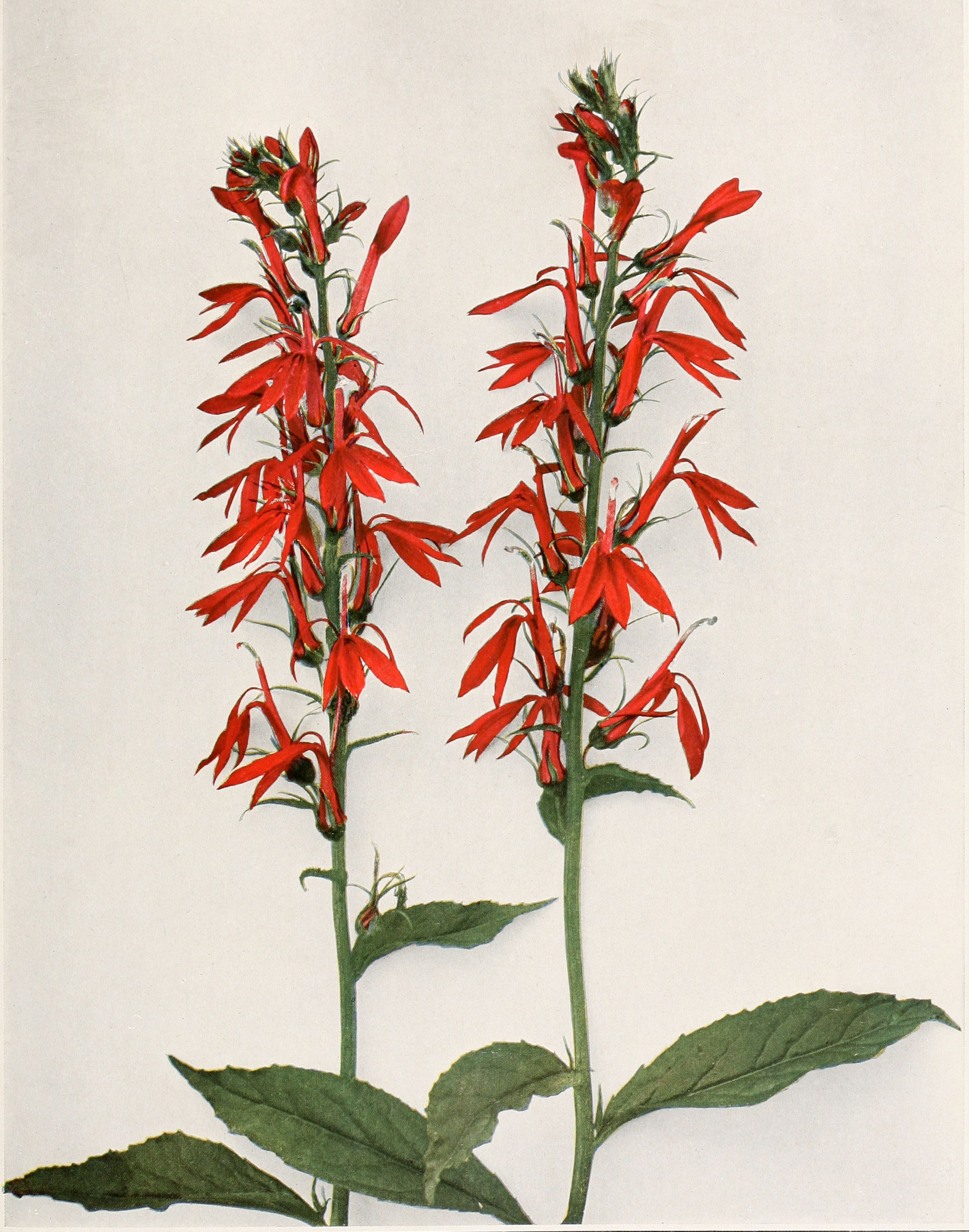
Lobelia cardinalis, commonly known as Cardinal Flower, stands among the most dramatically beautiful native wildflowers of North America. Its intensely brilliant scarlet-red flower spikes — produced from July through September — are among the most vivid colors found anywhere in the native plant world, instantly drawing the eye and creating stunning focal points in moist garden borders, stream edges, and rain gardens. The color is so vivid and so saturated that it almost appears artificial, yet every bit of it is natural and serves the critical purpose of attracting the plant’s primary pollinator: the Ruby-throated Hummingbird.
A native herbaceous perennial of the Campanulaceae (bellflower) family, Cardinal Flower grows 2 to 4 feet tall in moist to wet habitats across eastern and central North America, from New Brunswick and Quebec south to Florida and west to New Mexico and Colorado. In Kentucky and Tennessee, it is a characteristic wildflower of stream banks, seep springs, wet meadows, and moist forest margins, blooming in the heat of late summer when few other native plants provide such intense floral color.
Beyond its extraordinary ornamental value, Cardinal Flower plays a critical ecological role as a primary nectar source for Ruby-throated Hummingbirds during their southward fall migration. The plant’s distinctive long, narrow floral tube has co-evolved with the hummingbird’s slender bill, creating a near-exclusive pollination partnership. Butterflies including swallowtails and sphinx moths also visit the flowers, but hummingbirds are by far the dominant and most effective pollinators of this iconic native species.
Identification
Cardinal Flower is one of the easiest native wildflowers to identify when in bloom — the brilliant scarlet flower spikes are unmistakable. Out of bloom, the plant is more easily confused with other lobelia species, but the rosette form, reddish-tinged stems, and habitat preferences help with identification.
Leaves & Stems
The stems are erect, unbranched or rarely branched, and 2 to 4 feet tall, often with a reddish tinge particularly toward the base. The milky sap is mildly irritating to skin. Leaves are alternate, lance-shaped to ovate, 2 to 6 inches long, with irregularly toothed margins. The leaves are dark green above, paler below, and often have a slight reddish cast on the undersides and along the veins, especially in full sun. Basal leaves form a rosette that overwinters and provides the following year’s new growth. The plant may form small colonies over time through basal offsets and self-seeding.
Flowers
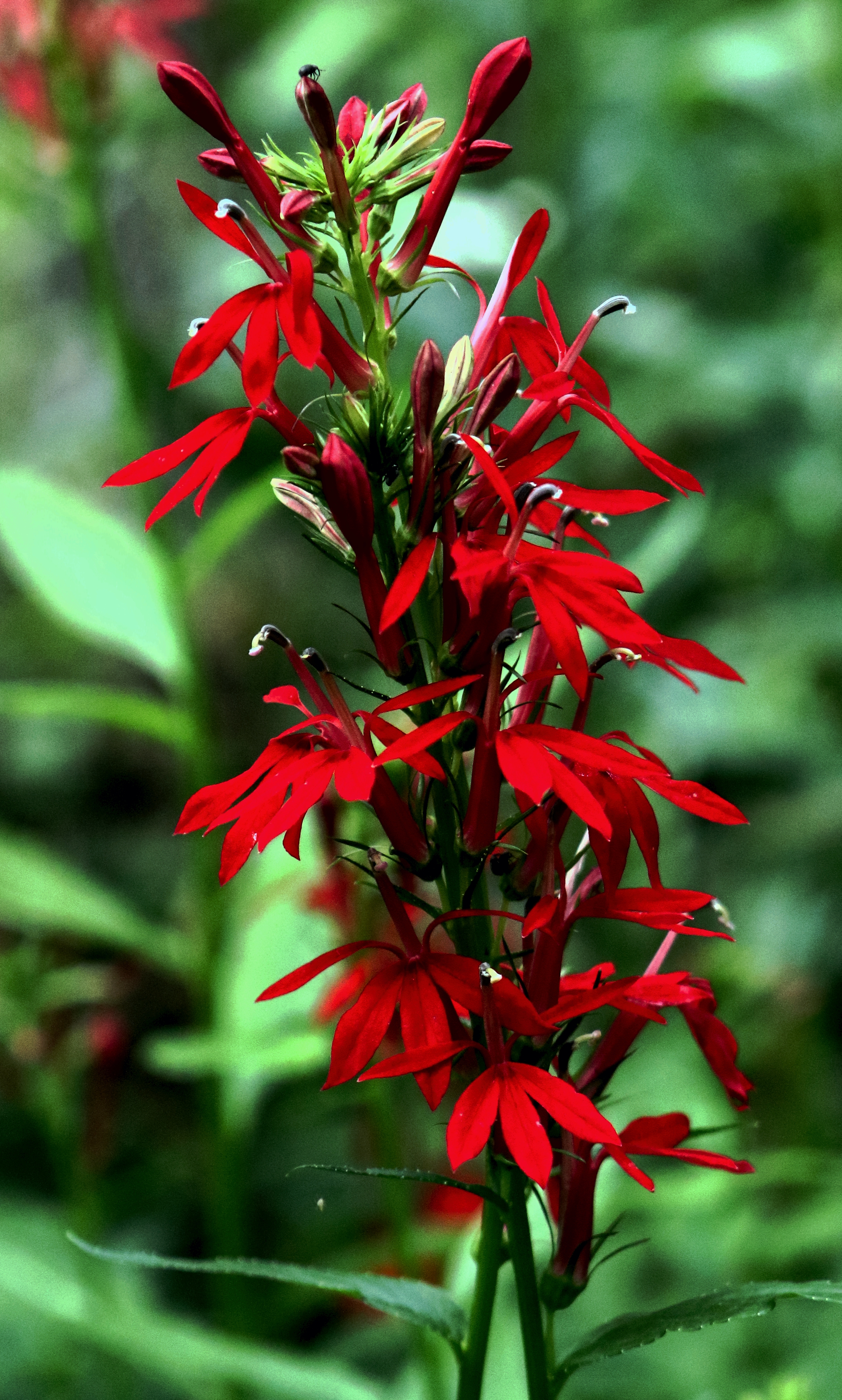
The flowers are the plant’s defining feature — they are produced in dense terminal racemes (spikes) from late July through early September. Each individual flower is about 1 to 1½ inches long with a distinctive two-lipped structure: the two upper petals are narrow and erect; the three lower petals are broader and spread outward. The entire flower is a brilliant, intense scarlet-red, occasionally white or pink in rare forms. The reproductive parts (staminal column) protrude conspicuously from the upper lip. In Kentucky and Tennessee, peak bloom typically occurs in August.
Quick Facts
| Scientific Name | Lobelia cardinalis |
| Family | Campanulaceae (Bellflower) |
| Plant Type | Herbaceous Perennial |
| Mature Height | 2–4 ft |
| Sun Exposure | Full Sun to Part Shade |
| Water Needs | Moderate to High |
| Bloom Time | July – September |
| Flower Color | Brilliant scarlet-red (rarely white or pink) |
| Attracts | Hummingbirds, swallowtail butterflies, sphinx moths |
| Deer Resistant | Generally yes (mildly toxic, unpalatable to deer) |
| USDA Hardiness Zones | 3–9 |
Native Range
Cardinal Flower is one of the most widely distributed native wildflowers in North America, found from New Brunswick and southern Quebec across the continent to California and south to Florida and northern Mexico. Its extraordinary range encompasses nearly all of the eastern and central United States as well as parts of the Southwest and Pacific states. In Kentucky and Tennessee, it is a native plant of stream banks, seep springs, wet meadow margins, and moist forest clearings throughout both states.
Within its range, Cardinal Flower is strongly associated with consistently moist or wet habitats, particularly along stream banks where periodic flooding ensures constant soil moisture. It grows in both full sun and partial shade, reaching its greatest abundance in sunny, moist stream margins and seep areas. In Tennessee, it is especially common in the Cumberland Plateau, Highland Rim, and Blue Ridge regions; in Kentucky, it occurs statewide wherever suitable moist habitats exist.
Despite its wide range, Cardinal Flower is not always common — it requires consistently moist conditions and can disappear from sites that experience drought or habitat alteration. It is considered a good indicator of high-quality, minimally-disturbed riparian habitats.
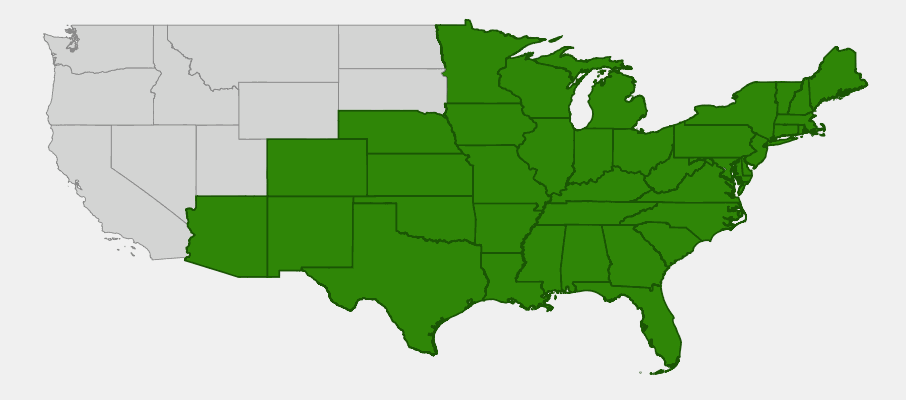
📋 Regional plant lists featuring Cardinal Flower: Kentucky & Tennessee
Growing & Care Guide
Cardinal Flower is easy to grow when its key requirement — consistent moisture — is met. In moist, partially shaded conditions, it naturalizes readily and can become one of the most spectacular plants in the garden during its long late-summer bloom period.
Light
Cardinal Flower grows in full sun to part shade, with best flowering in full sun or light shade. In Kentucky and Tennessee’s hot summers, afternoon shade reduces heat stress and extends the bloom period. In consistently wet sites such as rain gardens or stream edges, it tolerates and even thrives in full sun. In shadier spots, it may lean toward light and produce fewer but still beautiful blooms.
Soil & Water
This is a moisture-loving plant — the single most important cultural requirement is consistent moisture. Cardinal Flower thrives in permanently moist to wet soils and will grow right at the water’s edge in shallow standing water. It tolerates clay soils well, provided they stay moist. In typical garden beds, regular irrigation is essential, especially during the dry late-summer bloom period. Mulch heavily to retain moisture. Do not plant in dry soils or drought-prone locations.
Planting Tips
Plant in spring or fall, spacing plants 18 to 24 inches apart for a natural colony effect. Cardinal Flower is somewhat short-lived (2–4 years) but self-seeds freely in moist conditions, effectively naturalizing in suitable habitats. Collect and scatter seed on bare, moist soil in fall to encourage establishment. The basal rosette overwinters and produces new stems each spring. It also spreads by basal offsets — small plantlets that form around the base of older plants and can be divided in early spring.
Pruning & Maintenance
No pruning is required. Allow spent flower stalks to set seed, as self-seeding ensures the colony’s continuity. Cut dead stalks to the ground in late winter. Avoid heavy mulching over the basal rosettes, which need some light to persist through winter. In especially cold winters, a light mulch of shredded leaves over the rosette provides protection without smothering it.
Landscape Uses
- Rain gardens — thrives in the wet zone and provides outstanding late-summer color
- Stream & pond edges — a classic riparian wildflower for moist margins
- Hummingbird gardens — an absolute must-have for attracting Ruby-throated Hummingbirds
- Butterfly gardens — attracts Eastern Tiger Swallowtails and sphinx moths
- Wet meadows & bog gardens — thrives in the moist margins of naturalistic plantings
- Cut flowers — the scarlet spikes make dramatic fresh-cut arrangements
Wildlife & Ecological Value
Cardinal Flower is one of the most ecologically important native wildflowers for hummingbirds in eastern North America, and its value to pollinators and other wildlife is extraordinary.
For Birds
The Ruby-throated Hummingbird is the primary pollinator and the animal most strongly associated with Cardinal Flower. The co-evolutionary relationship is remarkable: the flower’s brilliant scarlet color, long tubular shape, and abundant nectar are specifically adapted to attract and be pollinated by hummingbirds. During fall migration, Cardinal Flower blooms coincide perfectly with southward-migrating hummingbird populations, providing a critical nectar source. Other hummingbirds including the Rufous Hummingbird also visit when present. The seeds are also eaten by small finches and sparrows.
For Mammals
White-tailed deer generally avoid Cardinal Flower — all parts of the plant contain toxic alkaloids (lobelamine, lobeline) that make it unpalatable and potentially harmful. This natural deer resistance is a significant practical advantage in gardens where deer pressure is high.
For Pollinators
In addition to hummingbirds, Cardinal Flower is visited by large bumblebees (which can reach the nectar), Eastern Tiger Swallowtails, Spicebush Swallowtails, and several sphinx moth species. The latter, being long-tongued, can access the nectar tube effectively. Short-tongued bees typically cannot reach the nectar but may gather pollen from accessible stamens.
Ecosystem Role
Cardinal Flower is an important structural component of moist, late-summer wildflower communities. Its late bloom time (July–September) fills a critical gap in the nectar calendar when many spring and early-summer flowers have finished. The plant’s association with moist habitats makes it a reliable indicator of high-quality riparian areas. As a perennial, it contributes organic matter to riparian soils and helps stabilize stream banks through its fibrous root system.
Cultural & Historical Uses
Cardinal Flower has a long history in both Indigenous medicine and European-American herbal practice. Several Native American nations recognized its potent medicinal properties — and its potential toxicity. The Cherokee used root preparations to treat typhoid fever and other serious illnesses; the Iroquois used it in treatments for venereal disease and as part of complex ceremonial medicine. The Meskwaki reportedly used it in love magic. These uses reflect a sophisticated understanding of the plant’s powerful alkaloid chemistry.
Early European settlers in North America quickly recognized Cardinal Flower as a plant of striking beauty, and it was among the first American wildflowers sent to Europe for botanical gardens. John Tradescant the Younger brought specimens to England in the 1630s, and it was widely cultivated in European gardens throughout the 17th and 18th centuries, where it caused a sensation with its extraordinary color.
Today, Cardinal Flower is widely available as a native ornamental and is featured in countless rain garden and wildlife habitat plantings across eastern North America. Several cultivated varieties have been developed, including white-flowered and rose-pink forms, as well as hybrids with the closely related Great Blue Lobelia (Lobelia siphilitica). However, the original wild-type scarlet form remains by far the most ecologically valuable and visually spectacular selection for Kentucky and Tennessee native gardens.
Frequently Asked Questions
Is Cardinal Flower toxic?
Yes — Cardinal Flower contains alkaloids including lobeline and lobelamine that are toxic to humans, livestock, and most mammals if ingested. It should not be eaten. Skin contact with the milky sap may cause irritation in sensitive individuals. Keep away from children. Despite its toxicity to mammals, it is an excellent choice for gardens with deer pressure, as deer generally avoid it.
How long does Cardinal Flower live?
Individual plants are relatively short-lived, typically 2–4 years. However, the species is long-persistent in suitable habitats because it self-seeds freely and spreads by basal offsets. Allow some plants to set seed and scatter naturally for a self-renewing colony. In consistently moist conditions, a well-established planting will maintain itself indefinitely.
Can Cardinal Flower grow in a container?
Yes, with dedication to watering. Container-grown Cardinal Flower requires a large pot (at least 12 inches wide and deep) and must never be allowed to dry out — standing the container in a saucer of water helps maintain the constant moisture the plant needs. It does well in water garden containers at pond edges.
What is the difference between Cardinal Flower and Great Blue Lobelia?
The two species are closely related and share similar growing requirements. Cardinal Flower (Lobelia cardinalis) has brilliant scarlet-red flowers and primarily attracts hummingbirds. Great Blue Lobelia (L. siphilitica) has blue-purple flowers and primarily attracts bumblebees. They bloom at similar times, hybridize naturally where they co-occur, and make excellent companion plants in the native garden.
Why is Cardinal Flower dying back after blooming?
Cardinal Flower is monocarpic on the stem level — individual stems die after flowering and setting seed. This is normal! The parent plant produces basal offsets (small rosettes at the base) before or after flowering. These rosettes overwinter and produce the next year’s bloom stalks. The key is to not remove the entire plant after it blooms — leave the basal rosettes in place, as these are the next generation of plants.