Desert Rose-mallow (Hibiscus coulteri)
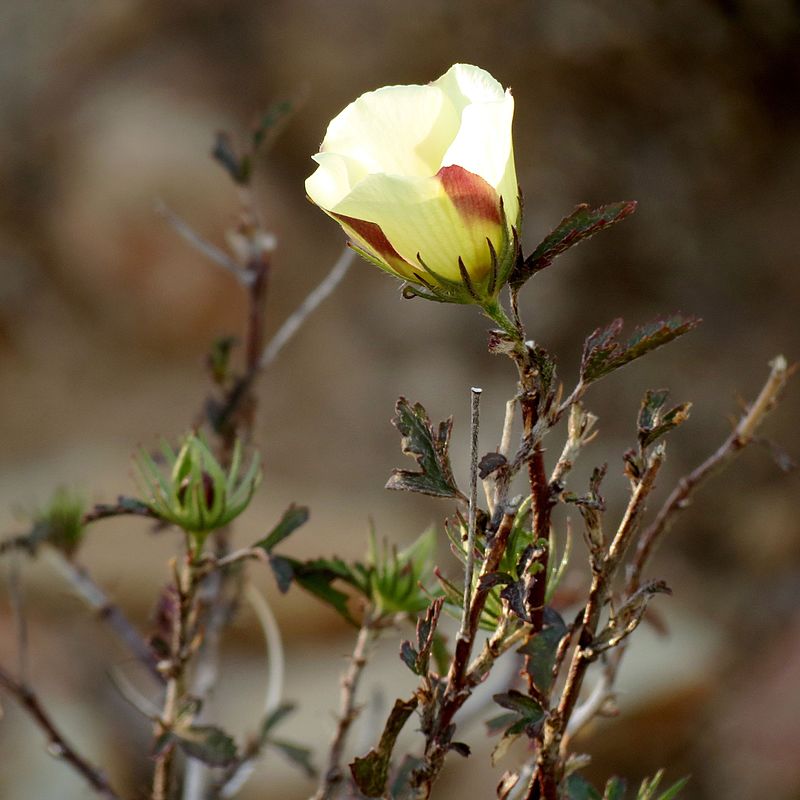
Hibiscus coulteri, the Desert Rose-mallow, is a slender, graceful native shrub that produces some of the most elegant flowers in the Sonoran Desert flora. A member of the Malvaceae (mallow) family, this perennial subshrub thrives in rocky canyons and beneath the dappled shade of larger desert shrubs and trees — a surprising preference for a plant in such an arid environment. Its large, hollyhock-like flowers are creamy white to pale yellow with a dramatic dark maroon center, creating a stunning contrast that draws the eye and benefits pollinators in the desert understory where few other showy blooms appear.
Growing to about 3 feet in height, Desert Rose-mallow has a delicate, airy structure with slender stems and deeply lobed gray-green leaves. It is found in rocky canyons, hillsides, and among desert shrubs from southern Arizona through New Mexico and into Texas, typically occurring at elevations below 4,000 feet in the Sonoran and Chihuahuan desert zones. Its tolerance for growing beneath nurse plants — palo verde trees, ironwoods, large saguaros — makes it particularly valuable in shaded garden spots that challenge most desert natives.
For native plant gardeners in the low desert, Desert Rose-mallow offers something rare: a flowering shrub that actually prefers some shade and is well-suited to those challenging spots beneath established desert trees. Its flowers appear for an extended season from late spring through fall, providing consistent nectar for hummingbirds, native bees, and butterflies throughout the warm months. Drought tolerant and caliche-tolerant, this lovely native is easy to grow once established in the right spot.
Identification
Desert Rose-mallow is recognized by its combination of deeply lobed, gray-green leaves, slender branching stems, and the distinctive large, bowl-shaped flowers with a dark maroon center eye. It is a small subshrub — woody at the base but with more herbaceous upper stems — that typically grows 2 to 3 feet tall and wide.
Stems & Leaves
The stems are slender and sparingly branched, covered with fine, star-shaped (stellate) hairs that give them a gray-green to whitish appearance. Leaves are alternate, 1 to 3 inches long, and deeply 3- to 5-lobed in a palmate pattern, resembling a miniature hollyhock or maple leaf. The leaf margins are irregularly toothed, and both leaf surfaces bear fine stellate pubescence characteristic of the mallow family. Leaves are aromatic when crushed with a faint, pleasant fragrance.
Flowers & Fruit
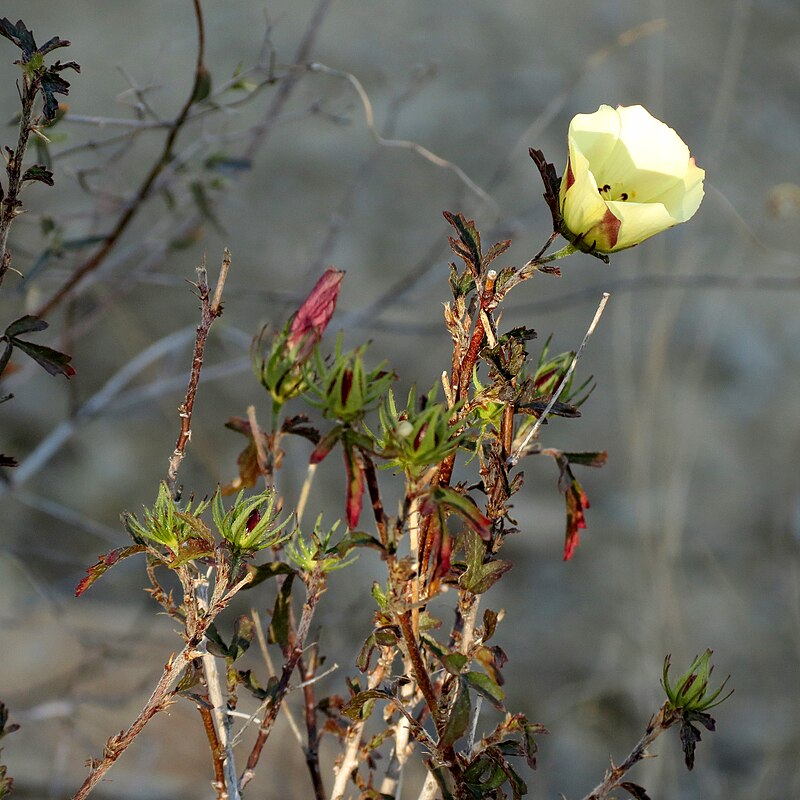
The flowers are the plant’s glory: large (2–3 inches in diameter) for such a small shrub, with 5 broad, overlapping petals that are creamy white to pale yellow with a striking dark maroon to deep burgundy basal spot on each petal, creating a prominent central eye. The numerous stamens are united into a column (a characteristic mallow feature) with a five-parted stigma extending beyond. Flowers open in morning, lasting through the day, and new blooms appear continuously from March through October. The fruit is a round, 5-celled capsule containing kidney-shaped seeds.
Quick Facts
| Scientific Name | Hibiscus coulteri |
| Family | Malvaceae (Mallow) |
| Plant Type | Perennial Subshrub |
| Mature Height | 3 ft |
| Sun Exposure | Full Sun |
| Water Needs | Low (Drought Tolerant) |
| Bloom Time | March – October |
| Flower Color | White to pale yellow with dark maroon center |
| Notes | Nice blossoms. Grows well under larger shrubs. |
| USDA Hardiness Zones | 8–11 |
Native Range
Desert Rose-mallow has a relatively restricted native range centered on the Chihuahuan and Sonoran desert regions of the American Southwest and adjacent northern Mexico. In the United States, it occurs in southern and central Arizona, southern New Mexico, and the Big Bend region of southwestern Texas — all characterized by hot, dry desert or desert-grassland climates with mild winters and intense summer monsoon rains.
Within Arizona, Desert Rose-mallow is most commonly encountered on the rocky lower mountain slopes, canyon walls, and bajadas of the Sonoran Desert uplands, typically below 4,000 feet elevation. It shows a preference for rocky, well-drained substrates — granitic slopes, limestone outcroppings, and canyon walls where drainage is excellent and competition from grasses is reduced. Its habit of growing beneath larger shrubs and trees reflects its preference for the light shade and somewhat moister, more protected microhabitat found under desert nurse plants.
The species extends south into Sonora, Chihuahua, and Baja California, Mexico, where it inhabits similar rocky desert hillside habitats. Its overall distribution reflects the extent of the Chihuahuan Desert and Sonoran Desert biomes — two of North America’s most biodiverse hot desert ecosystems.
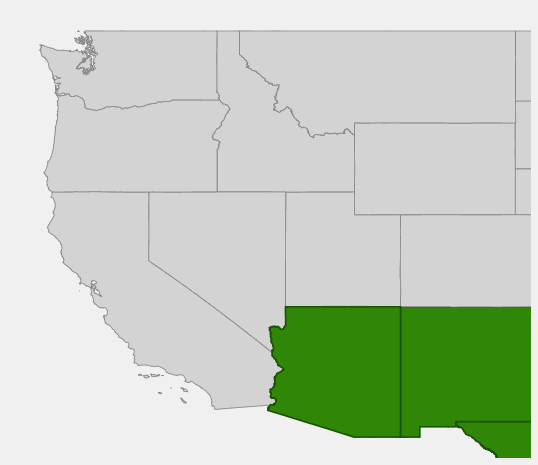
📋 Regional plant lists featuring Desert Rose-mallow: Arizona
Growing & Care Guide
Desert Rose-mallow is a rewarding plant for gardeners who understand its preferences. Unlike most desert natives that demand full, unobstructed sun, this species is a true understory plant that performs best with filtered light — making it perfect for those challenging shaded spots in the desert garden.
Light
While classified as a full-sun plant in some references, Desert Rose-mallow in Arizona’s intense low-desert environment benefits significantly from afternoon shade or filtered light beneath taller shrubs. Plant it on the north or east side of larger desert shrubs, under the canopy of a palo verde or ironwood tree, or in any location that receives morning sun with shade during the hottest afternoon hours. This replicates its natural habitat of growing beneath desert nurse plants.
Soil & Water
Desert Rose-mallow is highly drought tolerant once established, requiring minimal supplemental water. It strongly prefers rocky, well-drained soils — clay soils with poor drainage are the primary problem for this plant. Sandy or gravelly desert soils are ideal. Young plants benefit from weekly watering during summer months until roots are established. Established plants in Tucson and similar climates often survive on monsoon rainfall alone, though occasional deep soakings during dry spring months promote better flowering.
Planting Tips
Plant Desert Rose-mallow in fall or early spring for best establishment. Deliberately place it beneath or adjacent to an established desert nurse plant — ironwood, palo verde, desert hackberry — to replicate its natural growing conditions. Amend extremely heavy clay soils with coarse gravel to improve drainage. Container plants transplant well; avoid disturbing the root system. Space plants 3 to 4 feet apart.
Pruning & Maintenance
Light pruning in early spring encourages compact, bushy growth and abundant flowering. Remove dead or frost-damaged stems as needed. In mild winters, plants may retain some leaves; in colder zones, they may die back to the base and resprout. Provide a light mulch layer around the root zone to protect crowns from hard freezes. This is a naturally short-lived perennial (3–5 years); allow it to self-seed to maintain a colony in the garden.
Landscape Uses
- Understory planting beneath desert trees and large shrubs
- Rocky slope accent — thrives in well-drained rocky conditions
- Hummingbird garden — flowers attract Costa’s and Anna’s Hummingbirds
- Native butterfly garden — supports mallow-specialist butterflies
- Desert restoration — excellent for rocky bajadas and canyon walls
Wildlife & Ecological Value
Desert Rose-mallow’s large, accessible flowers and extended bloom season make it one of the more wildlife-valuable native plants for its size in the Sonoran Desert ecosystem.
For Birds
Hummingbirds, particularly Costa’s Hummingbird and Anna’s Hummingbird, visit the large tubular flowers regularly for nectar. The plant’s seeds are consumed by small sparrows and finches in the desert understory. During summer, the foliage supports caterpillars and insects that become critical protein sources for nesting birds feeding chicks.
For Mammals
White-tailed deer browse the foliage, particularly in dry seasons when other vegetation is scarce. The seeds may be consumed by small desert rodents. The plant’s woody base provides protected nesting sites for lizards and small invertebrates that form part of the desert food web.
For Pollinators
Desert Rose-mallow is an outstanding pollinator plant. Its large, open flowers are accessible to many bee species, including large carpenter bees (Xylocopa spp.) that are among its most important pollinators. Specialist mallow bees (Diadasia spp.) collect pollen almost exclusively from plants in the mallow family and are frequently observed on Desert Rose-mallow blooms. Painted lady butterflies and other large butterflies nectar at the flowers throughout the bloom season.
Ecosystem Role
As an understory specialist in the desert ecosystem, Desert Rose-mallow fills an important niche — providing flowering resources in the shaded microhabitat beneath desert trees where few other flowering plants thrive. This makes it particularly valuable during periods when sun-loving plants are dormant or heat-stressed. Its roots help stabilize rocky slopes, and its leaf litter contributes to the thin but critical organic layer in desert soils.
Cultural & Historical Uses
Desert Rose-mallow was known to Indigenous peoples of the Sonoran Desert region, including the Tohono O’odham (Papago) and Seri peoples, primarily as a medicinal plant. The mucilaginous properties characteristic of the mallow family — produced by polysaccharides in the leaves, flowers, and roots — were used to soothe irritated membranes, treat skin conditions, and as a gentle topical remedy for minor wounds and inflammation. The roots of various hibiscus species have been used across cultures for their emollient and soothing properties.
The beautiful flowers of Desert Rose-mallow have long been admired by both Indigenous peoples and later European botanists exploring the Sonoran Desert. The species was named in honor of Thomas Coulter (1793–1843), an Irish botanist and physician who explored Mexico and California in the 1820s and 1830s, collecting extensive botanical specimens throughout the region. Coulter sent specimens to William Jackson Hooker at Kew Gardens, who formally described many new species from the Southwest from Coulter’s collections.
In contemporary horticulture, Desert Rose-mallow has gained recognition as a valuable ornamental for xeriscape and native plant gardens in the Desert Southwest. Its shade tolerance, extended bloom season, and stunning flowers make it increasingly sought after from native plant nurseries. Conservation gardeners value it as part of desert restoration plantings, where it helps recreate the complex understory structure of natural desert communities that has been degraded by urban development and invasive grass-driven fires.
Frequently Asked Questions
How is Desert Rose-mallow different from Globe Mallow?
Desert Rose-mallow (Hibiscus coulteri) has larger, showier flowers (2–3 inches) that are white or pale yellow with a dark maroon center. Globe Mallow (Sphaeralcea spp.) has smaller (about 1 inch), cup-shaped flowers that come in orange, pink, red, or lavender. Desert Rose-mallow also prefers partial shade, while Globe Mallow requires full sun. The two are both in the mallow family but are in different genera.
Can Desert Rose-mallow handle cold temperatures?
Desert Rose-mallow is hardy in USDA Zones 8–11. It can handle light frost but may be damaged by hard freezes below 25°F (−4°C). In Zone 8 areas, protect the crown with mulch during winter, and expect plants to resprout from the base even if top growth is killed. In Zone 9 and warmer, it is essentially evergreen in mild winters.
Why is my Desert Rose-mallow not flowering?
Insufficient light is the most common cause of poor flowering. While this plant tolerates more shade than most desert natives, it still needs 4–6 hours of direct sun daily to flower well. Also check that soil drainage is good — waterlogged soil drastically reduces vigor and bloom production.
How do I propagate Desert Rose-mallow?
The easiest method is from seed. Collect seeds when capsules turn brown and begin to split. Scarify seeds lightly with sandpaper or soak in warm water overnight before planting. Direct sow outdoors in fall or start in containers in late winter. Stem cuttings taken in late spring can also root successfully with bottom heat and mist.
Does Desert Rose-mallow attract hummingbirds?
Yes — the large, white flowers with their dark center guides are attractive to Costa’s Hummingbirds and Anna’s Hummingbirds, both common in southern Arizona gardens. The extended bloom season from March through October provides consistent hummingbird support throughout the year in Arizona.

Looking for a nursery that carries Desert Rose-mallow?
Browse our native plant nursery directory: Arizona