
Dwarf Birch (Betula nana)
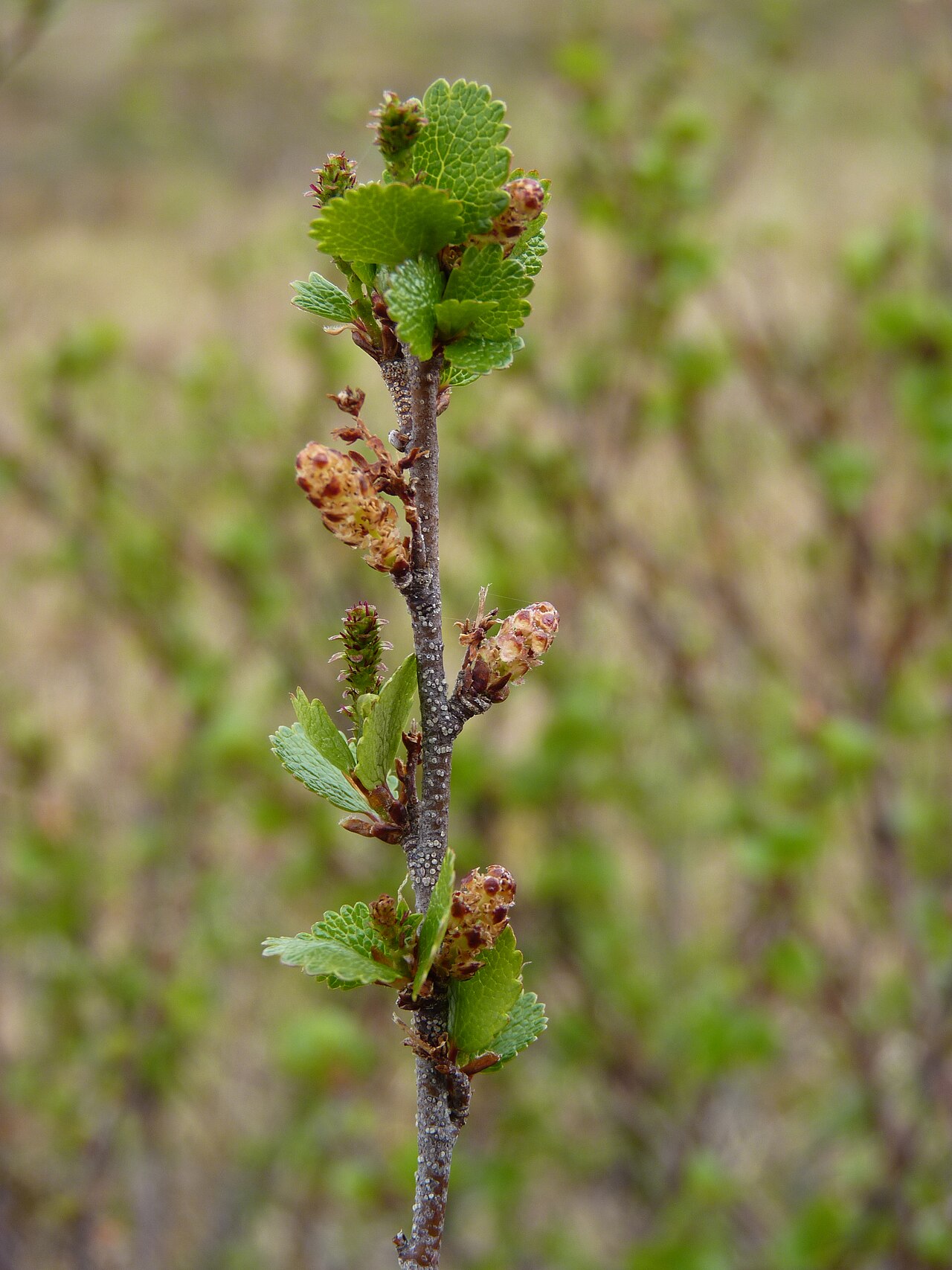
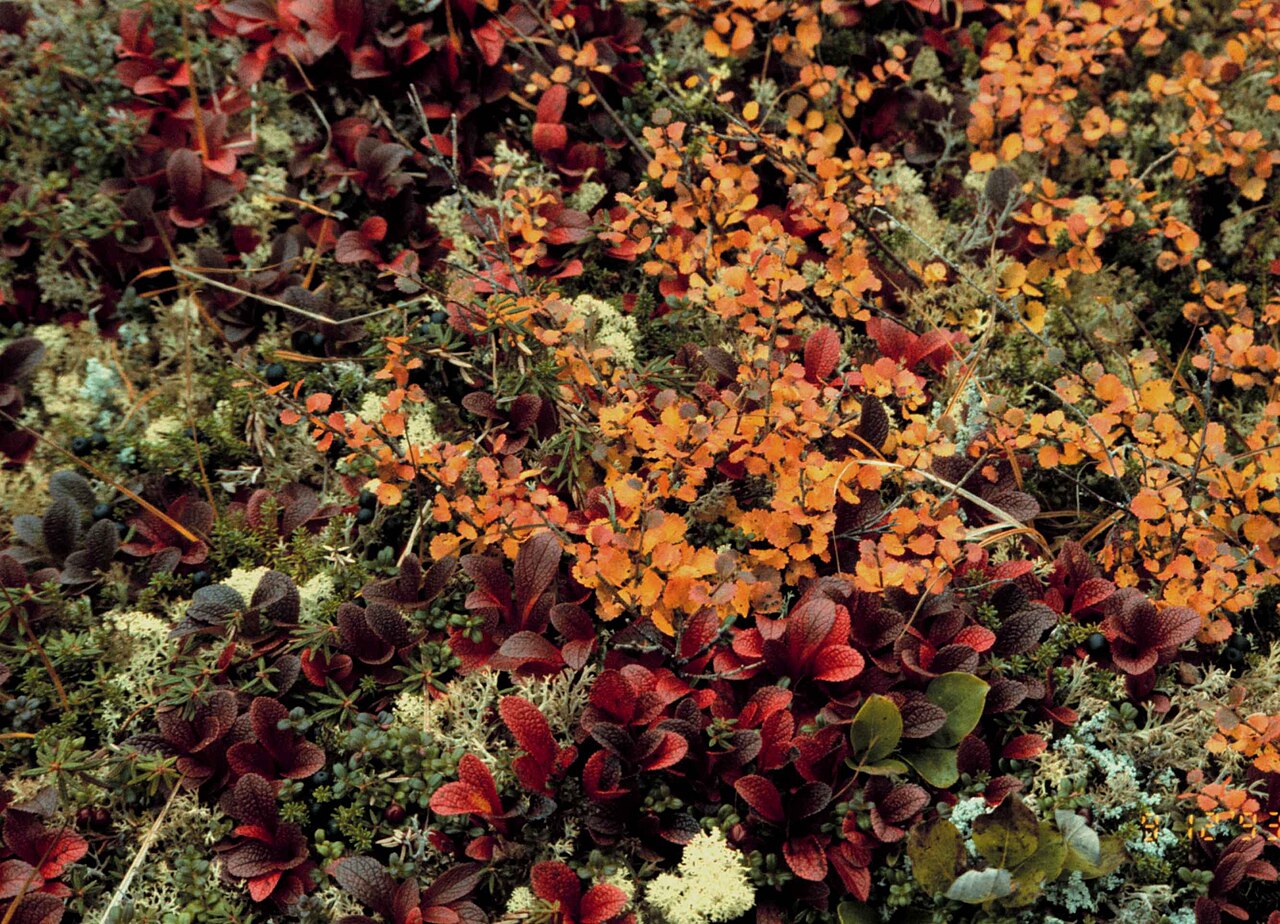
Betula nana, known as Dwarf Birch or Arctic dwarf birch, is the smallest birch in North America and one of the defining shrubs of the far north. It is a low, sprawling to upright deciduous shrub of the birch family (Betulaceae), rarely more than 3 feet (1 m) tall, with tiny, coin-round leaves edged in rounded teeth. Across Alaska it carpets wet tundra, bog margins and open mountain slopes, and in autumn whole hillsides turn orange and brick red with its foliage. It is circumpolar, ranging from Scotland and Scandinavia across Siberia into Alaska, northern Canada and Greenland.
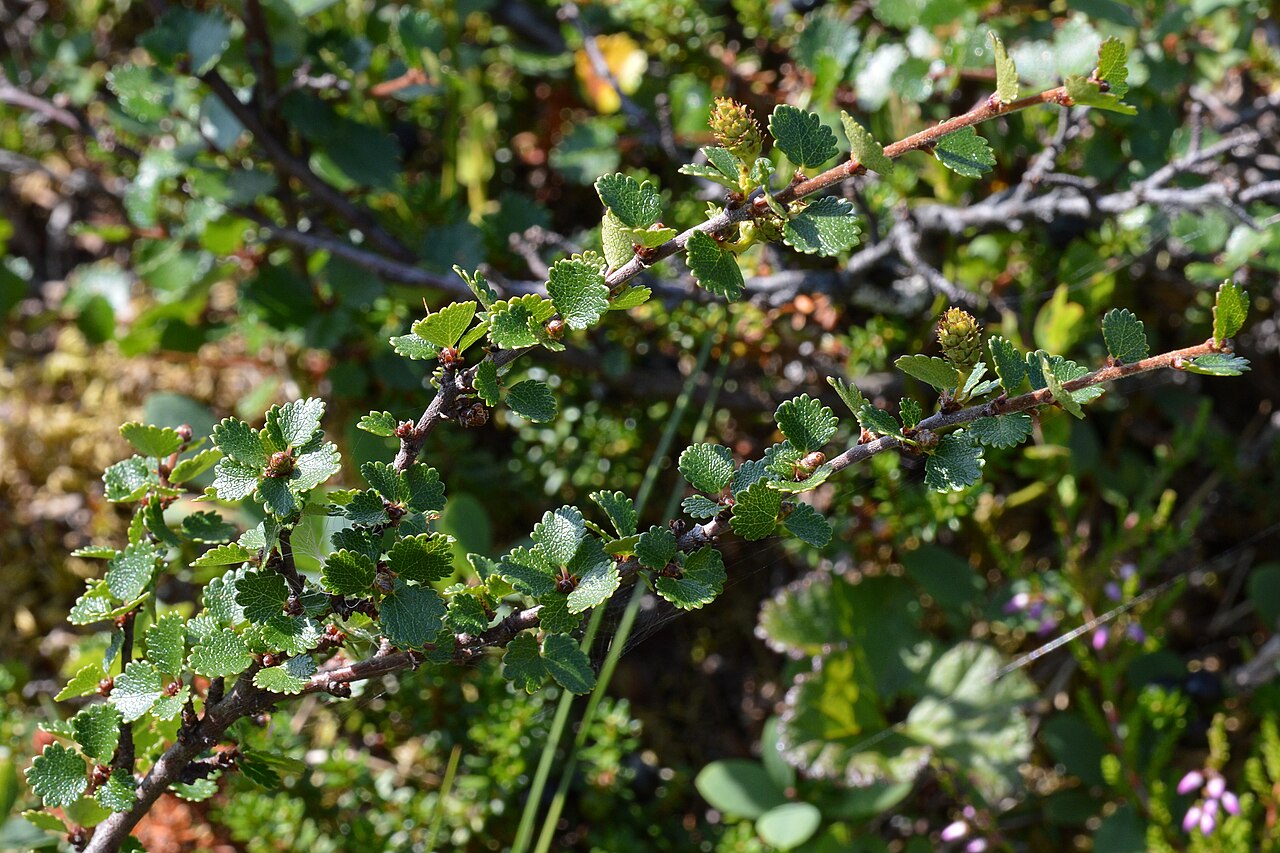
The North American plants belong mostly to subspecies exilis, which has hairless, heavily resin-coated twigs and ranges from northern Asia through Alaska, Yukon and the western Canadian Arctic. The Flora of North America (FNA) places the hairy-twigged subspecies nana in the eastern Arctic and Greenland. Dwarf birch is easily confused with its close relative Resin Birch (B. glandulosa), and several botanists have combined the two. Where their ranges meet, they hybridize freely and produce a confusing set of intermediates. FNA follows Eric Hultén’s view that they are separate species. Dwarf birch usually has smaller, rounder leaves with teeth running all the way to the base, while resin birch leaves are mostly untoothed near the base.
This guide is mainly for Alaskan gardeners, restoration crews and northern naturalists. Dwarf birch is not a plant for warm, humid lowland gardens. It needs cold winters, cool summers and moist, acidic, well-aerated soil. Where those conditions exist, it is a durable, slow-growing native groundcover shrub with excellent fall color, and it is one of the most important winter browse plants for caribou, moose and ptarmigan. The sections below cover how to recognize it, where it truly grows, and how to establish it in a northern landscape.
Identification
Dwarf birch is a many-stemmed shrub, typically 8 inches to 2 feet (20–60 cm) tall on open tundra and up to about 3 feet (1 m) in sheltered bogs and thickets. On windswept ridges it can grow almost flat, with stems creeping through moss and lichen and rooting where they touch the ground. The combination of very small, round, scalloped leaves and erect, cone-like catkins identifies it at a glance in most of Alaska. The main look-alike is resin birch, discussed above.
Bark & Stems
Older stems have smooth, close, gray to dark brown bark with inconspicuous lenticels. Unlike tree birches, the bark does not peel in papery sheets. In subsp. exilis, the Alaskan form, young twigs are hairless or only slightly downy and glossy reddish brown. They carry a thick, sticky resin coating, often with small warty resin glands. Crushed twigs lack the wintergreen smell of Sweet Birch and Yellow Birch. Stems branch densely, and on open sites they layer, so one plant can form a low mat several feet across over many years.
Leaves
The leaves are the best identification feature. They are broadly round to kidney-shaped, often wider than long, and usually only ¼ to ½ inch (0.5–1.2 cm) across in subsp. exilis. Leaves of the eastern subsp. nana are slightly larger, up to about ¾ inch (2 cm). The margins are deeply scalloped (crenate), with rounded teeth that typically continue to the base of the blade. Each leaf has only 2 to 6 pairs of side veins. The upper surface is dark green and somewhat glossy, and the underside is paler and hairless or lightly hairy. In fall the leaves turn yellow-orange, copper and deep red before dropping.
Flowers
Like all birches, dwarf birch is wind-pollinated and bears separate male and female catkins on the same plant. The catkins form during the previous season and overwinter tightly closed inside the buds. They expand together with the new leaves in late spring, usually late May to June in Alaska and later on Arctic and alpine sites. Male catkins are small, brownish to reddish and shed yellow pollen. The female catkins are short, upright and greenish to reddish. They have no petals and no showy color, but they bloom at the same time as the leaves unfold, which gives the shrubs a bronze cast in early summer.
Fruit & Seeds
The female catkins ripen into erect, nearly cylindrical, cone-like fruiting catkins about ¼ to ½ inch (0.5–1.5 cm) long. Each scale has three lobes. The fruits are tiny winged nutlets (samaras). Their wings are much narrower than the seed body, unlike the broad wings of paper birch. The fruiting catkins shatter in fall and release the seeds onto the snow, where wind spreads them across the tundra surface.
Quick Facts
| Scientific Name | Betula nana (North American plants mostly subsp. exilis; syn. B. exilis) |
| Family | Betulaceae (birch family) |
| Plant Type | Low deciduous shrub; prostrate to upright |
| Mature Height | 8 in – 3 ft (20 cm – 1 m); usually under 2 ft on open tundra |
| Mature Spread | 2–4 ft, wider where stems layer |
| Growth Rate | Slow |
| Sun Exposure | Full Sun to Part Shade |
| Water Needs | Moist to wet; tolerates saturated peat |
| Soil Type | Peaty, acidic organic soils; gravelly or rocky tundra; cool, well-aerated |
| Soil pH | 4.5–6.5 (acidic) |
| Bloom Time | Late May – June (catkins with new leaves) |
| Flower Color | Inconspicuous brownish to reddish catkins |
| Fall Color | Orange, copper and deep red |
| Fruit | Small, erect, cone-like catkins of narrow-winged nutlets; shatter in fall |
| Deer Resistant | No (browsed by moose and caribou) |
| USDA Hardiness Zones | 1–5 (needs cool summers) |
Native Range
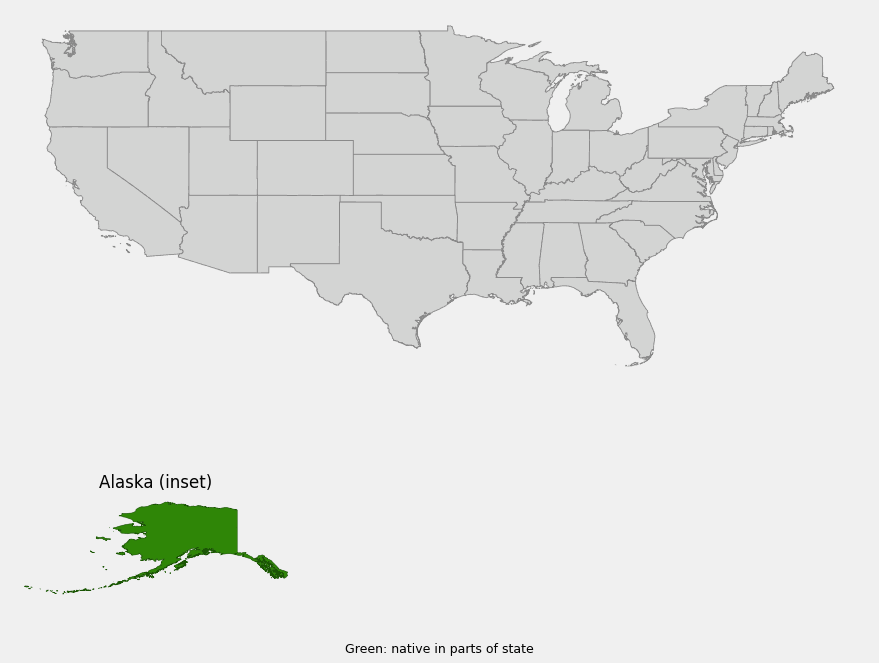
Dwarf birch is a circumpolar plant of the subarctic and Arctic. In North America, FNA records subsp. exilis from Alaska, Yukon, the Northwest Territories, British Columbia, Alberta, Saskatchewan and Manitoba, and onward into northern Asia. The eastern subsp. nana grows in Greenland and the Canadian eastern Arctic. The U.S. Forest Service’s Fire Effects Information System (FEIS) describes the species as native throughout Alaska and across northern Canada to Baffin Island, Labrador and Greenland. FNA gives its elevation range as sea level to about 7,900 feet (2,400 m).
In Alaska, dwarf birch grows almost everywhere outside the dense coastal rainforest. According to FEIS, it runs along the coast and through the interior mountains from the northern part of Southeast Alaska to the western end of the Alaska Peninsula, and north across the interior and the Brooks Range to the Arctic coastal plain. It is a dominant shrub of tussock tundra on the North Slope and the Seward Peninsula. It also grows in the black spruce muskegs and bog margins of the Tanana and Yukon valleys, on the Kenai lowlands, and in the shrub tundra of the Yukon–Kuskokwim Delta. Fall color in Denali National Park comes largely from dwarf birch.
The USDA PLANTS database also lists Betula nana as native in the lower 48 states. This reflects older treatments that included resin birch and the Rocky Mountain dwarf birches in a broader B. nana. Under the FNA treatment followed here, the low birches of the Rockies, the northern Great Lakes and New England are resin birch (B. glandulosa) or Bog Birch (B. pumila), not dwarf birch. For that reason, the map on this page shades Alaska only. In the contiguous United States, gardeners looking for a native dwarf birch should look to those two species.
📋 Regional plant lists featuring Dwarf Birch: Alaska
Growing & Care Guide
Dwarf birch is a specialist of cold, wet, acidic ground, and it does best when the garden copies those conditions. In Southcentral and Interior Alaska it is a hardy, low-maintenance shrub for rain gardens, bog edges and naturalistic plantings. South of its native range it rarely thrives: hot summers, warm nights and alkaline or compacted soil stress it, and it becomes prone to dieback. Outside Alaska, choose resin birch or bog birch from local sources instead.
Light
Plant dwarf birch in full sun to light part shade. On open tundra it grows in full exposure, and its densest, most colorful growth comes in sun. It tolerates the dappled shade of open black spruce woodland, but deep shade under a closed canopy produces thin, leggy plants with poor fall color. In Interior Alaska’s long summer days, even a site with a few hours of midday shade usually receives enough light.
Soil & Water
Dwarf birch wants consistently moist, acidic soil rich in organic matter: peat, decomposed moss or a sandy loam amended with plenty of compost. It tolerates seasonal saturation and grows naturally on permafrost-underlain peat. Like most tundra plants, though, its roots need some air, and it does poorly in stagnant, sour clay or water that stands all summer. Aim for a pH of about 4.5 to 6.5. Avoid lime, wood ash and concrete rubble near the root zone. Water deeply during dry spells for the first two summers. Once established in a suitably moist site, it needs no routine irrigation.
Planting Tips
- Plant container-grown stock in spring after the soil thaws, or in late summer to allow root growth before freeze-up.
- Set the root crown at soil level and mulch with shredded bark, moss or leaf litter to keep the roots cool and moist.
- Space plants 2 to 3 feet apart for a continuous low cover. They layer slowly and fill in over several years.
- Pair with Labrador tea, lingonberry and blueberries, which share its soil preferences. All of them depend on fungal partners in the same organic soil layer.
- When restoring disturbed tundra, transplant intact sod plugs from a permitted salvage site rather than bare-root stems. This keeps the fungal partners and the surrounding moss layer together.
Pruning & Maintenance
Dwarf birch needs very little care. Remove dead or snow-broken stems in late spring once new growth shows where the live wood is. Old, open plants can be renewed by cutting a third of the oldest stems to the base. Like many birches, it resprouts from the root crown and buried stems. Avoid heavy pruning in late winter, when birch sap is flowing. Do not fertilize: extra nitrogen produces soft growth that is vulnerable to winter dieback, and native tundra plants are adapted to very low nutrient levels. Field experiments in Alaskan tundra have shown that dwarf birch responds strongly to added nutrients and warmth by growing tall and crowding out its neighbors.
Propagation
Collect fruiting catkins in late summer or early fall, just as they begin to break apart, and sow the tiny seeds on the surface of a moist, acidic mix. Birch seed needs light to germinate, so cover it barely or not at all. Germination studies of dwarf birch show that cold stratification improves germination, so sow outdoors in fall or give the seed several weeks of moist chilling before spring sowing. Seedlings are small and slow. Softwood cuttings taken in early summer root with rooting hormone under mist. Rooted layers from the edge of an established plant can also be dug up and moved in spring.
Landscape Uses
- Low native groundcover shrub for Alaskan rain gardens, swales and bog-garden edges
- Fall-color accent in naturalistic and tundra-style plantings
- Revegetation of disturbed tundra, trail edges and gravel pads in the Arctic and subarctic
- Understory shrub for open black spruce and birch woodland gardens
- Wildlife plantings for ptarmigan, grouse and other northern birds
Wildlife & Ecological Value
For Pollinators
Dwarf birch is wind-pollinated and offers no nectar, so it is not a pollinator plant in the usual sense. Its early pollen is collected by some bees, and its leaves feed the caterpillars of many birch-feeding moths. Studies near the Alaskan treeline have recorded a diverse community of leaf-chewing insects on dwarf birch. These insects in turn feed nesting songbirds during the short Arctic summer.
Birds
Willow and rock ptarmigan eat dwarf birch buds and catkins through the long winter, when few other foods stick out above the snow. The dense, low shrub cover shelters nesting tundra songbirds, including American tree sparrows, white-crowned sparrows and redpolls. Redpolls also pick the tiny seeds from shattering catkins and from the snow surface.
Mammals
Dwarf birch is a staple browse plant for caribou and reindeer, which eat its leaves heavily in early summer when they are most nutritious. Studies of Kenai Peninsula moose found it to be part of the winter browse supply, although moose prefer willows. Snowshoe hares, voles and other small mammals nibble the stems and bark under the snowpack, and bison in Interior Alaska use the shrub-rich areas that regrow after fires.
Ecosystem Role
Dwarf birch is one of the main structural shrubs of Arctic and subarctic tundra. Its canopy traps drifting snow, which insulates the soil and affects permafrost temperatures. Its leaf litter feeds the slow nutrient cycle of tundra soils. It resprouts vigorously from root crowns and buried stems after tundra fire and can dominate burned slopes within a few years. Long-term warming and fertilization experiments at Toolik Lake on Alaska’s North Slope showed that dwarf birch, more than any other tundra plant, responds to warmer, nutrient-richer conditions by growing taller and more branched. Ecologists use it as a key indicator of the “shrubification” of the Arctic now underway across Alaska.
Cultural & Historical Uses
Across the North, dwarf birch has served as fuel, bedding and medicine. FNA notes that western Alaskan Eskimo peoples used a decoction of the leaves of subsp. exilis to ease intestinal discomfort. Across the treeless tundra, its resinous twigs were one of the few woody fuels within reach, and travelers gathered them to boil water and cook. In Lapland, the Sámi also laid the springy branches under sleeping skins as bedding.
The species has a long history in botany. Carl Linnaeus, who met the plant on his 1732 journey through Lapland, gave it its name in 1753. He also wrote a short academic dissertation devoted to Betula nana, describing the shrub and its uses in Lapland. In northern Europe and Scotland, dwarf birch is a relict of the Ice Age. Its leaves and pollen are abundant in late-glacial lake sediments, and paleoecologists use them to reconstruct cold periods.
Today, dwarf birch is best known as a barometer of Arctic change. Repeat photographs and satellite studies across northern Alaska show shrub cover expanding as summers warm, with dwarf birch and willows spreading into formerly open tundra. Those changes affect caribou forage, snow depth, fire behavior and the carbon stored in permafrost soils. Planting it in an Alaskan garden connects a home landscape to one of the most closely studied plants in the circumpolar North.
Frequently Asked Questions
How do I tell dwarf birch from resin birch?
Both are low, resinous shrub birches, and they hybridize where they meet. Dwarf birch usually has smaller, rounder leaves (often under ½ inch) with scalloped teeth that run all the way to the base. Resin Birch has slightly larger, more oval leaves whose base is usually untoothed, and its twigs are often covered with large warty resin glands. In the lower 48 states, a native shrub birch is almost always resin birch or bog birch.
Will dwarf birch grow in my garden outside Alaska?
Only in cool-summer, cold-winter climates with acidic, moist soil. It is sometimes sold as an ornamental, and the gold-leaved cultivar ‘Golden Treasure’ is grown in northern Europe. In most of the contiguous United States it suffers in summer heat. For a native alternative, choose Bog Birch in the northern Midwest and Northeast, or resin birch in the Rockies and northern Cascades.
How tall does dwarf birch get?
Most plants stay between 8 inches and 2 feet tall on open tundra, and FNA gives a maximum of about 3 feet (1 m). In sheltered, nutrient-rich sites it can be taller, especially where it hybridizes with resin birch. On exposed ridges it may grow nearly flat.
Is dwarf birch good for wildlife?
Yes. It is one of the most important winter foods for ptarmigan and a major summer forage plant for caribou and reindeer. Moose, hares and small mammals also browse it. Its dense, low cover shelters nesting tundra birds.
Does dwarf birch have showy flowers?
No. Like all birches it is wind-pollinated and bears small, brownish catkins as the leaves unfold in late spring. Its ornamental value lies in its fine texture, its tiny scalloped leaves and its brilliant orange-to-red fall color.

Looking for a nursery that carries Dwarf Birch?
Browse our native plant nursery directory: Alaska