Resin Birch (Betula glandulosa)
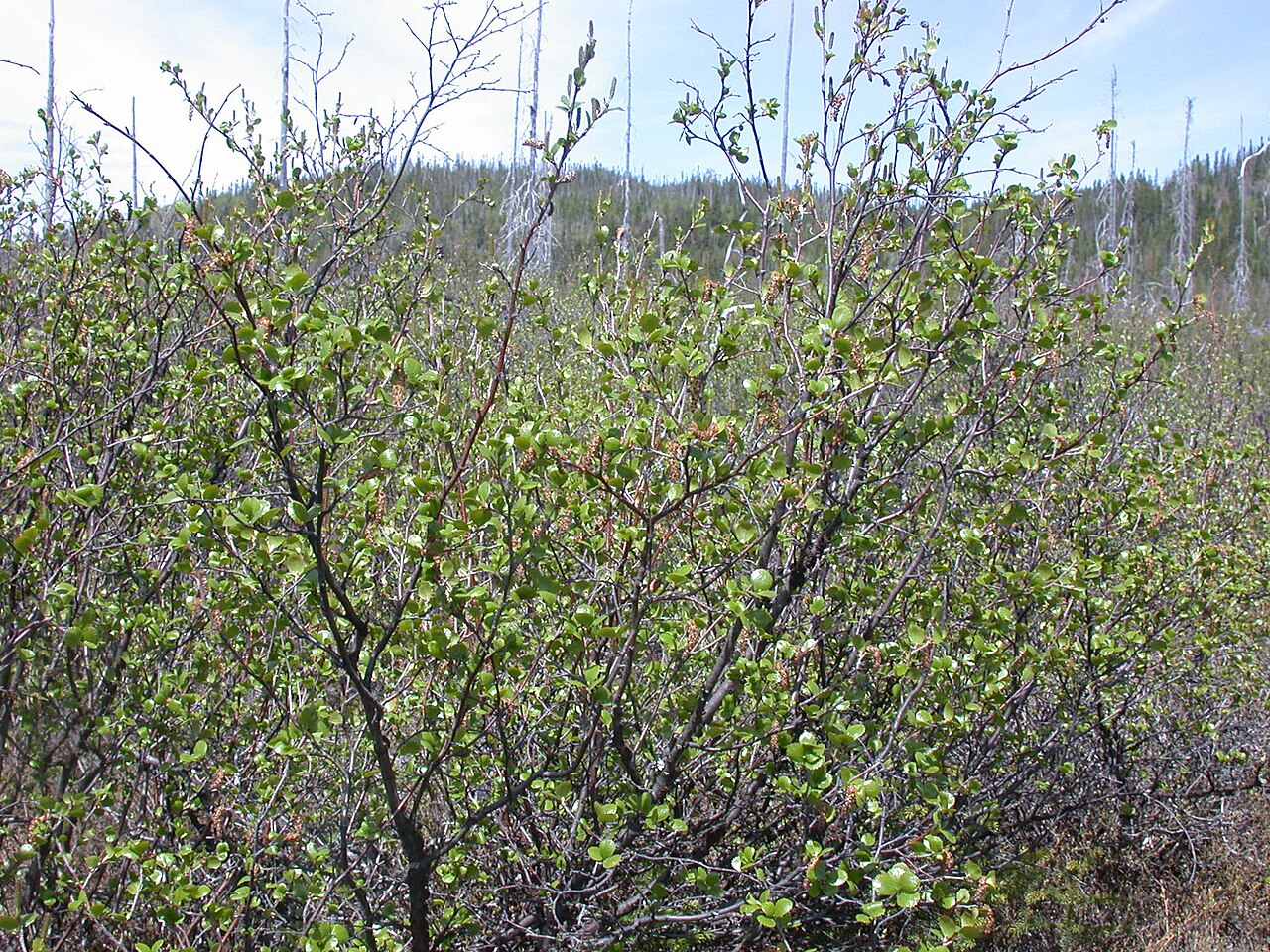
Betula glandulosa, commonly known as Resin Birch (also called Dwarf Birch or Glandular Birch), is a low, twiggy native shrub found across the cold, wet corners of North America — from Arctic Alaska and the Canadian tundra south into the high Rocky Mountains, the Cascades, and a scattering of alpine bogs in the Sierra Nevada and northern New England. It almost never looks like a tree. Instead it forms dense, knee-to-waist-high thickets of slender brown stems studded with tiny, round, scalloped leaves, most at home in the saturated peat of a bog, fen or subalpine wet meadow.
The name “resin birch” comes from the wart-like, resinous glands that stud its young twigs and leaf undersides — rub a stem and your fingers come away faintly sticky and aromatic. Those glands, combined with its small, coarsely round-toothed leaves, are the surest way to separate it from its look-alike relative, Bog Birch (Betula pumila), which plantnative.org already profiles on a separate page. The two species share overlapping habitat and a confusingly similar common name, and they do occasionally hybridize, but they are distinct species — see the Identification section below for how to tell them apart.
For gardeners working a cold, wet, or high-elevation native planting — a bog garden, a pond margin, a rain garden in a mountain town, or a naturalistic alpine rockery — Resin Birch is a tough, low-maintenance shrub that asks for almost nothing once established and feeds a surprising amount of wildlife through a long, hard winter. In parts of its range, including Maine and New Hampshire, it is a rare alpine specialist and deserves to be left undisturbed in the wild; gardeners there should look for nursery-propagated stock sourced from elsewhere in the species’ much larger western and northern range.
Identification
Resin Birch is a low, deciduous, multi-stemmed shrub, typically 1 to 4 feet tall in the Rocky Mountains and Pacific Northwest, sometimes reaching 6 feet in favorable bog sites, but often reduced to a dwarfed, sprawling mat only ankle-to-knee high at its coldest, windiest alpine and Arctic sites. It spreads slowly by layering — low branches that touch damp ground can root — so old colonies often form broad, uneven thickets rather than single bushes.
Twigs & Bark
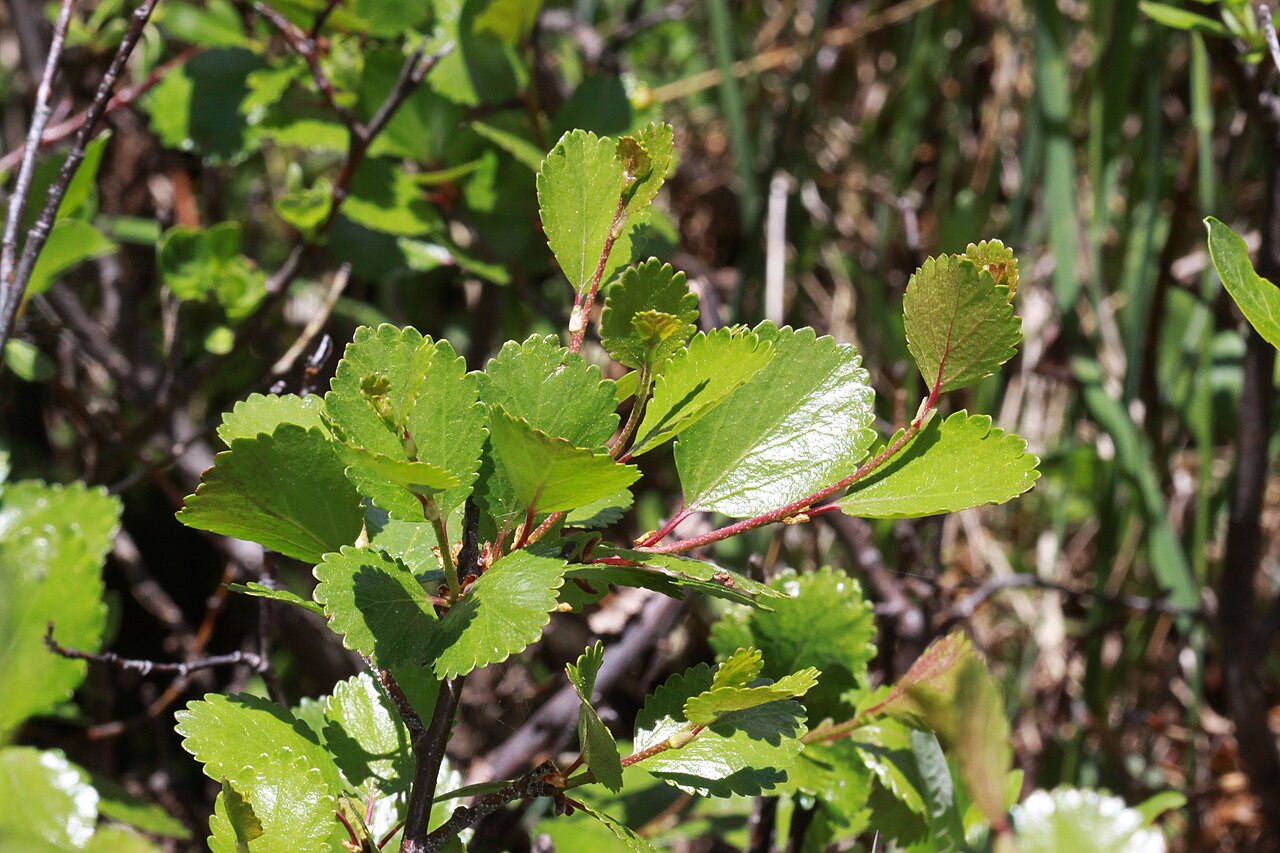
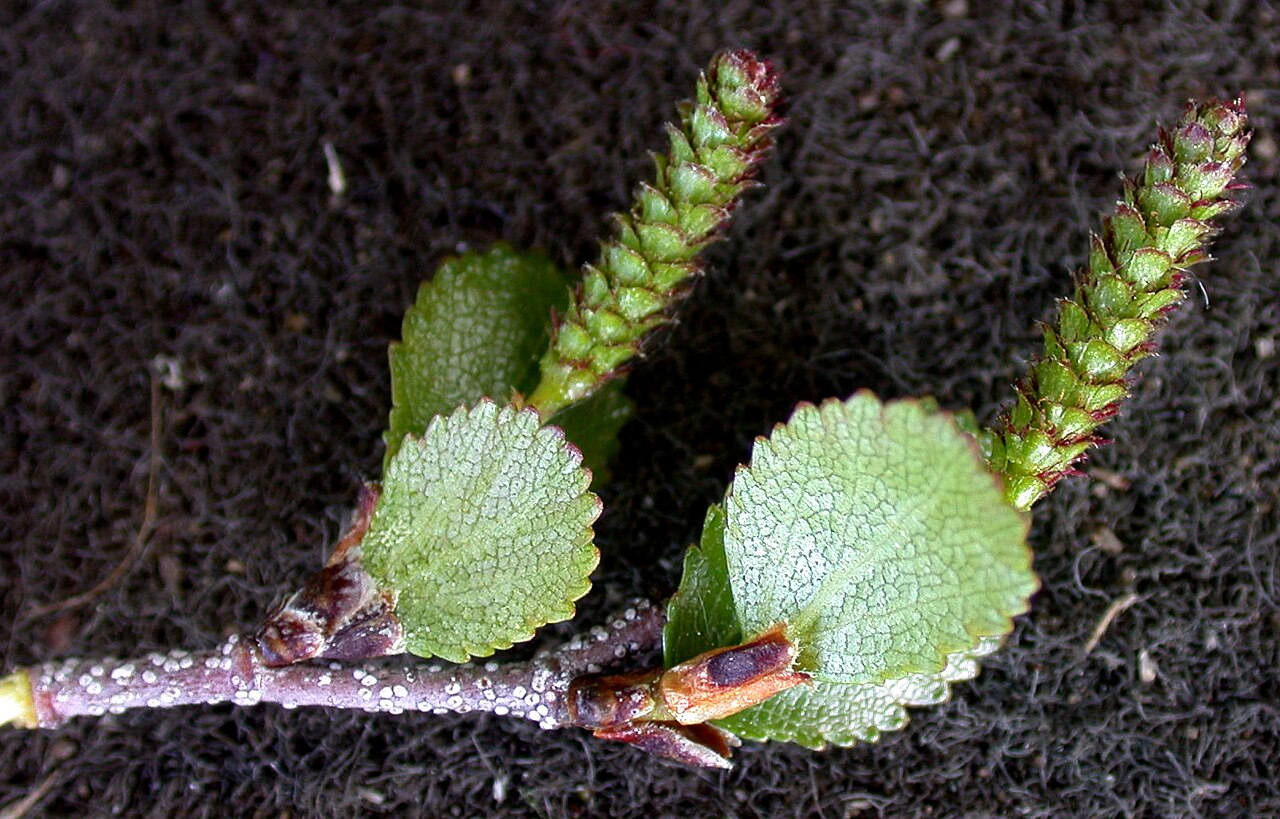
Young twigs are reddish-brown to purplish and are covered in small, raised, wart-like resin glands, giving them a rough, slightly sticky, sandpapery feel — this is the single best field mark for the species. The twigs are hairless or nearly so. Older stems turn gray-brown and smooth. This glandular, hairless twig is the key difference from Bog Birch, whose young twigs are instead finely downy (pubescent) and generally lack the obvious wart-like glands.
Leaves
Leaves are small, rounded to broadly obovate, usually ½ to 1¼ inch long, with a blunt or notched tip and a wedge-shaped base. The margin is coarsely round-toothed (crenate-serrate) rather than sharply saw-toothed. Leaves are glossy dark green above, paler beneath, often with scattered resin dots on the lower surface, and turn soft yellow to orange in fall. Bog Birch leaves are typically a bit larger (to about 1½ inches), more distinctly oval, and lack the resin dots.
Flowers & Fruit
Like other birches, Resin Birch is monoecious, bearing separate male and female catkins on the same plant. Slender, drooping male catkins form in late summer or fall and overwinter bare on the twig tips, expanding and shedding yellow-green pollen the following spring. Female catkins are shorter, upright to spreading, and cylindrical; after wind pollination they thicken into small, cone-like structures that ripen in mid-to-late summer and then break apart, releasing many tiny, winged nutlets that are carried short distances by wind and water.
Quick Facts
| Scientific Name | Betula glandulosa Michx. |
| Family | Betulaceae (Birch) |
| Plant Type | Deciduous shrub |
| Mature Height | 1–4 ft (to 6 ft in favorable bog sites) |
| Mature Spread | Similar to height; spreads slowly into broad colonies by layering |
| Growth Rate | Slow |
| Sun Exposure | Full Sun to Part Shade |
| Water Needs | Moist to wet; tolerates saturated, boggy soil |
| Soil Type | Peaty, sandy, or rocky; acidic |
| Soil pH | Acidic, about 4.5–6.5 |
| Bloom Time | April – June (wind-pollinated catkins) |
| Flower Color | Yellow-green (male); reddish-green (female) |
| Fall Color | Yellow to orange |
| Fruit | Tiny winged nutlets in cone-like catkins, ripening mid-to-late summer |
| Deer Resistant | No — browsed by deer, elk, and moose |
| USDA Hardiness Zones | 1–6 |
Native Range
Resin Birch has a wide, cold-climate distribution across northern and western North America. It is common and often dominant across Alaska and arctic and subarctic Canada, and reaches south through the high country of the western United States: the Cascades and Olympic Mountains of Washington and Oregon, the mountains of Idaho, Montana and Wyoming, the Rocky Mountains of Colorado and Utah, and disjunct, high-elevation populations in the Sierra Nevada of California. A separate, very small and isolated population occurs in the alpine zone of Maine and New Hampshire, where it is state-tracked as rare — in Maine it is known from a single county and considered imperiled, confined to cold alpine ravines and plateaus far from the species’ main range.
Across this range, Resin Birch is a plant of consistently wet, acidic, or cold ground: sphagnum bogs, fens, pond and lake margins, wet subalpine and alpine meadows, tundra, and the edges of streams at high elevation. It also grows on drier, rocky alpine and subalpine slopes and ridgelines above treeline, where it forms low, wind-pruned mats. It is not native to the warmer lowlands, coastal plains, or dry interior basins of the states it touches — gardeners should plant it only in cold, consistently moist or high-elevation sites that mimic this habitat.
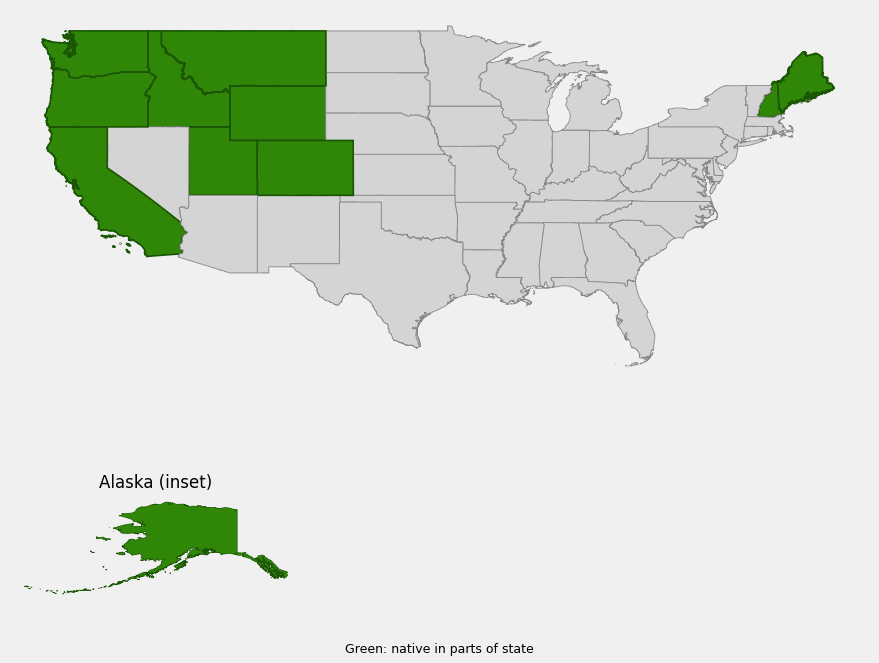
📋 Regional plant lists featuring Resin Birch: Alaska · Idaho, Eastern Oregon & Eastern Washington · Western Oregon & Western Washington · Montana & Wyoming · Utah & Western Colorado · New Hampshire, Maine & Vermont
Growing & Care Guide
Resin Birch is easy to grow once you match it to the right site: cold winters, steady moisture, and acidic soil. It is not a shrub for a typical dry garden bed or a warm-climate yard — it belongs in bog gardens, rain gardens, pond and stream margins, and naturalistic plantings in mountain and northern climates.
Light
Resin Birch grows best in full sun to light shade. In the open bogs and alpine meadows where it is most common, it receives strong sun for much of the growing season; in sheltered subalpine sites it tolerates partial shade from taller shrubs and conifers, but flowering and fall color are best with more sun.
Soil & Water
This is a wetland and cold-climate shrub at heart. It thrives in consistently moist to wet, acidic soils — peat, muck, or wet sand — and tolerates standing water at the root zone for extended periods, as in a bog or fen. It also succeeds in well-drained, rocky alpine soils as long as snowmelt or seepage keeps roots cool and moist through the growing season. It does not tolerate hot, dry, or alkaline soils.
Planting Tips
Plant container-grown stock in spring after the ground has thawed, in a site that stays consistently damp — a bog garden, rain garden low point, or pond margin. Because the species spreads slowly by layering, give it room to form a colony over time rather than treating it as a single specimen shrub. It is best suited to mountain, northern, and coastal cold-climate gardens; in warm lowland regions it will struggle regardless of how much water it is given.
Pruning & Maintenance
Resin Birch needs little maintenance. Occasional thinning of old or dead stems in late winter keeps colonies tidy, but the shrub is naturally low and twiggy and does not need shaping. It has no significant pest or disease problems in cultivation.
Landscape Uses
Resin Birch fits a narrow but valuable set of garden situations:
- Bog gardens and rain gardens in cold climates
- Pond and stream margins that stay consistently moist
- Alpine and rock gardens at higher, cooler elevations
- Wetland and wildlife habitat restoration in the mountain West and Alaska
- Erosion control on wet subalpine slopes, thanks to its spreading, layering habit
Wildlife & Ecological Value
In the cold, open habitats where it grows, Resin Birch is an important source of food and cover for a wide range of wildlife, especially in winter when little else is available.
For Birds
Ptarmigan and grouse browse the buds, catkins, and twigs through the winter months, and the tiny winged nutlets released from the ripening female catkins are eaten by redpolls, siskins, and other seed-eating songbirds. The dense, low thickets also provide nesting and hiding cover for ground-nesting birds in open tundra and subalpine habitat.
For Mammals
Resin Birch is a staple winter browse plant for moose, caribou, and mule deer across its northern and mountain range, and snowshoe hares feed heavily on the twigs and bark, especially where snow brings the browse within reach. Small mammals use dense colonies for cover from predators.
For Pollinators
Like other birches, Resin Birch is wind-pollinated rather than insect-pollinated, so it offers little nectar value. Its main ecological contribution is structural and as a food source rather than as a pollinator plant.
Ecosystem Role
As one of the few woody plants able to grow in cold, saturated peat and thin alpine soils, Resin Birch helps stabilize bog edges, pond margins, and subalpine slopes, and its slow spread by layering helps knit together the low shrub layer in tundra and alpine plant communities. In the rare New England populations, it is itself a conservation concern, persisting as a relict of colder post-glacial climates.
A Note on Bog Birch and Resin Birch
Visitors familiar with plantnative.org’s existing Bog Birch page may wonder how the two plants relate. Betula pumila (Bog Birch) and Betula glandulosa (Resin Birch) are both small native shrub birches of cold wetlands, their ranges overlap broadly across the northern United States and Canada, and the two are even known to hybridize where they grow together. But they are distinct species. Bog Birch tends to have slightly larger, more oval leaves and finely hairy (pubescent) young twigs without obvious resin warts; Resin Birch has smaller, rounder, more coarsely scalloped leaves and hairless twigs roughened by wart-like resin glands. Bog Birch is also, on the whole, more a plant of boreal and Great Lakes peatlands, while Resin Birch’s North American range extends much further west and higher into the mountains. Gardeners choosing between them should match the species to their own regional plant list and should not assume the two names are interchangeable.
Cultural & Historical Uses
Across the Arctic and Subarctic, Indigenous peoples historically used the twigs and foliage of Resin Birch and its close relatives in a variety of everyday ways, including brewing the leaves and twigs into a bush tea and burning the resinous, oily stems as fast-catching kindling and smoking fuel, since the resin glands make the wood burn readily even when slightly green. These were practical, everyday uses rather than medicinal treatments, and are noted here as history rather than as guidance for modern foraging.
Because of its low stature and typically remote, cold habitat, Resin Birch has little commercial history and is grown today mainly for ecological restoration and specialty native landscaping in bog gardens and alpine plantings, rather than as an ornamental shrub in the general nursery trade.
Frequently Asked Questions
Is Resin Birch the same plant as Bog Birch?
No. They are closely related, overlapping, and sometimes-hybridizing shrub birches, but Betula glandulosa (Resin Birch) and Betula pumila (Bog Birch) are distinct species. See the note above and plantnative.org’s separate Bog Birch page for that species.
Will Resin Birch grow in a normal garden bed?
Only if that bed stays consistently cool and moist to wet. Resin Birch is adapted to bogs, wet meadows, and cold alpine ground, and it will not thrive in average, well-drained garden soil, especially in warmer climates.
How tall does Resin Birch get?
Most plants stay in the 1- to 4-foot range, though it can reach about 6 feet in favorable bog sites. In the harshest alpine and Arctic sites it stays much lower, forming a wind-pruned mat only a foot or so tall.
Is Resin Birch endangered?
It is secure and often abundant across most of its Alaska, Canadian, and Rocky Mountain range, but it is state-tracked as rare and imperiled in Maine and New Hampshire, where it survives only in a few isolated alpine sites. Gardeners in New England should source nursery stock rather than collecting from these rare wild populations.
Is Resin Birch toxic?
No toxicity is documented for people or pets; like other birches it is routinely browsed by deer, elk, and moose without ill effect. As with any wild plant, it is not a food crop and is not grown or sold for human consumption.

Looking for a nursery that carries Resin Birch?
Browse our native plant nursery directory: Alaska · Washington · Oregon · Idaho · Montana & Maine · Wyoming · Colorado · Utah · California · New Hampshire