Elegant Clarkia (Clarkia unguiculata)
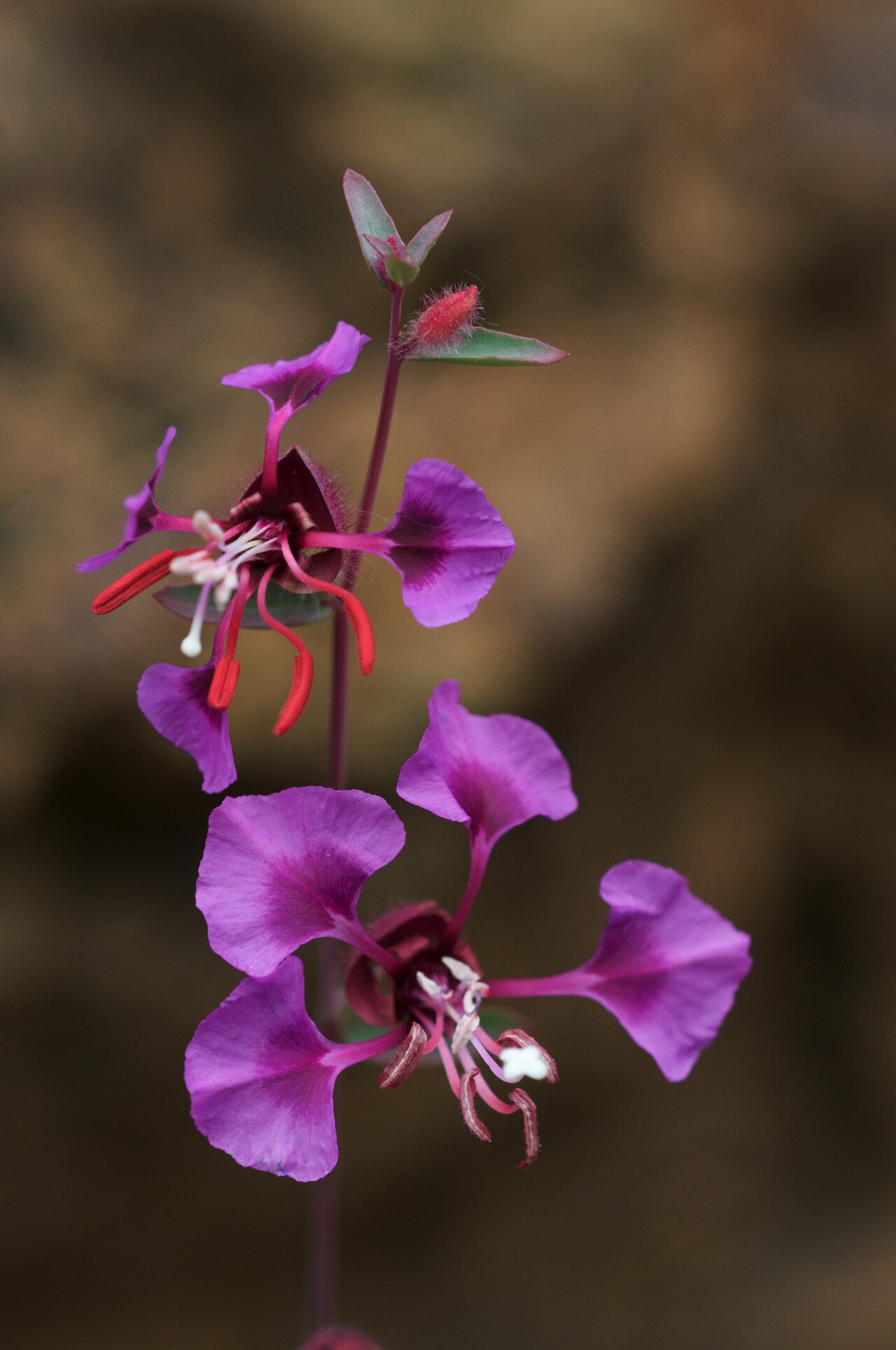
Clarkia unguiculata, commonly called Elegant Clarkia or Mountain Garland, is a wiry, wand-like annual wildflower found only in California, where it lights up dry foothill slopes and open woodlands with whorls of satiny, four-petaled flowers each late spring. A member of the evening primrose family (Onagraceae), it belongs to the genus Clarkia, named for William Clark of the Lewis and Clark expedition, whose party collected the first specimens of a related species along the Columbia River in 1806. The species name unguiculata means “clawed,” a direct reference to the narrow, stalk-like base of each petal that widens abruptly into a broad, fan-shaped blade.
Elegant clarkia is one of the most widespread and recognizable of California’s many native Clarkia species, growing in the Coast Ranges from Mendocino County south to San Diego County and through the foothills encircling the Central Valley, including much of the Sierra Nevada foothill belt. It favors the in-between seasons — germinating with fall and winter rains, then shooting up a slender flowering stalk just as many other spring annuals are finishing their bloom, which is how it earned the common name mountain garland: a late, lingering string of color draped across drying hillsides.
In the garden, elegant clarkia is prized by native-plant gardeners for exactly this timing. It fills the gap between the big spring wildflower show and the heat of summer, asks for almost nothing once established, and self-sows reliably where it is happy. It is a mainstay of California wildflower seed mixes and a frequent component of pollinator plantings, valued for its clear magenta-purple color, airy habit, and reliable performance in lean, dry soil.
Identification
Elegant clarkia is an erect to slightly sprawling annual herb, typically 1 to 3 feet (30–100 cm) tall, with slender, wiry, often reddish stems that branch loosely above the base. The whole plant has a delicate, airy appearance that belies its toughness in dry, rocky soil.
Stems
Stems are thin, round in cross-section, and usually reddish or purplish, especially in full sun, with short fine hairs toward the upper portions. A single plant may send up one main flowering stalk or several from the base, depending on growing conditions and competition.
Leaves
Leaves are simple, alternate, and narrowly lance-shaped to linear, 1 to 3 inches (2.5–8 cm) long, with smooth to faintly toothed margins and short stalks. They are thin-textured and often held somewhat upright against the stem, giving the plant a sparse, uncluttered look even when flowering heavily.
Flowers
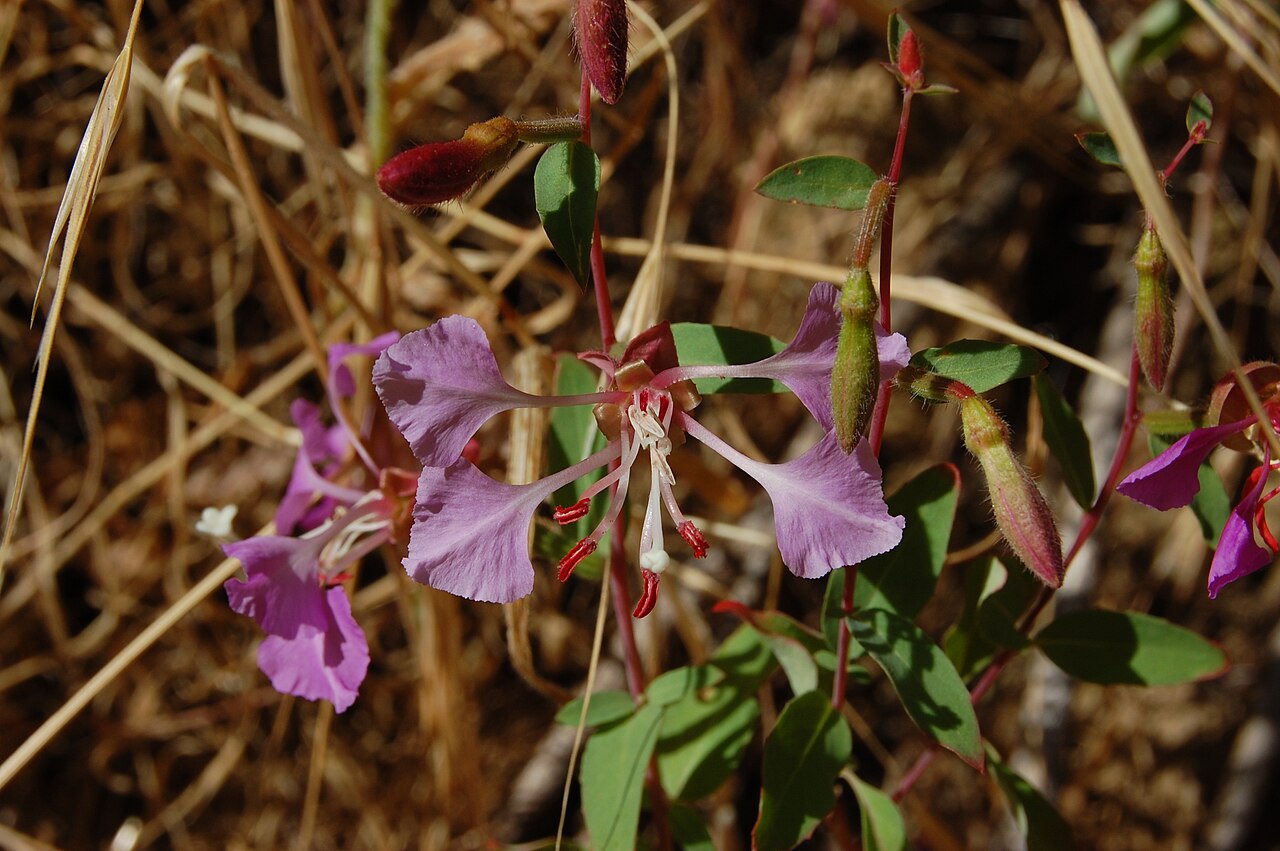
The flowers are the plant’s signature feature: four petals, each 0.5 to 1 inch (1.5–2.5 cm) long, rosy-pink to magenta-purple, often with a darker reddish-purple blotch or diamond-shaped spot at the base. Each petal narrows into a short, distinct claw at its point of attachment — the detail that gives the species its scientific name — before flaring into a broad, slightly three-lobed or fan-shaped blade. Eight stamens are arranged in two ranks of four, typically with bright red filaments and anthers that alternate long and short, and a central white or pale pink stigma protrudes beyond them. Flowers open in succession up the stalk from buds held in the leaf axils, so a single plant stays in bloom for several weeks, typically between May and July depending on elevation and rainfall.
Fruit & Seeds
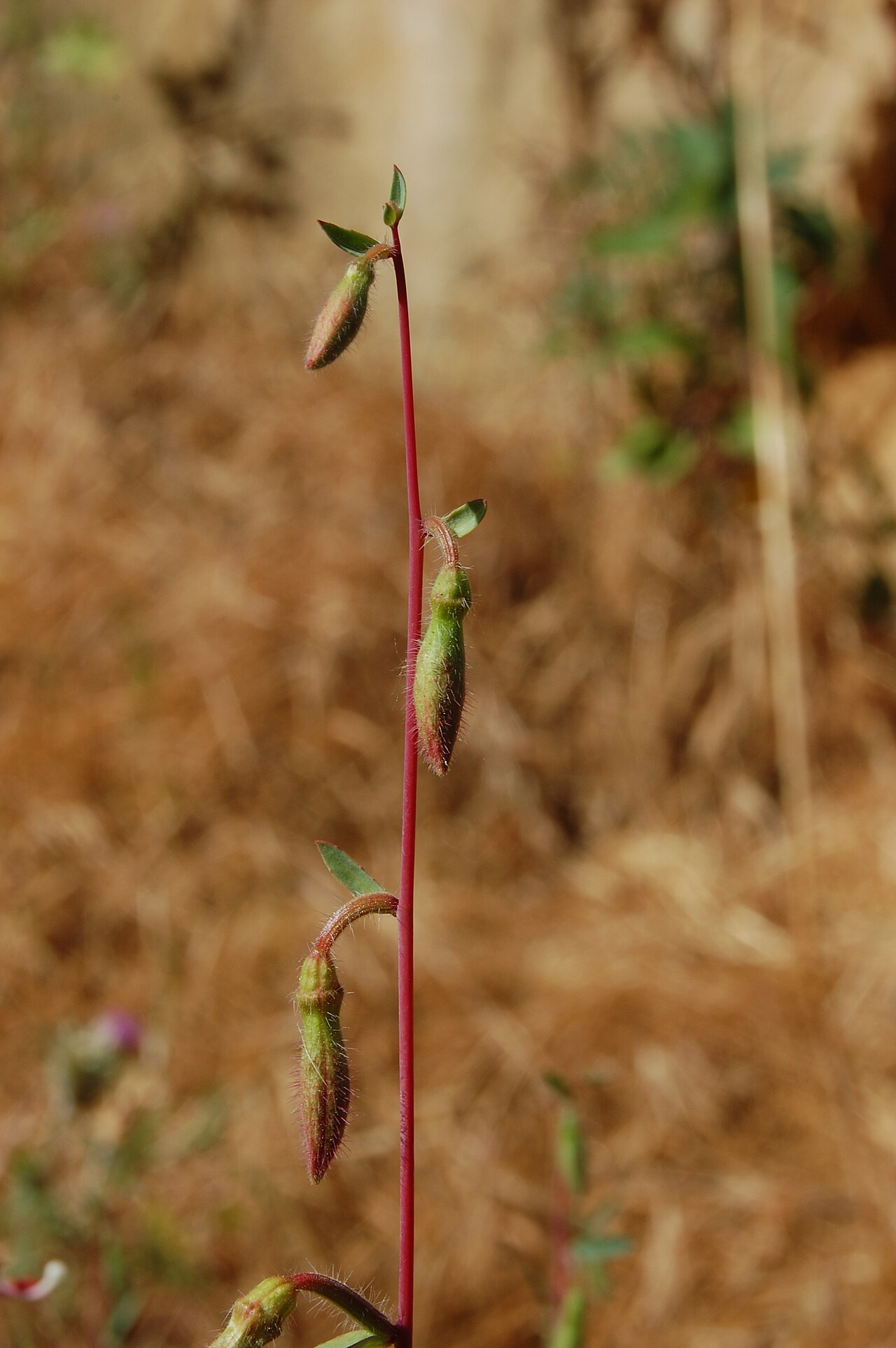
After pollination, each flower produces a slender, cylindrical seed capsule 1 to 2 inches (2.5–5 cm) long, covered in fine stiff hairs and often curving slightly as it matures. The capsules hang below the newest flowers along the upper stem, splitting open along four lines when ripe to release numerous small, angular brown seeds. Plants typically set abundant seed and die back completely with the onset of dry summer heat, their role for the year complete.
Quick Facts
| Scientific Name | Clarkia unguiculata |
| Family | Onagraceae (Evening Primrose) |
| Plant Type | Annual Wildflower |
| Mature Height | 1–3 ft (30–100 cm) |
| Mature Spread | 8–16 in (20–40 cm) |
| Growth Rate | Fast (annual life cycle) |
| Sun Exposure | Full Sun to Part Shade |
| Water Needs | Low once established |
| Soil Type | Well-drained; tolerates poor, rocky or clay soils |
| Soil pH | 6.0–7.5 (slightly acidic to neutral) |
| Bloom Time | May – July |
| Flower Color | Rosy-pink to magenta-purple |
| Fall Color | None (annual; dies back in summer) |
| Fruit | Slender hairy seed capsule, 1–2 in |
| Deer Resistant | Yes (occasional light browsing only) |
| USDA Hardiness Zones | 7–10 (grown as a cool-season annual) |
Native Range
Elegant clarkia is endemic to California, meaning the entire wild population of the species occurs within the state and nowhere else. It is widespread through the Coast Ranges from Mendocino and Lake counties south to San Diego County, and through the foothills bordering the Central Valley, including much of the Sierra Nevada foothill belt from Shasta County south to Kern County. It is absent from the high Sierra Nevada crest, the deserts, and the immediate coast.
Within this range, elegant clarkia grows in open grassland, coastal sage scrub, chaparral openings, and foothill oak woodland, usually on dry, well-drained slopes and road cuts that receive full sun for at least part of the day. It is typically found from near sea level up to about 5,000 feet (1,500 m) in elevation, germinating with fall rains and flowering the following late spring into summer as the soil dries.
Because it is so easy to grow from seed, elegant clarkia is included in wildflower seed mixes sold across the country and sometimes appears well outside its native range as a garden escape; those plantings are not considered part of its natural distribution. Within California itself it is not considered rare or threatened — it remains one of the more common and reliably seen native annual wildflowers of the foothill grasslands.
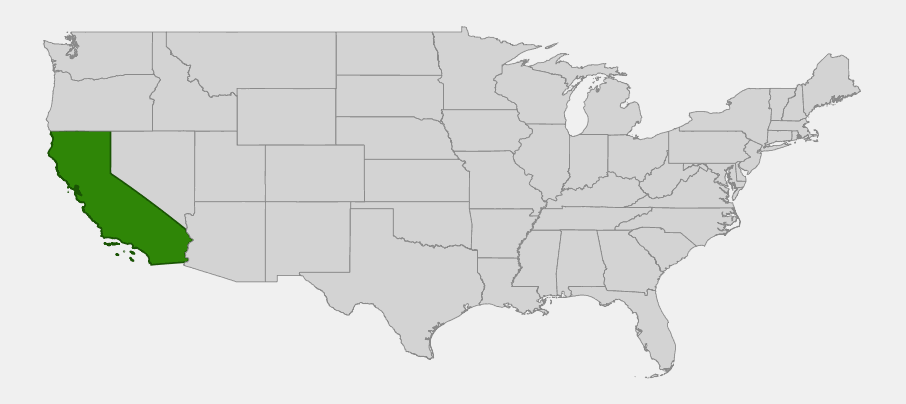
📋 Regional plant lists featuring Elegant Clarkia: Elegant Clarkia is endemic to California; Plant Native does not currently maintain a California-specific regional plant list.
Growing & Care Guide
Elegant clarkia is among the easiest California native wildflowers to establish from seed, and it rewards very little effort with weeks of airy, jewel-toned bloom right when many other spring flowers are fading.
Light
Give elegant clarkia full sun for the strongest flowering and sturdiest stems, though it tolerates light or part shade, especially in hotter inland gardens, where afternoon shade can extend the bloom period by keeping plants from drying out quite so fast.
Soil & Water
This species is built for lean, fast-draining soil and actually performs best without rich amendment — overly fertile, moisture-retentive soil tends to produce floppy, overgrown plants with fewer flowers. Water to germinate and establish seedlings, then taper off; established plants need little to no supplemental water and should be allowed to dry out and finish their cycle naturally as summer approaches.
Planting Tips
Sow seed directly in fall, pressing seed lightly into the soil surface rather than burying it, so that it can respond to the first winter rains the way it would in the wild. No special stratification is needed. Elegant clarkia resents transplanting because of its slender taproot, so direct seeding outperforms nursery starts in most gardens. Thin or space seedlings 6 to 12 inches apart for the best display, and expect reliable self-sowing in subsequent years once a patch is established.
Pruning & Maintenance
No pruning is needed during the growing season. Once plants finish flowering and the stems and capsules turn tan and dry, you can leave them standing to drop seed for next year or cut them back for tidiness — either approach works, since the bulk of seed dispersal happens before the stalks fully collapse.
Propagation
Elegant clarkia is propagated almost exclusively from seed. Collect dry, tan seed capsules before they split open, then store seed in a cool, dry place until fall sowing. No pretreatment is required; germination is triggered by the cooling, moistening conditions of autumn.
Landscape Uses
Elegant clarkia earns its keep in several garden roles:
- Wildflower meadows and naturalized dry slopes
- Pollinator gardens, mixed with other spring and early-summer annuals
- Erosion-prone, lean soils where little else will establish from seed
- Cut flowers — stems hold up well in arrangements
- Gap-filling between bulbs or perennials that go dormant by midsummer
- Container plantings, where its airy habit softens harder-edged companion plants
Wildlife & Ecological Value
Elegant clarkia is a reliable late-spring nectar and pollen source in California grasslands and foothill woodlands, flowering during a window when many earlier annuals have already finished.
For Pollinators
The flowers are visited by a range of native bees, including bumble bees, longhorn bees, and specialist bees in the genus Clarkia‘s pollinator guild that time their own flight period to coincide with Clarkia bloom. Honeybees also work the flowers readily. The bright magenta color and central darker blotch act as visual nectar guides, directing pollinators toward the flower’s center.
For Birds
Seed-eating birds such as sparrows and finches forage on the ripe seed capsules in summer once they split open, and the dense stands of dry stems provide minor cover for ground-foraging birds after the plants have finished flowering.
Ecosystem Role
As a fast-cycling annual, elegant clarkia helps hold and build soil on dry, open slopes between the growth of longer-lived perennials, and its heavy seed production helps sustain the soil seed bank that allows California’s annual grassland and chaparral-opening flora to rebound each year, including after fire or disturbance.
Cultural & Historical Uses
The genus Clarkia commemorates William Clark of the Lewis and Clark Expedition, whose party collected the first scientifically described specimens of a related species in 1806 along the Columbia River; the broader group of California Clarkia species, including elegant clarkia, was described by later botanists exploring the state’s foothills and valleys through the 19th century.
Historically, the small, oil-rich seeds of various native California Clarkia species were gathered by Indigenous peoples of California as a food source, parched and ground into meal along with other wild seed crops of the grassland and oak woodland. This seed-gathering tradition reflects the broader importance of California’s annual wildflower seed crop to pre-contact foodways across much of the state.
Today, elegant clarkia’s main cultural role is horticultural rather than culinary: it is a dependable, widely available component of wildflower seed mixes and a favorite of gardeners restoring dry slopes and meadows with regionally appropriate native plants.
Frequently Asked Questions
Is Elegant Clarkia the same plant as Farewell-to-Spring?
No. “Farewell-to-spring” most often refers to Clarkia amoena, a related but distinct California native species with larger, often more bowl-shaped flowers. Elegant clarkia (Clarkia unguiculata) is a separate species, best distinguished by its narrow, sharply clawed petal bases and red-and-white stamens.
Is Mountain Garland easy to grow from seed?
Yes. Direct-sown in fall onto lean, well-drained soil, elegant clarkia germinates readily with the first winter rains and needs no special pretreatment. It is one of the more forgiving California annual wildflowers for beginning native-plant gardeners.
Does Elegant Clarkia need regular watering?
Only while germinating and establishing in fall and early winter. Once seedlings are growing, reduce watering; this species is adapted to drying soil as it flowers and sets seed, and too much water in late spring tends to produce weak, floppy plants.
Will Elegant Clarkia come back every year on its own?
As an annual, each individual plant completes its life cycle in one season and dies after setting seed, but established plantings reliably self-sow, so a patch left undisturbed typically returns from dropped seed year after year.
Is Elegant Clarkia native outside of California?
No. It is endemic to California and not naturally found in any other state. It is, however, commonly included in wildflower seed mixes sold nationally, so it is sometimes seen growing outside its native range as a garden planting rather than a wild population.

Looking for a nursery that carries Elegant Clarkia?
Browse our native plant nursery directory: California