Honey Mesquite (Prosopis glandulosa)
Prosopis glandulosa, commonly known as Honey Mesquite, is one of the most ecologically and economically significant native trees of the American Southwest and southern Great Plains. A member of the legume family (Fabaceae), this hardy deciduous tree or large shrub ranges from the deserts of Arizona and California east across Texas and north into Kansas, occupying a vast swath of arid and semi-arid landscapes where few other trees can survive. Its extraordinary drought tolerance, deep taproot system, and ability to fix atmospheric nitrogen have allowed it to become a dominant plant across millions of acres of the southwestern landscape.
Honey Mesquite is a tree of superlatives: its taproot can penetrate 100 feet or more into the earth in search of water, making it one of the deepest-rooted plants in North America. Its sweet seed pods — “mesquite beans” — have fed humans and wildlife for thousands of years and remain an important food source for deer, javelinas, coyotes, birds, and livestock today. The tree produces a hard, dense wood prized for furniture, flooring, and especially for smoking meats. Its canopy provides critical shade in the blazing desert summer, creating cool microclimates under which other plants establish and wildlife shelters from the heat. For these reasons, Honey Mesquite is considered a foundation or keystone species in the desert and shrubland communities it inhabits.
In the landscape, Honey Mesquite is valued for its graceful, feathery foliage, fragrant yellow flowers, and spreading canopy that provides both shade and wildlife value with minimal water requirements. It is an ideal tree for water-conscious desert gardens, wildlife habitat plantings, and large-scale revegetation projects. While sometimes considered invasive outside its native range due to its vigorous spreading habit, within its natural range it is a vital native species that should be protected and encouraged.
Identification
Honey Mesquite typically grows as a multi-stemmed large shrub or small to medium-sized tree, reaching 20 to 30 feet tall with a similarly wide or wider canopy spread. The crown is rounded and open, often irregular in outline, creating the characteristic dappled shade associated with desert trees. Young plants are often shrubby and multi-stemmed; with age and in better moisture conditions, a more tree-like form with a single dominant trunk develops.
Bark and Branches
The bark of mature Honey Mesquite is dark brown to reddish-brown, becoming deeply furrowed and fibrous with age in a pattern that can be quite ornamental. Young branches are slender, greenish, and armed with sharp, straight thorns that can reach 2 inches in length — a significant defensive feature. The thorns occur at nodes along the branches. Older branches lose some thorns and develop rougher, darker bark.
Leaves
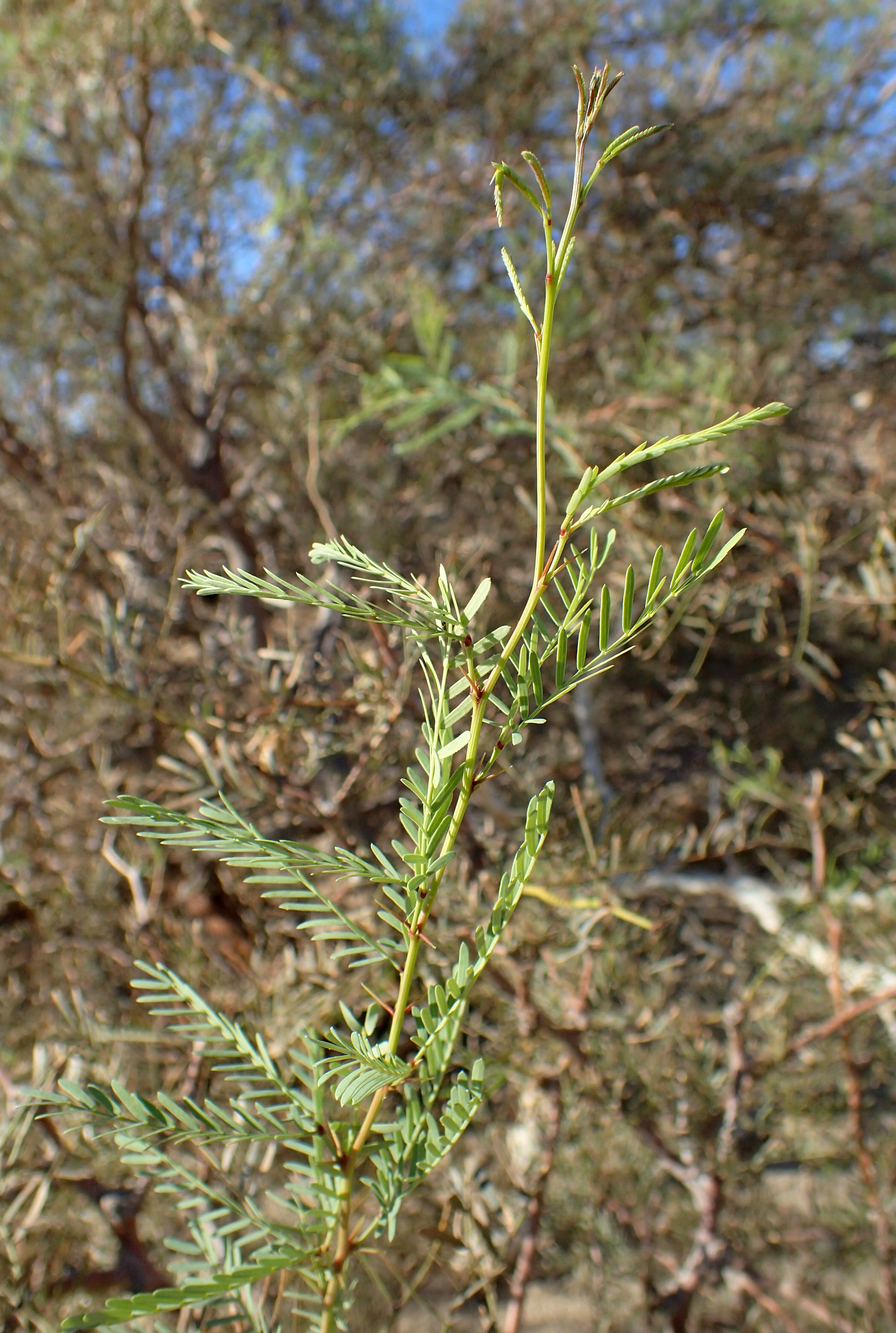
The leaves are bipinnately compound — each leaf consists of one or two pairs of primary leaflets (pinnae), and each pinna bears 6 to 20 pairs of tiny secondary leaflets (pinnules). The overall effect is a feathery, delicate texture quite unlike most other desert trees. The leaves are 2 to 3 inches long overall, with individual pinnules only about ¼ inch long and 1/16 inch wide. The leaf color is bright yellowish-green to medium green. Honey Mesquite is drought-deciduous — it drops its leaves during severe drought stress and re-leafs rapidly once moisture returns — though in areas with some summer rainfall it may remain leafy for most of the growing season.
Flowers & Fruit
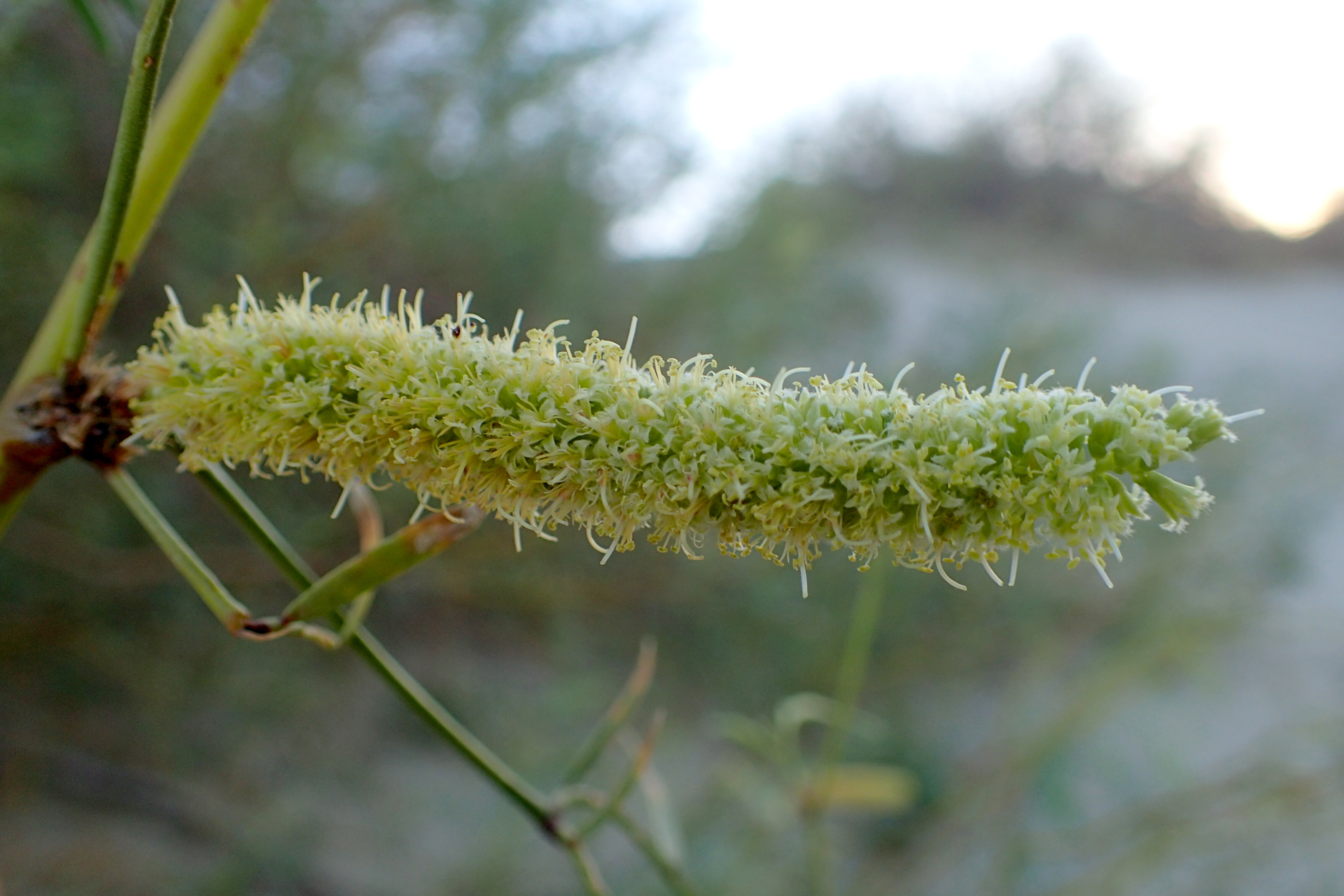
The flowers appear in spring and early summer (April through June) and are borne in dense, cylindrical, catkin-like spikes 2 to 3 inches long. Individual flowers are tiny, pale yellow to creamy white, and intensely fragrant — producing abundant nectar that is highly attractive to bees. Honey Mesquite is one of the most important honey plants in Texas and the Southwest; the resulting monofloral honey is light golden in color with a distinctive, mildly sweet flavor.
The fruit is a pod (legume) 4 to 9 inches long, straight to slightly curved, light tan to yellowish at maturity, with a sweet, fibrous flesh surrounding the hard seeds. The pods ripen in late summer and fall and are eagerly consumed by wildlife and livestock. The mesquite “bean” — technically the whole pod — was a critical staple food for Native American peoples throughout the Southwest.
Quick Facts
| Scientific Name | Prosopis glandulosa |
| Family | Fabaceae (Legume) |
| Plant Type | Deciduous Tree / Large Shrub |
| Mature Height | 25 ft |
| Sun Exposure | Full Sun |
| Water Needs | Low (Drought Tolerant) |
| Bloom Time | April – June |
| Flower Color | Pale yellow / creamy white |
| Fruit | Sweet tan pods (mesquite beans), 4–9 in |
| USDA Hardiness Zones | 6–11 |
Native Range
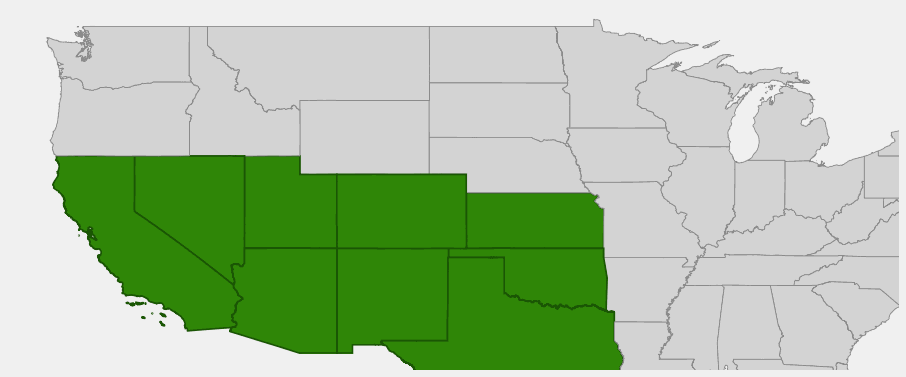
Honey Mesquite is native to the arid and semi-arid regions of the American Southwest, southern Great Plains, and adjacent Mexico. In the United States, its native range includes Arizona, California, Colorado, Kansas, Nevada, New Mexico, Oklahoma, Texas, and Utah — making it one of the most widely distributed native trees in the western and southwestern United States. It is most common and abundant in Texas, where it dominates vast areas of the Edwards Plateau, the Trans-Pecos, and South Texas Plains, but is also ecologically significant throughout Arizona and New Mexico.
Within its range, Honey Mesquite occupies a broad array of habitats: desert washes and dry arroyos where it can access deep water tables; grasslands and savannas where it grows as a scattered tree; riparian corridors; and disturbed areas. It is highly tolerant of poor soils, alkaline conditions, and extreme heat. The species has expanded significantly beyond its original range over the past 150 years, primarily due to overgrazing (which removes competing grasses and allows mesquite seedlings to establish), fire suppression, and seed distribution by cattle. What was once primarily a riparian and wash tree in Arizona has spread onto upland sites throughout much of the state.
Two varieties are recognized: Prosopis glandulosa var. glandulosa (Honey Mesquite, native to the eastern part of the range) and var. torreyana (Western Honey Mesquite, native to the western part including Arizona and California). The western variety tends to be smaller and more shrubby than the eastern form. Both are ecologically and culturally significant and are used interchangeably in restoration and landscaping within their respective ranges.
📋 Regional plant lists featuring Honey Mesquite: Arizona
Growing & Care Guide
Honey Mesquite is one of the toughest and most adaptable native trees available for the desert Southwest. It is highly recommended for large gardens, wildlife habitat plantings, and any site where shade, wildlife value, and drought tolerance are priorities. Its main requirements are full sun, good drainage, and plenty of room.
Light
Full sun is required. Honey Mesquite grows best with 8 or more hours of direct sunlight per day. It handles the intense reflected heat of the desert Southwest without difficulty and actually performs poorly in shade, becoming sparse, weedy, and prone to disease when light is insufficient.
Soil & Water
Honey Mesquite is remarkably tolerant of poor soils, including alkaline, caliche-heavy, and rocky soils that defeat other trees. It prefers deep, sandy or loamy soils where its taproot can penetrate deeply, but performs acceptably in most well-drained desert soils. Avoid planting in areas of standing water or heavy clay. Once established, Honey Mesquite is extremely drought tolerant and requires no supplemental irrigation in most of Arizona. During establishment (first 2 years), water deeply once every 2–3 weeks in summer. The deep taproot makes established trees difficult to transplant — plant from small containers and let the root system develop in place.
Planting Tips
Plant in fall or early spring. Use small container stock (1- or 5-gallon) rather than large trees to allow the root system to develop naturally. Water deeply at planting and for the first growing season. Mulch the root zone with 3 to 4 inches of organic mulch or decomposed granite to conserve moisture. Allow room for the mature canopy spread — plant at least 20 feet from structures, pools, and underground utilities, as the root system is extensive and aggressive.
Pruning & Maintenance
Young mesquites benefit from selective pruning to develop a single-trunk form, if desired. Remove crossing branches and those that grow too low to the ground. Avoid heavy pruning during summer heat. Honey Mesquite is relatively fast-growing for a desert tree and may need periodic thinning to maintain an open, attractive canopy. The thorns are a significant consideration in maintenance — wear thick leather gloves and long sleeves. Fallen pods should be raked up if desired to prevent excessive seedling germination.
Landscape Uses
- Shade tree for patios, parking areas, and outdoor spaces in the desert Southwest
- Wildlife habitat — exceptional value for birds, mammals, and pollinators
- Desert washes and arroyos — natural and restoration plantings
- Windbreaks and hedgerows in rural and agricultural settings
- Revegetation of disturbed desert land
- Honey production — plant near beehives for exceptional desert honey
Wildlife & Ecological Value
Honey Mesquite supports an extraordinary diversity of wildlife. It is considered a keystone species in the desert Southwest and southern Great Plains ecosystems, providing food, shelter, and structural complexity that benefits hundreds of species.
For Birds
The mesquite’s spreading canopy provides prime nesting habitat for dozens of species of desert birds, including Verdin, Cactus Wren, Curve-billed Thrasher, Mourning Dove, Gambel’s Quail, and various flycatchers and warblers. The fragrant flowers attract insects that are critical food for insectivorous birds during breeding season. The pods are consumed by quail, doves, and other seed-eating birds throughout fall and winter. The thorny canopy provides protection from predators for nesting birds.
For Mammals
The sweet, nutritious pods are consumed by virtually every large mammal in the mesquite’s range: Mule Deer, White-tailed Deer, Pronghorn, Javelina, Coyote, Gray Fox, Raccoon, Ringtail, and numerous rodents including Kangaroo Rats and Pocket Mice. The pods are calorie-dense and critically important during fall and winter when other food sources are limited. Bears, where present, also consume large quantities of pods.
For Pollinators
Honey Mesquite is one of the most important bee plants in the Southwest. The fragrant, pollen-rich flower spikes attract native bees in vast numbers — over 40 species of native bees have been documented visiting mesquite flowers in Texas alone. Honey bees produce a distinctive monofloral mesquite honey from the nectar. Butterflies, moths, and other insects also visit the flowers.
Ecosystem Role
As a nitrogen-fixing legume, Honey Mesquite enriches the soil beneath its canopy and in its surrounding “sphere of influence” — improving conditions for other plants. The fallen leaf litter creates deep, moist, organic-rich soil in an otherwise harsh desert environment. Studies have shown that species diversity and soil quality are markedly higher within and immediately under mesquite canopies compared to open desert areas. The shade created by the mesquite canopy provides a cooler, moister microclimate where many other desert plants establish and grow.
Cultural & Historical Uses
Honey Mesquite was arguably the single most important plant for Indigenous peoples of the desert Southwest and southern Great Plains. For the O’odham, Tohono O’odham, Pima, Apache, Navajo, Comanche, and dozens of other peoples, mesquite pods (often called “mesquite beans”) were a critical staple food. The pods were harvested in summer and fall when ripe, dried and stored, then ground into a nutritious flour used to make flat cakes, porridge, and a fermented drink. A single mature mesquite tree could produce 40 to 60 pounds of pods per year, representing a substantial caloric contribution to desert diets. The sweetness of the pods comes from natural sugars in the pod wall, and mesquite flour has a naturally low glycemic index — an advantage for metabolic health that modern nutritionists have rediscovered.
The wood of Honey Mesquite is exceptionally hard, heavy, and rot-resistant — ranking among the hardest woods in North America. Indigenous peoples used it for tool handles, bows, digging sticks, and construction. In the historical period, it became widely used for railroad ties, fence posts, flooring, and furniture. Today, mesquite wood is most famous as a barbecue smoking fuel, especially in Texas, where “mesquite-smoked” is a culinary signature. Mesquite charcoal is still commercially produced and widely sold. Artisans prize mesquite for knife handles, bowls, and rustic furniture because of its beautiful grain and reddish-brown color.
The bark has been used to make a dark brown dye and as a tanning agent for hides. Gum that exudes from wounds in the bark was used as a glue, a black hair dye, and a remedy for eye infections and stomach ailments. A tea made from the bark was used for digestive issues. The inner bark fibers were woven into rope and rough textiles. In modern times, Honey Mesquite is increasingly recognized not as a “weed tree” to be eradicated but as a culturally and ecologically essential native species deserving respect, management, and restoration.
Frequently Asked Questions
Is Honey Mesquite invasive?
Within its native range (Arizona, New Mexico, Texas, and the rest of its natural distribution), Honey Mesquite is a native species and not invasive. It has expanded beyond its historic distribution in some areas due to overgrazing and fire suppression, which is an ecological concern in grassland systems but does not make it “invasive” in the biological sense. Outside its native range, mesquite species can become invasive. Always check whether a plant is native to your specific location before planting.
Are mesquite pods safe to eat?
Yes, the ripe pods are edible and nutritious — they have been a human food source for thousands of years. The pods should be dried and ground into flour; the seeds themselves are very hard and typically not eaten. Only fully ripe pods (light tan to golden brown) should be harvested — green pods may cause digestive upset. Commercially available mesquite flour is made from ground dried pods and is used as a gluten-free flour with a sweet, nutty flavor.
How deep do mesquite roots go?
Honey Mesquite has one of the deepest root systems of any plant. The taproot can penetrate 100 feet or more to reach permanent groundwater, making it extraordinarily drought tolerant once established. This deep root system also makes established trees very difficult to kill or transplant — a consideration when planning removal.
How do I prevent too many mesquite seedlings?
Rake and dispose of fallen pods before they germinate. Mow or mulch the area under the tree to prevent germination. If unwanted seedlings appear, pull them when small — mesquite develops its deep taproot quickly, and plants over a few inches tall become difficult to pull out by hand. Alternatively, embrace the seedlings and transplant them to desired locations while they are still small.
What is the difference between Honey Mesquite and Velvet Mesquite?
Velvet Mesquite (Prosopis velutina) is closely related and native to the same region (Arizona, New Mexico, Mexico). The key difference is that Velvet Mesquite has distinctly velvety-hairy pods, leaves, and young branches, while Honey Mesquite is essentially hairless (or very slightly hairy). Both species have similar ecology, wildlife value, and cultural uses. Many botanists treat them as varieties of the same species.

Looking for a nursery that carries Honey Mesquite?
Browse our native plant nursery directory: Arizona