Indigo Bush (Dalea fremontii)
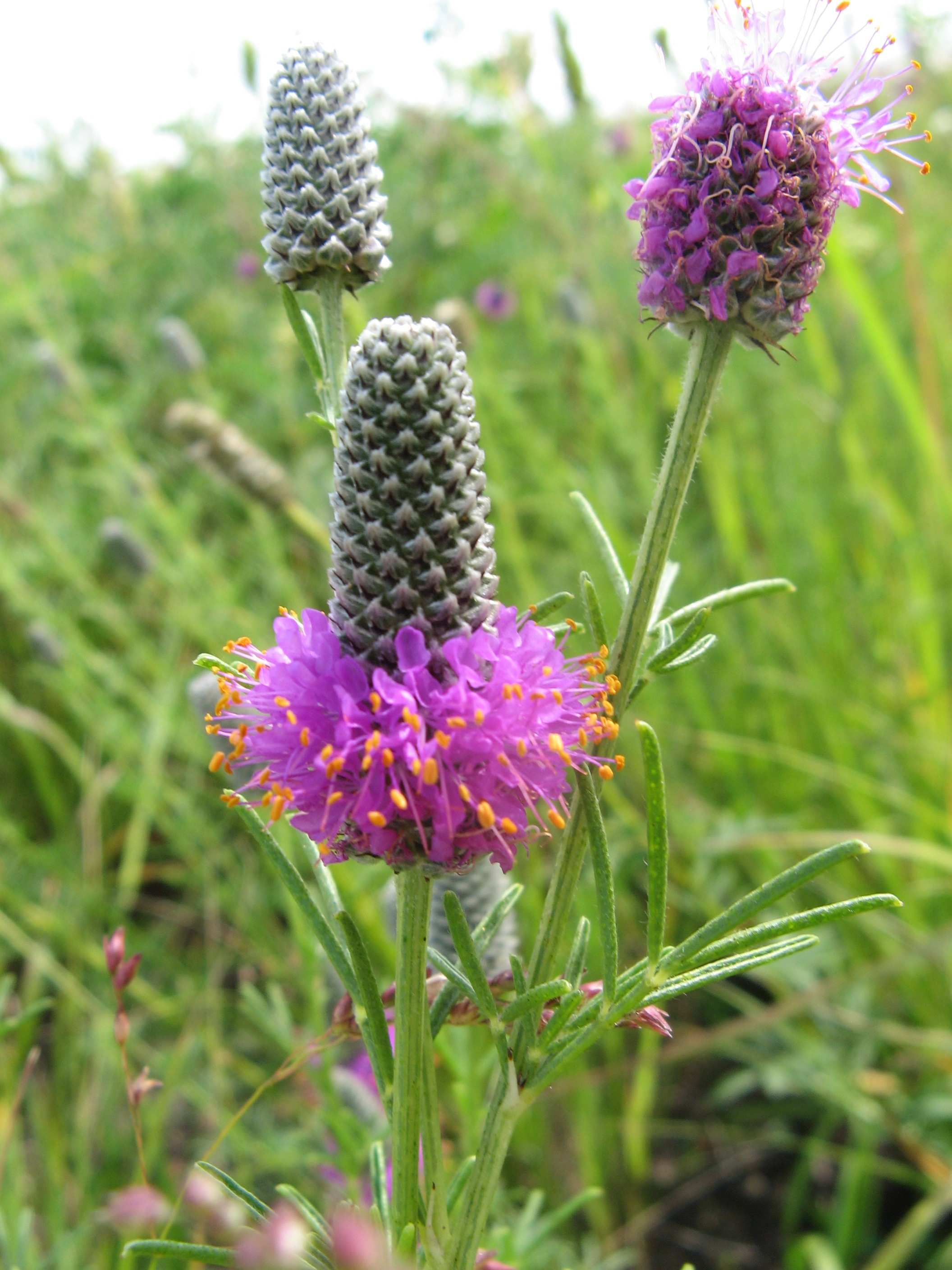
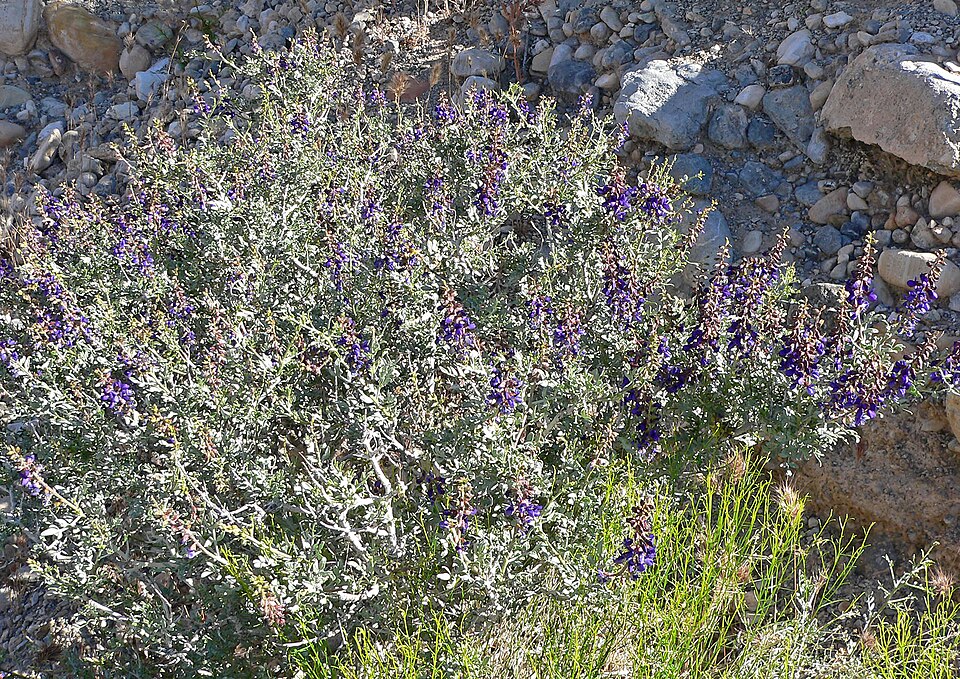
Dalea fremontii, commonly known as Indigo Bush, Fremont’s Indigo Bush, or Fremont Dalea, is one of the most spectacularly flowering native shrubs of the Mojave and Sonoran deserts. When this compact, silvery-gray shrub erupts in bloom from late winter through spring, it transforms into a dense cloud of rich purple-indigo flower clusters that appear almost electric against the pale desert landscape. The fragrance — sweet, floral, and slightly musky — perfumes the air around blooming plants and attracts remarkable concentrations of native bees, which appear in dozens of species to collect the abundant nectar and pollen. For desert pollinator gardens, Indigo Bush is an essential plant.
Growing naturally on rocky desert slopes, canyon walls, and dry washes in the Mojave and Sonoran deserts of California, Nevada, Arizona, and Utah, Dalea fremontii has evolved for some of the harshest conditions in North America. It thrives in shallow, rocky, well-drained soils where summer temperatures routinely exceed 110°F and annual rainfall may be just 3–8 inches. Its silvery foliage color reflects intense solar radiation and reduces heat load on the leaves — an elegant adaptation that simultaneously creates one of the most beautiful ornamental effects in the plant kingdom. The small, glandular leaves produce a subtle but pleasant resinous fragrance that adds another sensory dimension to the desert garden.
The species is named for the American explorer John C. Frémont, who collected plants throughout the West during his famous western surveys in the 1840s. Several plants bear his name, but Dalea fremontii is among the most beautiful of the “Frémont plants.” In Utah, Indigo Bush is found primarily in the Mojave Desert zone of the southwestern part of the state — in Washington County around St. George — where it reaches the northern limit of its range. It is considered one of the most desirable native shrubs for low-water desert landscaping throughout the Southwest.
Identification
Indigo Bush is a compact, rounded shrub typically growing 2 to 4 feet tall and 2 to 4 feet wide (batch data lists 3 ft), with a dense, branching structure that becomes more open and woody with age. The overall appearance is of a fine-textured, silvery-gray mound when out of bloom — and a spectacular purple dome when in flower. It is one of the more reliably compact native shrubs, rarely becoming rangy or unkempt when grown in appropriate conditions.
Stems & Bark
The stems are slender, highly branched, and covered with fine, silvery-white hairs when young. Old stems become grayish-brown and more woody. The plant has a dense, twiggy branching pattern that creates a fine texture even when leafless. There are no thorns or spines. The wood is light and fine-grained. The stem tips are often resinous and aromatic when broken, releasing a pleasant, spicy-sweet fragrance.
Leaves
The leaves are pinnately compound, tiny — just 0.5 to 1 inch long — with 7–17 small, oval leaflets arranged along a slender rachis. Each leaflet is 2–5 mm long, and both the leaflets and leaf stalk are densely covered with fine silvery hairs, giving the entire plant its characteristic silver-gray color. The leaves are dotted with tiny, round glands visible under magnification, which produce the plant’s distinctive resinous fragrance. Despite being so small, the leaves provide effective evapotranspiration reduction through their hairy coating — the hairs trap a layer of still air around each leaf, significantly reducing water loss in the desert heat.
Flowers & Fruit
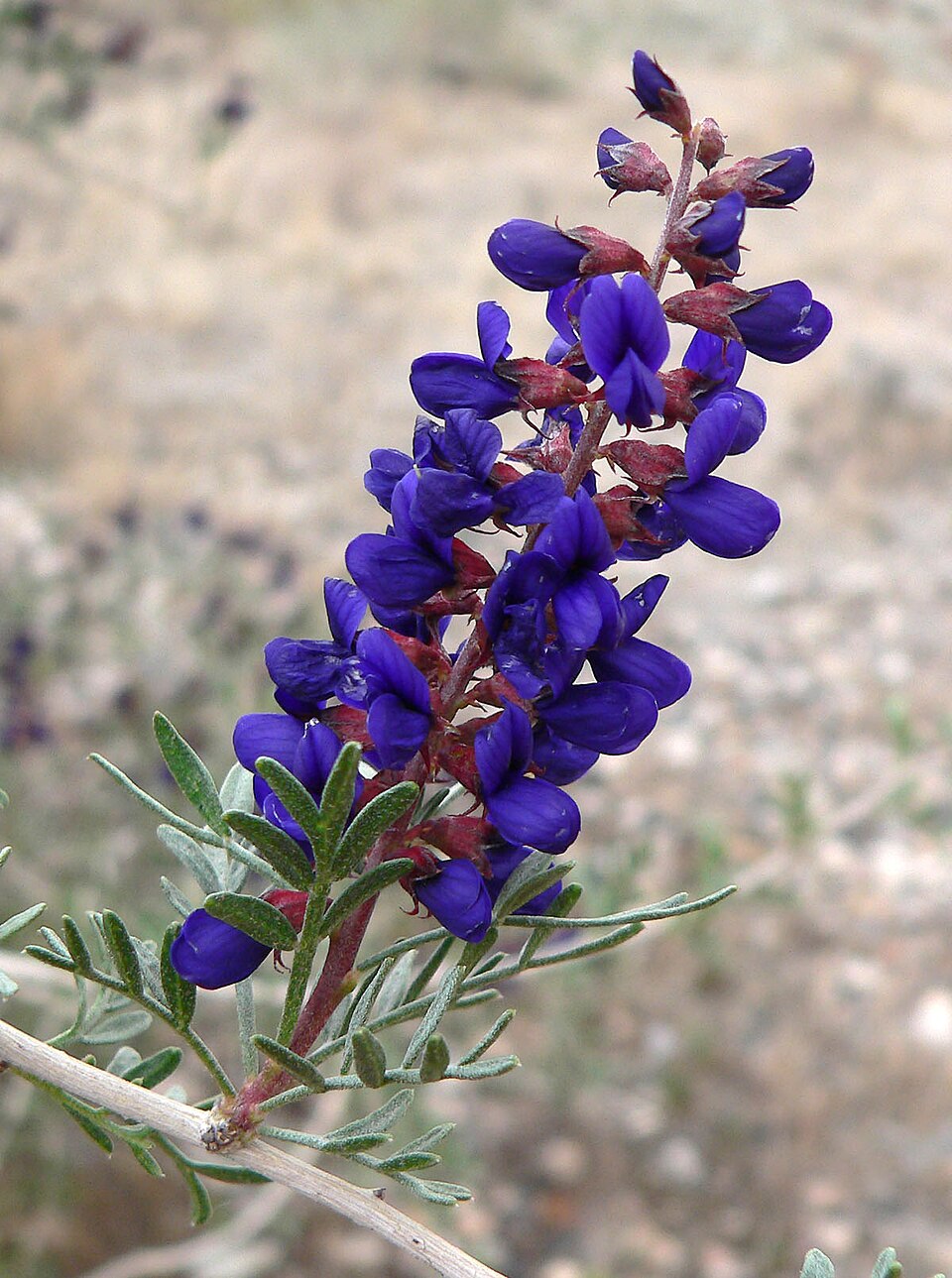
The flowers are the plant’s most striking feature. They are arranged in dense, cylindrical to ovoid flower spikes 1–3 inches long at the branch tips, each consisting of dozens of small pea-like florets in brilliant purple to deep indigo (sometimes reddish-purple) with contrasting golden-yellow stamens. The color intensity is remarkable — these are among the most vividly colored flowers of any native desert shrub. Bloom peaks from February through April, though it can begin as early as January in warm years and continue into June. The fragrance is sweet and floral with a slightly musky undertone that is highly attractive to pollinators. The fruits that follow are small, one-seeded pods enclosed within the persistent calyx — tiny but produced in great numbers.
Quick Facts
| Scientific Name | Dalea fremontii |
| Family | Fabaceae (Legume/Pea) |
| Plant Type | Deciduous Shrub |
| Mature Height | 3 ft |
| Sun Exposure | Full Sun |
| Water Needs | Low (Drought Tolerant) |
| Bloom Time | February – May (peak March – April) |
| Flower Color | Purple / deep indigo |
| USDA Hardiness Zones | 7–11 |
Native Range
Indigo Bush (Dalea fremontii) is native to the Mojave and Sonoran deserts of the southwestern United States. Its U.S. range is relatively compact: it occurs in California (eastern Mojave Desert and desert slopes of the Peninsular Ranges), Nevada (Clark County and the Las Vegas area), Arizona (western and central Mojave Desert margins, Sonoran Desert), and Utah (Washington County in the southwest corner of the state). It typically grows on rocky desert slopes, bajadas, canyon walls, and gravelly washes from near sea level to about 4,000 feet elevation.
In Utah, Dalea fremontii reaches the northern edge of its range in Washington County, where the Mojave Desert extends into Utah’s “Dixie” — the warm, arid southwestern corner of the state centered on the St. George area. Here, Indigo Bush grows in association with other Mojave Desert indicator species including Creosote Bush, Blackbrush, Joshua Tree, and various desert willows. The Utah populations are at the northern range limit and represent an ecologically significant edge population adapted to the coldest end of the species’ tolerance range.
In Mexico, Indigo Bush extends southward into Baja California and Sonora. The species shows some geographical variation across its range, with several recognized varieties differing in leaf size, pubescence, and flower color intensity. The variety found in Utah and Nevada (Dalea fremontii var. fremontii) tends to be the most cold-hardy expression of the species and is the form used in ornamental horticulture. As a legume, Dalea fremontii fixes atmospheric nitrogen through root nodule bacteria, contributing to soil fertility in the nutrient-poor rocky soils it typically inhabits.
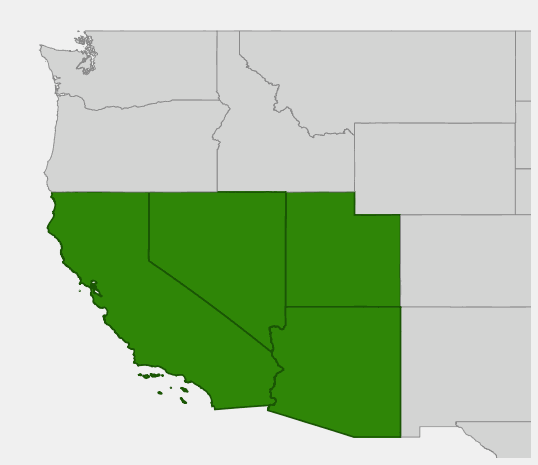
📋 Regional plant lists featuring Indigo Bush: Utah
Growing & Care Guide
Indigo Bush is a rewarding and relatively easy plant to grow in desert and semi-arid climates with the right conditions. The key is providing excellent drainage and full sun — given those fundamentals, it is a tough, long-lived shrub that will reward you with spectacular spring blooms for many years.
Light
Full sun is mandatory. Indigo Bush evolved on open, exposed rocky desert slopes where it receives maximum sunlight throughout the day. In partial shade, it will bloom poorly, grow weakly, and be susceptible to fungal diseases. Plant in the hottest, sunniest location available — south or west-facing exposures near reflective walls are ideal.
Soil & Water
Sharp drainage in rocky or sandy soil is critical. Like most Mojave Desert natives, Indigo Bush is extremely sensitive to overwatering and root rot. Never plant in heavy clay soil or any area with standing water. Rocky, gravelly, or sandy soils with naturally low organic content are ideal. Once established (after 1–2 growing seasons with supplemental irrigation), Indigo Bush requires virtually no supplemental water in desert climates receiving 5+ inches of annual rainfall. During establishment, water deeply every 2–3 weeks in summer. After establishment, quarterly deep watering during drought periods is sufficient — or none at all in climates with adequate winter rainfall.
Planting Tips
Plant in fall or early spring in container-grown form. Indigo Bush does not transplant easily bareroot. Avoid disturbing the root system during transplanting. Mulch with ¾-inch gravel rather than organic mulch to maintain appropriate soil moisture levels around the root crown. Space plants at least 4 feet apart to allow for their natural rounded form. Plant where the spectacular spring bloom can be enjoyed — near patios, along paths, or in prominent positions in the garden where the brilliant purple flowers will have maximum visual impact.
Pruning & Maintenance
Indigo Bush needs minimal pruning. After the spring bloom, light trimming of the flowering branch tips can encourage a second flush of growth. In fall or late winter, remove any dead wood and trim to maintain the compact, rounded shape. Avoid heavy pruning — Indigo Bush is slow to recover from major cuts. No fertilization is needed. Remove any weeds that compete with young plants, but established plants generally hold their own against most weed competition due to their dense, spreading root system.
Landscape Uses
- Desert xeriscape accent — spectacular spring bloom with minimal water
- Pollinator garden centerpiece — major bee and butterfly attractor
- Rock garden specimen — thrives in rocky, well-drained conditions
- Desert hedge or screen — dense branching provides some visual screening
- Slope stabilization — deep roots anchor soil on dry banks
- Foundation planting — compact size fits low-water foundation beds
Wildlife & Ecological Value
Indigo Bush is one of the premier pollinator plants of the Mojave Desert, providing vital nectar and pollen resources during a critical period — late winter and early spring — when few other desert plants are in bloom.
For Birds
While not a major direct food plant for birds, Indigo Bush provides important secondary benefits. The dense, twiggy structure provides nesting sites and cover for desert birds including Black-tailed Gnatcatchers, Verdin, and Cactus Wrens. The abundant insects attracted to the flowering plant create a feeding bonanza for insectivorous birds during the spring bloom period. Verdins and other desert birds use the gum-producing stems for nest materials.
For Mammals
Mule Deer and Desert Bighorn Sheep may browse the foliage in areas where their ranges overlap with Indigo Bush populations, though the resinous leaves are apparently not a preferred browse. Small mammals including Kangaroo Rats and Desert Pocket Mice consume the seeds. The dense, thorny character of old Indigo Bush clumps (produced by the abundance of dead twigs) provides shelter for Desert Cottontails and other small mammals.
For Pollinators
This is where Indigo Bush truly excels. The fragrant purple flower spikes produce abundant nectar and pollen from late winter through spring, attracting extraordinary concentrations of native bees. Specialists include several solitary bee species that collect only Dalea pollen — including Diadasia and Tetralonia species. Honey bees produce a distinctively flavored, high-quality Dalea honey in areas with abundant Indigo Bush populations. Painted Lady butterflies, Desert Checkerspots, and various skipper species are regular visitors for nectar. The early bloom time is especially valuable because it precedes the main spring wildflower show, providing food for pollinators emerging from winter dormancy.
Ecosystem Role
As a nitrogen-fixing legume, Indigo Bush improves desert soil fertility through its symbiotic relationship with nitrogen-fixing bacteria in root nodules. This makes it an important facilitator species on rocky desert slopes where soils are extremely nutrient-poor. It is also a nurse plant — the sheltered microhabitat beneath old Indigo Bush clumps provides ideal germination and establishment conditions for other desert species including cacti and perennial wildflowers.
Cultural & Historical Uses
Various Dalea species (also known as Prairie Clovers) have been used by Indigenous peoples across western North America, and Dalea fremontii was used by desert-dwelling peoples including the Cahuilla, Mojave, and various Yuman-speaking groups of the lower Colorado River region. The Cahuilla ground the seeds and used them as a food source during lean times. The roots and bark were used in traditional medicine — decoctions were prepared for kidney and urinary ailments, and as a general tonic. The plant’s aromatic properties were also employed in ceremonial contexts.
The explorer John C. Frémont, for whom the species is named, encountered Dalea fremontii during his surveys of the western United States in the 1840s. Frémont’s expeditions were among the first scientific surveys of the American West, and the botanical collections he made — preserved at institutions including the Smithsonian — documented hundreds of plant species new to science, including this Dalea. The naming of numerous plants for Frémont reflects the enormous scientific importance of his work in documenting western North American flora.
Today, Indigo Bush is increasingly valued in native plant horticulture. Nurseries in the Southwest — particularly in Arizona, Nevada, and southern Utah — are expanding their production of Dalea fremontii in response to growing demand from homeowners and landscape professionals seeking drought-tolerant, high-impact flowering plants. Its combination of spectacular bloom, tiny water footprint, and exceptional pollinator value makes it increasingly recognized as one of the premier plants for sustainable desert landscaping. Conservation organizations also use it in revegetation of degraded desert habitats, particularly on disturbed rocky slopes and desert roadcuts where few other native shrubs will establish readily.
Frequently Asked Questions
When does Indigo Bush bloom?
In the Mojave Desert and southern Utah, Indigo Bush typically begins blooming in February and peaks in March–April. The bloom duration is 4–8 weeks depending on temperature. In warm years it may start as early as January; in cold years it may not peak until May. After the main spring bloom, occasional scattered flowers may appear through summer, particularly if summer monsoon rains occur.
Is Indigo Bush the same as Desert Indigo?
Dalea fremontii (Fremont’s Indigo Bush) should not be confused with Amorpha fruticosa (False Indigo Bush) or Baptisia species (True Indigo). Despite sharing the “Indigo Bush” name, these are unrelated plants. Dalea fremontii is a low, compact desert shrub native to the Mojave and Sonoran deserts; the others are plants of moister environments. The vivid purple flower color of Dalea fremontii earns it the “indigo” designation.
How cold-hardy is Indigo Bush?
Dalea fremontii is reliably hardy to approximately 0–10°F (USDA Zone 7), making it suitable for southern Utah, the Las Vegas area, and similar climates. Brief dips to -5°F may be tolerated by established plants. It is not suitable for cold-winter areas with prolonged freezes below 0°F. In borderline zones, plant in a sheltered south-facing microclimate with excellent drainage to maximize cold hardiness.
Why is my Indigo Bush not blooming?
Most commonly, poor blooming is caused by insufficient light. Indigo Bush requires full sun — at least 6–8 hours of direct sun daily — for good flower production. Other causes include overwatering (which promotes vegetative growth at the expense of flowers), heavy pruning shortly before the bloom period, or planting in a climate that is too cold for the species.
Can Indigo Bush be grown in containers?
Yes, with the right conditions. Use a fast-draining cactus/succulent mix, a terra cotta or unglazed ceramic pot with excellent drainage holes, and place in full sun. Water deeply but infrequently. Containers in desert climates can get extremely hot on south-facing exposures, which actually benefits Indigo Bush — just ensure adequate drainage so the roots never sit in standing water. Repot every 2–3 years to refresh the soil.
Looking for a nursery that carries Indigo Bush?
Browse our native plant nursery directory: Utah