Ladyfingers (Dudleya edulis)
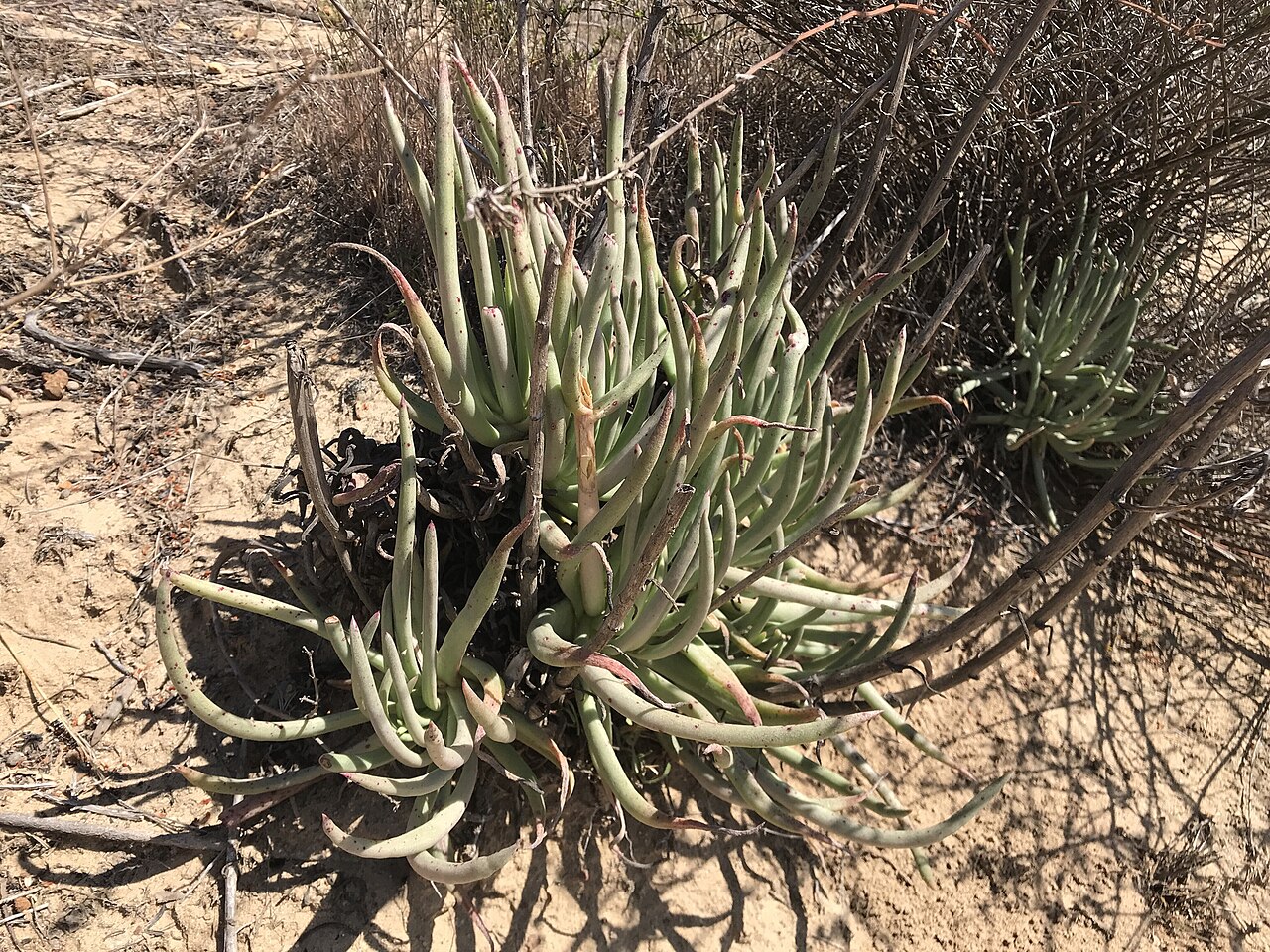
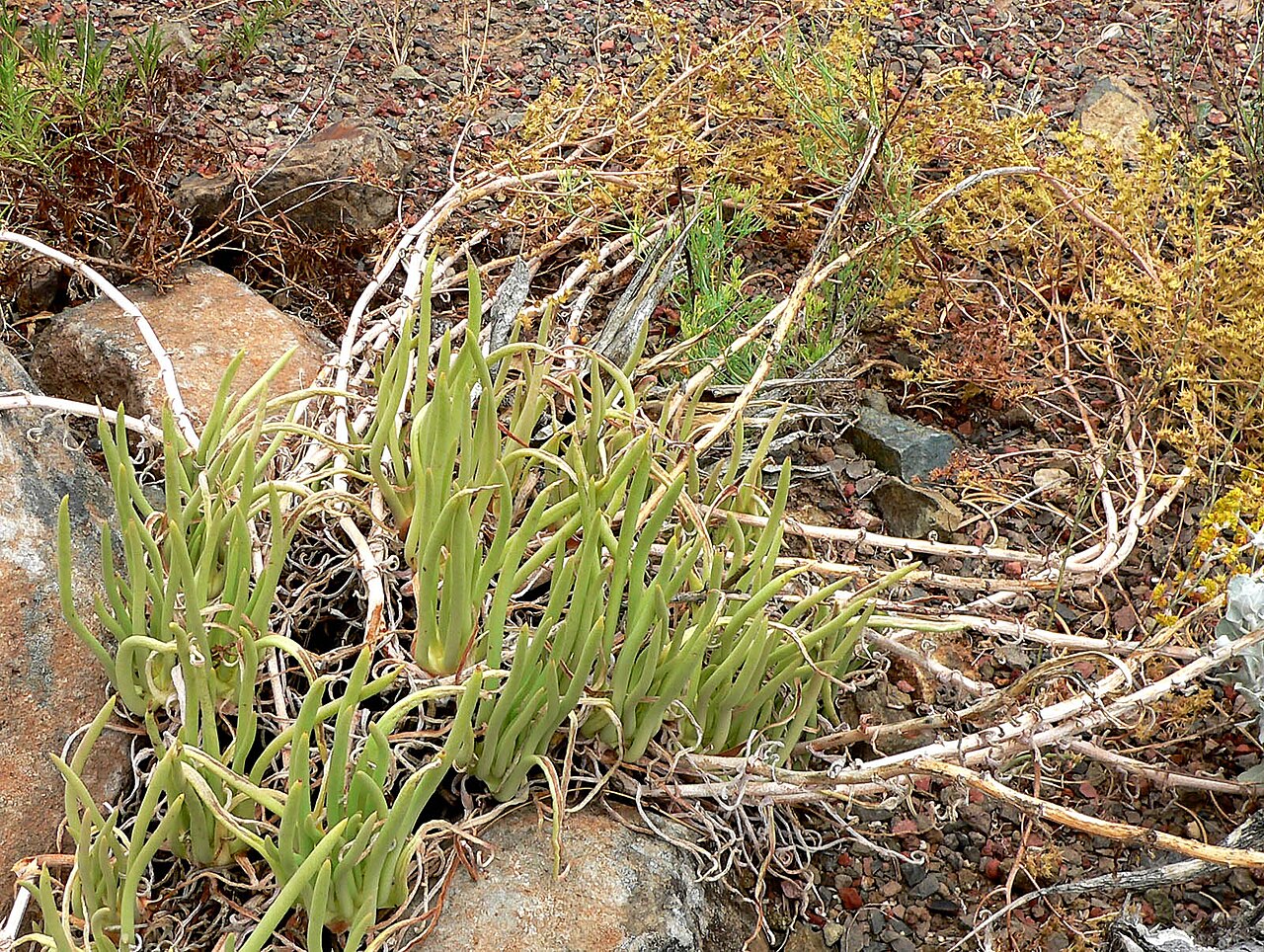
Dudleya edulis, commonly called ladyfingers, fingertips, mission lettuce, or San Diego dudleya, is a clump-forming succulent in the stonecrop family (Crassulaceae) found almost nowhere outside San Diego County, California, and the immediately adjoining Baja California coast. Its common name describes the plant perfectly: slender, cylindrical, pale green leaves radiate upward from the base like a bundle of fingers, giving each rosette a distinctive, almost sculptural look against bare rock.
The species epithet edulis means “edible,” a reference to the Kumeyaay people’s traditional practice of harvesting and eating the plant’s tender young flower stalks in spring, long before European contact. This history, along with the plant’s striking form, has made ladyfingers a favorite of San Diego-area native plant gardeners looking for an unmistakably regional succulent.
Ladyfingers is built for one of the toughest environments in coastal Southern California: steep, sun-blasted sandstone cliffs and dry chaparral slopes where little water ever reaches the soil except as condensing marine fog. Its leaves are adapted to pull moisture directly from that nightly fog layer, making it a strong candidate for xeriscapes, rock gardens, and coastal native plantings that need a true no-irrigation succulent.
Identification
Ladyfingers forms low, spreading clumps of rosettes rather than a single dominant stem, with new offsets forming at the base over time to create a mounding colony several rosettes wide.
Leaves
The leaves are the plant’s defining feature: fleshy, cylindrical, and tapering to a point, pale green to grayish-green, and growing upright from a short underground caudex to about 8 inches (20 cm) tall. Their rounded, finger-like cross-section (rather than the flatter, broader leaves of many other Dudleya) is the easiest way to distinguish this species at a glance. In full sun and drought stress the leaf tips often take on pink to reddish tones.
Flowers
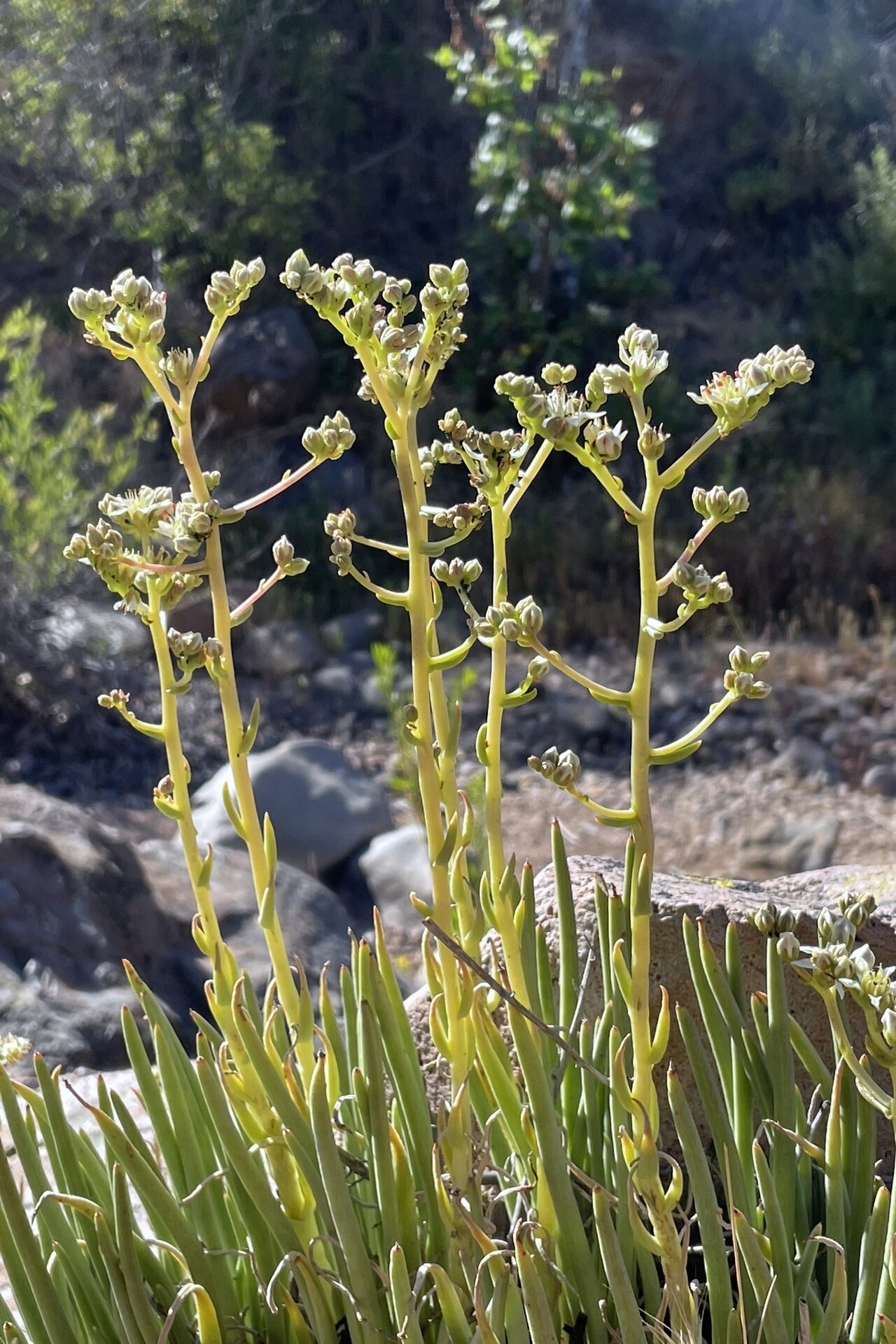
In late spring, mature rosettes send up branching flowering stalks 4 to 20 inches (10–50 cm) tall, well above the leaves, each bearing up to 10 or 11 small flowers per branch. The flowers have pointed, white to cream petals about a centimeter long, giving the whole inflorescence a frothy, pale appearance that stands out against the plant’s green foliage and gray rock surroundings. Bloom runs from May into July.
Growth Habit
As a true succulent, ladyfingers stores water in its leaves and is drought-dormant through the hottest, driest part of summer and fall, when older leaves may shrivel slightly. It typically grows rooted directly in rock crevices, on bare sandstone, or in thin, well-drained soil pockets on steep slopes — conditions that exclude most competing vegetation.
Quick Facts
| Scientific Name | Dudleya edulis |
| Family | Crassulaceae (Stonecrop) |
| Plant Type | Perennial Succulent |
| Mature Height | 8 in leaves; flower stalks to 20 in (0.5 m) |
| Mature Spread | 12–24 in clumping colony |
| Growth Rate | Slow |
| Sun Exposure | Full Sun to Part Sun |
| Water Needs | Very Low (summer-dry) |
| Soil Type | Rocky, sandy, fast-draining; tolerates bare rock crevices |
| Soil pH | Neutral to slightly alkaline |
| Bloom Time | May – July |
| Flower Color | White to cream |
| Deer Resistant | Yes |
| USDA Hardiness Zones | 9b–11 |
Native Range
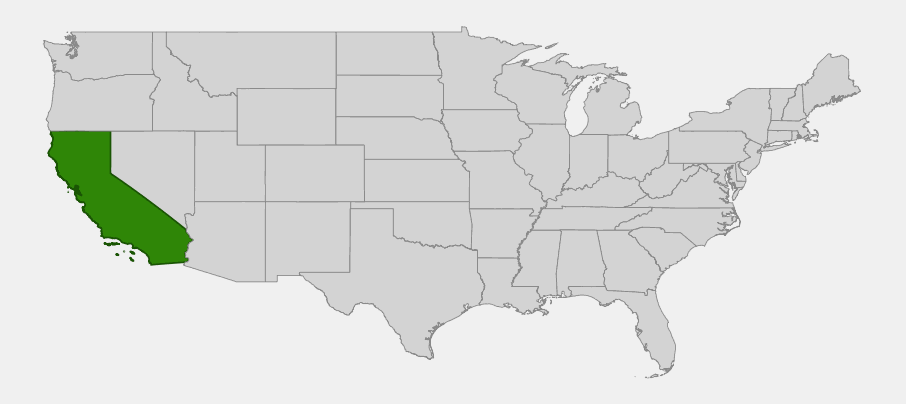
Ladyfingers is native to a narrow band of coastal and near-coastal Southern California, with its core range running from coastal and inland Orange County south through southern Riverside County and through San Diego County, extending roughly 40 miles inland from the ocean. From there its range continues south across the border into northwestern Baja California, Mexico, where it reaches into the Rio San Vicente drainage toward the southwest flank of Cuyamaca Peak.
Throughout its range, ladyfingers grows almost exclusively on sandstone sea cliffs, rocky hillsides, and exposed rock outcrops within coastal sage scrub and chaparral plant communities, from sea level up to around 4,200 feet (1,300 m) in elevation. Along the coast it faces the ocean directly, where it is adapted to intense wind, salt spray, and the nightly marine fog layer that rolls in and settles as dew — its primary water source through the dry season. Further inland and south into Baja California, plants shift to growing primarily on north-facing slopes rather than the west-facing maritime exposures typical of the coastal populations.
Ladyfingers is not currently listed as threatened or endangered, but like much of San Diego County’s coastal sage scrub and chaparral habitat, its range overlaps heavily with areas under pressure from coastal development, making the undisturbed bluffs and canyons where it grows increasingly valuable for native plant conservation.
📋 Regional plant lists featuring ladyfingers: California & Nevada
Growing & Care Guide
Ladyfingers is an excellent, low-maintenance succulent for San Diego and Southern California coastal gardens, as long as it is given the sharp drainage and minimal summer water it needs to avoid rot.
Light
Full sun to light part shade. Coastal gardens with regular marine fog can grow it in fuller sun than hot inland sites, where a bit of afternoon shade helps prevent leaf scorch.
Soil & Water
Sharp drainage is essential — rocky, sandy, or gravelly soil that never holds standing water. Plant on a slope, in a rock garden, or atop a raised mound if your native soil is heavier. Established plants need little to no supplemental irrigation; in gardens without regular coastal fog, an occasional deep soak during the first year or two of establishment helps, but overwatering, especially in summer, is the most common cause of failure. Good air circulation around the base also helps prevent rot in humid microclimates.
Planting Tips
Plant in fall or winter, when rains naturally support root establishment without the risk of summer rot. Set the caudex at or slightly above soil level, never buried, and mulch with coarse gravel rather than organic mulch, which holds moisture against the base of the plant. Space clumps 12 to 18 inches apart to allow colonies to spread naturally over time.
Pruning & Maintenance
Essentially none required. Spent flower stalks can be cut back after bloom if a tidier look is desired, but leaving them lets seed disperse for naturalized colonies. Avoid overhead watering and keep irrigation away from the rosette base.
Propagation
By seed sown in fall, or by carefully removing and rooting offset rosettes, which form readily at the base of mature clumps. Offsets are the faster and more reliable method for gardeners wanting established-looking plants sooner.
Landscape Uses
- Rock gardens and dry-stacked walls — thrives rooted directly in crevices
- Xeriscape and no-irrigation coastal gardens
- Container and pot specimens for patios and courtyards
- Coastal sage scrub restoration plantings in San Diego County
- Slope stabilization on dry, rocky banks where little else will grow
Wildlife & Ecological Value
Though small in stature, ladyfingers contributes meaningfully to the coastal sage scrub and chaparral communities it anchors in San Diego County.
For Pollinators
The small white to cream flowers attract native bees and other small pollinating insects during the late spring to summer bloom period, a time when many of the region’s showier wildflowers have already finished. The branching flower stalks, held well above the foliage, make the blooms easy for flying insects to find against the surrounding rock.
Wildlife Value
The dense, fleshy rosettes provide cover for small lizards and invertebrates on otherwise exposed rock faces, and the plant’s root system helps stabilize thin soils on steep slopes, reducing erosion in habitat that often has little else anchoring it.
Ecosystem Role
As one of relatively few succulent species adapted specifically to San Diego County’s sandstone cliffs and canyon walls, ladyfingers occupies a niche that few other native plants can fill, surviving in conditions too dry, exposed, and nutrient-poor for most competing vegetation. Its continued presence is often used as an indicator of relatively undisturbed coastal sage scrub and chaparral habitat.
Cultural & Historical Uses
Ladyfingers has a long documented history of use by the Kumeyaay people, the Indigenous inhabitants of the San Diego region, who traditionally harvested the plant’s tender young flower stalks, or scapes, in early spring and ate them raw. The Tiipai members of the Kumeyaay had a specific name, milh kajmila, for the narrow-leaved Dudleya species of their territory, including this one. This traditional foraging practice is the direct source of the species name edulis, meaning “edible.”
American botanist Thomas Nuttall first collected and described the species during his visit to California in the 1830s, noting it on “rocks and ravines, St. Diego” and initially placing it, somewhat unusually, in the genus Sedum. The plant was later moved through several genus reassignments — including a period in the now-obsolete genus Stylophyllum — before settling into its current placement within Dudleya following Reid Moran’s 20th-century revision of the genus.
Today ladyfingers is grown primarily as an ornamental succulent, valued by Southern California native plant gardeners for its sculptural leaf form and its unmistakable connection to San Diego County’s coastal sandstone landscape. It is a regular presence in native and drought-tolerant rock gardens throughout the region.
Frequently Asked Questions
Why is it called “ladyfingers”?
The name describes the plant’s slender, cylindrical, finger-like leaves, which radiate upward from the base in a shape that resembles a bundle of fingers. It is unrelated to the okra dish of the same common name.
Is ladyfingers edible?
The Kumeyaay people traditionally harvested the plant’s young flower stalks in spring and ate them raw, which is the source of the species name edulis (“edible”). This is a documented historical practice rather than a current recommendation; foraging any wild plant requires correct identification and local knowledge.
Can I grow ladyfingers outside San Diego County?
Yes, as long as the climate is mild (roughly USDA zones 9b–11) and the soil drains sharply. It is widely grown throughout coastal and inland Southern California gardens, though it benefits from the fog and mild temperatures of its native coastal range.
How much water does ladyfingers need?
Very little once established. In its native coastal fog belt it needs no supplemental irrigation at all. In drier inland gardens, an occasional deep soak during the first year or two of establishment is helpful, but overwatering — especially in summer — is the most common cause of rot and plant loss.
Does ladyfingers flower every year?
Yes, mature rosettes typically send up a branching flower stalk each spring, usually blooming from May into July, though a very young or stressed plant may skip a season before it is established enough to flower.

Looking for a nursery that carries Ladyfingers?
Browse our native plant nursery directory: California