Lobelia (Lobelia puberula)
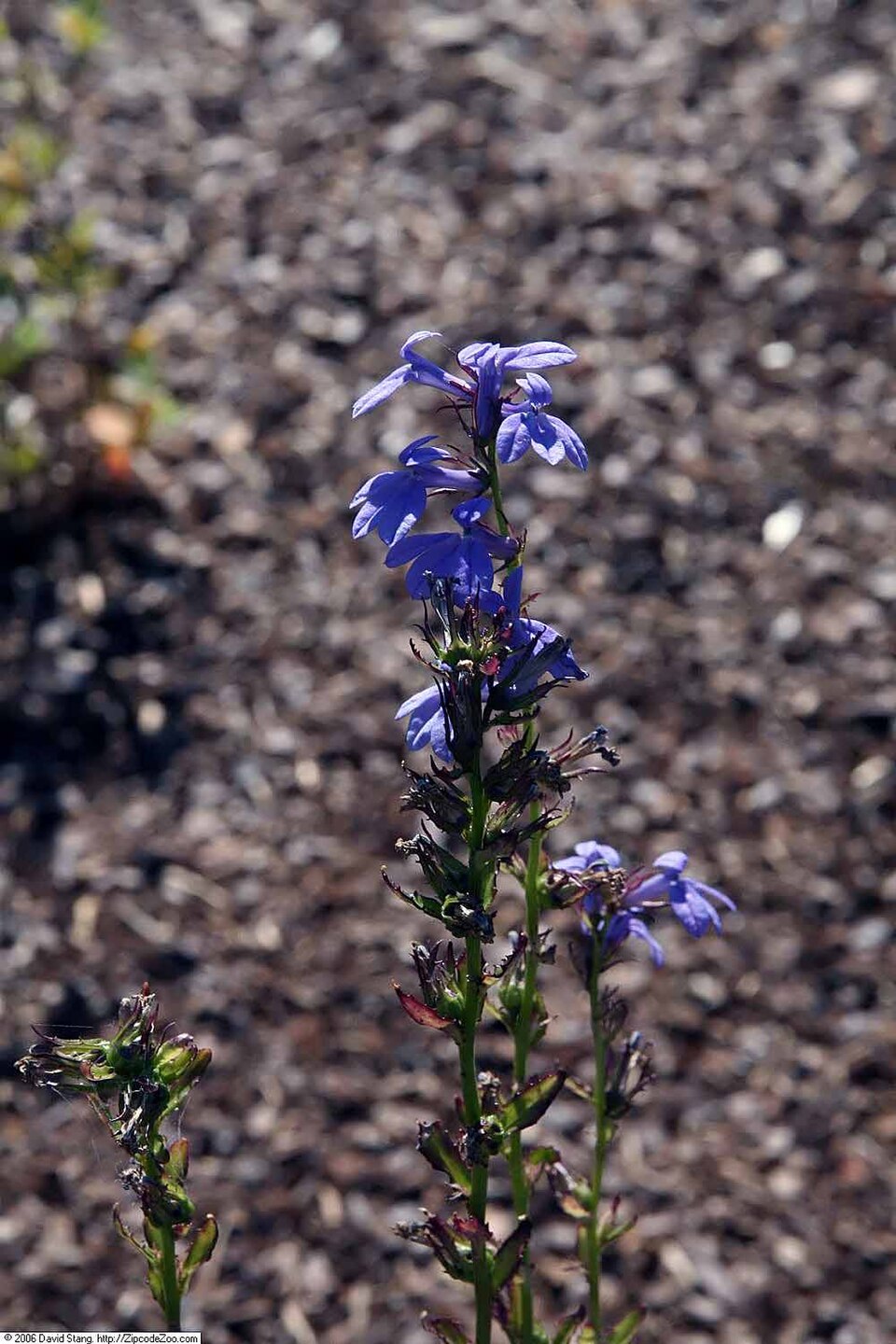
Lobelia puberula, commonly known as Lobelia, Downy Lobelia, or Blue Downy Lobelia, is a striking native perennial wildflower of the southeastern United States that brings brilliant blue to violet spikes of color to late summer and autumn landscapes. This member of the Campanulaceae (bellflower) family is distinguished by its tall, unbranched flowering stems that rise 2 to 4 feet high, topped with dense racemes of distinctive two-lipped tubular flowers that range from pale blue to deep violet-purple.
Growing naturally in moist to moderately dry soils from full sun to partial shade, Lobelia is particularly valued for its late-season blooms when many other native wildflowers have finished flowering. The plant’s lance-shaped leaves are densely covered with soft hairs (pubescent), giving the species its specific epithet “puberula,” meaning “slightly hairy.” This downy texture helps distinguish it from other native lobelias and contributes to the plant’s overall silvery-green appearance that contrasts beautifully with its vivid flower spikes.
Beyond its ornamental appeal, Lobelia puberula plays an important ecological role as a late-season nectar source for butterflies, bees, and other pollinators when few other flowers are available. The plant’s adaptability to various light conditions and moderate drought tolerance makes it an excellent choice for native plant gardens, butterfly gardens, and naturalized meadow plantings throughout its native range in the Carolinas and much of the southeastern United States.
Identification
Lobelia puberula is a herbaceous perennial that typically reaches 2 to 4 feet in height, growing as an erect, usually unbranched stem topped with a distinctive flowering spike. The entire plant has a characteristic downy or pubescent texture that gives it a soft, grayish-green appearance and helps distinguish it from closely related species.
Stems & Growth Form
The main stem is simple (unbranched), round in cross-section, and densely covered with soft, fine hairs. The plant grows from a basal rosette in spring, sending up one or more flowering stems that remain upright throughout the growing season. The stem is typically green to slightly reddish, becoming more woody at the base as the season progresses.
Leaves
The leaves are alternate, simple, and lance-shaped (lanceolate), measuring 1 to 4 inches long and ½ to 1 inch wide. They are widest near the middle and taper to both ends, with the lower leaves generally larger than those higher on the stem. All leaf surfaces are covered with soft, dense hairs that give them a grayish-green, velvety appearance. The leaf margins are finely toothed (serrate), and the leaves lack petioles, attaching directly to the stem (sessile).
Flowers
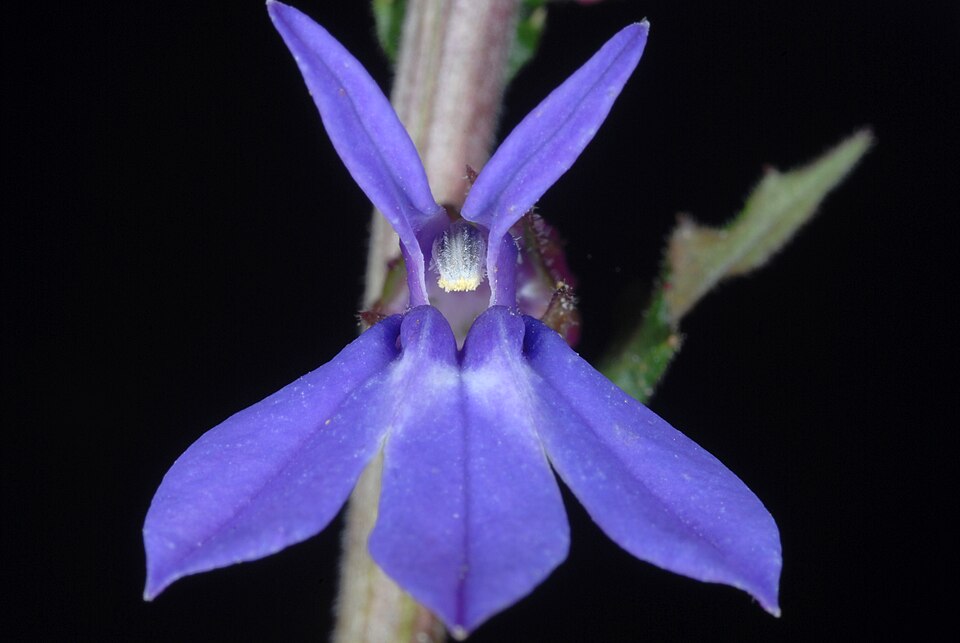
The flowers are the plant’s most distinctive feature, arranged in dense, spike-like terminal racemes 4 to 12 inches long. Individual flowers are tubular, about ½ to ¾ inch long, and strongly two-lipped (bilabiate). The upper lip is divided into two narrow lobes, while the lower lip is broader and divided into three lobes. Flower color ranges from pale blue to deep violet-purple, with occasional white forms. The flowers bloom from the bottom of the spike upward, creating a prolonged blooming period from late summer through fall.
Fruit & Seeds
The fruit is a small capsule containing numerous tiny seeds. The capsules split open when mature, releasing the seeds which can be dispersed by wind. Each plant can produce thousands of seeds, contributing to its ability to naturalize in suitable habitats.
Quick Facts
| Scientific Name | Lobelia puberula |
| Family | Campanulaceae (Bellflower) |
| Plant Type | Herbaceous Perennial |
| Mature Height | 2–4 ft |
| Sun Exposure | Full Sun to Full Shade |
| Water Needs | Moderate |
| Bloom Time | August – October |
| Flower Color | Blue to violet |
| USDA Hardiness Zones | 5–9 |
Native Range
Lobelia puberula is native to the eastern and southeastern United States, with its primary range extending from New Jersey and Pennsylvania south to Florida and west to eastern Texas and Oklahoma. The species is most abundant in the southeastern coastal plain and piedmont regions, where it thrives in the warm, humid climate and diverse soil conditions typical of this region.
The plant naturally occurs in a variety of habitats including moist meadows, prairie edges, open woodlands, and along streams and pond margins. It is particularly common in disturbed or semi-open areas where competition from woody plants is limited but moisture remains adequate. In the wild, Lobelia puberula often forms colonies through both seed dispersal and vegetative spread, creating impressive displays of blue flowers in late summer.
Within its native range, the species shows considerable adaptability to different soil types and moisture conditions, from sandy coastal plain soils to heavier clay soils of the interior. This adaptability has made it a valuable plant for restoration projects and native landscaping throughout much of the southeastern United States, where it helps support late-season pollinator populations.
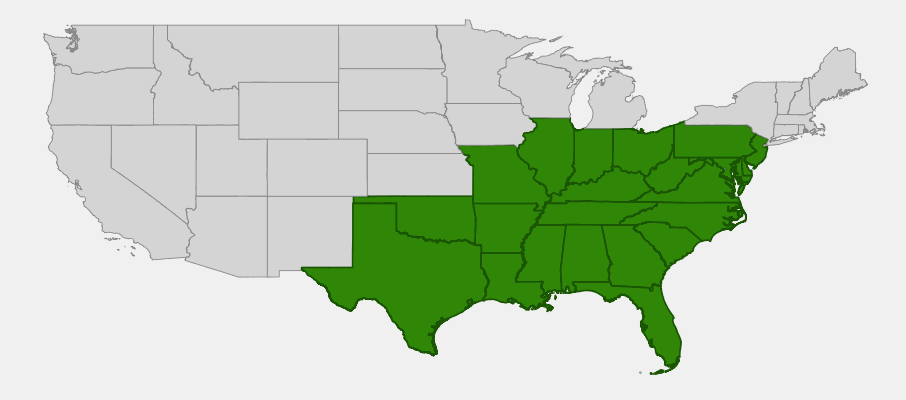
📋 Regional plant lists featuring Lobelia: North Carolina & South Carolina
Growing & Care Guide
Lobelia puberula is a relatively low-maintenance native perennial that adapts well to cultivation when provided with appropriate growing conditions. Its tolerance for various light levels and moderate drought make it suitable for a wide range of garden situations.
Light
This versatile plant performs well in full sun to partial shade, and can even tolerate full shade conditions, though flowering may be reduced in very low light. In full sun, plants tend to be more compact and flower more profusely, while in partial shade they may grow taller and have a more open habit. The plant’s natural pubescent covering helps protect it from intense sunlight and reduces water loss.
Soil & Water
Lobelia puberula prefers moist, well-drained soils but shows good tolerance for periodic drought once established. It grows well in a wide range of soil types, from sandy to clay soils, with a preference for slightly acidic to neutral pH (6.0–7.5). While the plant can tolerate wet conditions, it does not thrive in permanently waterlogged soils. Regular watering during establishment and dry periods will promote the best growth and flowering.
Planting Tips
Plant Lobelia puberula in spring or fall when temperatures are moderate. Choose a site that receives at least 4-6 hours of sunlight for best flowering, though partial shade sites will also work. Space plants 12-18 inches apart to allow for their natural spread. The plant can be started from seed sown directly in the garden in fall or early spring, or from nursery-grown plants.
Pruning & Maintenance
This is a low-maintenance perennial that requires minimal care once established. Deadheading spent flower spikes can prolong blooming and prevent excessive self-seeding if desired. Cut stems back to ground level in late fall or early spring. The plant may self-seed readily in suitable conditions, which can be either beneficial for naturalizing or managed by removing seed heads before they mature.
Landscape Uses
Lobelia puberula is excellent for:
- Butterfly and pollinator gardens — provides late-season nectar when few other flowers are blooming
- Native plant gardens — authentic southeastern wildflower
- Naturalized meadows — creates drifts of blue color in late summer
- Rain gardens — tolerates both wet and dry periods
- Cottage gardens — adds vertical interest and late-season color
- Roadside and restoration plantings — tolerates poor soils and difficult conditions
Wildlife & Ecological Value
Lobelia puberula provides significant ecological benefits, particularly as a late-season nectar source when many other native flowers have finished blooming. Its extended flowering period from late summer through fall makes it especially valuable for supporting pollinator populations preparing for winter.
For Pollinators
The tubular flowers of Lobelia are specially adapted for pollination by long-tongued insects, particularly butterflies and moths. Common visitors include swallowtail butterflies, skippers, and sphinx moths. The flowers’ blue to violet coloration is particularly attractive to butterflies, which can see into the ultraviolet spectrum. Native bees, including bumblebees and leafcutter bees, also visit the flowers for nectar.
For Birds
While not a primary food source for birds, the numerous tiny seeds produced by Lobelia can provide food for small songbirds, particularly finches and sparrows. The dense flower spikes also attract small insects that become food for insectivorous birds during the late summer and fall migration period.
For Other Wildlife
The nectar-rich flowers support various beneficial insects including native flies and beetles. Small mammals rarely browse the foliage, as lobelias contain alkaloids that make them unpalatable to most herbivores. This chemical protection allows the plants to maintain their attractive appearance throughout the growing season.
Ecosystem Role
As a late-blooming native perennial, Lobelia puberula helps extend the flowering season in natural plant communities, providing crucial resources when other food sources are becoming scarce. Its ability to grow in semi-disturbed areas makes it valuable for ecological restoration, helping to stabilize soils while supporting biodiversity.
Cultural & Historical Uses
Like other members of the Lobelia genus, Lobelia puberula has a history of use in traditional medicine, though it should be noted that all lobelias contain potentially toxic alkaloids and should not be consumed without expert knowledge. Indigenous peoples of the southeastern United States recognized various species of lobelia for their medicinal properties, though specific historical uses of L. puberula are less well documented than those of its more famous relative, L. inflata (Indian tobacco).
The genus name “Lobelia” honors Matthias de l’Obel (1538-1616), a Flemish botanist and physician who served as botanist to King James I of England. The specific epithet “puberula” refers to the plant’s characteristic downy or pubescent covering, from the Latin meaning “somewhat hairy” or “downy.” This distinguishing feature was recognized early by botanists as a key identifying characteristic of the species.
In modern times, Lobelia puberula has gained appreciation primarily as an ornamental plant valued for its late-season blooms and wildlife benefits. It has become increasingly popular in native plant gardening and ecological restoration projects throughout the southeastern United States. The plant’s tolerance for various growing conditions and its spectacular display of blue flowers have made it a favorite among gardeners seeking to create habitat for butterflies and other pollinators.
Contemporary research has focused on the plant’s ecological role and its potential for use in sustainable landscaping and restoration ecology. Studies have documented its value as a pollinator plant and its ability to thrive in disturbed habitats, making it useful for revegetation projects and rain garden installations. The species is now commonly available from native plant nurseries and is included in many regional wildflower seed mixes designed for southeastern ecosystems.
Frequently Asked Questions
Is Lobelia puberula the same as Cardinal Flower?
No, Lobelia puberula (Blue Downy Lobelia) is a different species from Lobelia cardinalis (Cardinal Flower). While both are native lobelias, Cardinal Flower has bright red flowers and typically grows in wetter conditions, while Lobelia puberula has blue to violet flowers and tolerates drier soils.
Is Lobelia puberula toxic to pets?
Yes, like all lobelias, this plant contains alkaloids that can be toxic if consumed in significant quantities. However, the bitter taste generally deters animals from eating it. As with any potentially toxic plant, monitor pets and children around it, though serious poisoning is uncommon due to the plant’s unpalatable taste.
How can I encourage Lobelia to self-seed?
Allow the flower spikes to remain on the plant through winter rather than deadheading them all. The tiny seeds will be released naturally and may germinate the following spring. Disturbed or lightly tilled soil provides ideal germination conditions for the small seeds.
Why aren’t my Lobelia plants blooming well?
Poor flowering can result from too much shade, overly rich soil (which promotes foliage growth at the expense of flowers), or drought stress during bud formation. Ensure plants receive at least 4-6 hours of sunlight and consistent moisture during the growing season.
Can Lobelia puberula be grown from seed?
Yes, the plant is easily grown from seed. Sow seeds in fall or early spring on the soil surface (they need light to germinate) and keep moist until germination occurs. Seeds may take 2-4 weeks to germinate. Plants grown from seed typically bloom in their second year.

Looking for a nursery that carries Lobelia?
Browse our native plant nursery directory: North Carolina · South Carolina