
Mountain Laurel (Kalmia latifolia)
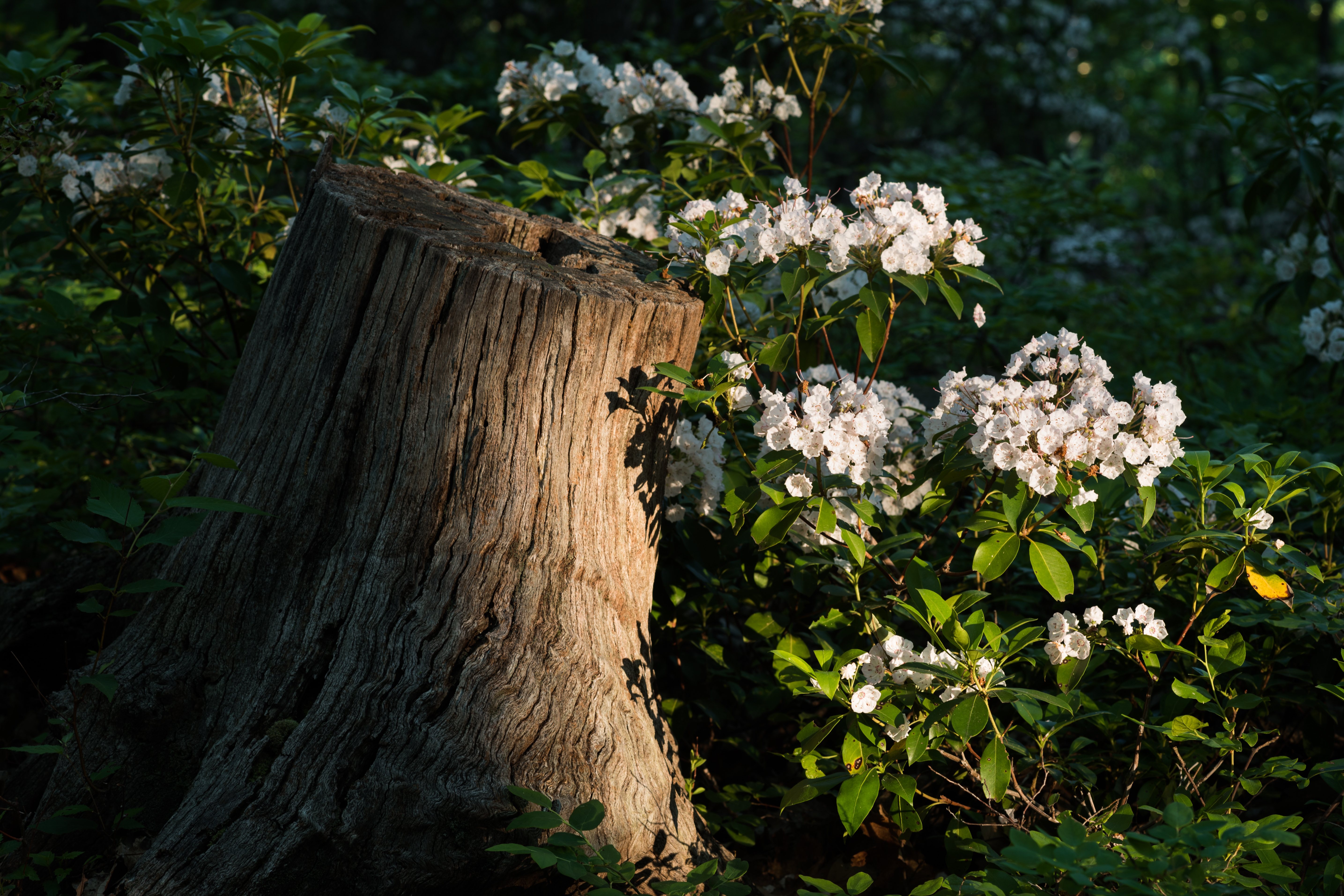
Kalmia latifolia, commonly known as Mountain Laurel, Calico Bush, or Spoonwood, is one of North America’s most spectacular flowering shrubs and a cornerstone species of the eastern deciduous forest. This member of the Ericaceae (heath) family creates breathtaking displays each spring when its dense clusters of cup-shaped flowers — ranging from pure white to deep pink with intricate crimson markings — cover the evergreen foliage like nature’s own fireworks. The name “Mountain Laurel” reflects its preference for higher elevations and rocky slopes, though it thrives in a variety of forest habitats from Connecticut to Florida.
A slow-growing but long-lived shrub, Mountain Laurel typically reaches 5 to 15 feet in height, though exceptional specimens can grow much larger — some reaching 20-40 feet in ideal conditions. Its glossy, dark green leaves remain evergreen through winter, providing year-round structure in the landscape. The shrub’s dense, twisting branches create perfect nesting sites for birds, while its spectacular May blooms support dozens of native pollinators including bees, butterflies, and hummingbirds.
Despite being toxic to livestock (earning it the alternate name “sheep-kill”), Mountain Laurel is completely safe in the landscape and offers exceptional value for native plant gardens, naturalized areas, and wildlife habitat. Its ability to thrive in both sun and shade, tolerance of acidic soils, and stunning seasonal interest make it one of the finest native shrubs for eastern North American gardens.
Identification
Mountain Laurel is a distinctive evergreen shrub with a dense, rounded growth habit. Young plants often appear more compact and bushy, while mature specimens develop an open, graceful form with picturesque twisted trunks and branches. The bark is smooth and reddish-brown on young stems, becoming darker and more furrowed with age.
Leaves
The leaves are perhaps Mountain Laurel’s most recognizable feature — they are alternate, simple, and evergreen, measuring 2-5 inches long and 1-2 inches wide. Each leaf is elliptical to oblong with a leathery texture, glossy dark green upper surface, and lighter green underside. The leaf margins are entire (smooth-edged), and the prominent midvein gives each leaf a slightly cupped appearance. Young leaves often have a bronze or reddish tint before maturing to their characteristic deep green.
Flowers
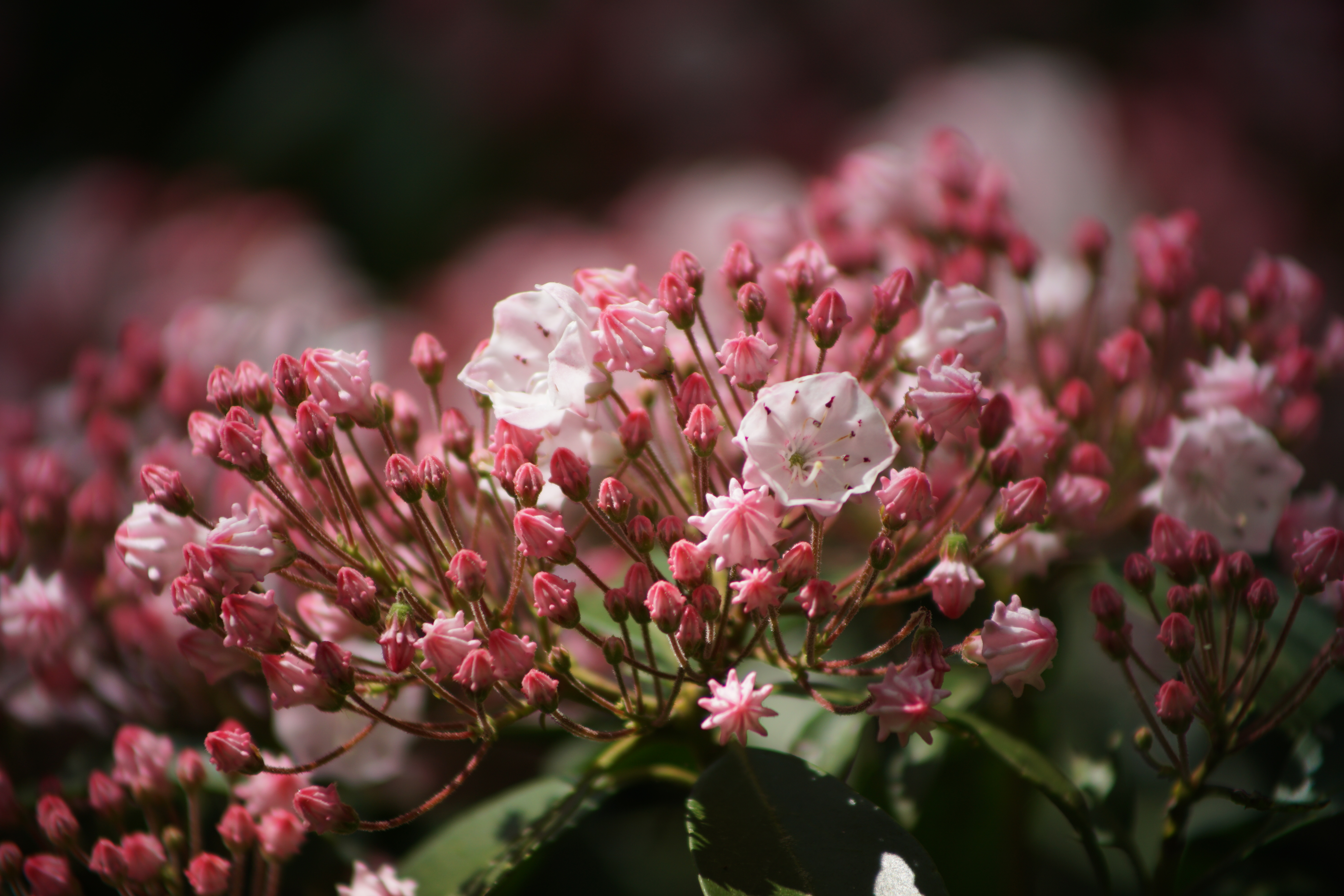
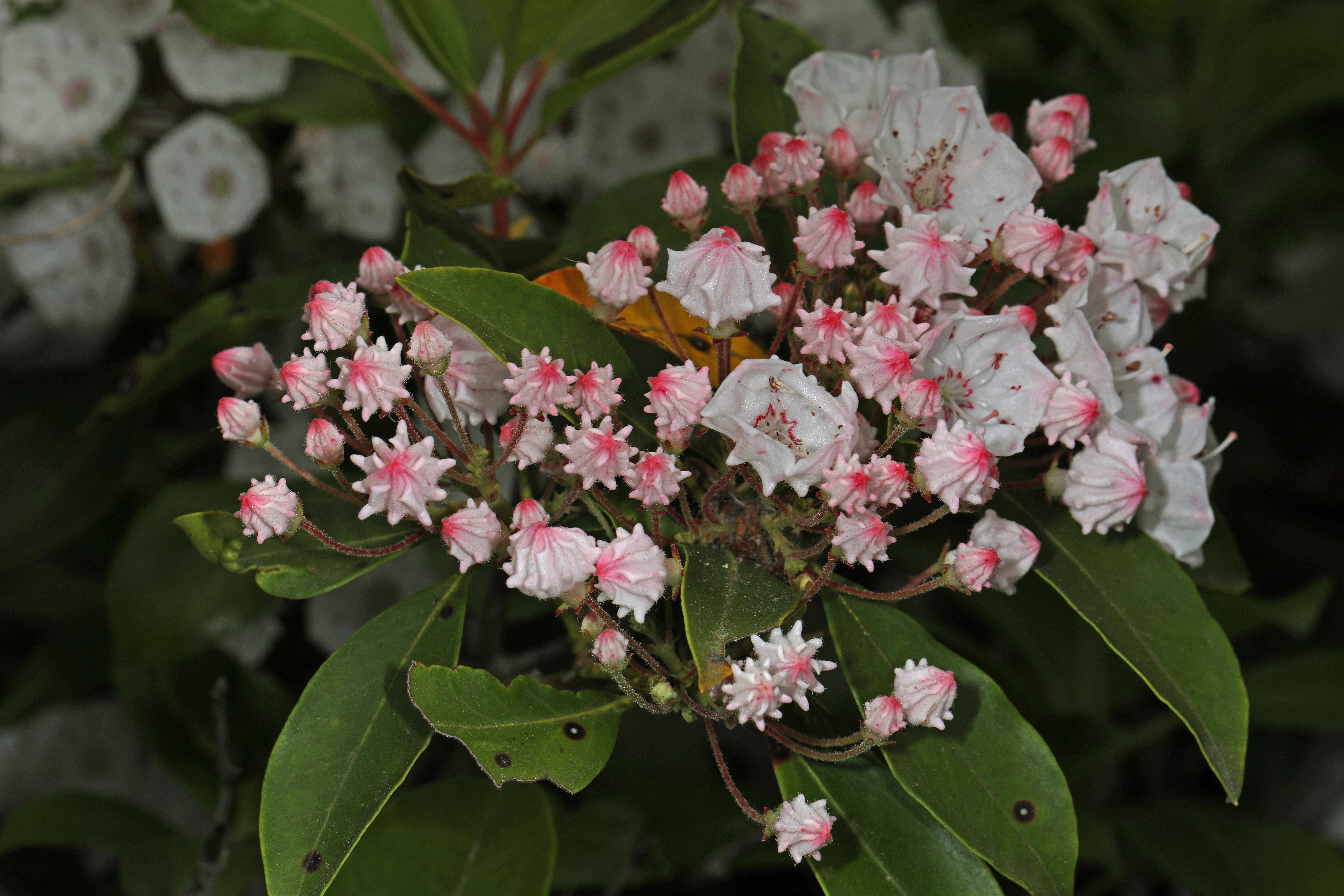
The flowers are Mountain Laurel’s crowning glory — appearing in dense, rounded clusters (corymbs) at the branch tips from late April through June, depending on location and elevation. Individual flowers are cup-shaped, about ¾ inch across, with five fused petals that form a distinctive shallow bowl. The color ranges from pure white to various shades of pink, often with intricate dark pink or crimson markings radiating from the center like spokes on a wheel.
Each flower has a fascinating mechanism: ten stamens are bent backward and tucked into small pouches in the petals. When a pollinator lands, the stamens spring forward, dusting the visitor with pollen. This “explosive” pollination mechanism is unique among North American shrubs and makes Mountain Laurel flowers particularly effective at ensuring cross-pollination.
Fruit
The fruit is a small, dry capsule about ¼ inch in diameter that splits open in fall to release tiny seeds. The capsules are initially green, turning brown as they mature, and often persist on the plant through winter, providing subtle textural interest.
Quick Facts
| Scientific Name | Kalmia latifolia |
| Family | Ericaceae (Heath) |
| Plant Type | Evergreen Shrub |
| Mature Height | 5 ft |
| Sun Exposure | Full Sun to Part Shade |
| Water Needs | Low to High |
| Bloom Time | April – June |
| Flower Color | White to deep pink with crimson markings |
| USDA Hardiness Zones | 4–9 |
Native Range
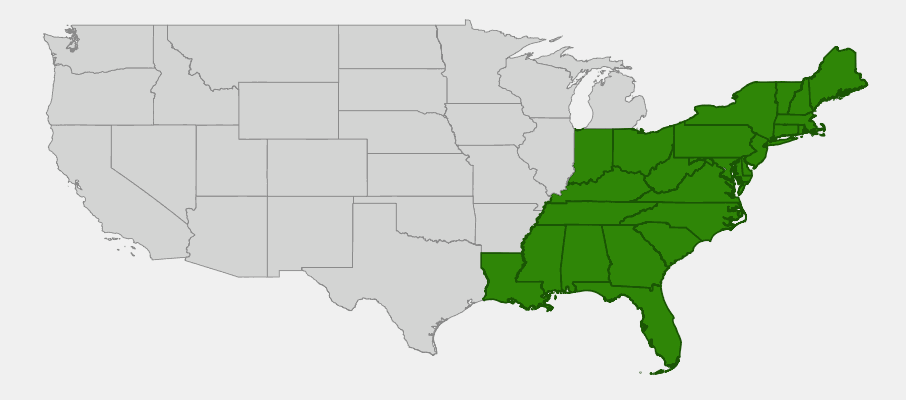
Mountain Laurel is native to the eastern United States, with a natural range extending from southern Maine south to northern Florida and west to Indiana, Kentucky, Tennessee, and Louisiana. The species shows its greatest diversity and abundance in the Appalachian Mountains, where it forms dense thickets known as “laurel hells” — nearly impenetrable stands that can cover hundreds of acres on mountain slopes and in coves.
In its native habitat, Mountain Laurel typically grows as an understory shrub in acidic, well-drained soils beneath deciduous and mixed forests. It’s commonly associated with oak-hickory forests, pine-oak woodlands, and mixed hardwood-conifer forests. The species shows remarkable adaptability, growing from near sea level in coastal areas to elevations over 4,000 feet in the southern Appalachians.
Mountain Laurel plays a crucial ecological role in its native range, providing structure in the forest understory and creating important microhabitats for wildlife. Its evergreen foliage offers year-round cover, while its flowers support a diverse array of native pollinators. The species is particularly important in areas where other shrubs struggle, such as steep slopes, rocky outcrops, and areas with thin, acidic soils.
📋 Regional plant lists featuring Mountain Laurel: North Carolina & South Carolina
Growing & Care Guide
Mountain Laurel is surprisingly adaptable and easier to grow than many gardeners realize, provided you understand its preferences. Like many members of the heath family, it thrives in acidic, well-drained soil but is quite flexible about light conditions and moisture levels once established.
Light
Mountain Laurel shows remarkable versatility in light requirements. In its native habitat, it grows successfully in everything from deep forest shade to nearly full sun conditions. In full sun, plants tend to be more compact and flower more profusely, but they may need extra water during hot summers. In partial shade, plants develop a more open, graceful habit and still bloom well. Even in fairly dense shade, Mountain Laurel maintains its form and provides excellent evergreen structure, though flowering may be reduced.
Soil & Water
The key to success with Mountain Laurel is acidic, well-drained soil with a pH between 4.5 and 6.0. The plant is quite drought tolerant once established, making it an excellent choice for xeriscaping, but it also performs well in consistently moist (not waterlogged) conditions. Adding organic matter like leaf mold, pine needles, or compost helps create the ideal growing medium. Mulching with organic materials helps maintain soil moisture and provides the acidic conditions the plant prefers.
Planting Tips
Plant Mountain Laurel in spring or early fall for best establishment. Choose a location with morning sun and afternoon shade in hot climates, or full sun in cooler areas. Space plants 6-8 feet apart for a naturalistic screen, or use as a single specimen. The plant has shallow, fibrous roots, so avoid disturbing the soil around established plants.
Pruning & Maintenance
Mountain Laurel requires minimal pruning and actually resents heavy pruning. Remove spent flower clusters immediately after blooming to promote bushier growth and prevent seed formation. Any pruning should be done immediately after flowering, as flower buds for the following year form in summer. Remove dead, damaged, or crossing branches in late winter. The plant’s natural form is quite attractive, so heavy shaping is rarely necessary.
Landscape Uses
Mountain Laurel’s versatility makes it valuable in many landscape situations:
- Foundation plantings — provides year-round evergreen structure with spectacular spring flowers
- Woodland gardens — perfect understory shrub for naturalized areas
- Screening — creates dense, evergreen privacy screens 5-15 feet tall
- Slope stabilization — excellent for erosion control on hillsides
- Wildlife habitat — supports native pollinators and provides nesting sites
- Rock gardens — thrives in thin, acidic soils where other shrubs struggle
- Container growing — works well in large planters with acidic potting mix
Wildlife & Ecological Value
Mountain Laurel plays a vital role in eastern forest ecosystems, providing resources and habitat structure that support a diverse array of wildlife throughout the year.
For Birds
Mountain Laurel’s dense, evergreen foliage provides critical nesting habitat for many forest birds. Species like Towhees, Thrushes, and various warblers build nests within the protective cover of laurel thickets. The persistent seed capsules provide food for finches and other seed-eating birds in late fall and winter. The shrub’s structural complexity creates hunting perches for flycatchers and other insectivorous birds.
For Mammals
While the foliage is toxic to most grazing mammals (hence the name “sheep-kill”), Mountain Laurel provides important cover for small mammals including chipmunks, squirrels, and various mice species. The dense thickets create secure travel corridors and denning sites. White-tailed deer occasionally browse young shoots, though they generally avoid the plant due to its toxicity.
For Pollinators
Mountain Laurel flowers are ecological powerhouses, supporting a remarkable diversity of native pollinators. The unique “explosive” pollination mechanism attracts bumblebees, carpenter bees, and other large bees that are strong enough to trigger the spring-loaded stamens. Butterflies, including Eastern Tiger Swallowtails and various fritillaries, also visit the nectar-rich flowers. The extended blooming period (4-6 weeks) provides sustained support during a critical time for pollinator populations.
Ecosystem Role
Mountain Laurel serves as a keystone species in many eastern forest communities. Its ability to grow in challenging sites — thin soils, steep slopes, dense shade — allows it to colonize areas where other shrubs cannot survive. This creates habitat structure in otherwise barren areas. The plant’s slow decomposition rate means its fallen leaves create long-lasting acidic soil conditions that support specialized plant communities adapted to low pH environments.
Cultural & Historical Uses
Mountain Laurel has a rich history of human use and cultural significance throughout its native range. Indigenous peoples of the eastern woodlands knew the plant well and used it medicinally despite its toxicity — the Menominee used small amounts of the inner bark to treat headaches and rheumatism, while the Cherokee employed it externally for various skin conditions. However, these uses required extensive knowledge and preparation due to the plant’s dangerous alkaloids.
European colonists quickly learned to fear Mountain Laurel after numerous livestock deaths earned it names like “sheep-kill,” “lamb-kill,” and “calf-kill.” However, they also discovered the wood’s unique properties — it’s extremely hard and takes a beautiful polish, making it prized for small woodworking projects. The common name “spoonwood” refers to its historical use for carved spoons, bowls, and other kitchen implements.
Mountain Laurel holds special cultural significance in Pennsylvania, where it was designated the official state flower in 1933. The plant appears on the Pennsylvania state quarter and is celebrated annually during “Mountain Laurel Festival” events throughout the state’s mountainous regions. In many Appalachian communities, the timing of laurel blooms traditionally marked important seasonal activities like spring planting.
The horticultural history of Mountain Laurel began in the 1730s when John Bartram first sent specimens to English gardens. By the 1750s, it was widely cultivated in European estates and had become one of the most sought-after American native plants. Modern breeding programs have developed numerous cultivars with improved flower colors, more compact growth habits, and enhanced cold tolerance, making Mountain Laurel accessible to gardeners well beyond its native range.
Frequently Asked Questions
Is Mountain Laurel really toxic, and is it safe to plant around pets and children?
Mountain Laurel does contain toxic compounds called grayanotoxins in all parts of the plant, but it’s perfectly safe as an ornamental when planted responsibly. The bitter taste deters casual nibbling, and serious poisoning requires consuming significant quantities. Simply don’t use it near livestock pastures, and teach children not to eat any landscape plants — standard garden safety practice.
Why won’t my Mountain Laurel bloom?
The most common causes are insufficient light (needs at least 4-6 hours of sunlight daily for good flowering), alkaline soil (requires acidic conditions with pH 4.5-6.0), or excessive fertilization (too much nitrogen promotes leafy growth at the expense of flowers). Young plants may take 3-5 years to begin blooming reliably.
How fast does Mountain Laurel grow, and when will it reach mature size?
Mountain Laurel is naturally slow-growing, typically adding 6-12 inches per year. Plants may take 10-15 years to reach mature flowering size, but this slow growth contributes to their longevity — specimens can live for decades with minimal care. The wait is worth it for the spectacular spring display and year-round evergreen structure.
Can Mountain Laurel grow in alkaline soil?
Mountain Laurel strongly prefers acidic soil and will struggle in alkaline conditions, often developing chlorosis (yellowing leaves) and poor growth. If you have alkaline soil, you can create acidic planting beds by adding sulfur, peat moss, and organic mulches, or consider growing it in containers with acidic potting mix.
Will Mountain Laurel spread or take over my garden?
Mountain Laurel is not invasive and spreads very slowly if at all in garden conditions. Individual plants maintain their clumping form for decades without spreading significantly. It’s actually quite well-behaved compared to many other flowering shrubs, making it an excellent choice for formal landscapes as well as naturalized areas.

Looking for a nursery that carries Mountain Laurel?
Browse our native plant nursery directory: North Carolina · South Carolina