
Mountain Mint (Pycnanthemum virginianum)
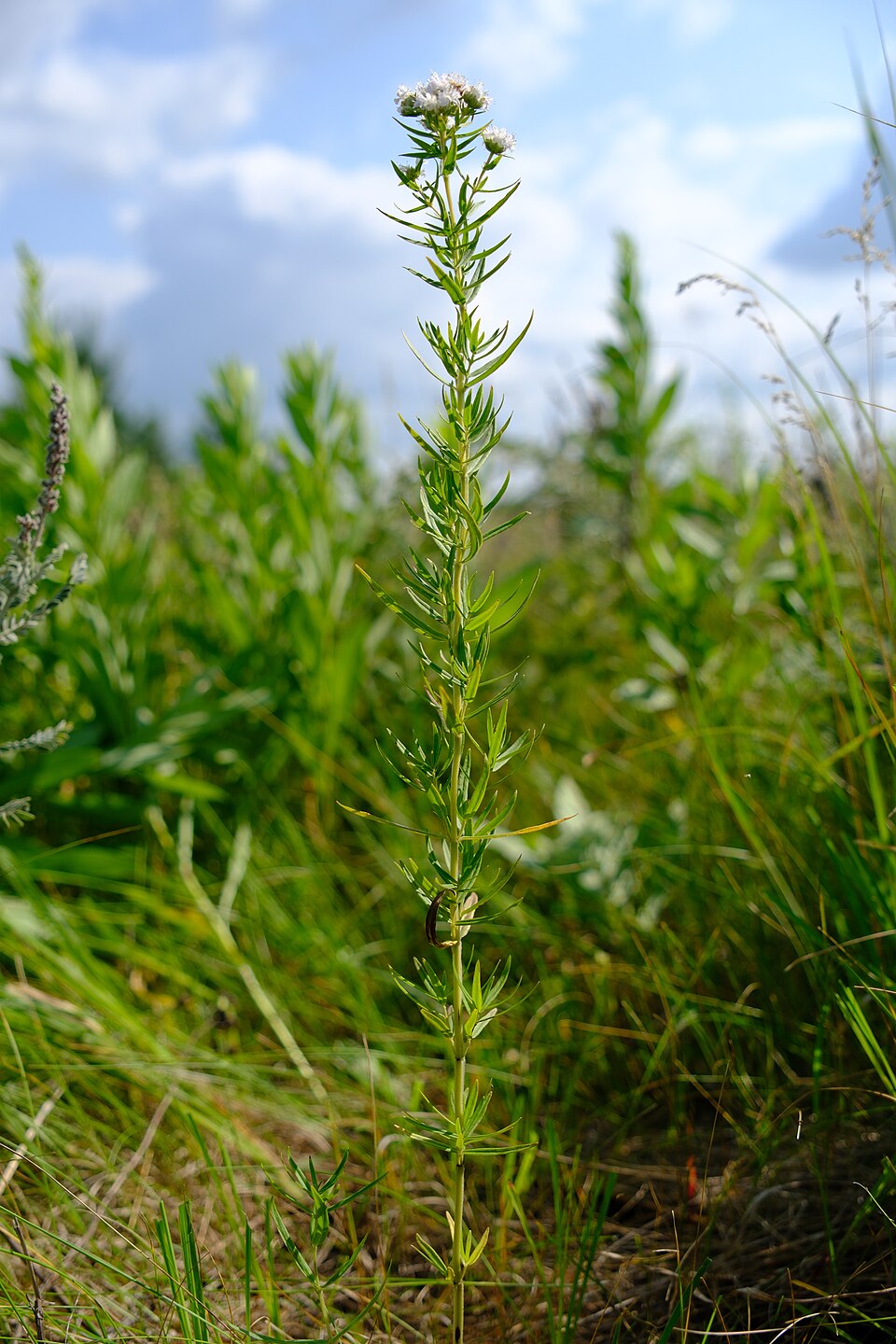
Pycnanthemum virginianum, commonly known as Mountain Mint, Virginia Mountain Mint, or Common Mountain Mint, is an aromatic native perennial herb that brings exceptional ecological value and delightful fragrance to gardens across eastern North America. This member of the Lamiaceae (mint) family is renowned for its intensely mint-scented foliage, dense clusters of tiny white flowers, and remarkable ability to support dozens of native bee species and beneficial insects. The plant’s common name can be misleading — while called “mountain” mint, it thrives equally well in lowland prairies, meadows, and gardens from sea level to moderate elevations.
Growing naturally in a variety of habitats from wet meadows to dry prairies, Mountain Mint forms attractive clumps of upright stems reaching 2 to 3 feet tall, topped with distinctive flat-topped clusters of small white flowers that bloom from July through August. The narrow, lance-shaped leaves release a powerful mint fragrance when crushed, making this plant as much a sensory experience as a visual one. Unlike many mints, Mountain Mint is not invasively aggressive — it spreads gradually by rhizomes and self-seeding, making it an excellent choice for naturalized plantings and wildflower gardens.
What truly sets Mountain Mint apart is its incredible value to pollinators. The tiny flowers, arranged in dense terminal clusters, are magnets for native bees, butterflies, beneficial wasps, and other insects. A single plant can support over 40 species of native bees, making it one of the most important pollinator plants in the eastern flora. Combined with its drought tolerance, low maintenance requirements, and late-season bloom time when many other wildflowers have finished, Mountain Mint has earned its place as a cornerstone species in ecological gardens and prairie restorations throughout the Great Plains and eastern United States.
Identification
Mountain Mint is an herbaceous perennial that forms clumps of upright, square stems typical of the mint family. The plant reaches 2 to 3 feet tall at maturity, with a somewhat open, branching structure that becomes more dense as the plant matures. The entire plant is highly aromatic, with a sharp, penetrating mint scent that is released at the slightest touch.
Stems & Leaves
The stems are distinctly four-angled (square in cross-section) — a hallmark of the mint family — and may be slightly pubescent or nearly smooth. The leaves are simple, opposite, and sessile (lacking stems), with a narrow lanceolate to linear shape that tapers to a sharp point. Each leaf is 1 to 3 inches long and ¼ to ½ inch wide, with entire or slightly serrated margins. The upper surface is dark green and smooth; the underside is paler and may show fine hairs along the veins. When crushed, the leaves release an intensely aromatic mint fragrance that can be detected from several feet away.
Flowers
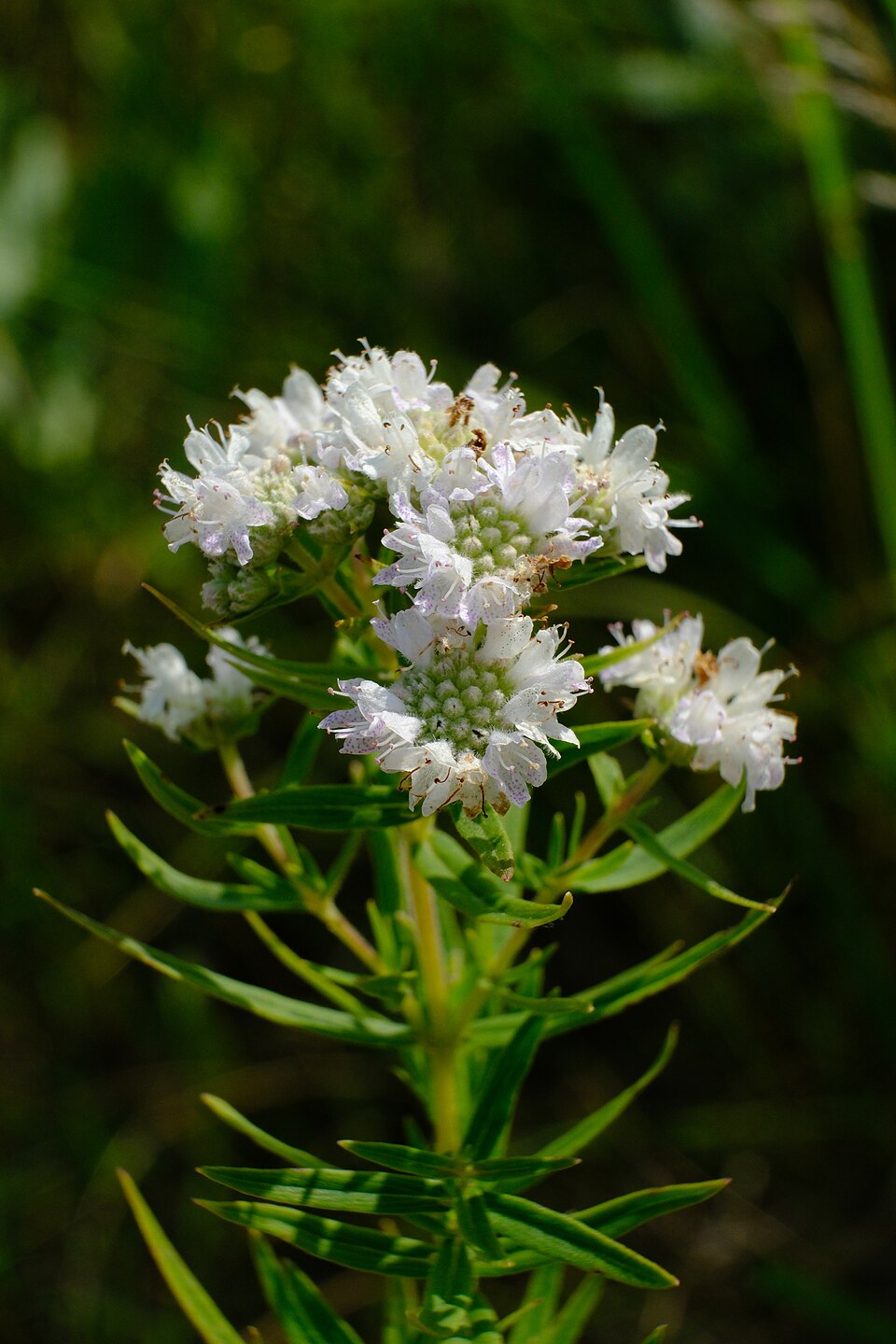
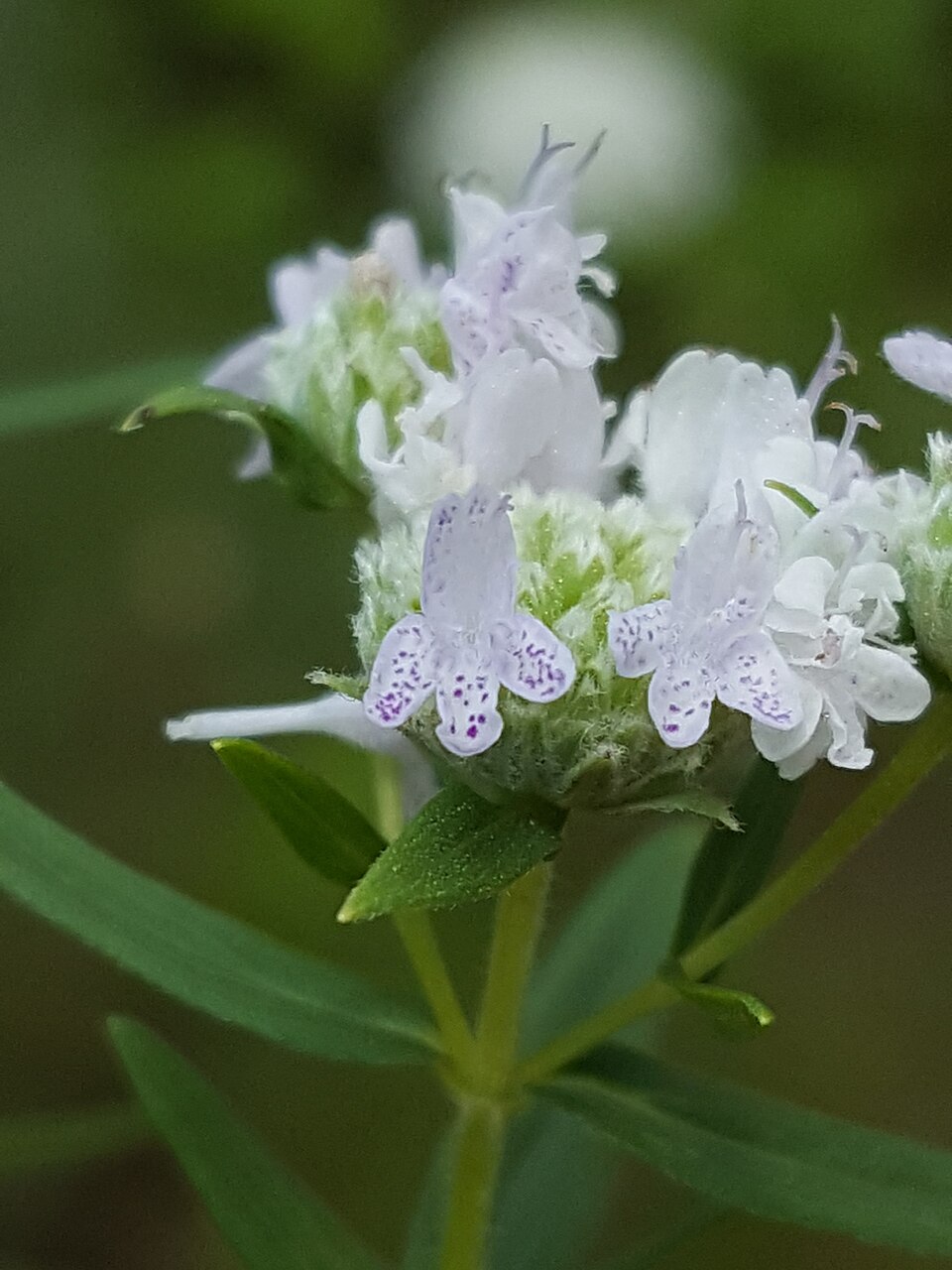
The flowers are Mountain Mint’s most distinctive feature. They appear in dense, flat-topped terminal clusters (corymbs) from July through August, sometimes extending into early September. Individual flowers are tiny — just ⅛ to ¼ inch long — with white to pale lavender corollas that have darker purple spots on the lower lip. Each flower has four stamens and a deeply lobed calyx. The uppermost leaves beneath the flower clusters often have a whitened, silvery appearance due to dense white hairs, creating an attractive contrast with the darker green foliage below.
Seeds & Dispersal
After flowering, Mountain Mint produces small, dry fruits containing four tiny nutlets (seeds) per flower. The seeds are dispersed primarily by gravity and wind, though some may be carried by animals. The plant also spreads vegetatively through rhizomes, gradually expanding its colony over time.
Quick Facts
| Scientific Name | Pycnanthemum virginianum |
| Family | Lamiaceae (Mint) |
| Plant Type | Herbaceous Perennial |
| Mature Height | 2–3 ft |
| Sun Exposure | Full Sun to Part Shade |
| Water Needs | Moderate to High |
| Bloom Time | July – August |
| Flower Color | White with purple spots |
| USDA Hardiness Zones | 3–8 |
Native Range
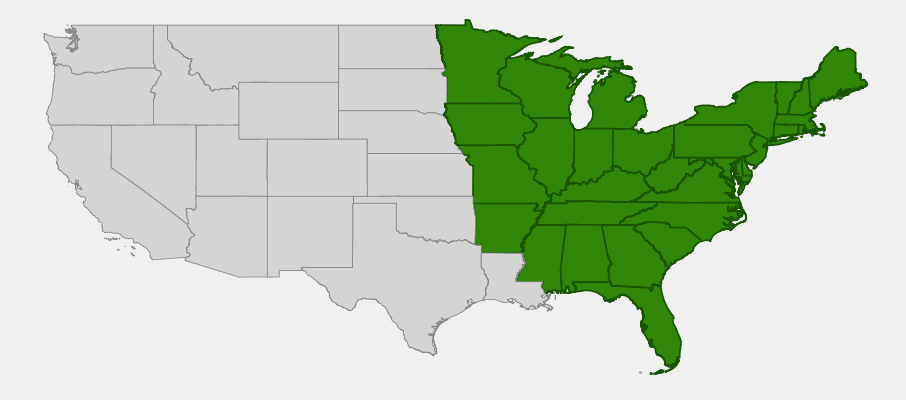
Mountain Mint is widely distributed across eastern North America, ranging from southeastern Canada south to northern Florida and Georgia, and west to the edge of the Great Plains. Its natural range encompasses much of the eastern deciduous forest region, extending into the prairie-forest transition zones of the Midwest. The species is particularly common in the Appalachian region, the Great Lakes states, and the northern portions of the southeastern Coastal Plain.
In its native habitat, Mountain Mint thrives in a variety of environments including wet meadows, prairie edges, open woodlands, old fields, and disturbed sites such as roadside ditches and abandoned agricultural lands. It shows remarkable adaptability to different soil moisture levels, growing equally well in seasonally wet areas and well-drained upland sites. This ecological flexibility has made it one of the more successful native plants in adapting to human-modified landscapes.
The species is found from near sea level in the Atlantic Coastal Plain to moderate mountain elevations throughout the Appalachians. It frequently occurs in areas that receive periodic disturbance — whether from natural processes like flooding or fire, or human activities like mowing or grazing — which helps maintain the open, sunny conditions it prefers.
📋 Regional plant lists featuring Mountain Mint: North Dakota, South Dakota & Western Minnesota
Growing & Care Guide
Mountain Mint is one of the easiest and most rewarding native perennials to grow, combining low maintenance requirements with exceptional ecological value. Once established, it thrives with minimal care and provides years of reliable blooms that support countless beneficial insects.
Light
Mountain Mint performs best in full sun but tolerates partial shade, especially in southern regions where some afternoon shade can be beneficial. In full sun, plants develop the most compact, dense growth and heaviest flowering. In partial shade, they tend to be taller and more open, but still flower well. Avoid deep shade, which leads to weak, floppy growth and poor flowering.
Soil & Water
One of Mountain Mint’s greatest assets is its adaptability to a wide range of soil conditions. It grows well in everything from clay to sand, tolerates both wet and dry conditions, and adapts to pH levels from slightly acidic to alkaline. While it can handle periodic flooding and consistently moist soils, it also shows good drought tolerance once established. For best performance, provide moderately moist, well-drained soil, but don’t worry if conditions are less than perfect — Mountain Mint is forgiving.
Planting Tips
Plant Mountain Mint in spring or fall, spacing plants 18 to 24 inches apart. It can be grown from seed, division, or nursery plants. Seeds can be direct-sown in fall or spring, or started indoors 6–8 weeks before the last frost. The plant self-seeds readily, so expect volunteers in subsequent years. Division is easy and can be done in spring or fall — simply dig and separate the rhizomatous clumps.
Pruning & Maintenance
Mountain Mint requires minimal maintenance. Deadheading spent flowers will extend the blooming period, but leave some seed heads for winter interest and wildlife food. Cut plants back to 4–6 inches in late fall or early spring. The plant spreads gradually by rhizomes — this is usually desirable in naturalistic plantings but can be controlled by dividing clumps every 3–4 years.
Landscape Uses
Mountain Mint is incredibly versatile in the landscape:
- Pollinator gardens — essential for supporting native bees and butterflies
- Prairie and meadow plantings — excellent companion to native grasses
- Rain gardens — tolerates both wet and dry cycles
- Wildflower gardens — provides late-season color and fragrance
- Herb gardens — aromatic foliage for teas and natural insect repellent
- Cut flower gardens — flowers last well in arrangements
- Erosion control — rhizomatous growth helps stabilize soil
Wildlife & Ecological Value
Mountain Mint ranks among the most ecologically valuable native plants in eastern North America, supporting an extraordinary diversity of beneficial insects and providing late-season nectar when many other sources have finished blooming.
For Birds
While birds don’t typically eat Mountain Mint seeds directly, they benefit enormously from the plant’s ability to support huge populations of insects. Seed-eating birds like American Goldfinches may occasionally consume the small seeds, but the primary value is indirect — the abundant insect life that Mountain Mint supports provides critical protein sources for breeding birds and their nestlings. The plant’s structure also offers some nesting material and shelter for smaller songbirds.
For Mammals
Small mammals generally avoid Mountain Mint due to its intensely aromatic oils, which actually makes it an excellent choice for gardens where deer and rabbit browsing is a problem. However, the aromatic properties that repel some animals attract others — the strong mint scent may help mask human scent, making Mountain Mint plantings popular with wildlife watchers and hunters.
For Pollinators
This is where Mountain Mint truly shines. The plant is a magnet for native bees, supporting over 40 species including sweat bees, leafcutter bees, mason bees, and mining bees. Butterflies regularly visit the flowers, including Monarchs, Painted Ladies, Pearl Crescents, and various skippers. Beneficial wasps, hover flies, bee flies, and thick-headed flies are also frequent visitors. The timing of Mountain Mint’s bloom is critical — it flowers from July through August when many spring wildflowers have finished, providing essential late-season nectar resources.
Ecosystem Role
Mountain Mint serves as a keystone species in many ecosystems, meaning its presence supports a disproportionately large number of other species. The plant’s ability to thrive in disturbed habitats makes it valuable for early successional communities, while its late-season flowering provides critical resources during a time when nectar sources can be scarce. In prairie and meadow ecosystems, Mountain Mint helps extend the flowering season and adds vertical structure that benefits nesting insects and provides hunting perches for predatory insects that help control pest populations.
Cultural & Historical Uses
Mountain Mint has a rich history of use by Indigenous peoples and early European settlers, valued both for its medicinal properties and practical applications. Various Native American tribes, including the Cherokee, Delaware, and Iroquois, used different species of Pycnanthemum for treating fevers, digestive ailments, and respiratory conditions. The intensely aromatic leaves were often brewed into teas believed to have antiseptic and digestive properties.
Early European colonists quickly adopted Mountain Mint for similar uses, and the plant became a common medicinal herb in frontier communities where commercial medicines were unavailable. The leaves were harvested and dried for winter use, providing a mint-flavored tea that was both enjoyable and believed to have healthful properties. Like other members of the mint family, Mountain Mint contains volatile oils with antimicrobial properties, which likely gave some scientific basis to its traditional medicinal uses.
Beyond medicine, Mountain Mint found practical uses around the homestead. The intensely aromatic leaves served as a natural insect repellent when rubbed on clothing or skin, helping to deter mosquitoes, flies, and other pests. Dried bundles of Mountain Mint were hung in cabins and barns to repel rodents and insects, and the leaves were sometimes scattered among stored grains and clothing. The plant’s square stems and fibrous nature made it occasionally useful for cordage and basket weaving, though it was not a preferred material for these purposes.
In modern times, Mountain Mint has gained recognition not just as a garden ornamental but as a critical component of sustainable landscaping and ecological restoration. Its exceptional value to pollinators has made it a cornerstone species in pollinator-friendly gardens, while its adaptability and low maintenance requirements have endeared it to advocates of native plant gardening. Some herbalists still use Mountain Mint for traditional purposes, though its primary value today is clearly ecological rather than medicinal.
Frequently Asked Questions
Is Mountain Mint invasive like other mints?
No. Unlike aggressive exotic mints like spearmint or peppermint, Mountain Mint spreads slowly and gradually by rhizomes. It’s not invasive and won’t take over your garden, though it will naturalize over time. This controlled spreading is actually beneficial for creating naturalistic plantings and supporting pollinator habitat.
Can you use Mountain Mint for tea?
Yes, Mountain Mint leaves can be used to make a minty herbal tea, though the flavor is more intense and somewhat different from commercial mints. Always use plants you’ve grown yourself or identified with certainty, and start with small amounts as some people may be sensitive to the oils. The tea has traditionally been used for digestive and respiratory issues.
Why do bees love Mountain Mint so much?
Mountain Mint produces abundant, easily accessible nectar in small flowers that are perfectly sized for many native bee species. More importantly, it blooms during the summer “nectar dearth” when many spring flowers have finished and fall asters haven’t yet begun. A single Mountain Mint plant can support dozens of bee species simultaneously.
Will Mountain Mint survive harsh winters?
Yes, Mountain Mint is extremely cold-hardy, surviving winters well into USDA Zone 3. The above-ground portions die back each winter, but the root system and rhizomes are very hardy. New growth emerges vigorously each spring.
How do I control Mountain Mint if it spreads too much?
Mountain Mint spreads gradually by underground rhizomes, but it’s easy to control by dividing clumps or simply digging up unwanted plants. The spread is slow enough that you’ll have plenty of time to manage it. Division every 3–4 years keeps plants vigorous and prevents excessive spread.
Looking for a nursery that carries Mountain Mint?
Browse our native plant nursery directory: North Dakota · South Dakota · Minnesota