
Pignut Hickory (Carya glabra)
Carya glabra, commonly known as Pignut Hickory, Red Hickory, or Sweet Pignut, is a magnificent native deciduous tree of eastern North America that stands as one of the region’s most ecologically and economically important forest species. This member of the Juglandaceae (walnut) family typically reaches 50 to 80 feet in height with a narrow, oval crown, and is renowned for both its exceptionally hard, valuable wood and its brilliant golden-yellow fall color that rivals any ornamental tree.
The tree gets its common name from its small, somewhat pear-shaped nuts that were historically fed to pigs, though the nuts are actually quite sweet and nutritious for both wildlife and humans when properly processed. Pignut Hickory is distinguished from other hickories by its relatively smooth bark when young (becoming more ridged with age), its typically 5-leaflet compound leaves, and its thin-shelled nuts that split only partway to the base when ripe.
As a dominant canopy species in eastern deciduous forests, Pignut Hickory plays a crucial ecological role, supporting over 200 species of moths and butterflies as a larval host plant while providing high-energy nuts for wildlife ranging from squirrels and chipmunks to wild turkeys and wood ducks. The tree’s deep taproot system and moderate growth rate make it an excellent choice for long-term landscaping, restoration projects, and sustainable forestry throughout its extensive native range from southern Maine to northern Florida and west to eastern Kansas.
Identification
Pignut Hickory is a large deciduous tree that typically grows 50 to 80 feet tall (occasionally to 100+ feet) with a trunk diameter of 2 to 3 feet. In forest settings, it develops a straight trunk with a narrow, oval crown; in open areas, the crown becomes more rounded and spreading. The overall form is elegant and stately, making it one of the most recognizable trees in eastern forests.
Bark
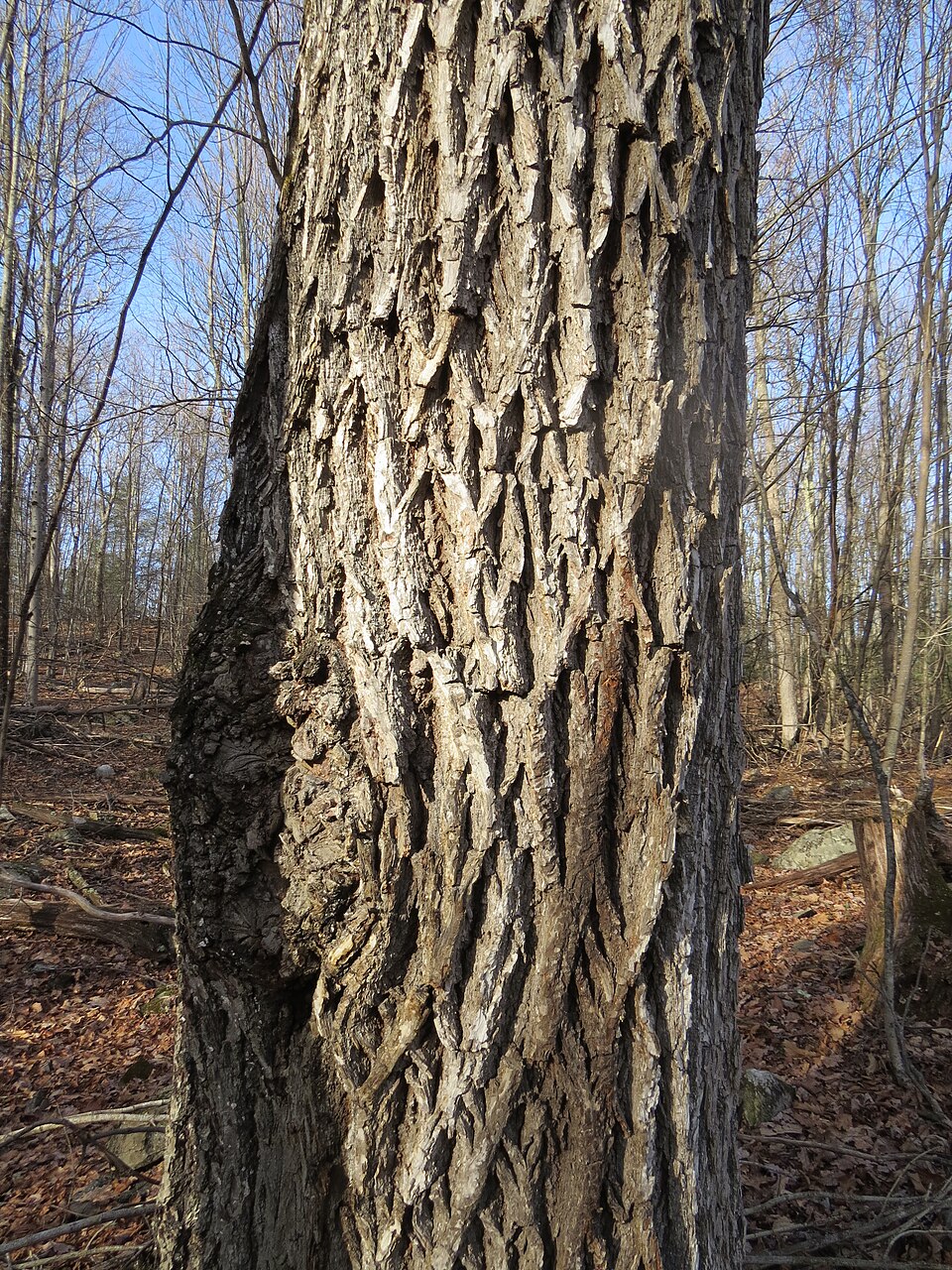
The bark is one of Pignut Hickory’s most distinctive features, changing significantly with age. Young trees have relatively smooth, gray bark that becomes increasingly ridged and furrowed as the tree matures. Mature bark develops shallow furrows with flat-topped ridges in a diamond-like pattern, giving the trunk a characteristic “shaggy” appearance, though not as extremely shaggy as Shagbark Hickory. The bark color ranges from gray to gray-brown.
Leaves
The leaves are compound, typically with 5 leaflets (sometimes 3 or 7), arranged alternately on the branches. Each leaflet is 3 to 6 inches long, lance-shaped to oval, with finely serrated margins and a pointed tip. The leaflets are dark green and glossy above, paler beneath, and essentially hairless (glabrous) when mature – a key identifying feature reflected in the species name “glabra.” The central leaflet is usually the largest, with the side leaflets decreasing in size. In fall, the leaves turn a spectacular golden-yellow color that can be seen from great distances.
Flowers
Pignut Hickory is monoecious, with separate male and female flowers on the same tree. Male flowers appear in drooping catkins (3 to 4 inches long) that emerge in early spring before the leaves. Female flowers are small and inconspicuous, appearing in clusters of 2 to 5 at the tips of new growth. The flowers are wind-pollinated and not particularly ornamental.
Fruit & Nuts
The fruit is a distinctive nut enclosed in a thin, four-sectioned husk that splits only partway to the base when ripe – unlike Shagbark Hickory nuts whose husks split completely. The nuts are roughly pear-shaped or egg-shaped, about 1 to 1½ inches long, with a thin shell and sweet, edible meat. The nuts mature in fall and are eagerly consumed by wildlife. Despite the name “pignut,” the nuts are quite palatable to humans when fresh.
Quick Facts
| Scientific Name | Carya glabra |
| Family | Juglandaceae (Walnut) |
| Plant Type | Deciduous Tree |
| Mature Height | 50–99 ft |
| Sun Exposure | Part Shade to Full Shade |
| Water Needs | Low (Drought Tolerant) |
| Bloom Time | April – May |
| Flower Color | Greenish (catkins) |
| USDA Hardiness Zones | 4–9 |
Native Range
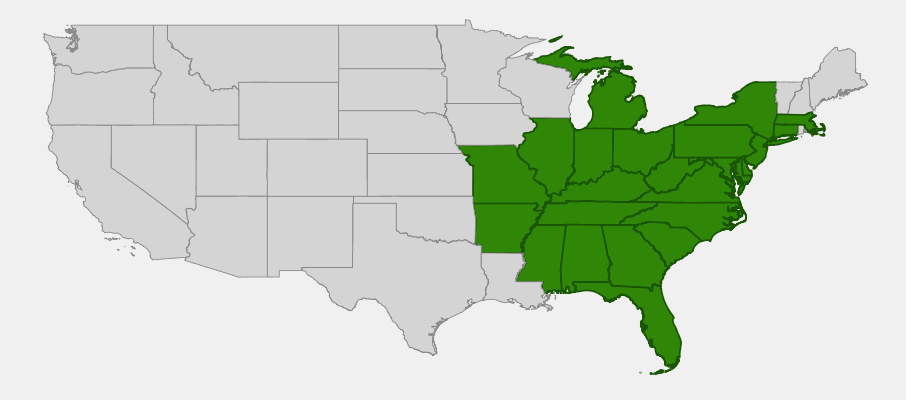
Pignut Hickory has an extensive native range throughout much of eastern North America, from southern Maine and southern Quebec south to northern Florida and west to southeastern Nebraska, eastern Kansas, and eastern Texas. This broad distribution makes it one of the most widespread hickory species and reflects its adaptability to diverse growing conditions and climates.
The species is a dominant component of eastern deciduous forests, particularly in oak-hickory associations where it often grows alongside White Oak, Red Oak, American Beech, and other hickory species. It thrives in well-drained upland sites, preferring slopes, ridges, and valley sides with deep, fertile soils. Pignut Hickory is less common in bottomland areas compared to other hickories, showing a preference for drier, more elevated sites.
Throughout its range, Pignut Hickory demonstrates remarkable ecological importance as both a keystone species and an indicator of forest health. Its presence often signals mature, stable forest ecosystems, and its nuts provide crucial wildlife food during fall and winter months when other food sources become scarce.
📋 Regional plant lists featuring Pignut Hickory: North Carolina & South Carolina
Growing & Care Guide
Pignut Hickory is a relatively low-maintenance native tree that, while slow-growing initially, develops into a magnificent specimen with patience. Its deep taproot system and drought tolerance make it suitable for challenging sites once established, though it requires adequate space to reach its full potential.
Light
Pignut Hickory is quite adaptable to light conditions, thriving in partial shade to full sun. In forest settings, young trees are shade-tolerant and can survive in the understory for many years before reaching the canopy. In landscape settings, the tree performs best with at least 4-6 hours of direct sunlight daily.
Soil & Water
The tree prefers deep, well-drained soils and is quite tolerant of various soil types, from sandy loams to clay soils, as long as drainage is adequate. It shows good drought tolerance once the deep root system is established, typically after 3-5 years. During establishment, regular watering during dry periods will promote better growth.
Planting Tips
Plant young nursery stock in spring or fall, choosing a site with plenty of room for the tree’s eventual mature size. Pignut Hickory has a long taproot and can be difficult to transplant once established, so site selection is critical. Space trees at least 40-50 feet apart in landscape settings.
Pruning & Maintenance
Minimal pruning is required beyond removing dead or damaged branches. The tree naturally develops good structure. Any pruning should be done during dormancy in late winter. Avoid disturbing the root zone, as hickories are sensitive to soil compaction and root damage.
Landscape Uses
Excellent for large-scale landscapes, parks, golf courses, and naturalized areas. The brilliant fall color makes it valuable as a specimen tree, while its wildlife benefits make it ideal for ecological landscaping and restoration projects.
Wildlife & Ecological Value
Pignut Hickory ranks among the most ecologically valuable trees in eastern North America, supporting an extraordinary diversity of wildlife and playing a crucial role in forest ecosystem dynamics.
For Lepidoptera
The tree serves as a larval host plant for over 200 species of moths and butterflies, including the Hickory Horned Devil (the caterpillar of the Regal Moth), Luna Moth, Hickory Tussock Moth, and various Underwing moths. This makes it one of the most important native trees for supporting butterfly and moth populations.
For Birds
The nutritious nuts are consumed by numerous bird species including Wild Turkey, Wood Ducks, various woodpeckers, nuthatches, and chickadees. The large size and longevity of mature trees provide crucial nesting cavities and roosting sites for cavity-nesting birds. The tree’s insects also support many insectivorous bird species.
For Mammals
Pignut Hickory nuts are a preferred food source for squirrels, chipmunks, bears, deer, and many smaller mammals. The high fat and protein content of the nuts makes them particularly valuable for wildlife preparing for winter. Large mammals like deer also browse young shoots and leaves.
Ecosystem Role
As a long-lived canopy dominant, Pignut Hickory helps structure forest ecosystems and creates habitat complexity. Its deep roots help stabilize soils and access deep water and nutrients. The tree’s longevity (often 200+ years) provides habitat continuity crucial for many wildlife species.
Cultural & Historical Uses
Pignut Hickory has been valued by humans for thousands of years, first by Native American peoples and later by European colonists and their descendants. The tree’s exceptional wood quality and nutritious nuts made it one of the most economically important trees in early America.
Native American tribes throughout the tree’s range recognized the value of hickory nuts as a concentrated food source. The nuts were often processed into “hickory milk,” a nutritious beverage made by pounding the nuts (shell and all) and straining the mixture through baskets. This technique extracted maximum nutrition from the nuts and could be stored for winter use. Many tribes also used the strong, flexible wood for tool handles, bows, and basketry.
European settlers quickly learned to value hickory wood for its exceptional strength and shock resistance. Pignut Hickory wood became the preferred material for tool handles, wagon wheels, baseball bats, and other applications requiring strength and durability. The saying “tough as hickory” reflects the wood’s legendary reputation. Even today, hickory remains unmatched for certain specialized uses, commanding premium prices in lumber markets.
The nuts, despite their name, were actually valued as food by early settlers. The name “pignut” may derive from their use as pig feed, but the nuts are quite edible when fresh and were often gathered for human consumption. Unlike some hickory species with very hard shells, Pignut Hickory nuts can be cracked relatively easily to extract the sweet meat inside.
In modern times, Pignut Hickory continues to be valued for specialty wood products, while its ecological importance has gained recognition in conservation and restoration efforts. The tree is now commonly planted in reforestation projects and wildlife habitat improvement programs throughout its native range.
Frequently Asked Questions
How fast does Pignut Hickory grow?
Pignut Hickory is initially slow-growing, typically adding 12-24 inches per year when young. Growth accelerates as the tree matures and the root system develops, but it remains a moderate grower compared to fast-growing trees like tulip poplar. Patience is rewarded with a long-lived, magnificent tree.
Are Pignut Hickory nuts really edible?
Yes, despite the name “pignut,” the nuts are quite edible and sweet when fresh. They’re smaller than some other hickory nuts but have thin shells that crack more easily. The nuts are best eaten fresh in fall, as they can become rancid if stored too long.
Can Pignut Hickory tolerate urban conditions?
The tree has moderate tolerance for urban conditions but performs best in areas with good soil and adequate space. It’s sensitive to soil compaction and pollution, making it better suited for parks and large residential areas rather than downtown urban environments.
How can I tell Pignut Hickory from other hickories?
Key identifying features include the relatively smooth bark (compared to Shagbark Hickory), typically 5-leaflet compound leaves that are essentially hairless, and nuts with husks that split only partway to the base. The golden-yellow fall color is also distinctive.
Why isn’t my young Pignut Hickory producing nuts?
Pignut Hickory typically doesn’t begin producing significant nut crops until 25-40 years old, with peak production occurring in older trees. Young trees focus their energy on growth rather than reproduction. Additionally, hickories often have irregular nut production cycles, with heavy crops followed by lighter years.

Looking for a nursery that carries Pignut Hickory?
Browse our native plant nursery directory: North Carolina · South Carolina