Pond Cypress (Taxodium ascendens)
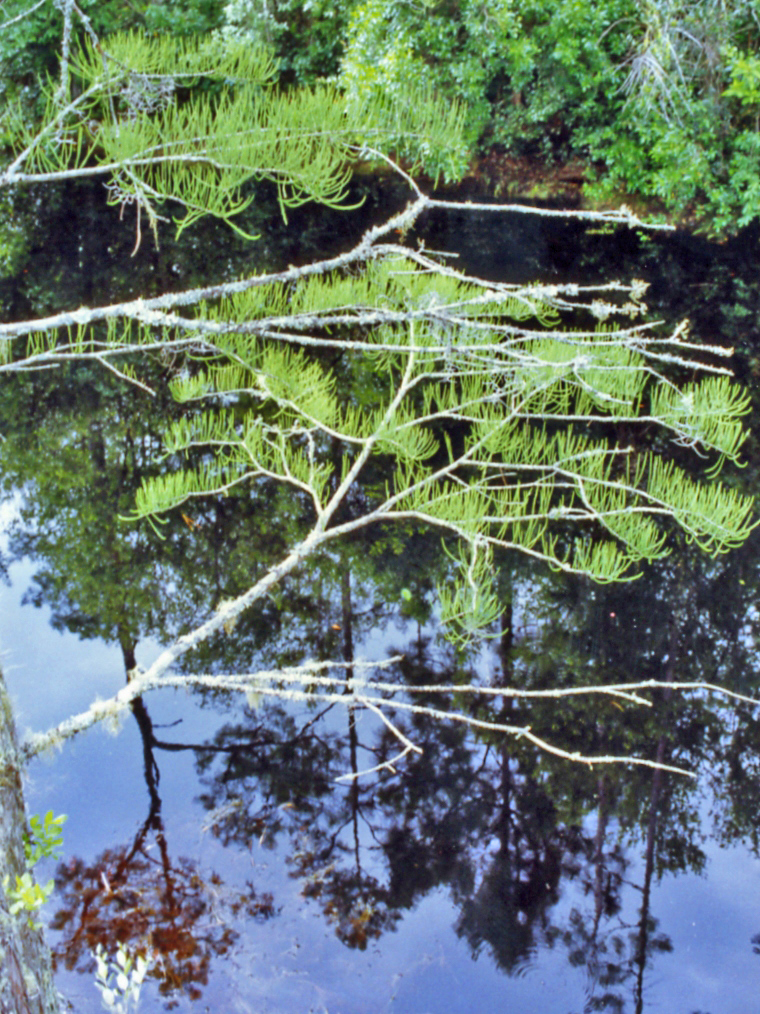
Taxodium ascendens, commonly known as Pond Cypress, is a distinctive deciduous conifer native to the pond margins, wet flatwoods, and shallow swamps of the southeastern Coastal Plain. While it is closely related to the more widely known Bald Cypress (Taxodium distichum), Pond Cypress has its own unique character: a narrower, more columnar crown, tightly appressed (ascending) branchlets, and a preference for the shallow standing water of cypress domes and isolated flatwood ponds rather than the flowing waters of rivers and tidal swamps where Bald Cypress is most abundant. The two species overlap in habitat and can hybridize where they co-occur, but Pond Cypress is the dominant species in the characteristic “cypress dome” landscape of Florida and the southeastern Coastal Plain.
Growing to about 45 feet tall (shorter than Bald Cypress, which can exceed 100 feet), Pond Cypress has a refined, elegant presence in the landscape. Its soft, blue-green to bright green foliage emerges in early spring and turns rich orange-brown to russet in fall before dropping — one of the most beautiful fall color displays of any wetland tree. Like Bald Cypress, Pond Cypress produces the characteristic “knees” — woody pneumatophores (specialized root extensions) that emerge from the water or saturated soil around the base of the tree — though the knees of Pond Cypress tend to be more irregular and narrower than those of Bald Cypress. These knees are thought to aid in oxygen exchange to the root system in anaerobic saturated soils.
Pond Cypress is an outstanding native tree for wet landscape settings: rain gardens, stormwater ponds, bog gardens, and the margins of retention basins. Its ability to grow with its roots submerged in shallow water makes it one of the few large trees that can be planted directly at the water’s edge. For southeastern native plant gardeners working with wet, challenging sites, Pond Cypress offers tall, graceful vertical structure, beautiful seasonal color, and significant wildlife value — with very little maintenance once established.
Identification
Pond Cypress is a medium-to-large deciduous conifer reaching 25 to 45 feet in height in most landscape settings, though trees in optimal habitat can exceed 60 feet. It has a distinctly narrower, more columnar crown than the broad, spreading crown of Bald Cypress, with branches that angle upward more steeply and branchlets that appressed (lie flat against the stem rather than spreading outward). This columnar silhouette is one of the most reliable ways to distinguish Pond Cypress from Bald Cypress in the field. The overall form is architecturally striking, particularly in winter when the bare, buttressed trunk and pyramidal crown outline are fully visible.
Bark & Trunk
The bark of Pond Cypress is fibrous, reddish-brown to gray-brown, with shallow interlacing ridges and a slightly shredded texture that is characteristic of the cypress family. The base of mature trees develops prominent buttressing — a widened, fluted base that extends outward from the trunk and provides stability in saturated, unstable soils. The buttressing is less pronounced than in large Bald Cypress trees but is still visually distinctive. From the buttressed base, the cylindrical wooden “knees” emerge from the soil or water around the tree — the familiar landmark of cypress swamps across the Southeast.
Foliage
The foliage of Pond Cypress consists of small, needle-like leaves (actually scale-like leaves borne on deciduous branchlets) that are tightly appressed against the stem rather than spreading outward as in Bald Cypress. This appressed arrangement gives the branchlets a rope-like or awl-like appearance. Individual leaves are ⅛ to ¼ inch long, linear, and blue-green to medium green above. In spring, the emerging foliage is a bright, fresh lime-green; through summer it deepens to blue-green; in fall it transitions through vivid orange to russet-brown before dropping. The fall color display of Pond Cypress is one of the most beautiful of any wetland tree in the Southeast.
Cones & Flowers
Pond Cypress is monoecious, bearing separate male and female cones on the same tree. Male pollen cones are small and purple-brown, borne in pendulous catkin-like clusters at the branch tips in February and March, releasing clouds of pollen before the foliage emerges. Female cones are round to slightly ovoid, about ¾ to 1 inch in diameter, with woody scales that thicken and harden as the cones mature. The cones ripen in October and November, turning from green to brown and breaking apart to release the seeds, which are distributed by water and wildlife.
Quick Facts
| Scientific Name | Taxodium ascendens |
| Family | Cupressaceae (Cypress) |
| Plant Type | Deciduous Conifer |
| Mature Height | 45 ft |
| Sun Exposure | Full Sun to Part Shade |
| Water Needs | Moderate to High |
| Bloom Time | February – March (pollen release) |
| Flower Color | Brown-purple (male strobili) |
| USDA Hardiness Zones | 5–10 |
Native Range
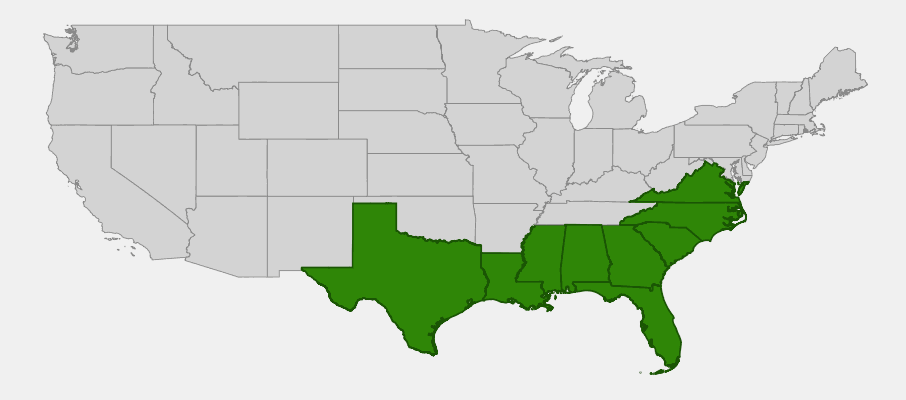
Pond Cypress is native to the southeastern Atlantic and Gulf coastal plains, with a range that closely mirrors that of Bald Cypress but with a stronger preference for the stagnant, shallow water of isolated flatwood ponds, cypress domes, and pocosins rather than the moving or tidal waters of river swamps. Its range extends from southeastern Virginia south through the Carolinas to Florida, then west along the Gulf Coast to southeastern Texas. Within this range, Pond Cypress is most abundant in Florida, where it is the dominant tree of the characteristic “cypress dome” landscape — isolated, circular stands of cypress that form in slight depressions in the flatwoods where water pools.
The “cypress dome” is one of the most recognizable landscape features of the Florida peninsula and the Gulf Coastal Plain. These structures form when Pond Cypress trees in the center of a pond depression grow taller than those at the margins (where water is shallower and soils are less nutrient-rich), creating a dome-shaped canopy profile when viewed from a distance. Cypress domes are hydrologically significant — they store water during wet seasons and release it slowly during dry periods, helping to regulate groundwater levels across the surrounding flatwoods. They are also among the most productive wildlife habitats in the Southeast, providing nesting sites for Great Blue Herons, Osprey, and other wetland birds.
In the Coastal Plain of the Carolinas and Virginia, Pond Cypress occurs in isolated flatwood ponds, wet pine savannas, and bay forest margins. It is less common in the Piedmont and essentially absent from upland or inland habitats. The species is not found in the Appalachians or in any habitat above the lower Coastal Plain, reflecting its strong dependence on the hydrological conditions of the outer coastal plain — shallow, still, acidic water overlying nutrient-poor sandy soils.
📋 Regional plant lists featuring Pond Cypress: Alabama, Georgia & Mississippi
Growing & Care Guide
Pond Cypress is one of the most rewarding native trees for wet landscape settings. Its combination of graceful form, spectacular fall color, ease of establishment, and ecological value make it a standout choice for any wet-site native planting in the Southeast.
Light
Pond Cypress grows best in full sun to part shade. In full sun with consistent moisture, it develops the fastest growth, most compact crown, and richest fall color. It tolerates light shade but becomes increasingly open and rangy with reduced light. In its natural habitat, Pond Cypress often grows in open conditions at the margins of ponds with little overhead canopy competition — providing excellent sun exposure. When selecting a planting site, choose the sunniest position available, especially for the first few years of establishment.
Soil & Water
Pond Cypress is specifically adapted to wet, poorly drained, and even flooded soils. It thrives in standing shallow water up to 6 inches deep and can tolerate deeper flooding for extended periods in its natural habitat. The ideal soil is sandy to loamy, acidic (pH 4.5–6.5), and high in organic matter — conditions typical of southeastern flatwood ponds and pocosins. Pond Cypress also grows well in average-moisture garden soils once established and can tolerate brief dry spells, but it performs best with consistent moisture at the root zone. It does not thrive in alkaline soils or compacted, poorly oxygenated clays.
Planting Tips
Plant Pond Cypress in fall or early spring while the tree is dormant. It establishes quickly from container stock and transplants well. When planting at the edge of a pond or water feature, position the tree so that the root ball is at or slightly below the waterline, or at the margin where soil is consistently saturated. The tree will quickly develop the characteristic knee structures around its base. For stormwater management areas, Pond Cypress can be planted directly in the bottom of retention basins where it will establish rapidly and provide significant aesthetic value. Space trees 15–20 feet apart for naturalistic plantings.
Pruning & Maintenance
Pond Cypress is extremely low-maintenance. No regular pruning is required; the tree naturally develops an attractive, symmetrical form. Remove dead branches if necessary in late winter while the tree is fully dormant. The knees that emerge around the base are a natural feature of the tree and should not be removed — they are part of the root system. Pond Cypress is highly resistant to insects and disease, and established trees rarely require any intervention. Avoid soil compaction around the root zone, which can inhibit the tree’s characteristic knee development.
Landscape Uses
Pond Cypress excels in wet landscape settings:
- Pond and water feature margins — thrives in shallow standing water
- Stormwater retention basins — one of the best trees for wet management areas
- Rain garden center-pieces — provides vertical accent in wet planting schemes
- Stream bank stabilization — deep, lateral roots stabilize saturated soils
- Cypress dome restoration — the keystone tree of this endangered wetland type
- Specimen tree — outstanding fall color and architectural form
- Wildlife habitat — supports herons, osprey, wood ducks, and many other species
Wildlife & Ecological Value
Pond Cypress provides critical wildlife habitat across all seasons. Its structure — from submerged roots to canopy branches — supports an exceptional range of aquatic, semi-aquatic, and terrestrial wildlife in the southeastern Coastal Plain.
For Birds
Pond Cypress knees and submerged roots provide critical nesting, foraging, and roosting substrate for Wood Ducks, which nest in natural cavities in older cypress trees. Great Blue Herons, Great Egrets, and Little Blue Herons nest colonially in stands of Pond Cypress, building large stick nests in the upper canopy branches. Osprey build platform nests on exposed dead snags in cypress stands. Prothonotary Warblers — one of the most brilliantly colored eastern warblers — nest in cavities in cypress wood along pond and stream margins. Swallow-tailed Kites, Anhingas, and many other southeastern wetland species use Pond Cypress stands for foraging and roosting.
For Mammals
River Otters use the submerged root systems and banks of cypress ponds as denning and foraging habitat. American Beavers eat the bark and wood of Pond Cypress and use it as dam material. White-tailed Deer regularly wade into shallow cypress ponds to feed on aquatic vegetation and use cypress dome margins as bedding sites. Florida Black Bears and Bobcats use the dense, dark interior of large cypress domes as refuge and denning habitat.
For Pollinators
While Pond Cypress flowers are wind-pollinated and do not provide nectar, the moist, fertile soil conditions around cypress ponds support rich communities of nectar-producing plants including pickerelweed, swamp milkweed, and native irises. The wet, shaded conditions under the cypress canopy also provide critical habitat for many moisture-dependent pollinators including several species of native bees that nest in saturated soils.
Ecosystem Role
Pond Cypress is the dominant tree of the cypress dome ecosystem — one of the most hydrologically significant wetland types in the southeastern coastal plain. Cypress domes store and slowly release water, recharging groundwater and moderating flood peaks across the surrounding landscape. The accumulated organic matter (muck and peat) in cypress pond soils represents centuries of carbon storage and is critically important for regional water quality. The unique structure of Pond Cypress — with its knees, buttressed trunk, and dense root mat — creates microhabitat for an exceptional range of aquatic invertebrates, amphibians, and fish that are found nowhere else in the landscape.
Cultural & Historical Uses
Pond Cypress and its close relative Bald Cypress have been central to the cultures of southeastern Indigenous peoples for millennia. The Seminole, Choctaw, Chitimacha, and other southeastern nations used the extraordinarily durable, rot-resistant wood of cypress trees for dugout canoes, structural posts, and other purposes where long-lasting material was critical. Cypress dugout canoes were the primary watercraft of the southeastern coastal plain and were prized for their durability and the ease with which they could be crafted from the large, straight-grained trunks of old-growth cypress trees. Archaeological evidence of cypress dugout canoes dates back thousands of years in the Southeast.
The distinctive “knees” of cypress trees held spiritual and practical significance for some southeastern Indigenous groups. The Seminole used cypress domes as places of refuge and resistance during the Seminole Wars of the 19th century, when the dense, impenetrable swamps of Florida’s cypress dome landscape provided natural fortification against U.S. Army pursuit. The famous chief Osceola and other Seminole leaders used the cypress swamps of central Florida as a base of operations during this conflict, demonstrating the profound strategic importance of these ecosystems to the people who knew them intimately.
European settlers quickly recognized the extraordinary durability of cypress wood, which was found to resist rot even when buried in soil or submerged in water for decades. Cypress lumber was used extensively throughout the 19th and early 20th centuries for water tanks, boat building, roofing shingles, and the structural components of buildings in areas with high moisture and termite pressure. The old-growth cypress forests of the southeastern Coastal Plain were almost entirely logged out between 1880 and 1940, representing one of the most complete eliminations of old-growth forest in American history. Today, virtually no true old-growth cypress forest remains, and the large trees that were once so common are now rare. Conservation efforts focus on protecting remaining second-growth stands and restoring cypress domes and swamps through strategic replanting.
Frequently Asked Questions
What is the difference between Pond Cypress and Bald Cypress?
Pond Cypress (Taxodium ascendens) and Bald Cypress (T. distichum) are closely related but differ in several ways. Pond Cypress has tightly appressed (ascending, closely held) needle-like leaves giving the branchlets a rope-like appearance; Bald Cypress has leaves that spread outward in a flat, feathery arrangement. Pond Cypress is shorter (to ~45 ft vs. 100+ ft for Bald Cypress), has a narrower, more columnar crown, and prefers shallow, still pond water rather than the flowing or tidal swamps favored by Bald Cypress.
Why do cypress trees have ‘knees’?
The ‘knees’ are woody pneumatophores — specialized extensions of the root system that emerge above the waterline or soil surface around the base of the tree. The most widely accepted theory is that they facilitate gas exchange (oxygen uptake) for the root system in anaerobic, oxygen-poor saturated soils. They also provide structural support in soft, unstable wetland substrates. The knees are a natural feature of the tree and should not be cut off, as they are part of the root system.
Can Pond Cypress grow in standing water?
Yes — it is one of the few large trees that grows well with its roots submerged in shallow standing water (up to 6 inches or more deep). This makes it an excellent choice for planting directly at the edge of ponds, stormwater basins, or wet retention areas. However, it also grows well in average-moisture garden soils once established and is quite adaptable as long as it receives full sun.
Does Pond Cypress lose its leaves in winter?
Yes — Pond Cypress is deciduous, losing its foliage each fall after an outstanding color display of orange to russet-brown. This often surprises people who expect a cypress tree to be evergreen. The bare winter form is actually quite attractive, with the feathery, pyramidal crown silhouette and buttressed trunk creating strong visual interest through the dormant season. New growth emerges in a fresh lime-green color in early spring.
How fast does Pond Cypress grow?
Pond Cypress has a moderate growth rate, typically adding 12–24 inches per year under good conditions (full sun, consistent moisture). Growth is fastest during the first several years after establishment in wet, fertile conditions. In optimal wetland settings, young trees can grow 2–3 feet per year. Growth slows as the tree matures, and very old trees are essentially stationary in height.

Looking for a nursery that carries Pond Cypress?
Browse our native plant nursery directory: Alabama · Georgia · Mississippi