Purple Needlegrass (Nassella pulchra)
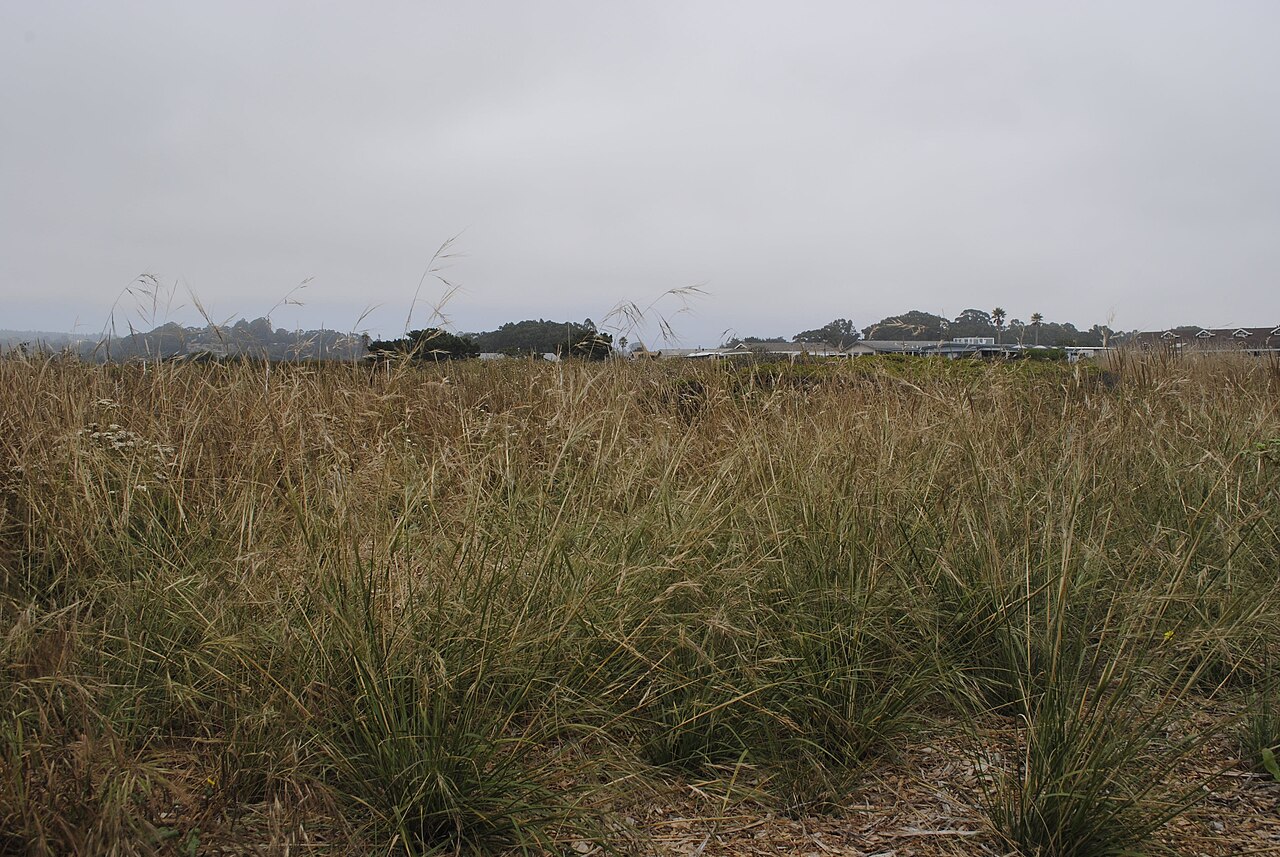
Nassella pulchra (formerly classified as Stipa pulchra), commonly called purple needlegrass, is California’s official state grass and one of the defining species of the native bunchgrass prairie that once covered vast stretches of the state before European settlement. It grows as a tidy, long-lived tussock of fine, arching blue-green leaves, transformed each spring into a haze of slender seed stalks tipped with long, twisting, purple-tinged awns that give the plant its common name and its graceful, windswept look.
Unlike the showy annual wildflowers that share its grassland habitat, purple needlegrass earns its place through endurance rather than spectacle. It is a true perennial bunchgrass, resprouting from the same root crown year after year, with an extraordinarily deep and extensive root system that lets it survive California’s long dry summers with little or no water. Where the invasive Mediterranean annual grasses that now dominate most California grassland have shallow, short-lived roots, purple needlegrass anchors deep into the soil and persists through drought, fire, and grazing in ways few other grasses can match.
In the garden and in restoration plantings alike, purple needlegrass is valued as a foundational structural plant: a low-water, low-maintenance bunchgrass that provides year-round form, supports native wildlife, and helps recreate the look and function of California’s vanishing native grasslands.
Identification
Purple needlegrass is a perennial bunchgrass forming dense, rounded tussocks of narrow, in-rolled leaves, typically 1 to 2 feet across at the base. Flowering stems rise well above the foliage, reaching 1.5 to 3.5 feet tall when in seed, giving the plant a fountain-like, two-tiered profile.
Leaves
Leaves are narrow, in-rolled, and blue-green to gray-green, growing mostly from the base of the clump in a dense, arching tuft. They are evergreen to semi-evergreen depending on summer moisture, often fading to a tan-gold color during the dry season before greening up again with fall rain.
Flowers & Seed Heads
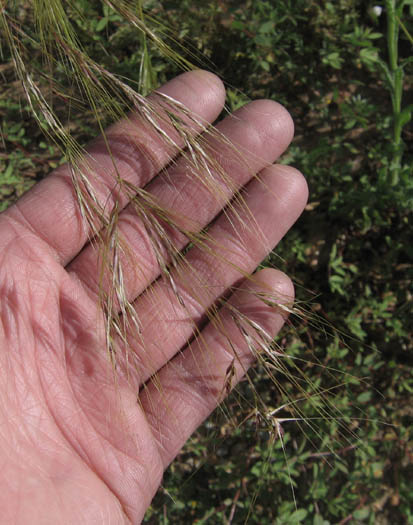
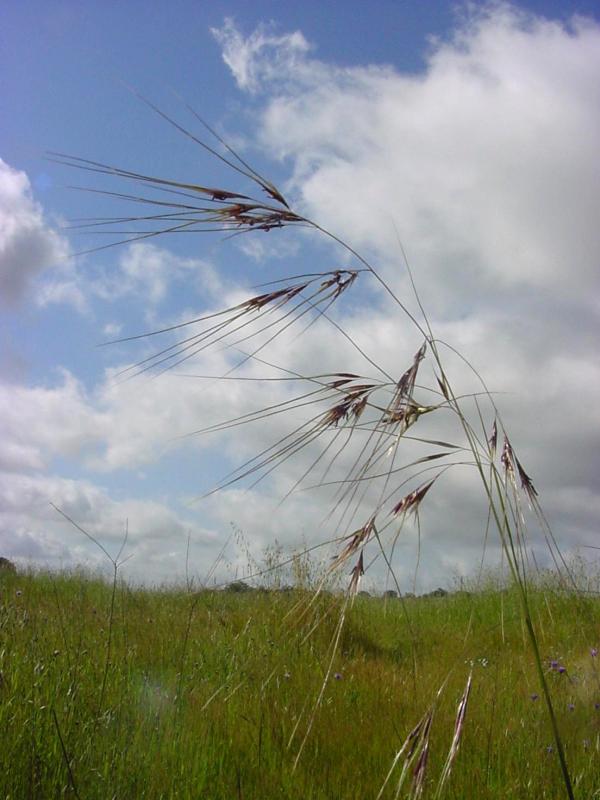
In spring, slender flowering stalks rise from the clump, bearing open, nodding panicles of small spikelets. Each spikelet is tipped with a long, bent and twisted awn, often 2 to 3 inches long, that is purplish when fresh, giving the whole seed head a soft, purple-gray haze that is the source of the plant’s common name. The awns are hygroscopic, twisting and untwisting with changes in humidity, which helps drive the sharp-tipped seed into the soil or animal fur for dispersal.
Fruit & Seeds
The fruit is a single-seeded grain (caryopsis) tipped with the long, bent awn described above. The sharp, barbed seed tip allows it to work its way into soil cracks for self-planting, but it can also catch painfully in skin, fur, and clothing, so plant purple needlegrass away from paths and play areas where people or pets brush against mature seed heads.
Quick Facts
| Scientific Name | Nassella pulchra (syn. Stipa pulchra) |
| Family | Poaceae (Grass) |
| Plant Type | Perennial Bunchgrass |
| Mature Height | 1.5–3.5 ft (45–105 cm) in flower; foliage clump 1–1.5 ft |
| Mature Spread | 1–2 ft (30–60 cm) |
| Growth Rate | Moderate; long-lived once established |
| Sun Exposure | Full Sun to Light Shade |
| Water Needs | Low; deep roots give excellent drought tolerance once established |
| Soil Type | Clay, serpentine, or loam; tolerates heavy and poor soils |
| Soil pH | 6.0–8.0 (adaptable, including serpentine) |
| Bloom Time | March – May |
| Flower Color | Purplish-tinged seed heads (wind-pollinated, inconspicuous florets) |
| Fall Color | Tan-gold foliage through the dry season |
| Fruit | Single-seeded grain with a long, bent, barbed awn |
| Deer Resistant | Generally yes once mature; grazed when young and tender |
| USDA Hardiness Zones | 7–10 |
Native Range
Purple needlegrass is native to California, where it was historically one of the dominant grasses of the state’s valley and coastal prairies, extending south into northern Baja California, Mexico. Its range runs essentially the length of the state, from the North Coast and Coast Ranges south through the Central Valley margins, the Sierra Nevada foothills, and the Transverse and Peninsular Ranges to the Mexican border.
Within California, purple needlegrass occurs across a wide range of elevations and soil types, from coastal bluffs and valley grassland near sea level to oak woodland and chaparral openings in the foothills. It grows particularly well on clay soils that bake hard in summer and on serpentine soils too mineral-poor for many other plants, conditions where its deep root system gives it a strong competitive advantage.
Before European settlement, purple needlegrass and other native perennial bunchgrasses are believed to have formed extensive prairies across much of lowland California. Most of that original bunchgrass prairie has since been converted to agriculture, development, or dominated by introduced Mediterranean annual grasses, leaving purple needlegrass as a remnant and restoration-priority species across much of its former range rather than the dominant grass it once was.
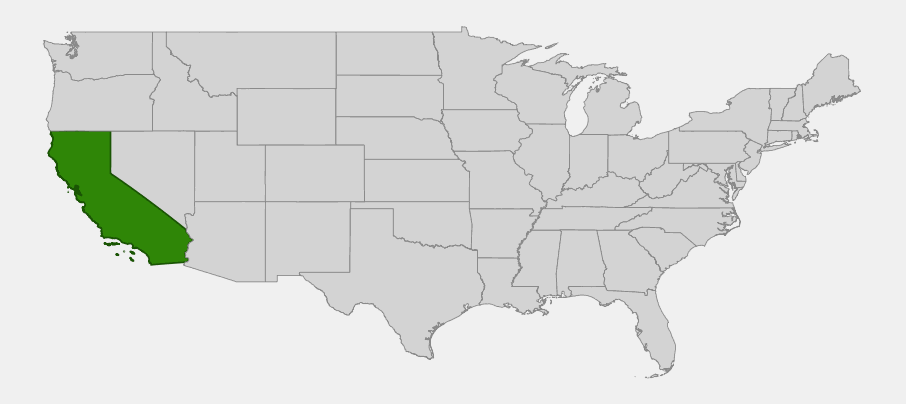
📋 Regional plant lists featuring Purple Needlegrass: California & Nevada
Growing & Care Guide
Purple needlegrass is a long-term investment plant: slower to establish than a fast annual wildflower, but extremely tough and low-maintenance once its deep root system is in place.
Light
Full sun is best for a dense, upright clump and the strongest seasonal bloom display, though plants tolerate light shade, particularly the dappled shade beneath open oak canopies where they occur naturally in the wild.
Soil & Water
Purple needlegrass is adapted to a wide range of soils, including heavy clay and nutrient-poor serpentine, and does not need or want rich, amended garden soil. Water needs are low once established: young plants need regular watering through their first one to two summers to develop a deep root system, after which established clumps need little to no supplemental irrigation and can survive on winter rainfall alone in most of their range. Good drainage is helpful but not essential, since the plant’s natural habitat includes seasonally wet clay soils.
Planting Tips
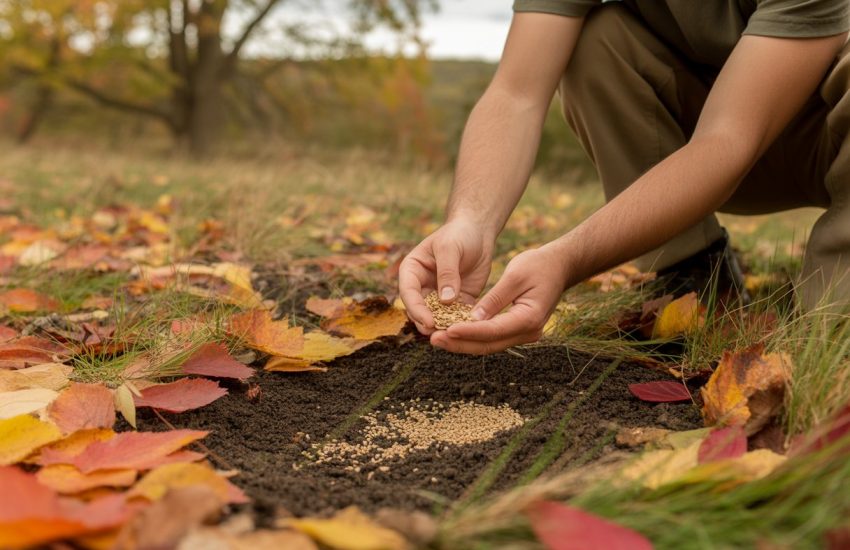
Purple needlegrass can be grown from container plants or direct-seeded in fall; container plants establish faster and more reliably in a garden setting. Space plants 18 to 24 inches apart to allow clumps to reach full size without excessive crowding. Fall planting, timed to the start of the rainy season, gives roots the longest possible head start before the following summer’s dry season.
Pruning & Maintenance
Established clumps need very little maintenance. Old, dead foliage can be combed out or lightly trimmed in late winter before new growth begins, which keeps the clump looking tidy and encourages fresh leaf growth. Avoid cutting plants back hard in summer, when they are naturally dormant and should be left undisturbed.
Propagation
Propagation is by seed or by division of established clumps. Collect ripe seed in late spring to early summer once the awns have browned, and sow in fall; division is best done in fall as well, replanting divisions promptly and keeping them watered until new roots establish.
Landscape Uses
- Native grassland and prairie restoration plantings
- Low-water lawn alternative or meadow groundcover
- Erosion control on slopes, thanks to its deep, binding root system
- Structural accent among wildflower annuals and perennials
- Oak woodland understory plantings beneath native oaks
- Habitat gardens supporting native grassland wildlife
Wildlife & Ecological Value
As the foundational species of California’s native grassland, purple needlegrass supports a web of wildlife that depends on structurally diverse, deep-rooted perennial grass cover.
For Pollinators
Though wind-pollinated and not a nectar source itself, purple needlegrass provides important habitat structure within pollinator gardens and restoration plantings, and it serves as the larval host plant for several native skipper butterflies, whose caterpillars feed on the grass blades.
For Birds
Ground-foraging and grassland birds use purple needlegrass stands for cover and nesting structure, and the ripening grain provides seed forage for native sparrows and other grassland seed-eaters through late spring and early summer.
For Mammals
Historically, purple needlegrass was an important forage grass for native grazing animals, and young, tender growth is still grazed by deer and rodents in spring; mature, awned seed heads are generally avoided due to the sharp, irritating awns. Small mammals use the dense clump bases for shelter and nesting material.
Ecosystem Role
Purple needlegrass is a cornerstone of California’s native bunchgrass prairie, an ecosystem that has been reduced to a small fraction of its historical extent by conversion to agriculture and the spread of introduced annual grasses. Its exceptionally deep root system, often reaching 20 feet into the soil, improves soil structure and water infiltration far below the reach of shallow-rooted annual grasses, while its long-lived, bunched growth form creates microhabitat diversity that supports a far richer community of native insects, birds, and small mammals than the monotonous stands of non-native annual grass that have replaced it across much of the state.
Cultural & Historical Uses
Purple needlegrass holds a special place in California’s identity: in 2004, the California Legislature designated it the official State Grass, recognizing its historical role as the dominant grass of the state’s original valley and coastal prairies and its ongoing importance to native grassland restoration.
Before European settlement transformed California’s grasslands, purple needlegrass and other native perennial bunchgrasses are understood to have formed extensive prairies that supported California’s Indigenous peoples in various ways, including as a source of small edible grass seed gathered and processed as part of a broader diet of native grains, along with cover and habitat for the game animals that Indigenous communities relied on. The conversion of these prairies to grazing land and agriculture following Spanish and later American settlement, along with the spread of introduced Mediterranean annual grasses, dramatically reduced purple needlegrass’s dominance across the landscape it once defined.
Today, purple needlegrass is a flagship species for California grassland restoration, planted widely in habitat restoration projects, native plant gardens, and roadside plantings as part of ongoing efforts to recover some fraction of the state’s lost native prairie.
Frequently Asked Questions
Is purple needlegrass really California’s state grass?
Yes. The California Legislature designated purple needlegrass the official State Grass in 2004, honoring its role as the historical dominant species of the state’s native valley and coastal prairies.
Are the seed awns of purple needlegrass dangerous?
The long, barbed awns are sharp and can work painfully into skin, fur, or clothing, so it’s best to plant purple needlegrass away from paths, play areas, and places pets frequent, especially once seed heads mature in late spring.
How drought tolerant is purple needlegrass?
Extremely, once established. Its root system can reach as deep as 20 feet into the soil, letting mature clumps survive California’s long dry summers on winter rainfall alone, with little to no supplemental irrigation needed.
Does purple needlegrass stay green year-round?
It is evergreen to semi-evergreen depending on summer moisture; foliage often fades to a tan-gold color during the driest months and greens back up with the return of fall and winter rain.
How long does it take purple needlegrass to establish?
Young plants need regular watering through their first one to two summers while the deep root system develops; after that establishment period, mature clumps are long-lived and need very little ongoing care.

Looking for a nursery that carries Purple Needlegrass?
Browse our native plant nursery directory: California