Salt Grass (Distichlis stricta)
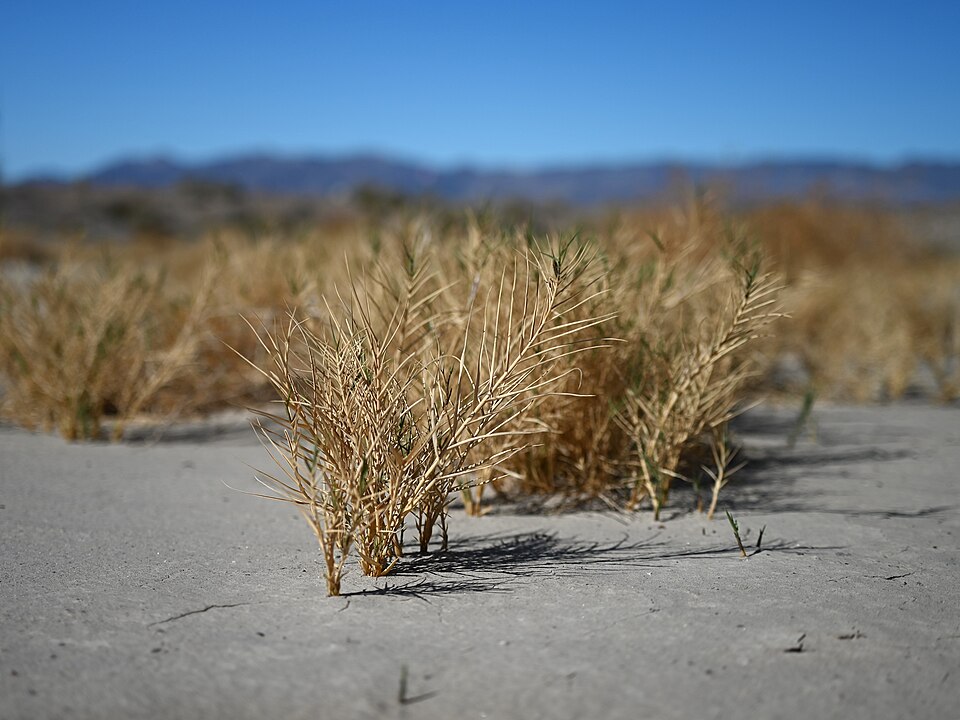
Distichlis stricta (also commonly referred to as Distichlis spicata var. stricta), known as Salt Grass, Desert Salt Grass, or Inland Salt Grass, is one of the most remarkable and ecologically specialized native grasses in North America — a true halophyte (salt-loving plant) that thrives in saline soils where virtually no other plant can survive. This low-growing, rhizomatous perennial grass forms dense, spreading mats in alkaline desert flats, salt marshes, playas, and irrigated areas with high soil salinity, performing a critical role in stabilizing these challenging environments and supporting specialized wildlife communities.
Salt Grass grows only about 1 foot tall but spreads aggressively by underground rhizomes, creating extensive, dense, sod-like colonies that can cover large areas. The leaves and stems have a characteristic rough, somewhat stiff texture and a bluish-green to grayish-green color. The plant is notable for its remarkable salt tolerance — it can excrete excess salt through specialized salt glands on its leaves, causing the leaf surfaces to appear dusted with small white salt crystals. This salt-secreting mechanism allows it to grow in soils with salinity levels that would kill virtually any other grass or plant.
For Arizona gardeners, land managers, and restoration ecologists working in saline, alkaline, or greywater-irrigated areas, Salt Grass offers extraordinary value. It is particularly useful as a greywater plant — tolerating the salts and minerals that accumulate in greywater-irrigated soils better than almost any other plant. Its dense, spreading growth also makes it valuable for erosion control in saline desert flats, playa margins, and along irrigation canals where high soil salinity prevents the establishment of other vegetation.
Identification
Salt Grass is a low-growing perennial grass, typically 6–12 inches tall, that spreads extensively by vigorous rhizomes to form dense, sod-like colonies. The plants are dioecious — individual plants are either male or female, with separate pollen-producing and seed-producing plants. The grass has a distinctive stiff, somewhat wiry appearance and feel, different from the softness of most other native grasses.
Stems & Leaves
The stems are erect to ascending, somewhat flattened, and distinctly two-ranked in their leaf arrangement (distichous — the source of the genus name Distichlis). The leaves are flat, firm, and somewhat rigid, 1–4 inches long, arranged alternately in two rows along the stem, giving the plant a distinctive ladder-like or herringbone appearance when viewed closely. The leaf surfaces may appear encrusted with tiny white salt crystals excreted by specialized epidermal glands — this is the plant actively removing excess salt from its tissues. The overall color is bluish-green to grayish-green.
Flowers & Seeds
Salt Grass flowers from late spring through summer (May–August). Male plants produce pollen-bearing spikelets in compact, yellowish-green clusters; female plants produce dense, seed-bearing spike clusters that mature to a straw-brown color. The spikelets are flattened and scale-like. Seeds are small and wind-dispersed. The plant spreads primarily by rhizomes, forming extensive underground networks that may persist for decades.
Quick Facts
| Scientific Name | Distichlis stricta (syn. D. spicata var. stricta) |
| Family | Poaceae (Grass Family) |
| Plant Type | Perennial Sod-Forming Grass |
| Mature Height | 1 ft |
| Sun Exposure | Full Sun |
| Water Needs | Moderate |
| Bloom Time | May – August |
| Special Feature | Extreme salt tolerance; excellent greywater plant |
| USDA Hardiness Zones | 4–10 |
Native Range
Salt Grass is one of the most widely distributed native grasses in western North America, occurring across virtually the entire western United States and into Mexico and Canada. Its native range in the US includes Arizona, California, Colorado, Idaho, Kansas, Montana, Nebraska, Nevada, New Mexico, North Dakota, Oklahoma, Oregon, South Dakota, Texas, Utah, Washington, and Wyoming — essentially the entire arid and semi-arid West. The species also occurs along the Atlantic and Gulf coasts in its coastal saltmarsh ecotype.
Within this vast range, Salt Grass occupies a very specific ecological niche: saline, alkaline, or seasonally flooded habitats. It grows on saline desert flats and playas in the Great Basin and Sonoran Desert, in salt marshes and coastal wetlands along the Pacific and Gulf coasts, along the margins of alkali lakes and springs, on the banks of irrigation canals where salt accumulates, and in any low-lying area where evaporation concentrates salts in the soil. In Arizona, it is most common on alkaline desert flats, the margins of desert dry lakes (playas), and along irrigation canals.
Salt Grass is often a dominant or co-dominant species in halophytic plant communities — communities specifically adapted to saline conditions — where it grows with other salt-tolerant plants such as saltbush, iodine bush, and seepweed. These saline plant communities are among the most ecologically specialized in North America, supporting unique assemblages of specialized insects, birds, and other wildlife.
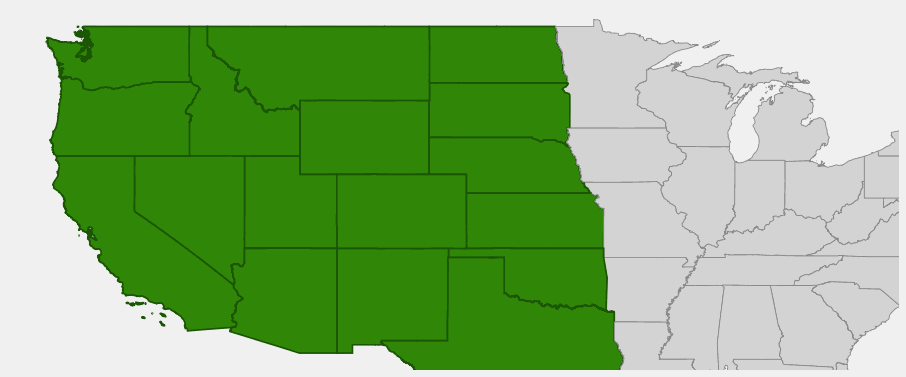
📋 Regional plant lists featuring Salt Grass: Arizona
Growing & Care Guide
Salt Grass is not a typical ornamental grass — it is a specialist plant for challenging conditions where salinity, alkalinity, or greywater use prevents other plants from establishing. In the right situation, it is invaluable; in a typical garden, it may spread too aggressively.
Light
Full sun is required. Salt Grass grows in open, exposed habitats without shade competition. It will not tolerate significant shading and performs best with maximum direct sunlight.
Soil & Water
Salt Grass is uniquely adapted to saline, alkaline soils that most plants find toxic. It actually performs poorly in rich, non-saline garden soils where other grasses can outcompete it. Plant it where salinity is a problem — greywater areas, alkaline flats, desert playa margins, or areas with high soil sodium. It tolerates moderate moisture and can handle periods of flooding as well as dry intervals. It is not as drought-tolerant as most desert plants and performs best with moderate, consistent moisture — even in saline soils.
Planting Tips
Establish Salt Grass from plugs, sod, or rhizome divisions — seed propagation can be difficult due to plant dioecy (male and female plants). Plant in spring or fall in saline or high-sodium soils. Be aware of its aggressive rhizomatous spread — contain it with deep root barriers or plant only where spreading is acceptable. In greywater systems, plant in the greywater application zone where salt accumulation from irrigation water will create the saline conditions it prefers.
Pruning & Maintenance
Salt Grass can be mowed or trimmed to maintain a low, dense mat. Mowing in late winter encourages fresh growth. In naturalistic plantings, leave it unmowed to provide maximum cover value for wildlife. Control spread by edging or digging rhizomes at the colony margins. No fertilization required — excess fertility encourages aggressive spread into non-target areas.
Landscape Uses
- Greywater systems — ideal plant for greywater irrigation areas
- Saline soil remediation — tolerates and stabilizes high-sodium soils
- Playa and dry lake margin plantings — naturally occurs in these habitats
- Alkali flat revegetation — pioneer species for saline disturbed soils
- Erosion control on saline flats and canal banks
- Specialized wildlife habitat — important grass for salt marsh and desert playa bird communities
Wildlife & Ecological Value
Salt Grass supports a specialized and often underappreciated suite of wildlife adapted to saline habitats.
For Birds
Salt Grass seeds are eaten by horned larks, savannah sparrows, and other open-ground bird species that frequent desert flats and alkali playas. The dense mat growth provides nesting cover for killdeer and other ground-nesting birds that use open, sparsely vegetated saline flats. The playas and salt flats where Salt Grass grows are important stopover habitat for migrating shorebirds.
For Mammals
Pronghorn, mule deer, and livestock graze Salt Grass — historically, it was an important forage grass for bison on alkali plains. Small mammals including kangaroo rats and jackrabbits use salt grass flats extensively. The dense mat growth provides cover for a variety of small desert animals.
For Pollinators
As a wind-pollinated grass, Salt Grass is not a nectar or pollen source for pollinators. However, the salt grass flats and playa margins it inhabits support unique communities of salt-tolerant insects, including specialized beetles, flies, and bugs that are in turn important food for birds and other insectivores.
Ecosystem Role
Salt Grass plays a critical ecosystem role as one of the few plants capable of stabilizing and vegetating highly saline soils. In desert playa systems, it forms a living mat that prevents dust storm formation from bare alkali flats — an important air quality function in the arid Southwest. Its extensive rhizome networks bind saline soils and resist erosion by both wind and water. As a primary producer in salt-tolerant plant communities, it forms the foundation of a specialized food web supporting insects, birds, and mammals adapted to saline habitats.
Cultural & Historical Uses
Salt Grass has a long history of use by Indigenous peoples throughout its range, particularly in the desert Southwest and Great Basin. The Cahuilla, Paiute, and other desert peoples gathered Salt Grass seeds as a food source — the seeds, though small, were collected in quantity and ground into a nutritious meal or flour. The Cahuilla also used the grass for thatching and basketry, weaving the stiff leaves into lightweight, functional baskets. The Paiute and other Great Basin peoples used Salt Grass extensively as emergency food during lean seasons.
European and American settlers quickly recognized Salt Grass as an indicator of saline or alkaline soil conditions — its presence was a reliable field sign of high soil sodium, allowing early settlers to avoid planting crops in unsuitable locations. Ranchers also valued Salt Grass as rangeland forage, particularly in areas where more palatable grasses could not grow. Historical accounts describe vast alkali flats in Arizona and Nevada covered with Salt Grass, providing important seasonal grazing for cattle, horses, and sheep.
In modern agriculture and environmental management, Salt Grass has attracted significant research interest for its potential use in phytoremediation — the use of plants to remove or stabilize soil contaminants. Its exceptional salt tolerance and ability to thrive in sodic soils make it a candidate for revegetating salt-affected agricultural lands, mine tailings, and other heavily disturbed saline sites. Researchers have also studied the plant’s salt-excretion mechanisms as a model for understanding halophyte physiology and potentially transferring salt tolerance to crop plants through biotechnology.
Frequently Asked Questions
Is Salt Grass appropriate for a regular garden?
Salt Grass is a specialist plant best suited for specific challenging conditions — saline soils, greywater areas, or alkali flats. In a regular garden with normal fertile soil, it will likely be outcompeted by other grasses or spread aggressively into unwanted areas. It is best used intentionally in the specific problem-soil situations it is adapted to solve.
What makes Salt Grass different from regular grasses?
Salt Grass has specialized salt glands in its leaves that actively excrete excess salt from its tissues — a physiological adaptation found in only a handful of plant species worldwide. This allows it to grow in soils with salt concentrations that would kill virtually any other grass. You can often see the excreted salt crystals on the leaf surfaces as a white, crystalline coating.
Can Salt Grass be used in a greywater garden?
Yes — Salt Grass is specifically recommended as a greywater plant because it tolerates the sodium, minerals, and mild detergents that accumulate in greywater-irrigated soils over time. Plant it in the greywater application zone and it will thrive where most plants would decline due to soil salt buildup.
Will Salt Grass spread into my other plants?
Yes — Salt Grass spreads aggressively by underground rhizomes and will invade adjacent planting areas if not contained. Install deep root barriers (12+ inches deep) around the planting area, or confine it to a dedicated zone where spreading is acceptable. Alternatively, use it where it can spread freely on saline or greywater-affected ground.
Does Salt Grass tolerate flooding?
Yes — Salt Grass tolerates periodic flooding and temporary inundation. In its natural habitat, it grows on playa margins and desert flats that may flood seasonally or during monsoon events. Its rhizome network persists through flooding and resumes growth after water recedes.

Looking for a nursery that carries Salt Grass?
Browse our native plant nursery directory: Arizona