Showy Goldenrod (Solidago speciosa)
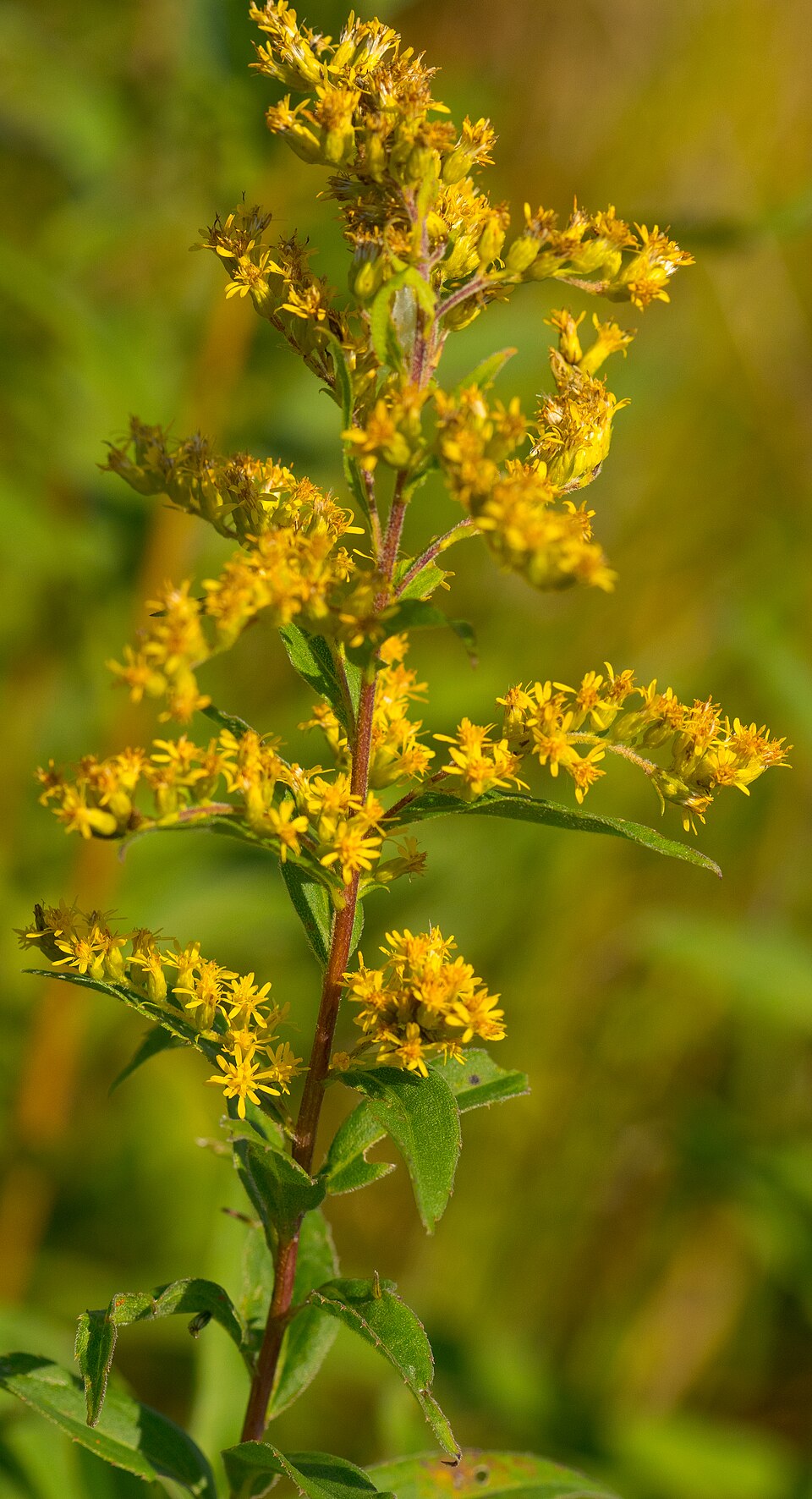
Solidago speciosa, commonly known as Showy Goldenrod, is widely regarded as the most beautiful of all the native goldenrods — a bold claim in a genus of some 100+ species, but one that is difficult to dispute when the plant is seen in full bloom. A member of the Asteraceae (daisy) family, Showy Goldenrod produces dramatic, upright, foot-long wands of blazing golden-yellow flowers in August through October that are compact, dense, and intensely colored compared to the loose, arching plumes of most other goldenrod species. The effect in the autumn landscape is breathtaking — a botanical firework of color at exactly the moment when the gardener most needs it.
Growing 1 to 5 feet tall (typically 2–4 feet in garden conditions), Showy Goldenrod has a more compact, disciplined growth habit than many of its sprawling relatives. The flower spikes rise erect and unbranched from a basal rosette of large, handsome leaves, creating a bold vertical accent in the late-season garden. The plant tolerates full sun to part shade and adapts to both moderate and dry conditions, making it broadly versatile across a range of garden situations. It is a prairie-and-savanna specialist in its natural habitat, thriving in the challenging combination of summer drought and intense sunshine that characterizes these ecosystems.
For gardeners in Michigan, Wisconsin, and Minnesota seeking to create a spectacular late-season native planting, Showy Goldenrod is nearly indispensable. It combines extraordinary ornamental quality with exceptional ecological value — the dense flower spikes support a rich community of late-season pollinators including migrating Monarch butterflies, specialist goldenrod bees, and dozens of other native bee and butterfly species. And unlike the invasive associations that have unfairly stigmatized goldenrods in popular culture, Showy Goldenrod does not cause hay fever — its pollen is too heavy and sticky to become airborne.
Identification
Showy Goldenrod is distinguished from other native goldenrods by a combination of features: its compact, upright flower spike (rather than arching or branched), its large, attractively textured basal leaves, and its intense, concentrated color. The overall impression is bolder and more architectural than most other native goldenrods.
Leaves
The basal leaves of Showy Goldenrod are large and distinctive — 4 to 6 inches long, oval to elliptic, with a prominently winged petiole, and a surface that may be smooth or slightly rough with fine hairs. The leaf margins are finely toothed. Stem leaves are alternate, progressively smaller toward the top of the stem, sessile (lacking a petiole) or clasping the stem slightly. The large, handsome basal leaves are one of the most useful identification features — they appear in spring well before flowering and persist through the growing season.
Flowers
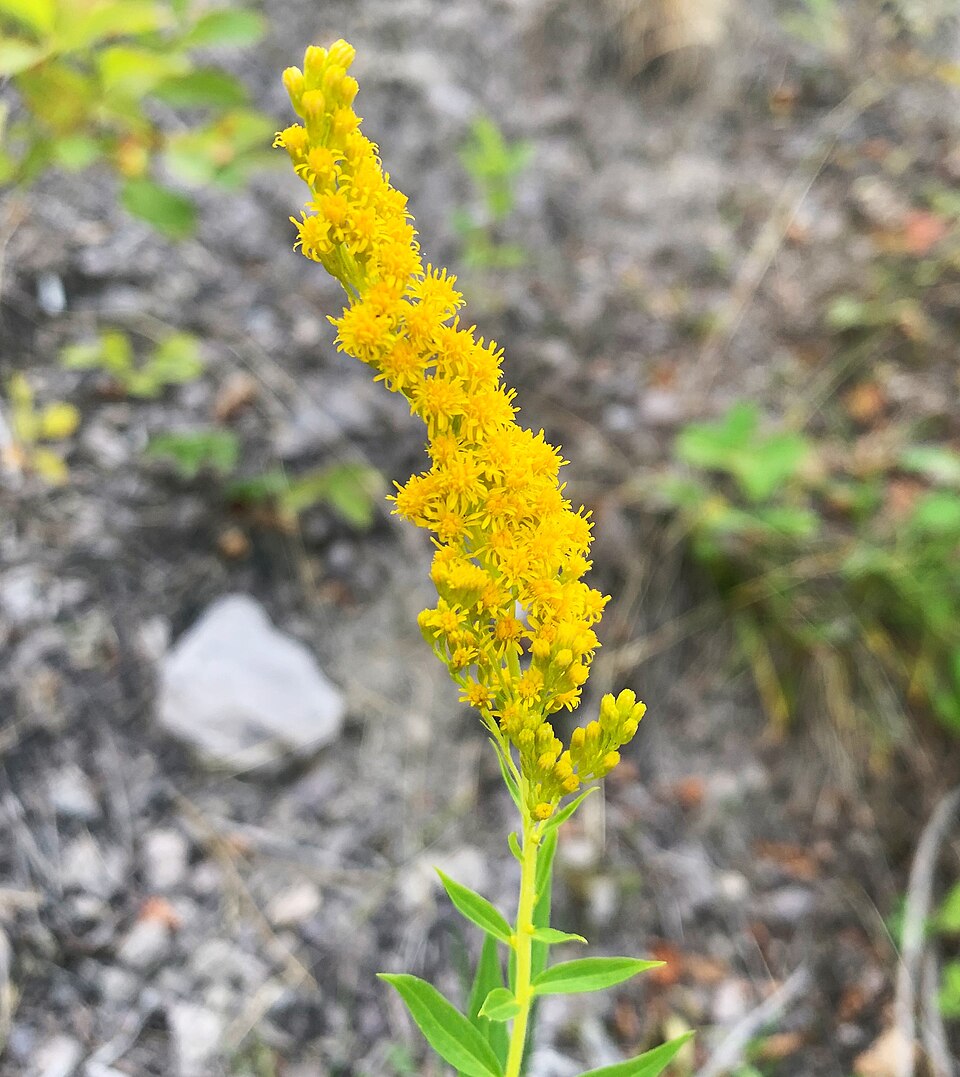
The flower head arrangement — the inflorescence — is what most distinguishes Showy Goldenrod from its relatives. Rather than the arching, wandering panicle of many goldenrods, Showy Goldenrod produces a compact, erect, cylindrical spike-like cluster of flower heads, typically 4 to 12 inches long, that rises directly from the top of the stem and from short ascending branches. Each small composite flower head has 7–9 bright yellow ray florets and a yellow disc. The overall effect is a dense, erect wand of intense golden color — the “showy” quality that gives the species its common name.
Stems & Roots
Stems are stout, smooth to slightly hairy, erect, and typically unbranched below the inflorescence. They arise from a short rhizomatous rootstock that slowly expands to form modest-sized clumps — less aggressive in its spreading than many other goldenrod species, making Showy Goldenrod better behaved in garden settings.
Quick Facts
| Scientific Name | Solidago speciosa |
| Family | Asteraceae (Daisy / Goldenrod) |
| Plant Type | Herbaceous Perennial Wildflower |
| Mature Height | 1–5 ft |
| Sun Exposure | Full Sun to Part Shade |
| Water Needs | Moderate to Low (Drought Tolerant once established) |
| Bloom Time | August – October (early autumn) |
| Flower Color | Bright golden-yellow |
| USDA Hardiness Zones | 3–9 |
Native Range
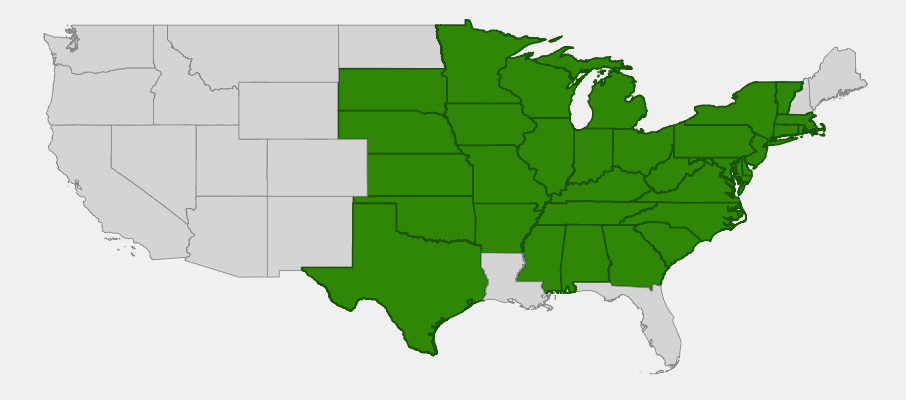
Showy Goldenrod is native to a broad swath of eastern and central North America, ranging from the Great Plains eastward to the Atlantic Coast and from southern Canada south to the Gulf states. Its native range encompasses the tallgrass prairie, oak savanna, and eastern deciduous forest biomes, where it is most characteristic of open, sunny habitats — prairies, savanna edges, open woodlands, and rocky hillsides with well-drained to dry soils.
In the Upper Midwest, Showy Goldenrod is found naturally throughout Michigan, Wisconsin, and Minnesota, where it grows in remnant prairies, open oak savannas, dry woodland edges, and along sandy roadsides. It is considered a conservative prairie species in many states — its presence signals relatively undisturbed native habitat, as it is less adapted than some goldenrods to the weedy, disturbed conditions of roadsides and waste places. It is most common on well-drained to dry soils, often on sandy or rocky substrates where it escapes competition from taller grasses and forbs.
Like many prairie specialists, Showy Goldenrod has experienced significant range contraction due to the conversion of native prairie and savanna to agriculture. It is now absent from much of its historical range in intensively farmed areas of the Corn Belt, persisting primarily in prairie remnants, conservation areas, and on rocky or sandy soils unsuitable for cultivation. Planting Showy Goldenrod in gardens and restoration sites helps counteract this long-term range contraction.
📋 Regional plant lists featuring Showy Goldenrod: Michigan, Minnesota & Wisconsin
Growing & Care Guide
Showy Goldenrod is an outstanding garden plant — ornamentally superior to most goldenrods while being easy to grow, drought tolerant, and far better behaved (less aggressively spreading) than the common roadside goldenrods most people are familiar with.
Light
Full sun produces the best growth and bloom in Showy Goldenrod — the most compact, upright stems and the most intensely colored, prolific flower display. In part shade (3–4 hours of direct sun), it will grow taller and more open, and bloom quantity decreases, but the plant remains healthy and reasonably attractive. Avoid deep shade, which results in weak, floppy stems and poor flowering.
Soil & Water
Showy Goldenrod performs best in lean, well-drained to dry soils — conditions that mimic its native prairie and savanna habitat. Avoid rich, heavily amended soils, which produce tall, floppy plants that need staking and are more susceptible to foliar diseases. Poor to average sandy or rocky soils are ideal. The plant is drought tolerant once established and requires little or no supplemental irrigation in the Great Lakes region after its first growing season. Avoid consistently moist or poorly drained sites.
Planting Tips
Plant Showy Goldenrod from container stock in spring or fall, spacing plants 18–24 inches apart. It establishes quickly and blooms the first or second year after planting. For a spectacular fall display, mass-plant 5 or more plants together — the combined impact of multiple flower wands is far more dramatic than individual specimens. It combines beautifully with native grasses (especially Little Bluestem), New England Aster, and other fall-blooming prairie species.
Pruning & Maintenance
Showy Goldenrod requires minimal maintenance. For more compact plants and increased flower production, cut stems back by one-third in mid-June (the “Chelsea chop”) — this delays bloom slightly but results in bushier plants with more stems and more flowers. Without cutting back, plants may lean slightly in rich soils; improve soil conditions rather than staking. Divide clumps every 4–5 years in spring to maintain vigor. Leave seed heads standing through winter for finch habitat and winter interest.
Landscape Uses
- Prairie and meadow plantings — a signature species of the tallgrass prairie community
- Sunny perennial borders — spectacular fall color anchor for mixed borders
- Pollinator gardens — essential late-season nectar source for bees and monarchs
- Naturalized areas and roadsides — thrives on dry, lean roadside soils
- Ecological restoration — conservative species indicating quality native habitat
- Cut flower gardens — excellent as fresh or dried cut flower
Wildlife & Ecological Value
Showy Goldenrod is an ecological powerhouse in the fall landscape, supporting one of the highest diversities of native insects of any North American wildflower genus, with the dense, compact flower spikes providing exceptional foraging opportunities.
For Pollinators
Goldenrods are often called “the staff of life for fall pollinators” — and Showy Goldenrod is among the best of them. The flowers support an exceptional diversity of bees, including specialist goldenrod bees (Colletes simulans, Andrena spp.), bumble bees, and many other native bee species gathering both nectar and pollen. Migrating Monarch butterflies use goldenrod nectar as primary fuel for their southward migration in September–October, and many other migrating butterfly species rely on it as well. Dozens of beetle, moth, and fly species also use goldenrod flowers.
For Birds
The small, fluffy seeds of Showy Goldenrod are consumed by American Goldfinch, House Finch, Pine Siskin, and various sparrows in fall and winter. Dense clumps provide minimal cover for small birds foraging at ground level. Leaving stems standing through winter maximizes seed availability.
For Insects
Beyond pollinators, goldenrods support over 100 species of insects that use them as larval host plants — including the goldenrod gall fly (Eurosta solidaginis), goldenrod gall moth, and dozens of native moth and butterfly species. The galls formed by these insects are themselves important winter food for Downy Woodpeckers and Black-capped Chickadees, which drill into the galls to extract the overwintering larvae.
Ecosystem Role
Showy Goldenrod is a keystone plant in prairie and savanna ecosystems, supporting a web of ecological relationships that extends far beyond the obvious pollinator connections. Its deep root system contributes to prairie soil structure, and its annual cycle of above-ground growth and decomposition contributes organic matter to the soil. As a conservative species of quality native habitat, it functions as a biological indicator of ecosystem health.
Cultural & Historical Uses
Goldenrods were used extensively by Indigenous peoples across North America, and Showy Goldenrod was among the species employed by Great Plains and Great Lakes tribes. The Cherokee used goldenrod leaf tea to treat sore throats and fevers. The Ojibwe used goldenrod flowers in ceremonial contexts and the roots and leaves medicinally. Various tribes used goldenrod preparations as treatments for kidney problems, toothache, and flatulence, and as charms and ceremonial offerings. Goldenrod smoke was used in purification ceremonies and to treat certain respiratory ailments.
An important historical note: goldenrods were long and unjustly blamed for causing hay fever, when in fact the real culprit is ragweed (Ambrosia spp.), which blooms simultaneously but produces vast quantities of lightweight, airborne pollen. Goldenrod pollen is heavy and sticky — adapted for insect transport — and rarely becomes airborne in quantities sufficient to cause allergic reactions. The confusion arose because goldenrod’s showy yellow flowers are visible just when hay fever season peaks, while ragweed’s insignificant greenish flowers go unnoticed. Thomas Edison, who himself suffered from hay fever, is said to have been a champion of goldenrod and explored the use of goldenrod latex as a natural rubber source.
In European horticultural tradition, goldenrods were actually highly prized ornamental plants in the 17th and 18th centuries, before European plant breeders began developing showier garden varieties. Showy Goldenrod has seen a major resurgence of ornamental interest in recent decades, both in North America and in European “new perennials” garden design movements, where its architectural qualities and ecological value make it a featured species in contemporary naturalistic garden design.
Frequently Asked Questions
Does Showy Goldenrod cause hay fever?
No. Goldenrod pollen is heavy, sticky, and insect-transported — it does not become airborne in meaningful quantities. Hay fever during goldenrod season is caused by ragweed (Ambrosia spp.), which blooms at the same time with inconspicuous flowers and produces vast amounts of lightweight airborne pollen. Goldenrod has been unjustly blamed for centuries.
How aggressively does Showy Goldenrod spread?
Showy Goldenrod is one of the better-behaved goldenrods in the garden. It spreads slowly by short rhizomes and self-seeding, but is far less aggressive than common Canada Goldenrod (S. canadensis). Clumps expand slowly and can be easily divided or contained. In lean, dry soils — its preferred conditions — spreading is minimal.
When is the best time to see Showy Goldenrod in bloom?
Peak bloom in the Great Lakes region typically occurs in August and September, with blooms often persisting into October. The plant is usually at its most spectacular in the first two weeks of September, when it coincides with migrating Monarch butterflies and the peak of fall color in many areas.
Can Showy Goldenrod be used as a cut flower?
Absolutely — Showy Goldenrod makes an excellent fresh and dried cut flower. Cut stems when the lower portion of the flower spike has opened and the upper portion is still in bud, then condition in water for several hours before arranging. For dried flowers, hang bunches upside down in a dry, airy location.
What’s the difference between Showy Goldenrod and Stiff Goldenrod?
Stiff Goldenrod (Solidago rigida) has similar compact, erect flower spikes and prairie habitat preferences, but its flower clusters are more flat-topped and button-like rather than wand-like, and its leaves are rough and stiff-textured. Showy Goldenrod typically has smoother, more attractive leaves and more intensely colored, denser flower spikes.