
Solomon’s Seal (Polygonatum biflorum)
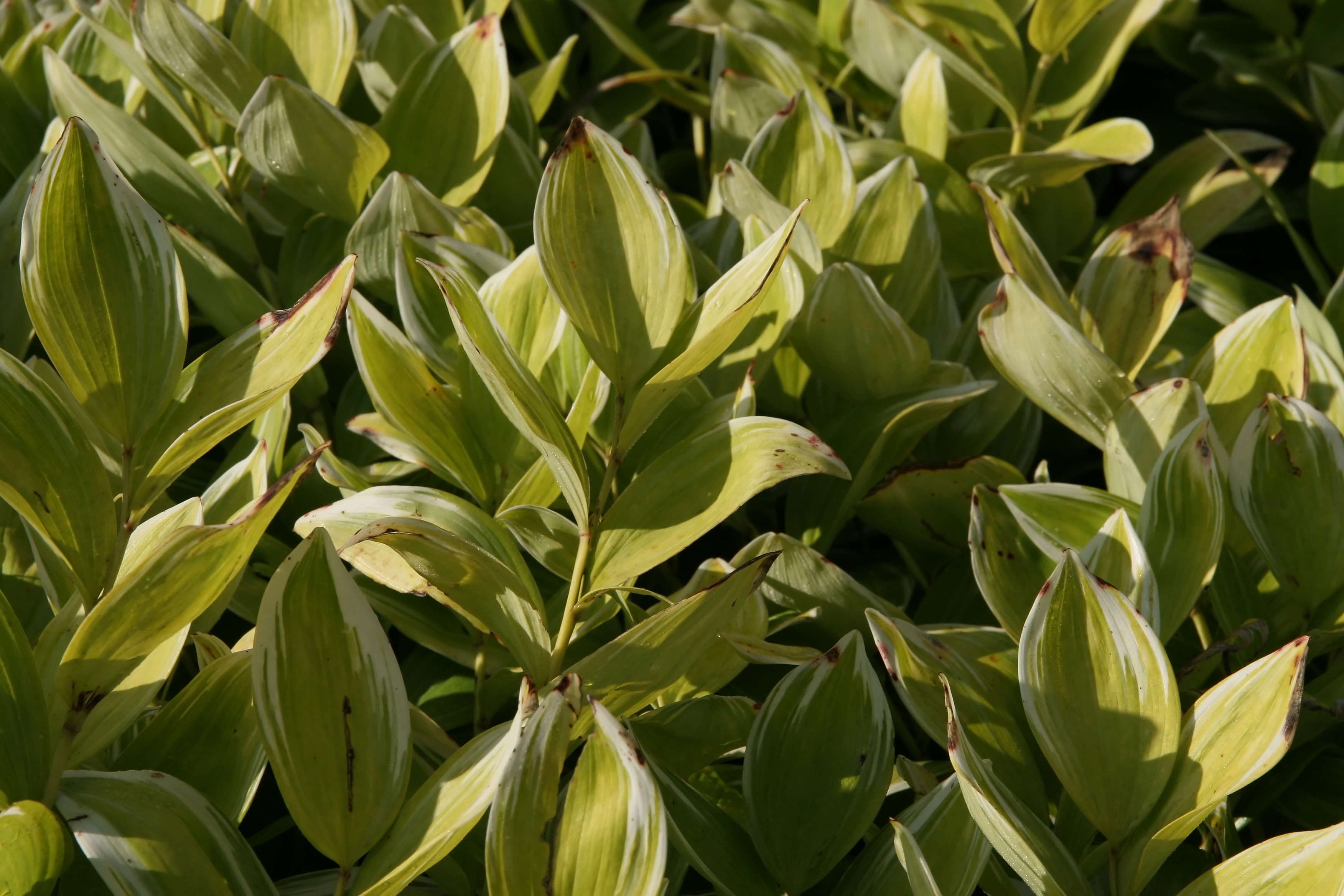
Polygonatum biflorum, commonly known as Solomon’s Seal, Smooth Solomon’s Seal, or Great Solomon’s Seal, is a graceful native perennial herb that adds elegant structure to woodland gardens across eastern and central North America. This member of the Asparagaceae family (formerly Liliaceae) is renowned for its distinctive arching stems lined with alternately arranged, oval leaves that create a distinctive ladder-like pattern — a growth form so perfectly symmetrical it appears almost architectural.
The plant’s common name derives from the rounded scars left on the thick rhizomes when the annual stems die back, supposedly resembling the seal of King Solomon. These rhizomes form extensive underground colonies over time, making Solomon’s Seal an excellent groundcover for shaded areas where few other plants thrive. In late spring, pairs of small, bell-shaped, greenish-white flowers dangle beneath the arching stems, followed by dark blue-black berries that ripen in late summer.
Solomon’s Seal is particularly valued for its ability to thrive in deep shade while providing consistent, reliable beauty throughout the growing season. Its arching stems create graceful horizontal lines that contrast beautifully with vertical woodland plants, while the berries provide important food for wildlife. This long-lived perennial requires minimal maintenance once established and naturalizes readily, making it an ideal choice for native woodland gardens, shade borders, and naturalistic plantings.
Identification
Solomon’s Seal grows as a herbaceous perennial from thick, fleshy, horizontal rhizomes. The plant typically reaches 1 to 3 feet tall and spreads slowly by rhizomes to form colonies. Each stem arches gracefully, creating the plant’s signature elegant profile that remains attractive throughout the growing season.
Stems & Growth Form
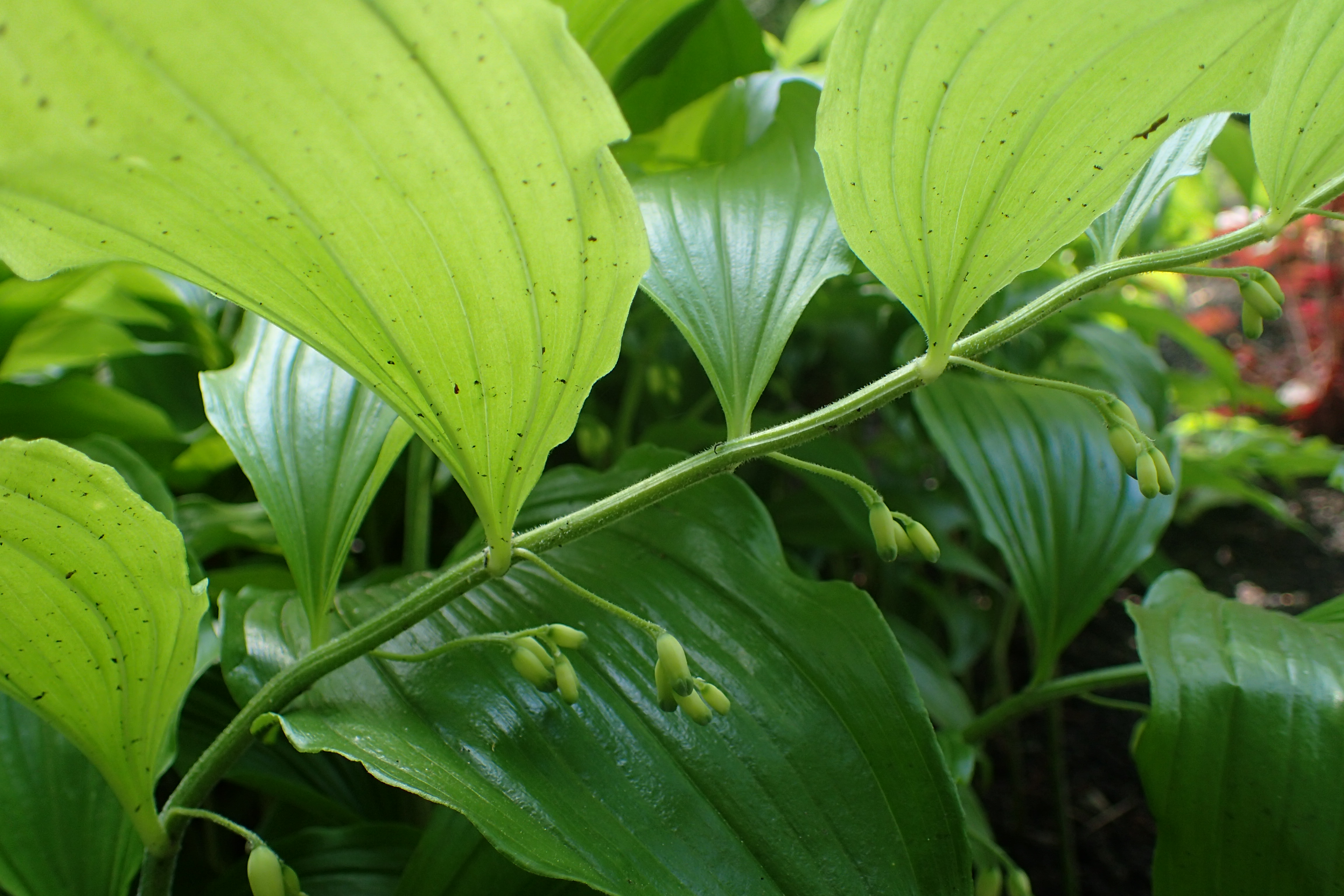
The smooth, unbranched stems emerge from underground rhizomes and arch gracefully outward, creating a distinctive fountain-like or arching growth pattern. Stems are green when young, sometimes with a reddish tinge, and become more woody toward the base as they mature. The arching habit allows the leaves to be displayed horizontally for maximum light capture in shaded conditions.
Leaves
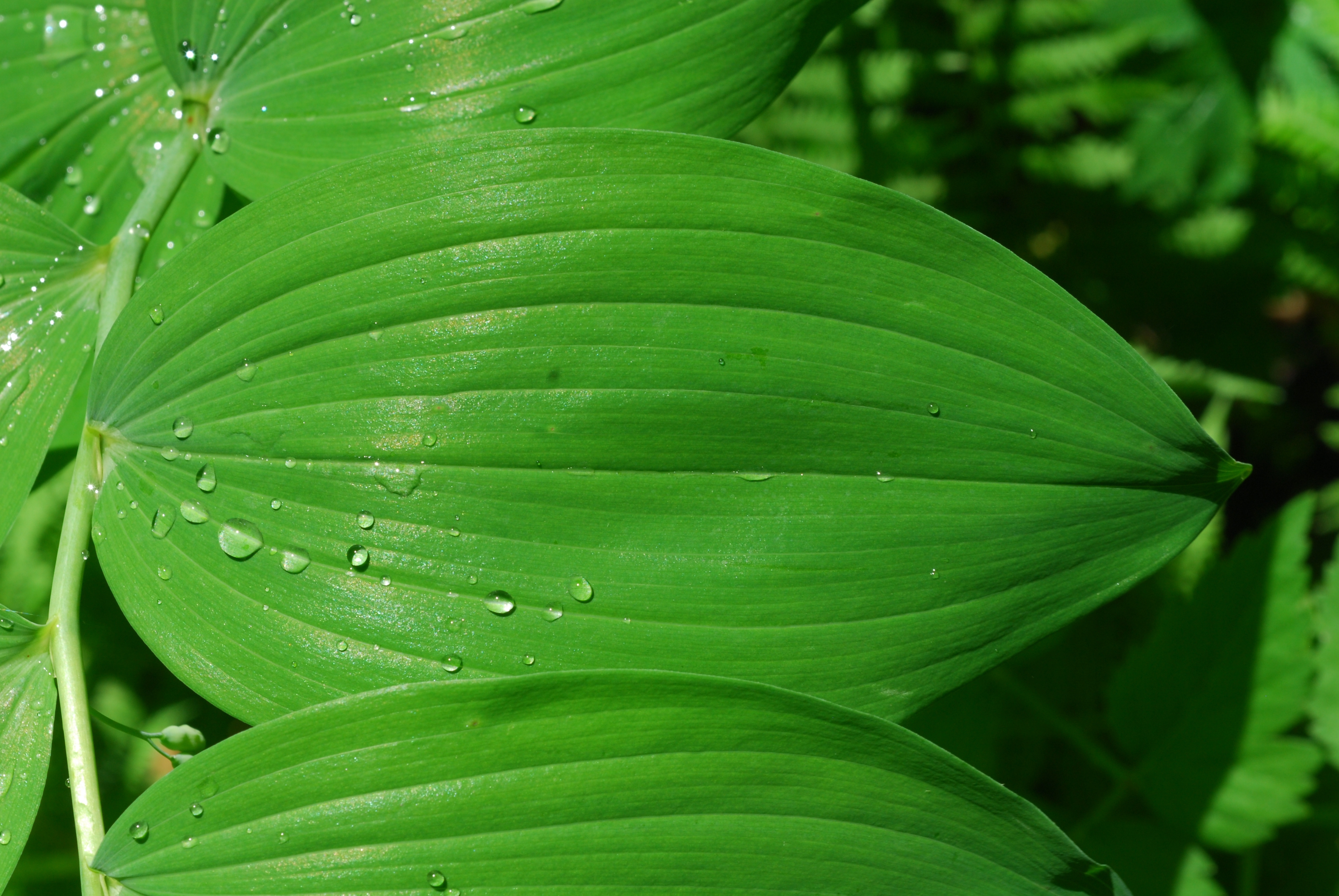
The leaves are one of Solomon’s Seal’s most distinctive features — oval to lance-shaped, 3 to 6 inches long and 2 to 3 inches wide, arranged alternately along the stem in a perfectly ordered pattern. Each leaf has prominent parallel veins running from base to tip, giving them a ribbed texture. The upper surface is medium to dark green and slightly glossy, while the underside is paler and sometimes slightly pubescent. The leaves attach directly to the stem without petioles, and their arrangement creates the characteristic ladder-like appearance.
Flowers & Fruit
In late spring to early summer (May-June), small, bell-shaped flowers appear in pairs (occasionally single or in groups of three) hanging from the leaf axils on thin stalks called peduncles. Each flower is ¼ to ½ inch long, tubular to bell-shaped, and greenish-white to cream-colored, often with a slight yellowish tinge. The flowers have 6 petals fused into a tube with flared tips, and 6 stamens hidden within.
The fruit develops in late summer as small, round berries about ¼ to ⅜ inch in diameter. Berries start green, then ripen to dark blue-black with a waxy bloom. Each berry contains several small seeds and provides important food for woodland birds and small mammals.
Quick Facts
| Scientific Name | Polygonatum biflorum |
| Family | Asparagaceae (Asparagus) |
| Plant Type | Herbaceous Perennial |
| Mature Height | 1–3 ft |
| Sun Exposure | Part Shade to Full Shade |
| Water Needs | Moderate |
| Bloom Time | May – June |
| Flower Color | Greenish-white |
| USDA Hardiness Zones | 3–8 |
Native Range
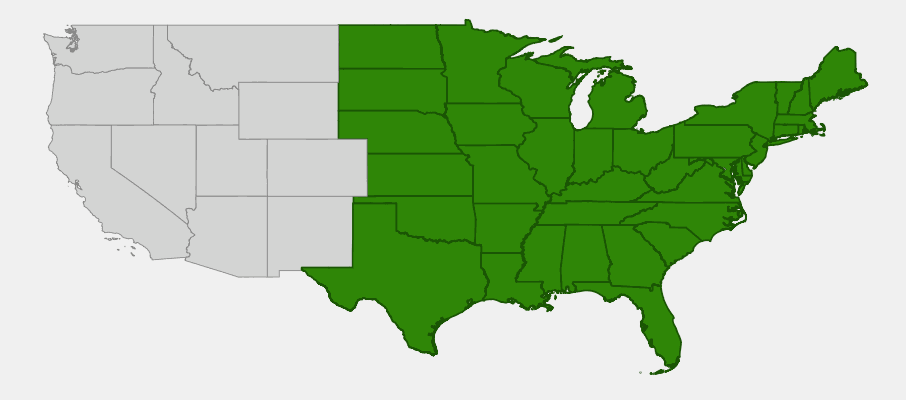
Solomon’s Seal has one of the most extensive native ranges of any North American woodland wildflower, spanning from southern Canada south to Florida and from the Atlantic coast west to the Great Plains. This wide distribution reflects the plant’s adaptability to various woodland conditions and its important ecological role in forest ecosystems across much of the eastern and central United States.
The species is most abundant in the mixed deciduous-coniferous forests of the Great Lakes region and Appalachian Mountains, where it thrives in the rich, moist soils beneath maple, oak, and hickory canopies. It extends west into the prairie-forest edge communities of the Great Plains states and south into the pine-hardwood forests of the southeastern coastal plain. This broad native range makes Solomon’s Seal suitable for cultivation across most of temperate North America.
In its natural habitat, Solomon’s Seal is typically found in mesic to rich woods, stream valleys, ravines, and wooded floodplains where soils remain consistently moist but well-drained. It often grows in association with other native woodland herbs like Wild Ginger, Trilliums, Ferns, and May-apple, forming part of the diverse herbaceous layer that characterizes mature eastern deciduous forests.
📋 Regional plant lists featuring Solomon’s Seal: North Dakota, South Dakota & Western Minnesota
Growing & Care Guide
Solomon’s Seal is among the most reliable and low-maintenance native perennials for shaded gardens. Its adaptability to various light and soil conditions, combined with its drought tolerance once established, makes it an excellent choice for both beginning and experienced gardeners looking to create sustainable woodland plantings.
Light
Solomon’s Seal performs best in partial to full shade, tolerating deep shade better than most perennials. In its native woodland habitat, it thrives beneath the forest canopy where dappled sunlight filters through. While it can tolerate some morning sun, particularly in northern climates, too much direct sunlight can cause leaf scorch and reduce the plant’s vigor. The deeper the shade, the more open and graceful the arching stems become as the plant reaches toward available light.
Soil & Water
This adaptable perennial grows in a wide range of soil types but performs best in rich, humusy, well-draining soil that mimics woodland conditions. Solomon’s Seal tolerates various pH levels from slightly acidic to neutral (6.0-7.0) and adapts well to clay, loam, or sandy soils as long as drainage is adequate. While it prefers consistent moisture, established plants are surprisingly drought-tolerant and can handle dry periods better than many shade perennials. Mulching with leaf compost or shredded bark helps maintain soil moisture and adds organic matter.
Planting Tips
Plant Solomon’s Seal in fall or early spring when the rhizomes are dormant. Space plants 18-24 inches apart to allow for natural spreading. The plant can be grown from seed, but division of established clumps is more reliable and faster. When planting, set the rhizomes horizontally about 1-2 inches below the soil surface. Solomon’s Seal combines beautifully with other native woodland plants like Wild Ginger, Coral Bells, and various ferns.
Pruning & Maintenance
Solomon’s Seal requires minimal maintenance once established. Allow the foliage to remain until it naturally dies back in fall — the yellowing leaves continue to photosynthesize and feed the rhizomes for next year’s growth. Cut stems to ground level in late fall or early spring before new growth emerges. The plant rarely needs division but can be divided every 4-5 years in early spring if you want to propagate it or control its spread.
Landscape Uses
Solomon’s Seal’s elegant form and reliability make it valuable in many landscape settings:
- Woodland gardens as a foundational understory plant
- Shade borders providing horizontal structure among vertical plants
- Mass plantings for naturalistic groundcover in large shaded areas
- Native plant gardens combined with other woodland wildflowers
- Erosion control on shaded slopes with its spreading rhizome system
- Wildlife gardens providing berries for birds and shelter for small creatures
- Rain gardens in shaded, moist areas
Wildlife & Ecological Value
Solomon’s Seal plays an important role in woodland ecosystems, providing food and habitat for a variety of wildlife throughout the growing season. Its berries, foliage, and nectar support numerous species, while its rhizome system helps stabilize soil and creates habitat structure in the forest understory.
For Birds
The dark blue-black berries are consumed by many woodland birds, including Wood Thrushes, American Robins, Veeries, Catbirds, and various warbler species. The berries ripen in late summer when other food sources may be scarce, making them particularly valuable. Ruffed Grouse and Wild Turkeys occasionally eat both berries and foliage, while the dense colonies provide nesting cover and protection for ground-nesting species.
For Mammals
White-tailed deer browse the foliage, particularly young shoots in spring, though mature plants can tolerate moderate browsing. Small mammals like chipmunks and mice consume the berries and occasionally cache them, helping with seed dispersal. The thick rhizome mats create runways and shelter for voles, shrews, and other small woodland creatures.
For Pollinators
The small, tubular flowers attract various native bees, including mining bees and small carpenter bees, as well as flies and occasional butterflies. While individual flowers are not showy, the synchronized blooming of colony patches provides a reliable nectar source in late spring when few other woodland plants are flowering. The flowers are particularly important for specialist pollinators adapted to woodland conditions.
Ecosystem Role
Solomon’s Seal contributes to forest ecosystem health in several ways. Its extensive rhizome system helps prevent soil erosion on slopes and stabilizes stream banks. The plant’s leaf litter decomposes to enrich woodland soils, and its roots help maintain soil structure and water infiltration. As a long-lived perennial that forms stable colonies, Solomon’s Seal provides consistent habitat structure that supports diverse communities of soil organisms, arthropods, and other woodland wildlife.
Cultural & Historical Uses
Solomon’s Seal has a rich history of medicinal and cultural significance among Indigenous peoples of North America, who used various parts of the plant for healing purposes long before European contact. The plant’s common name reflects both its distinctive rhizome scars and its historical reputation as a healing herb with almost magical properties.
Native American tribes, including the Cherokee, Iroquois, and Ojibwe, used Solomon’s Seal rhizomes to treat a wide variety of ailments. The Cherokee used root preparations for lung troubles, kidney problems, and as a general tonic, while the Iroquois applied poultices made from the rhizomes to treat cuts, bruises, and inflammations. The Ojibwe used Solomon’s Seal in combination with other plants to treat stomachaches and women’s health issues. The mucilaginous rhizomes were often processed into a starchy food during times of scarcity.
European settlers quickly adopted many of these traditional uses, and Solomon’s Seal became a popular folk remedy in early American medicine. Herbalists used it primarily for treating broken bones, wounds, and inflammations — the plant’s ability to “seal” wounds gave rise to both its common name and its association with King Solomon’s legendary healing wisdom. The plant was listed in official pharmacopoeias and medical texts well into the 19th century.
In traditional European herbalism, Solomon’s Seal was known as “Lady’s Seal” and was considered one of the most valuable healing herbs. Medieval herbalists believed the rhizome scars resembled the six-pointed Star of David (Solomon’s seal), which they interpreted as a divine sign of the plant’s healing powers. The plant was used to treat everything from tuberculosis to hysteria, and was particularly valued for its supposed ability to heal broken bones and torn ligaments.
Today, while Solomon’s Seal is still used in some herbal preparations, its primary value lies in its ecological and ornamental qualities. Modern research has identified various compounds in the plant, including saponins and allantoin, that may have anti-inflammatory properties, though the plant should not be used medicinally without professional guidance. Its greatest contribution now is as a beautiful, low-maintenance native plant that supports woodland biodiversity while connecting us to the rich cultural history of North American forests.
Frequently Asked Questions
How quickly does Solomon’s Seal spread?
Solomon’s Seal spreads slowly by underground rhizomes, typically expanding 6-12 inches per year. It’s not aggressive but will gradually form colonies over several years. This makes it ideal for naturalizing without becoming weedy or overwhelming other plants.
Is Solomon’s Seal toxic to pets or humans?
The berries and roots contain saponins and other compounds that can be mildly toxic if consumed in large quantities. While historically used medicinally, the plant should not be eaten and may cause stomach upset in pets. However, it’s not considered highly dangerous and serious poisoning is rare.
Why are my Solomon’s Seal leaves turning yellow in summer?
Some yellowing of older, lower leaves in mid to late summer is normal. However, excessive yellowing can indicate too much sun, insufficient water, or poor drainage. The plant prefers consistent moisture and shade, especially during hot summer months.
Can Solomon’s Seal grow in deep shade?
Yes! Solomon’s Seal is one of the best perennials for deep shade, tolerating even dense woodland conditions where many other plants struggle. In very deep shade, the stems may arch more gracefully as they reach toward available light, which actually enhances the plant’s natural beauty.
How do I propagate Solomon’s Seal?
The easiest method is division in early spring before new growth emerges. Carefully dig up established clumps and cut the rhizomes into sections, making sure each piece has at least one growing point (bud). Replant immediately at the same depth. You can also grow Solomon’s Seal from fresh seed, but it takes 2-3 years to reach flowering size.

Looking for a nursery that carries Solomon’s Seal?
Browse our native plant nursery directory: North Dakota · South Dakota · Minnesota