
Southern Fogfruit (Phyla stoechadifolia)
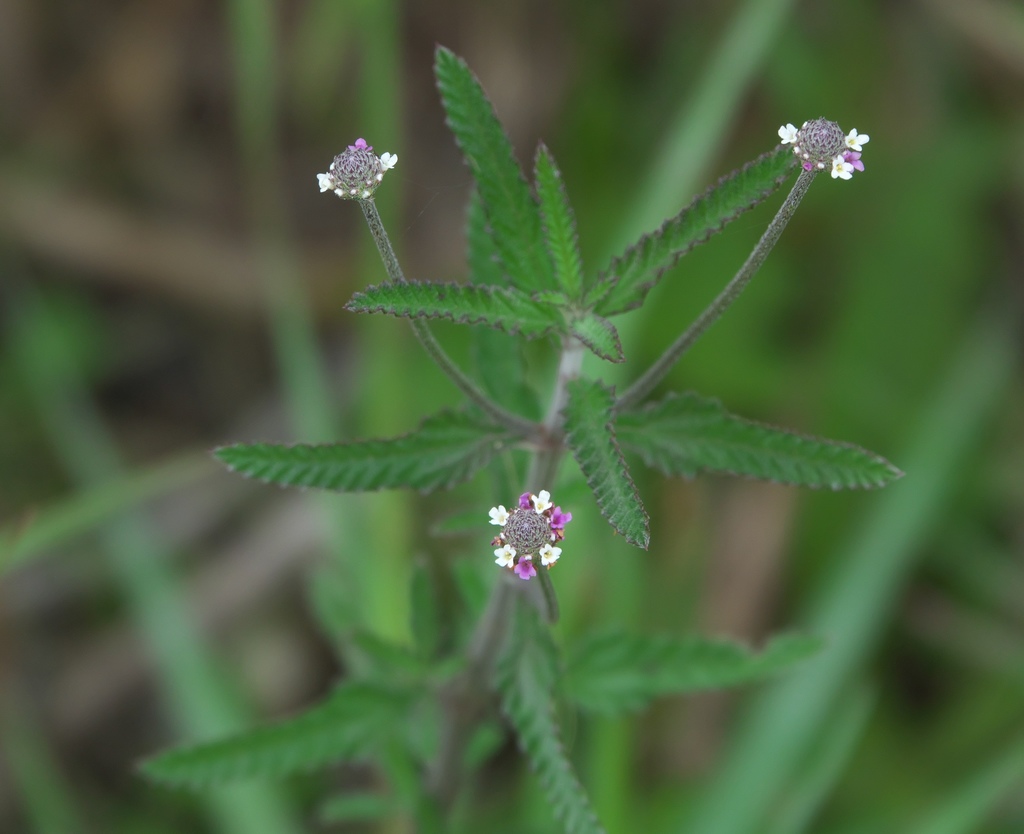
Phyla stoechadifolia, known as Southern Fogfruit or southern matchsticks, is a small, upright perennial of the verbena family (Verbenaceae) that reaches the United States only in the wet prairies and marshes of southern Florida. It grows about a foot to a foot and a half tall, with stiff, narrow, sharply toothed leaves in pairs along the stems, and from the leaf axils it sends up long, slender stalks topped with little heads of white, pink and lavender flowers. Those stalked heads, standing up like struck matches, explain the name “matchsticks.” The Atlas of Florida Plants, which follows a broader view of the genus, lists it as Lippia stoechadifolia, and you will see both names in nursery lists and field guides.
Southern fogfruit is a close relative of the familiar turkey tangle fogfruit (Phyla nodiflora), the low groundcover that creeps through Florida lawns and roadsides. Where turkey tangle hugs the ground, southern fogfruit stands up. Its leaves are narrower, stiffer and more coarsely toothed, and its flower heads are carried on longer stalks. Outside Florida it grows through the Bahamas and the Caribbean, including Puerto Rico, and from Mexico through Central America into northern South America.
In Florida this is a rare plant. It is listed as Endangered by the State of Florida (FDACS Regulated Plant Index, as reported by the Atlas of Florida Plants), and its Florida populations are limited to a few counties at the southern end of the peninsula. Gardeners who want to grow it should buy nursery-propagated plants from native plant nurseries and never collect plants or cuttings from the wild. This guide covers how to recognize southern fogfruit, where it grows, how to grow it in a wet, sunny garden spot, and why it matters to south Florida butterflies.
Identification
Southern fogfruit is easy to overlook among marsh grasses until its flower heads catch the eye. The combination of an upright habit, narrow saw-toothed leaves and long-stalked flower heads separates it from other Florida fogfruits.
Stems & Habit
The plant is an erect to ascending perennial, often slightly woody at the base, usually 12 to 18 inches tall. Older plants branch from the base and can sprawl and root where stems touch wet ground, so a single plant may form a loose patch over time. The stems are four-angled when young and roughened with short, flattened hairs, a trait shared with many members of the verbena family.
Leaves
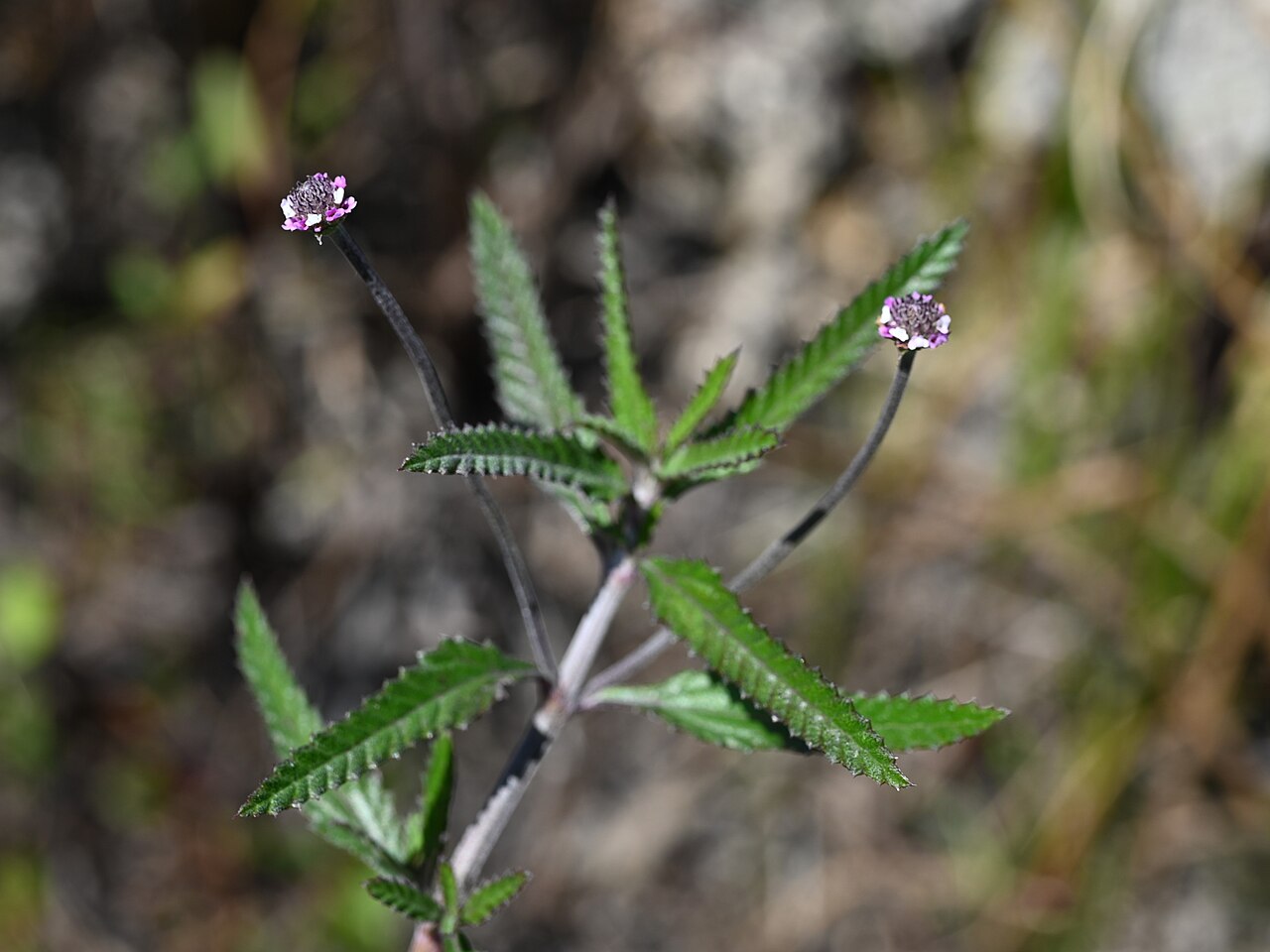
The leaves are opposite, narrowly lance-shaped and about 1 to 3 inches long, with deeply impressed veins and sharply toothed edges that often roll slightly under. They feel stiff and rough to the touch. The species name stoechadifolia means “with leaves like stoechas,” the old name for French lavender (Lavandula stoechas), whose narrow gray-green leaves they resemble.
Turkey tangle fogfruit (Phyla nodiflora) has broader, spoon-shaped leaves toothed only near the tip, and its stems creep flat along the ground. Lanceleaf fogfruit (Phyla lanceolata), a more northern species, is also upright but has broader, thinner leaves.
Flowers
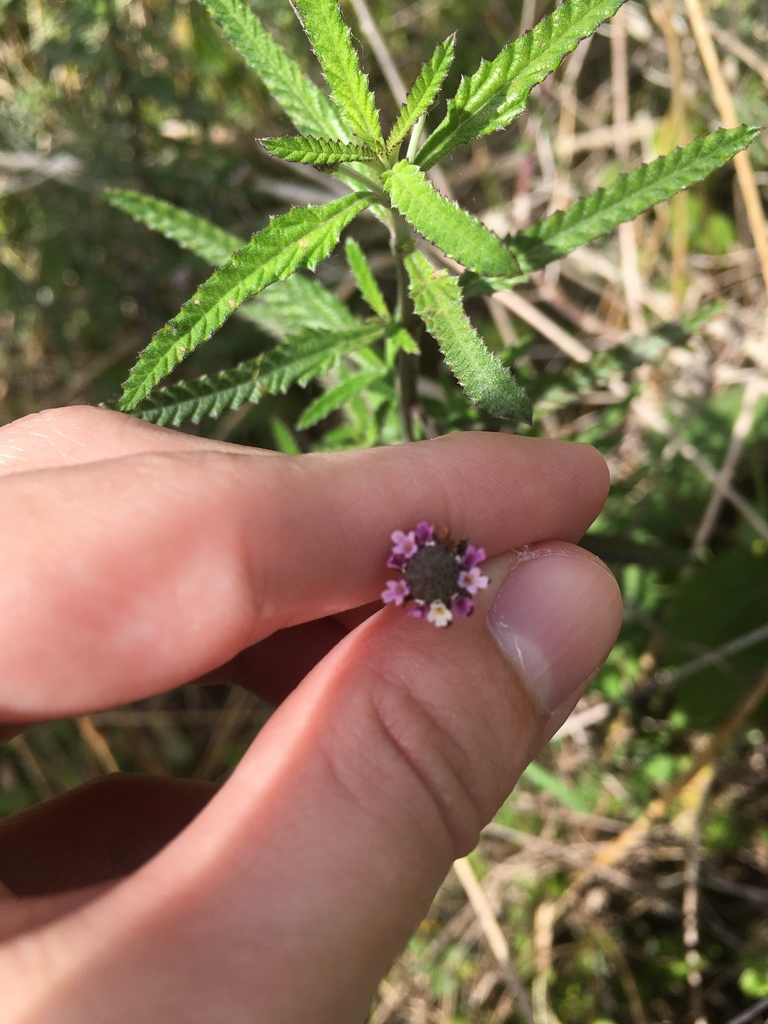
Flower heads are borne singly in the leaf axils on slender stalks that are longer than the leaves. Each head starts as a small rounded knob of overlapping purplish bracts. The tiny tubular, two-lipped flowers, each only about an eighth of an inch across, open in a ring around the head, starting at the bottom and moving upward. As old flowers drop and new ones open, the head lengthens into a short cylinder. Flowers are white to pink or lavender, often with a yellowish eye, and a single head may show several colors at once.
In south Florida southern fogfruit can bloom in any month, with the most flowers during the warm, wet season.
Fruit
Each flower produces a tiny dry fruit that splits into two one-seeded nutlets, hidden among the bracts of the head. The seeds are small and fall close to the parent plant or are carried by water across flooded prairies.
Quick Facts
| Scientific Name | Phyla stoechadifolia (syn. Lippia stoechadifolia, Verbena stoechadifolia) |
| Family | Verbenaceae (verbena family) |
| Plant Type | Herbaceous perennial, somewhat woody at the base |
| Mature Height | 12–18 in (occasionally taller) |
| Mature Spread | 12–24 in; can slowly form loose patches |
| Growth Rate | Moderate |
| Sun Exposure | Full sun to light shade |
| Water Needs | High; moist to seasonally flooded soil |
| Soil Type | Marl, wet sand, or limestone-based wetland soils |
| Soil pH | About 6.5–8.0 (neutral to alkaline marl) |
| Bloom Time | Year-round in south Florida; heaviest in the wet season |
| Flower Color | White, pink and lavender |
| Fall Color | None; evergreen in frost-free areas |
| Fruit | Tiny dry fruit splitting into two nutlets |
| Deer Resistant | Generally not browsed |
| USDA Hardiness Zones | 10–11 |
Native Range
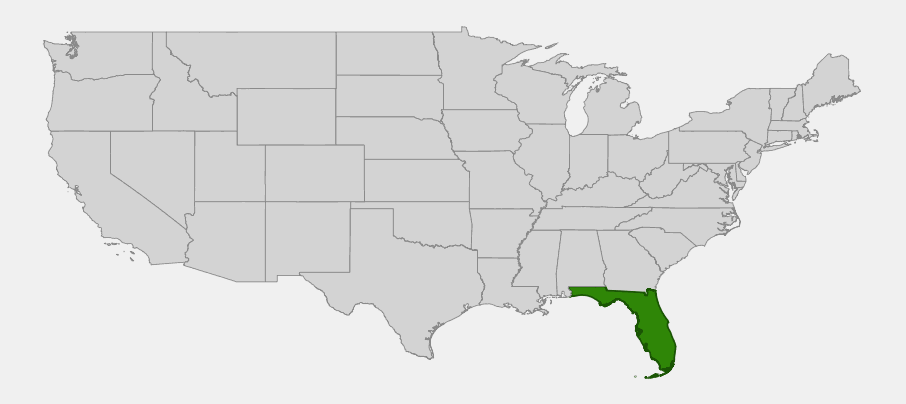
In the United States, southern fogfruit grows only in Florida, and only at the southern tip of the peninsula. USDA PLANTS records it as native in Florida and Puerto Rico. Herbarium and observation records in Florida come mainly from Miami-Dade, Broward and Collier counties, including the Everglades, Big Cypress and the remaining wet prairies on the edge of the Fort Lauderdale and Miami suburbs.
Beyond Florida, the species ranges through the Bahamas and the Caribbean islands, through much of Mexico, through Central America and into northern South America. South Florida sits at the northern edge of that tropical range, so frost limits it as much as habitat does.
Within its small Florida range the plant is tied to wet, sunny, open ground: marl prairies, short-hydroperiod glades and swales that flood for part of the year, the wetter edges of pine rocklands, and the margins of freshwater marshes and canals. Drainage, development and the spread of shrubs and invasive plants into these prairies have reduced the habitat available to it, and the Atlas of Florida Plants records it as Endangered under Florida’s Regulated Plant Index.
📋 Regional plant lists featuring Southern Fogfruit: North & South Florida
Growing & Care Guide
Southern fogfruit is not a common nursery plant, but a few Florida native nurseries grow it from cuttings and seed, and it adapts well to wet, sunny garden spots in south Florida. Because it is listed as Endangered in Florida, buy nursery-propagated plants only and never dig plants or take cuttings from wild populations, including those in parks and preserves. Outside zones 10 and 11 it is best treated as a container plant brought indoors in winter.
Light
Give it full sun or light shade. In the wild it grows in open prairies with little overhead cover. In too much shade the stems stretch, the plant flops, and flowering drops off sharply.
Soil & Water
This is a wetland plant. It does best in soil that stays moist all the time and can tolerate being flooded for a few weeks during the rainy season. Native marl and limestone-based soils suit it well, and it also grows in sandy or loamy soils kept consistently wet. It does not tolerate long dry spells, so in a typical yard plant it at the edge of a pond, in a rain garden, in a low swale, or in a container that sits in a saucer of water. It is not salt tolerant and should not be planted where salt spray or brackish water reaches it.
Planting Tips
Plant in late spring or early summer, at the start of the rainy season, so the roots establish while the soil is naturally wet. Space plants about a foot apart for a loose groundcover effect among low grasses and sedges. Because southern fogfruit is listed as Endangered in Florida, buy plants only from nurseries that propagate their own stock, ask the nursery where its material came from, and never transplant it from roadsides, canal banks or natural areas, even if those spots look disturbed.
Pruning & Maintenance
Little care is needed. Cut back leggy or untidy stems by about a third in late winter to encourage dense new growth and more flowers. Keep vigorous grasses, Brazilian pepper and other woody seedlings from shading it out. No fertilizer is needed; rich soil mostly encourages weeds. In a container, refresh the soil every couple of years and keep the pot from drying out.
Propagation
Stem cuttings root readily in moist potting mix or even in shallow water, and rooted stem sections can be separated from established garden plants. Seed can be sown on the surface of a moist, sandy mix in warm weather. Collect seed or cuttings only from your own garden or nursery-grown plants, not from wild populations.
Landscape Uses
- Rain gardens and wet swales: thrives where water collects after summer storms
- Pond and canal edges: a low, flowering edge plant among sedges and grasses
- Butterfly gardens: a nectar source and a possible larval host for buckeyes and crescents
- Wet prairie restoration: in south Florida marl prairie projects, using propagated stock
- Containers: in a pot set in a water-filled saucer on a sunny patio
Wildlife & Ecological Value
Southern fogfruit is small, but its nearly year-round flowering makes it a steady food source in south Florida wetlands, where nectar can be scarce in the dry season.
For Pollinators
The tiny flowers are visited by small butterflies, bees and wasps. South Florida naturalists report ceraunus blues, gray hairstreaks, tropical checkered-skippers, queens and other small butterflies nectaring at its heads. Fogfruits as a group are well-known larval host plants for the common buckeye, phaon crescent and white peacock butterflies, and southern fogfruit is reported to serve the same role where it grows.
For Birds
Southern fogfruit offers little direct food for birds, but the open, flowering prairies where it grows support insect-eating birds such as common yellowthroats, along with wading birds that hunt the shallow water during the wet season.
For Mammals
It has little importance as a food plant for mammals and is not a favorite of deer.
Ecosystem Role
Southern fogfruit is part of the low, species-rich ground layer of south Florida marl prairies and rockland edges, habitats that depend on seasonal flooding and periodic fire to stay open. Its rooting stems help bind wet soil along swales and canal edges. Its decline in Florida reflects the loss and drying of these prairies more than anything about the plant itself.
Cultural & Historical Uses
Linnaeus first described this plant in 1753 as Verbena stoechadifolia. It was later moved to Lippia by Kunth and to Phyla by John Kunkel Small, who wrote much of the early botany of south Florida. Botanists still disagree about whether Phyla should be kept apart from Lippia, which is why USDA PLANTS uses Phyla stoechadifolia while the Atlas of Florida Plants uses Lippia stoechadifolia.
The name “fogfruit” (also written “frogfruit”) is an old American name for the genus whose origin is uncertain. “Matchsticks” is a newer descriptive name for the flower heads on their long, thin stalks. The genus Lippia includes well-known aromatic herbs such as Mexican oregano (Lippia graveolens), but southern fogfruit itself has no well-documented culinary use.
For Florida gardeners, southern fogfruit is mostly a plant of conservation interest: a tropical species at the very edge of its range, surviving in a landscape that has been drained and developed. Growing it from nursery stock in a rain garden or pond edge is a small way to keep it in cultivation while protecting the wild plants that remain.
Frequently Asked Questions
Is southern fogfruit the same as turkey tangle fogfruit?
No. Both are Phyla species, but turkey tangle fogfruit (Phyla nodiflora) is a common creeping groundcover with broad, spoon-shaped leaves. Southern fogfruit grows upright, has narrow, stiff, sharply toothed leaves, and in the U.S. is limited to south Florida.
Is southern fogfruit protected in Florida?
Yes. It is listed as Endangered by the State of Florida in the FDACS Regulated Plant Index, as reported by the Atlas of Florida Plants. Buy nursery-propagated plants and never collect plants, cuttings or seed from the wild.
Why are there two scientific names?
USDA PLANTS places it in Phyla (Phyla stoechadifolia), while the Atlas of Florida Plants and some other floras include Phyla within Lippia and call it Lippia stoechadifolia. Both names refer to the same plant.
Can I grow southern fogfruit outside south Florida?
It is a tropical plant that tolerates little frost, so it is reliably perennial only in zones 10 and 11. Farther north, grow it in a container kept wet in summer and protected from freezes in winter.
Does it attract butterflies?
Yes. Its small flowers draw blues, hairstreaks, skippers and other small butterflies almost year-round, and fogfruits are known larval hosts for the common buckeye, phaon crescent and white peacock.

Looking for a nursery that carries Southern Fogfruit?
Browse our native plant nursery directory: Florida