Pickerelweed (Pontederia cordata)
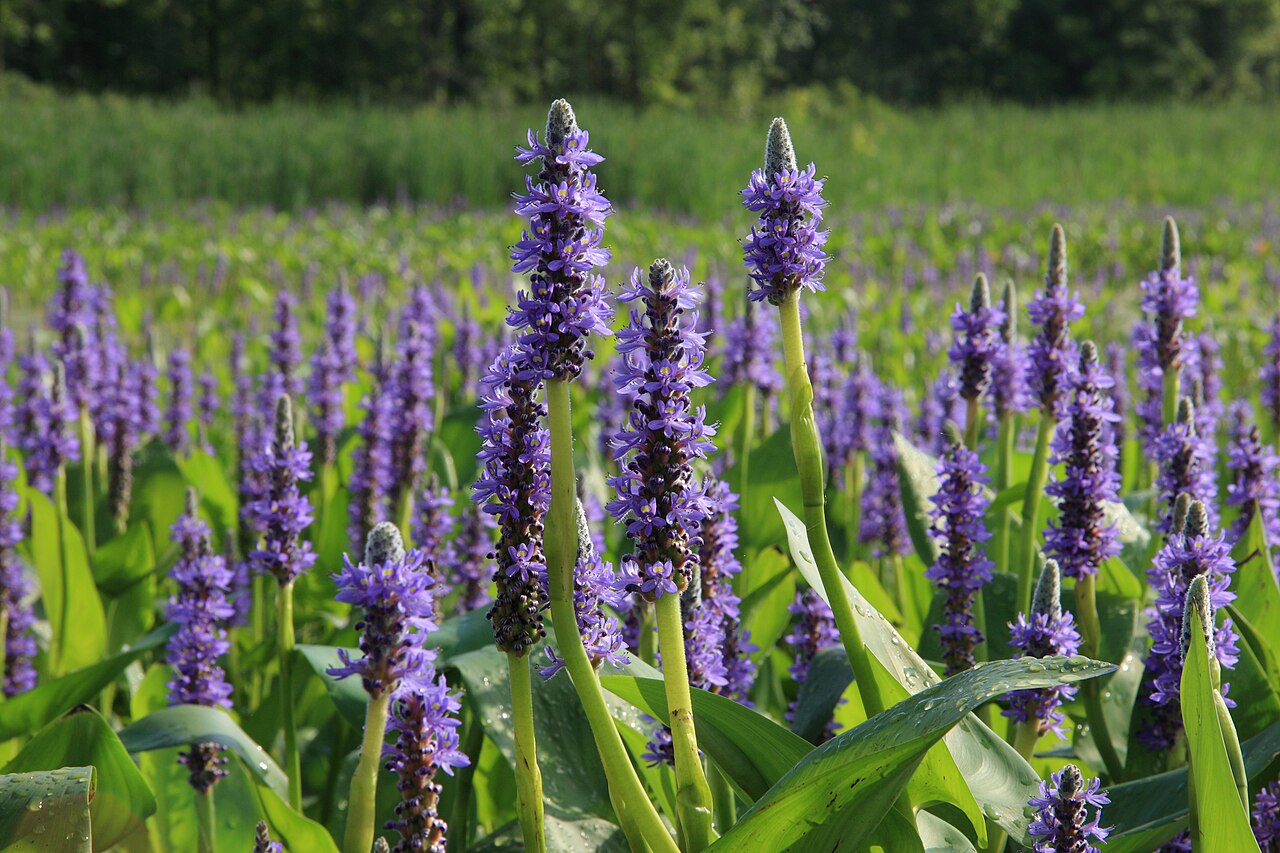
Pickerelweed (Pontederia cordata) is a true water-edge perennial: glossy green leaves rise from mud, followed by upright spikes of blue-violet flowers in summer. A group in bloom can transform a shallow pond margin into one of the brightest parts of a native garden. The plant is rooted, not free-floating. Its underground rhizomes hold a colony in place while the leaves and flower stalks project above the water.
For gardeners in Maryland, Virginia, and West Virginia, the first design question is water, not flower color. Pickerelweed belongs on a shallow freshwater shelf, in saturated pond-edge soil, or in a deliberately managed water container. A rain garden that dries hard between storms is not automatically suitable. The regional table’s wet-soil code is essential information: place the plant where its root zone will remain wet through the growing season.
This species offers both garden structure and wildlife activity. Bees and butterflies work the spikes; ducks can eat the seeds, and aquatic stems add complexity at the shoreline. A mature plant is measured in feet, not inches: allow roughly 2–4 feet of height and room for its rhizomes to expand. Its blue spires look especially good against lower sedges, provided each companion shares the same water-depth requirements.
Identification
Rhizomes and Stems
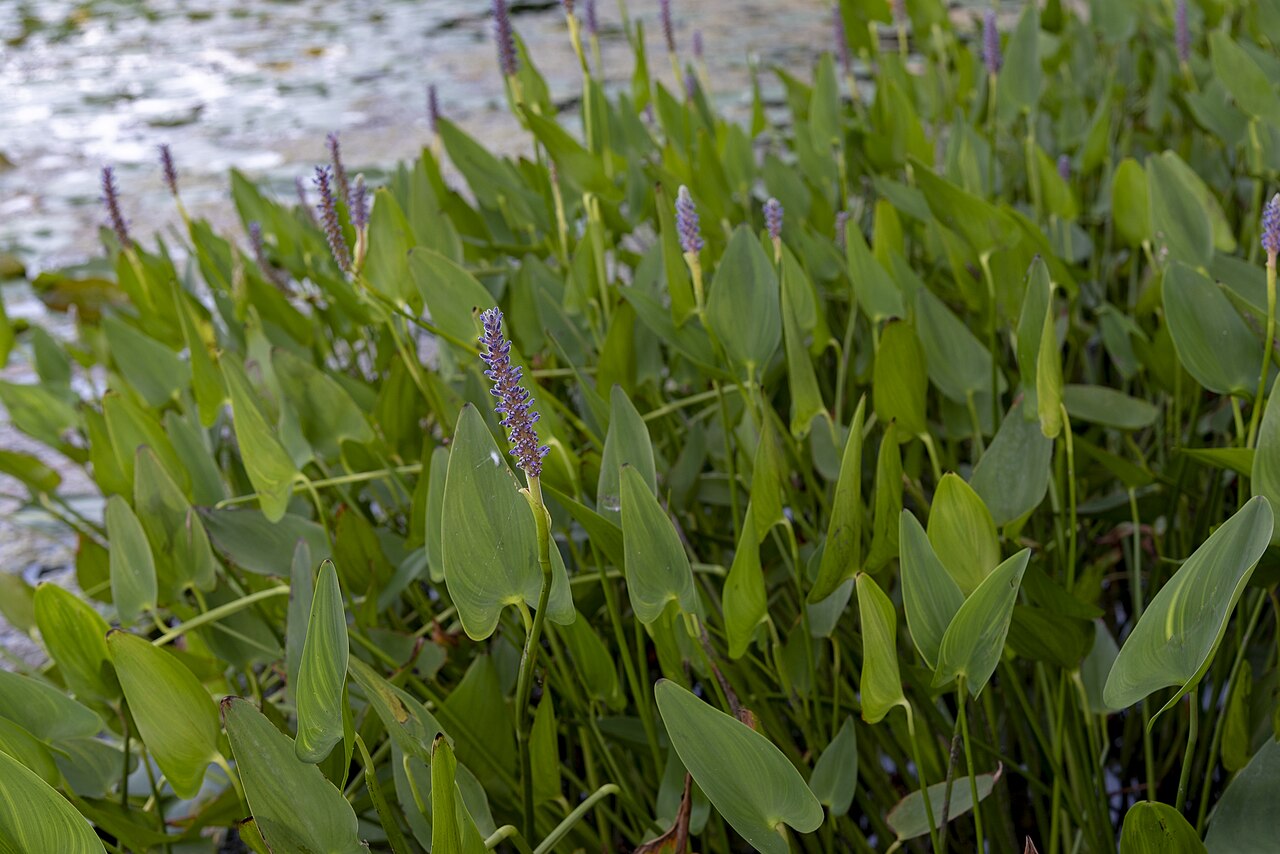
Thick rhizomes grow through shallow mud and produce upright shoots. A single nursery clump can become a substantial patch where it has room. Flower stalks are smooth, stout, and rounded, carrying the inflorescence above the foliage. The plant is an emergent aquatic: roots and lower stems can be underwater while most photosynthetic foliage remains above it. It is not a substitute for a deep-water floating plant, and a rhizome planted far below its natural shelf can fail even in an otherwise healthy pond.
Leaves
Leaves are glossy, firm, and deep green. Their blades range from heart-shaped to narrower lance-like forms, with a pointed tip and conspicuous longitudinal veins. Many arise directly from the rhizome on long stalks; a flowering stem also bears a leaf. This variation matters when identifying nonflowering plants: not every leaf will show the broad heart outline suggested by the name cordata. Look at several mature leaves and the attachment to the stems, rather than treating a narrow juvenile leaf as a different species.
Flowers
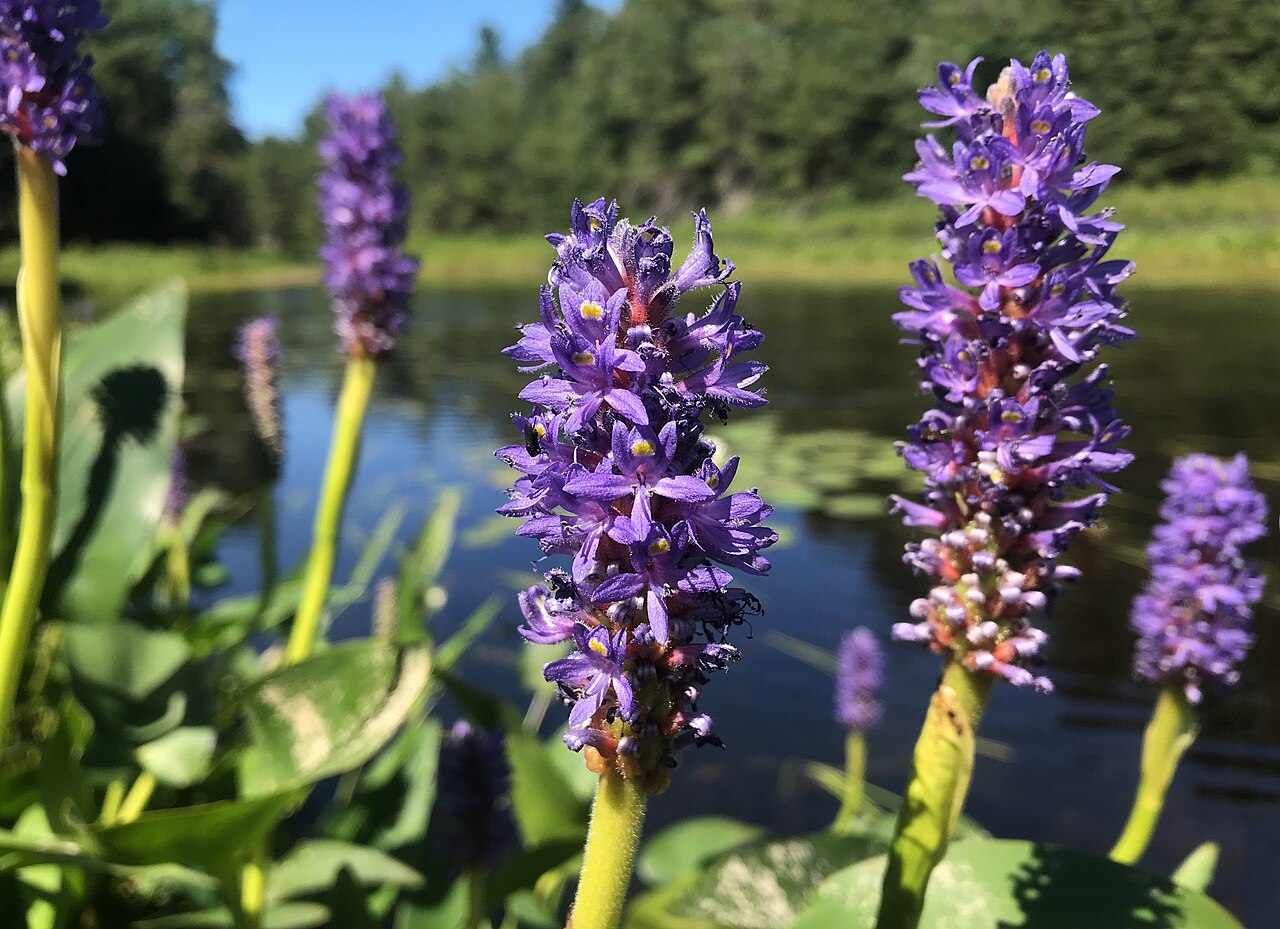
Dense blue to lavender spikes are held above the water on firm stems. A spike commonly measures a few inches long; this is the flower-cluster length, not the plant’s overall height. Individual flowers are small and tubular, with six lobes and contrasting yellow markings on the upper part. They open progressively along the spike, extending the display beyond the life of any one bloom. The exact flowering season shifts with latitude and local weather, usually spanning summer and sometimes early fall in the Mid-Atlantic.
Fruit and Seasonal Change
After flowering, the inflorescence develops small one-seeded fruits. Seed-bearing heads are less colorful than the flowers but remain part of the plant’s wildlife value. Foliage declines with cold weather, while the rhizomes persist in suitable wet soil. Do not mistake seasonal dieback for a reason to drain or discard the plant. In a container, winter exposure of the root mass is a different problem from normal browning leaves; manage the container so the rhizomes do not dry out or become completely exposed.
Quick Facts
| Scientific Name | Pontederia cordata L. |
| Family | Pontederiaceae (pickerelweed family) |
| Plant Type | Rhizomatous emergent aquatic perennial |
| Mature Height | 2–4 ft; flower spikes are only several inches long |
| Mature Spread | About 1.5–2 ft initially; colonies expand by rhizomes |
| Growth Rate | Rapid in suitable shallow water |
| Sun Exposure | Full sun best; partial sun tolerated |
| Water Needs | High; saturated soil or shallow freshwater |
| Soil Type | Mud, loam, clay, or sandy mineral soil kept wet |
| Soil pH | Broadly adaptable; neutral conditions commonly suitable |
| Bloom Time | Summer into early fall, depending on climate |
| Flower Color | Lavender-blue; white-flowered selections also exist |
| Fall Color | Not a fall-color plant; foliage dies back in cold climates |
| Fruit | Small single-seeded fruits in spent flower heads |
| Deer Resistant | Reports differ; do not rely on it as deer-proof |
| USDA Hardiness Zones | 3–10; container roots need additional winter protection |
Native Range
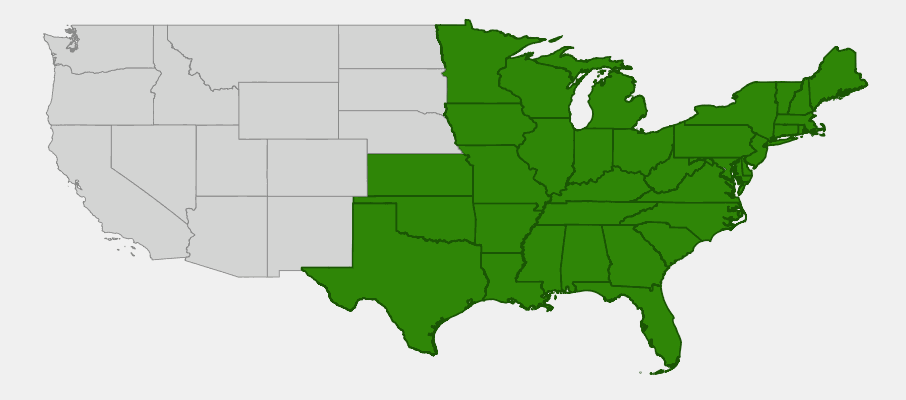
Pickerelweed is native across a large part of eastern North America and extends farther south in the Americas. Its North American range includes southern Canadian freshwater habitats, the eastern United States, and portions of the central states. It is a familiar plant of shallow marshes, pond margins, and quiet-water shores. Regional occurrence should be checked at the county or watershed level because the presence of water alone does not establish local native status.
The map summarizes the eastern and central U.S. portion of that native distribution. Some general distribution lists also include introduced western records; Oregon is not shaded here simply because a database lists an occurrence. Beyond the mapped United States, the species occurs in eastern Canada and parts of tropical and subtropical America. The USDA link supplies a finer geographic starting point, while regional wetland floras help separate native stands from garden escapes.
In the Maryland–Virginia–West Virginia list, pickerelweed is especially relevant to freshwater wetland planting. It should not be moved into natural ponds as an informal beautification project. A species can be native to a state yet inappropriate for a particular high-elevation pond, rare wetland community, or engineered basin. In a home pond, choose nursery-propagated stock with a known identity and keep the planting within its managed edge.
📋 Regional plant list: Maryland, Virginia & West Virginia
Growing & Care Guide
Light
Provide full sun when possible. Partial sun can support growth, but surrounding shrubs and tall wetland plants should not shade the whole clump for most of the day. A pond that is bright before trees leaf out may become too shady in summer. Place the plant where you can see the flowering spikes without blocking access for pond maintenance. In mixed shoreline plantings, allow enough open space that neighboring species do not cover the leaf blades.
Soil and Water
Keep the root zone saturated. A shallow water shelf with muddy mineral soil is usually the most natural arrangement; NC State describes water depths up to about 12 inches, with deeper temporary flooding tolerated. That is not a requirement to start a small plug under a foot of water. Begin shallow, keep the leaves above water, and adjust as it grows. Avoid fluffy potting mixes that float into the pond. Drying out repeatedly is a more serious mismatch than a modest difference in soil texture.
Planting Tips
Use a sturdy aquatic basket or a planting pocket that can contain the expanding rhizomes. Set the crown at the nursery soil level and lower the basket gradually onto a suitable shelf. Cover exposed soil with a shallow layer of clean gravel if needed to prevent disturbance, without burying the growing points. In an earth-bottomed pond, define the desired colony area before planting. Make sure a large mature clump will not obstruct a drain, small waterfall intake, access route, or the view of shorter shoreline plants.
Pruning and Maintenance
Remove broken or decaying leaves selectively rather than shaving the entire clump while it is actively growing. Divide a crowded container when rhizomes fill it and flowering or water circulation suffers. Retain some seed heads if wildlife and natural recruitment are priorities; remove them where spread needs tighter control. Do not dump divisions into a creek, ditch, or public waterbody. Compost or otherwise dispose of unwanted garden material responsibly, following local rules for aquatic plant waste.
Propagation
Division is the direct way to increase a known garden plant: separate a healthy rhizome section carrying a growing point and roots, then replant promptly in wet conditions. Seed propagation is possible, but seed handling and germination requirements should follow a reliable nursery protocol. Young seedlings need protection from drying and from waves or heavy water flow. For a native planting, several seed-grown plants from a suitable source can provide more genetic diversity than repeated division of one clone.
Winter and Container Care
Hardiness in a pond does not mean that a small above-ground pot can be neglected through a freeze. Keep roots wet and protect the container according to the local winter climate. In cold areas, a suitable pond shelf or protected wet storage arrangement is preferable to allowing the root ball to freeze dry on a patio. Do not sink foliage or crowns into unsuitable depths without checking the plant’s condition and the pond design. Mark the pot so it is not mistaken for an empty basket during dormant-season cleaning.
Landscape Uses
- Create a blue-flowered band on a shallow freshwater pond shelf.
- Use a contained clump as the tall element in a sunny water-garden tub.
- Combine with compatible native wetland plants in a permanently wet basin.
- Place near a pond viewing area to observe bees, dragonflies, and seasonal seed heads.
Wildlife & Ecological Value
For Pollinators
The flowering spikes attract bumblebees, butterflies, and other insects. NC State also notes specialized bee relationships within Pontederia, a reminder that a pond planting can support more than aquatic animals. Avoid treating the water or foliage with broad-spectrum products during flowering. A succession of wetland flowers with different bloom periods is more useful than expecting pickerelweed alone to provide resources for the whole growing season.
For Birds
Ducks can consume the seeds. Leaving a portion of the spent spikes lets that resource remain available where birds visit, although a small ornamental tub may not attract waterfowl at all. The plant is not a substitute for a diverse natural shoreline. Large flocks can damage young plantings, so protect new baskets if necessary while allowing the mature design to include places for wildlife activity.
For Aquatic Animals
Stems and submerged structure add shelter and surfaces around a pond edge. Dragonflies and damselflies use emergent plants during their life cycles, and fish can shelter among the underwater portions. Keep some open water and avoid allowing a single species to occupy every available shelf. The ecological value comes from a mixture of plant structures, water depths, and clean water, not simply the greatest possible number of stems.
Ecosystem Role
Rhizomatous growth helps occupy shallow muddy margins and contributes organic material to wetland food webs. Pickerelweed can be vigorous, which is useful in the right setting but requires management in a small pond. Native does not mean incapable of crowding neighbors. Outside its native range, especially in warm regions where aquatic escapes are problematic, consult local restrictions rather than treating a North American garden recommendation as universally appropriate.
Cultural & Historical Uses
The scientific epithet cordata refers to a heart-shaped form and is echoed in many of the plant’s leaves. The genus name Pontederia commemorates the botanist Giulio Pontedera. Common names such as pickerelweed and pickerel rush have been used for this familiar shoreline plant, although it is not a true rush in the family Juncaceae.
Botanical and ethnobotanical references record historical food uses for pickerelweed seeds and young foliage. Those records are not a recommendation to harvest from a garden pond or a roadside ditch: water quality, plant identity, and any chemical treatments matter. This guide treats pickerelweed as an ornamental and habitat plant and does not provide food-preparation instructions.
Its continued garden value is easy to understand without embellishment. The plant carries strong vertical lines, broad leaves, and a long succession of flowers in a place where many ordinary perennials fail. A well-sited clump demonstrates how matching a plant to wet ground can be more effective than repeatedly trying to dry, amend, or fill that part of a landscape.
Frequently Asked Questions
Is pickerelweed only 3–6 inches tall?
No. Mature plants commonly reach 2–4 feet. A measurement of a few inches generally describes the flower spike, not the whole plant. Leave vertical room above a pond shelf.
How deep should I plant it?
Use saturated soil or a shallow freshwater shelf, with foliage above the water. Established plants can occupy water up to roughly 12 inches deep, but small nursery plants should begin shallower and be adjusted gradually.
Can it grow in a dry rain garden?
Not reliably. A basin that briefly floods and then dries hard is a poor match unless one part remains consistently wet. Choose a species adapted to alternating wet and dry soil for the upper or fast-draining sections.
Will it spread?
Yes. Rhizomes can make a sizable colony. A basket makes division and containment easier in a small water garden; a naturalized pond edge requires room and periodic assessment.
Is it deer-proof?
No. Horticultural sources differ in their resistance ratings. Treat browsing as locally variable, protect new plants if needed, and do not depend on pickerelweed alone as a barrier to deer.
Sources & Further Reading
- NC State Extension: Pontederia cordata
- Lady Bird Johnson Wildflower Center: pickerelweed
- USDA PLANTS: Pontederia cordata
- Native Plant Trust: pickerelweed identification
Find Native Plants
Ask growers about nursery propagation and regional provenance. Browse our Maryland native plant nurseries, Virginia native plant nurseries, West Virginia native plant nurseries directory for suppliers.