Alaska Blueberry (Vaccinium ovalifolium)
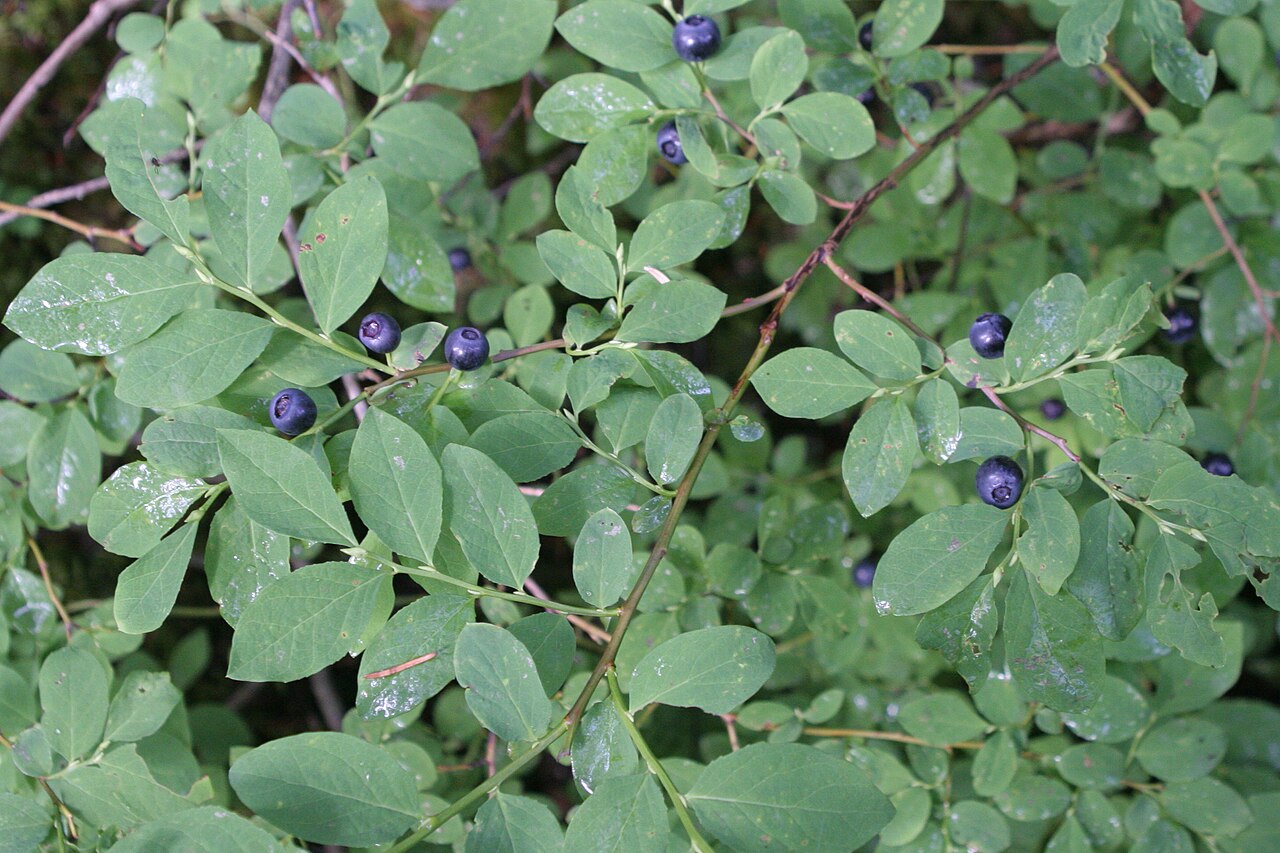
Alaska Blueberry (Vaccinium ovalifolium, including the plant long called Vaccinium alaskaense) is a deciduous native shrub of cool northern forests and openings. Small hanging flowers precede dark berries, while oval leaves and a branching woody framework give the plant year-round structure. It is a useful subject for a moist native woodland garden, not simply a smaller version of a commercial blueberry crop.
The Alaska regional table historically listed Vaccinium alaskaense at 2–8 feet tall, in partial sun and wet soil. This page preserves that garden context while explaining the name: Kew and ITIS now place V. alaskaense within V. ovalifolium. Some regional publications still distinguish the two. We therefore use one page with synonym information rather than creating two pages that imply they are universally accepted separate species.
Choose a cool site with reliable moisture, suitable acidic soil and room for a developing shrub. Locally appropriate nursery stock is preferable to digging wild berry bushes. The berries have a documented food history, but identification must be certain before harvest; an image of a dark berry is not enough to establish that an unknown shrub is edible.
Identification
Leaves & Branches
The leaves are alternate and broadly oval rather than needle-like or compound. New growth and leaf color change with the season, so photographs of emerging shoots can look different from a fully leafed fruiting shrub. Look at leaf arrangement, twig form and flowers together when identifying a plant.
This is a woody deciduous shrub: the leaves fall, but a branched framework remains. It should not be treated as a herbaceous perennial to cut to the ground routinely. Young twigs may be greenish or reddish, while older wood becomes less brightly colored. A winter label helps distinguish it from other dormant shrubs during maintenance.
Flowers
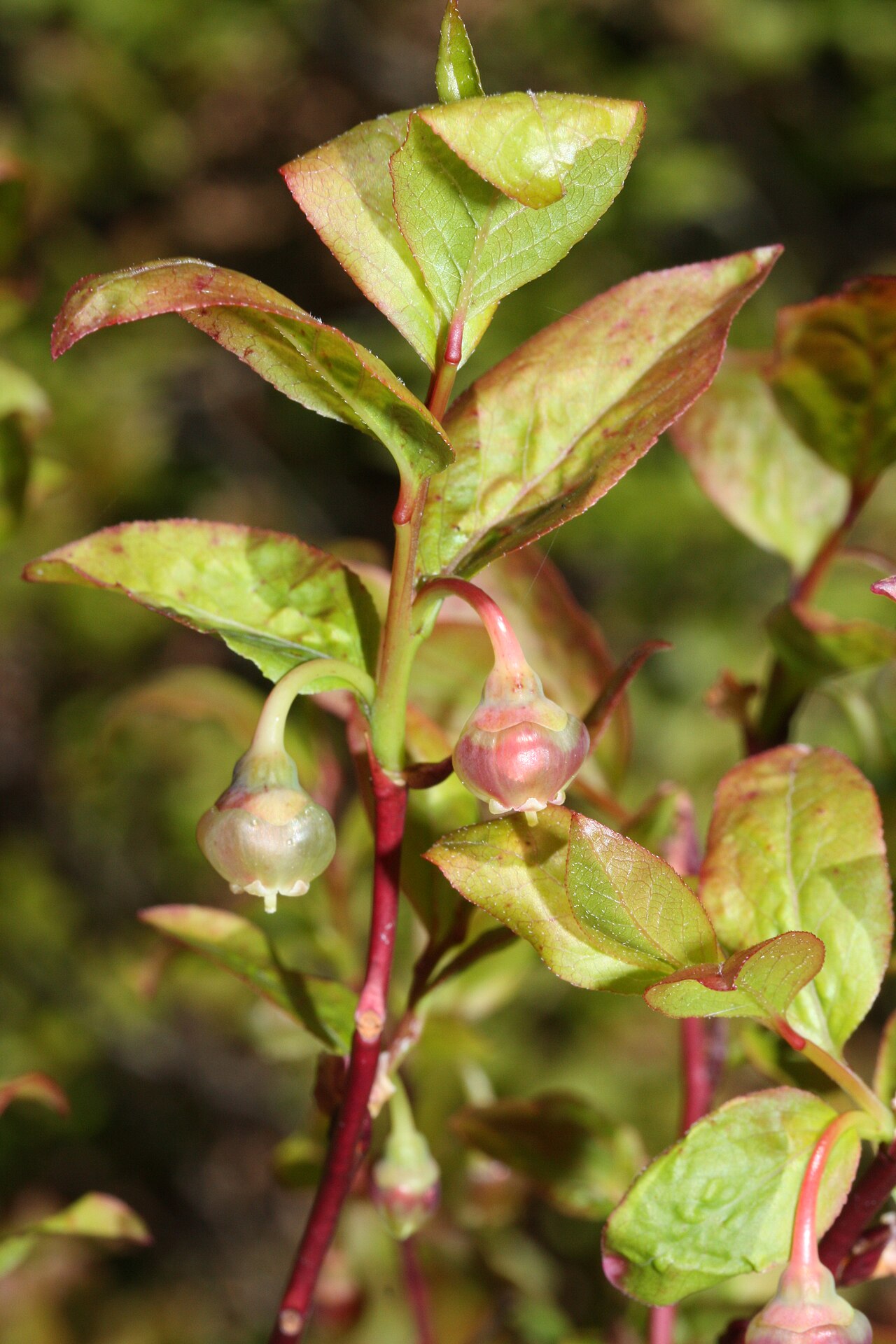
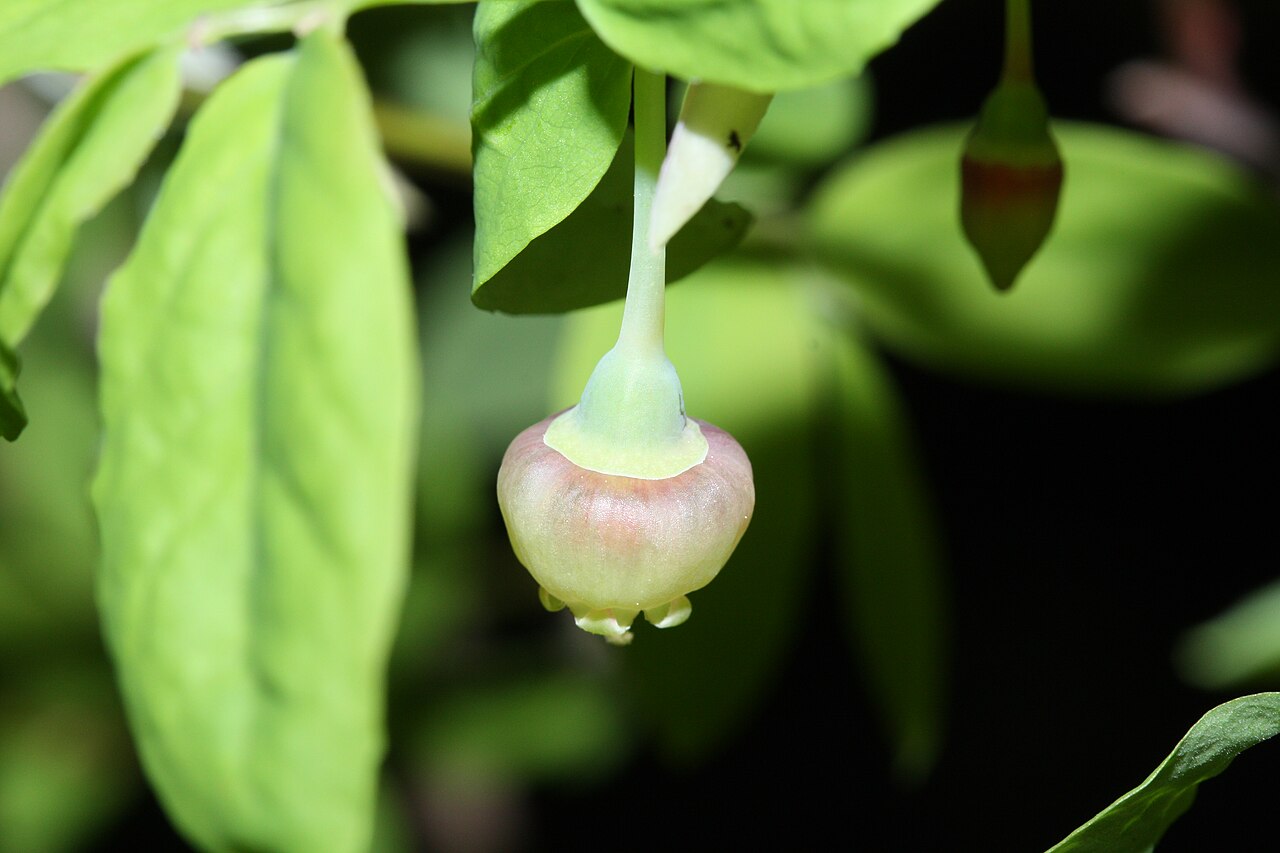
The flowers hang from the twigs and have an urn-like shape with a small opening. Pinkish tones are common. Their small size makes close observation rewarding, especially in a planting where the branches can be seen without trampling the root zone.
Older descriptions distinguish plants called V. alaskaense partly by when their flowers appear relative to leaf development. That historical distinction is useful context, but this guide does not turn one flowering photograph into a definitive taxonomic test. The accepted broader species includes variation, and related blueberries can be difficult to separate without a regional key.
Berries & Similar Shrubs
Ripe fruit is dark blue to purple-black, sometimes with a pale waxy bloom. Do not use bloom alone to identify a berry: it can vary or rub away, and other shrubs also carry dark fruit. Confirm the whole plant, preferably including its flowers and foliage, before treating a harvest as food.
Common names such as highbush blueberry, huckleberry, early blueberry and Alaska blueberry are not interchangeable scientific labels. Commercial highbush blueberries belong to other species and cultivated groups. A nursery’s generic “blueberry” is not necessarily the Alaska native sought for this planting.
Understanding the Synonym
The historical name Vaccinium alaskaense remains valuable for finding older Alaska and Pacific Northwest references. Kew places it under V. ovalifolium var. ovalifolium, and ITIS likewise treats it as a synonym. Other local works retain a narrower distinction. Keep any original provenance and name on your garden records rather than discarding useful information during a label update.
The photographs here intentionally retain their Commons file identities: two were identified as V. alaskaense by the photographer, and the fruiting photograph as V. ovalifolium. They illustrate the taxonomic concept used on this page, not a claim that every photographed plant has identical horticultural traits.
Quick Facts
| Scientific Name | Vaccinium ovalifolium; includes synonym Vaccinium alaskaense |
| Family | Ericaceae (heath family) |
| Plant Type | Deciduous woody shrub |
| Mature Height | Regional Alaska-blueberry entry: 2–8 feet; broader species varies |
| Sun Exposure | Partial sun or bright woodland shade |
| Water Needs | Consistently moist; table W, not a drought rating |
| Soil Type | Acidic, moisture-retentive woodland soil with a functioning root zone |
| Bloom Time | Spring to early summer depending on locality and snowmelt |
| Flower Color | Pinkish, urn-shaped flowers |
| Foliage | Alternate oval leaves; deciduous |
| Fruit | Dark blue to purple-black berries; positive identification required |
| Native Range | Alaska and disjunct northern/western North American areas, also northeast Asia |
Native Range
Under Kew’s accepted species treatment, Vaccinium ovalifolium is native in Alaska, Idaho, Michigan, Oregon, South Dakota and Washington, as well as several Canadian regions and northeast Asia. The map follows that treatment and visibly includes Alaska. It does not map only the narrower historical concept of V. alaskaense.
Older Forest Service accounts describe Alaska blueberry separately and give a narrower Pacific coastal range. That is a taxonomic difference, not a reason to combine every distribution statement into a larger map without explanation. For a particular restoration site, use the local flora and project’s accepted taxon and provenance guidance.
In coastal Alaska, these blueberries are associated with cool moist vegetation, including forest understories and openings. The state is not one uniform growing environment: a maritime woodland garden differs substantially from a dry exposed Interior site. Match the plant to a suitable local setting rather than relying on the state name alone.
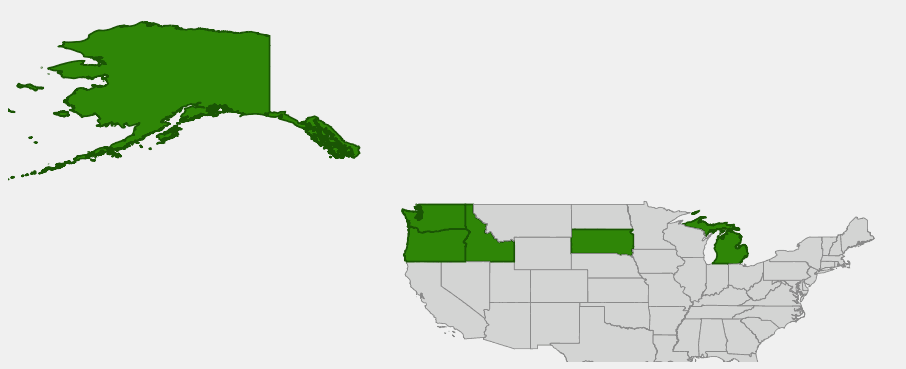
📋 Regional plant lists featuring Alaska Blueberrys: Alaska
Growing & Care Guide
Start with the Right Plant
Ask a nursery for the scientific name and source of its plants. A label reading only “huckleberry” leaves too much uncertainty, and a commercial blueberry cultivar is not a direct replacement for this native shrub. If the label uses Vaccinium alaskaense, record it alongside the accepted name rather than assuming the nursery supplied an unrelated plant.
For a native habitat project, provenance deserves as much attention as species identity. A plant grown from a distant part of a broad range may not match the local population or site conditions. For a home garden, start with a small number of healthy propagated plants from a supplier familiar with regional growing conditions.
Light & Garden Position
The regional table recommends partial sun, a useful starting point for a woodland-edge planting. Bright filtered light can give a shrub space to grow without exposing it to a hot reflected surface. Dense shade beneath competing tree roots may keep it alive but is not the same as a productive, easy-to-maintain garden setting.
If fruit is an important goal, observe how the plant flowers and sets berries in its actual position before making large changes. Do not promise a particular crop from a new shrub or assume every seedling fruits identically. Weather, establishment and pollinator activity all affect what a gardener sees in a given year.
Soil & Acidity
Blueberries belong to the heath family, and an acidic root environment is important. Test the soil before making substantial changes. Adding a handful of an acidifying product without knowing the starting conditions can create an uneven or unsuitable root zone rather than solving a problem.
Use organic material thoughtfully to maintain a woodland-like surface, but do not bury the stem bases beneath a thick wet mound. Protect the shallow rooting area from repeated digging, compaction and traffic. A shrub growing beside a path needs enough room that routine walking and weeding do not continually damage its roots.
Do not assume that a species occurring in a moist forest wants a sealed container or an airless planting pit. Water must move through the soil, and the roots need a suitable physical environment. If the garden’s underlying soil is strongly unsuitable, a different native shrub may be a better long-term choice than continuous corrective treatment.
Watering
The W code in the Alaska table identifies a wet or moist-site preference, not a drought-tolerance grade. Keep newly planted roots from drying out, especially while they are still concentrated in the nursery root ball. Check moisture there as well as in the surrounding bed; the two can behave differently after rain.
Use slow watering that reaches the root zone rather than repeated superficial splashing. During a prolonged dry spell, inspect the soil and foliage before deciding how much additional water is needed. Do not interpret a naturally cool coastal origin as a guarantee that the shrub will tolerate a hot, dry urban planting without attention.
Conversely, water less when the soil is already saturated. Persistent decline in wet ground may signal drainage or root problems, not a need for still more irrigation. Evaluate the site before replacing the plant with another specimen in the same unresolved conditions.
Planting & Space
Set a container-grown shrub at its nursery depth and settle soil gently around it. Avoid deep burial of the woody base. Water thoroughly after planting and retain a clear label with both the accepted scientific name and any historical name supplied by the nursery.
Allow room for a shrub, not merely the small pot visible at purchase. The regional entry gives 2–8 feet, and the broader species can vary beyond a single nursery expectation. Keep branches away from narrow access routes where they would need repeated clipping just to pass.
Remove competing weeds while the plant establishes, working carefully near the roots. A moderate mulch layer can help conserve moisture and show where the planting begins, but leave the crown visible. Avoid herbicide drift and do not treat every unfamiliar shoot near the shrub as a weed without checking its origin.
Pruning
Use pruning to remove clearly damaged or dead wood and to manage specific structural problems, not to force the shrub into an arbitrary shape. Observe a full season before applying the heavy pruning routine used for a commercial blueberry crop of another species.
Cut with clean tools and retain enough healthy growth for the plant’s ordinary seasonal development. Repeated indiscriminate shearing can remove flowering wood and conceal the natural form. Where the plant consistently outgrows its space, relocation or a better-sized species may be more sensible than perpetual severe cutting.
Propagation
Seed and vegetative propagation are both documented for these blueberries, but they require attention to identity and growing conditions. For a gardener seeking a reliable native shrub, buying propagated stock is often the simplest starting point. Wild digging disrupts roots and the surrounding forest floor and should not be used as a shortcut.
If growing from seed, obtain a protocol appropriate to the seed lot and keep records of collection source, storage and treatment. Tiny seedlings can develop slowly, so label pots carefully and avoid discarding them solely because they do not behave like annual vegetables. A single germination percentage from a controlled study is not a promise for a home seed tray.
Vegetative material preserves the identity of the donor plant more closely than mixed seed, but rooting success still varies. Use clean propagation materials and follow a tested nursery method. Do not transfer soil and roots from wild sites casually, since that can move pests and disturb habitat.
Harvest & Wildlife
Harvest only from a plant whose identity is established. The page’s photographs help explain the species, but they are not a field-foraging certification. Keep unknown berries out of the harvest and respect site restrictions wherever collecting is permitted.
In bear country, a fruiting shrub is also a potential wildlife attractant. Plan its location with local wildlife guidance in mind rather than planting a berry thicket beside a doorway and expecting only small birds. Manage dropped fruit and human access according to the setting.
Do not promise that one plant will supply a household crop or that wildlife will leave a chosen share untouched. A native landscape can value berries as part of an ecological relationship even when the human harvest is modest. Decide whether your primary goal is habitat, ornamental structure or food production before choosing the planting’s scale.
Seasonal Observation
Watch bud opening, flowering, fruit development and leaf fall in the first years. These observations help separate normal seasonal change from a real problem. A deciduous shrub losing leaves in autumn is not automatically unhealthy, while repeated summer wilting deserves investigation.
Where leaves yellow unusually or growth stalls, check moisture, soil conditions and root disturbance before adding fertilizer. Request local extension guidance if the cause remains unclear. Routine treatment without diagnosis can obscure the original problem and create new ones.
Wildlife & Ecological Value
The berries are used by birds and mammals, and the shrub also provides woody cover and browse. Forest Service accounts document these relationships for the blueberry complex. This is not a deer-proof planting: browsing and fruit removal may be normal parts of its role in the landscape.
Flowers provide opportunities for bee visits, while fruit connects the shrub to seed dispersal and seasonal feeding. A diverse planting with other locally appropriate species can offer a wider range of resources than a single berry shrub alone. Keep the surrounding vegetation structurally varied where space permits.
Wildlife value includes animals that may be inconvenient near a house. Bears can use berry crops, so native status should not override practical siting decisions. Follow local wildlife recommendations and consider whether a different native plant would suit a busy entrance or play area better.
Cultural & Historical Uses
Blueberries in this group have a long documented food history among Indigenous peoples of Alaska and British Columbia. The Forest Service review records fresh and preserved fruit use. Such history should be presented respectfully and specifically, not turned into an unsupported list of medicinal claims or a claim that all communities used the plant in the same way.
The names Alaska blueberry, oval-leaf blueberry and huckleberry reflect both regional language and changing taxonomy. Keeping synonyms visible makes older field guides easier to use. It also prevents a plant directory from counting an old and a current name as two separate additions.
This page offers no medicinal dosing or treatment advice. For garden planning, the useful lessons are positive identification, provenance, suitable growing conditions and a realistic understanding of fruiting shrubs as part of a shared landscape.
Frequently Asked Questions
Why is Vaccinium alaskaense in the table but ovalifolium in the page name?
Kew and ITIS treat alaskaense as a synonym within ovalifolium. Some regional sources retain the older distinction, so both names are recorded here.
Is this a commercial highbush blueberry?
No. A generic nursery blueberry or commercial cultivar may belong to a different species or hybrid group. Ask for the scientific identity.
Does it prefer shade?
Partial sun or bright woodland shade is the regional starting point. Dense shade and a dry competing root zone are not equivalent to a moist woodland edge.
Can it grow in dry soil?
This guide recommends consistent moisture, not a drought garden. Establishment watering is particularly important.
Are dark berries enough to identify it?
No. Confirm the entire plant before harvest, using reliable regional identification guidance.
Will it attract wildlife?
Yes, berry-producing shrubs can attract birds and mammals, potentially including bears. Plan placement for the local setting.
Should I dig a wild bush?
Choose propagated nursery stock and protect the wild forest floor instead.

Looking for a nursery that carries Alaska Blueberry?
Browse our native plant nursery directory: Alaska
Sources & Further Reading
- Kew: Vaccinium alaskaense synonym record.
- Kew: Vaccinium ovalifolium — accepted range.
- ITIS accepted species record.
- US Forest Service: oval-leaf huckleberry — ecology and historical uses.
- US Forest Service: historical Alaska-huckleberry treatment.
- University of Washington propagation protocol.
- Alaska Plant Materials Center blueberry profiles — regional distinctions.