Strawberry Bush (Euonymus americanus)
Euonymus americanus, commonly known as Strawberry Bush, Hearts-a-bustin’, or American Spindle Tree, is a distinctive native deciduous shrub of southeastern North America that brings year-round interest to the woodland garden. This member of the Celastraceae (bittersweet) family earned its common name from the remarkable fruit display in early fall — bumpy, bright scarlet capsules that burst open to reveal brilliant orange-red seeds dangling on silken threads, creating a spectacular autumn show that resembles hanging strawberries.
Growing naturally in the understory of moist deciduous forests and along shaded stream banks, Strawberry Bush is a graceful medium-sized shrub reaching 4 to 6 feet tall, with slender green stems, opposite serrated leaves, and tiny inconspicuous flowers that give way to the plant’s crowning glory — those extraordinary warty fruit capsules that provide one of the most eye-catching displays in the southeastern forest. The plant’s ability to thrive in deep shade makes it invaluable for challenging garden spots where few other flowering shrubs will perform.
Despite being less common in cultivation than it deserves, Strawberry Bush remains an excellent choice for native plant gardens, woodland borders, and wildlife-friendly landscapes throughout the Southeast and Mid-Atlantic regions. Its shade tolerance, moderate water needs, and exceptional fall fruit display make it a cornerstone species for anyone building a native understory garden from North Carolina to Florida and west to Texas.
Identification
Strawberry Bush typically grows as a loose, open shrub, reaching 4 to 6 feet tall and equally wide, with a somewhat irregular, spreading form. The plant often develops multiple stems from the base, creating an attractive multi-trunked appearance that fits naturally into woodland settings.
Stems & Bark
The stems are distinctive — young branches are bright green and four-angled or slightly winged, giving them a square appearance in cross-section. As they age, the stems become more rounded and develop a grayish-brown bark with lighter streaks. The green coloration of young stems provides winter interest even after the leaves have fallen.
Leaves
The leaves are simple, opposite, and oval to elliptical, measuring 2 to 4 inches long and 1 to 2 inches wide. Each leaf has a pointed tip and finely serrated margins with small, sharp teeth. The upper surface is bright to medium green and somewhat glossy; the underside is paler. The leaves are thin-textured with a prominent midrib and noticeable lateral veins. In autumn, the foliage may turn pale yellow before dropping, though fall color is generally understated compared to the spectacular fruit display.
Flowers
The flowers are tiny and easily overlooked — just ¼ inch across with five small, greenish-yellow to purplish petals that appear in late spring to early summer. They emerge in small clusters from the leaf axils on short stalks. While individually insignificant, the flowers are important for pollinators and are essential for the fruit production that follows. Male and female flowers appear on the same plant, ensuring good fruit set.
Fruit
The fruit is Strawberry Bush’s most remarkable feature and the source of its common name. The seed capsules are roughly ¾ inch across, deeply lobed and warty in texture, resembling miniature pink to bright red strawberries. In September and October, these capsules split open along five lines to reveal bright orange-red seeds, each surrounded by a fleshy, colorful aril and suspended on a thin thread. The opened capsules persist for weeks, creating one of the most spectacular autumn displays of any native shrub. The seeds are dispersed by birds who eat the colorful arils.
Quick Facts
| Scientific Name | Euonymus americanus |
| Family | Celastraceae (Bittersweet) |
| Plant Type | Deciduous Shrub |
| Mature Height | 4–6 ft |
| Sun Exposure | Part Shade to Full Shade |
| Water Needs | Moderate |
| Bloom Time | May – July |
| Flower Color | Greenish-yellow to purple |
| USDA Hardiness Zones | 6–9 |
Native Range
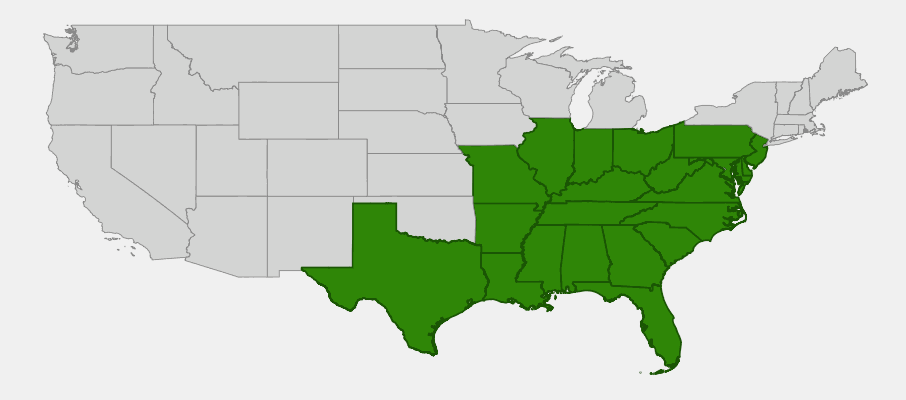
Strawberry Bush is native to the southeastern and south-central United States, with its range extending from southern New York and Pennsylvania south to Florida and west to eastern Texas, Oklahoma, and southeastern Kansas. The species is most abundant in the Coastal Plain and Piedmont regions, where it thrives in the understory of mixed hardwood forests, particularly those dominated by oaks, hickories, and maples.
In its natural habitat, Strawberry Bush is commonly found along stream banks, in ravines, and on moist, well-drained slopes where it benefits from the filtered light of the forest canopy. It often grows in association with other shade-tolerant shrubs like Spicebush (Lindera benzoin), Elderberry (Sambucus canadensis), and various viburnums. The species shows a particular affinity for areas with rich, organic soils that remain consistently moist but well-drained.
While Strawberry Bush was historically more common throughout its range, habitat loss and forest fragmentation have reduced populations in some areas, particularly in urbanizing regions. However, the species remains locally abundant in protected forests and is showing renewed interest among native plant gardeners who appreciate its unique ornamental qualities and wildlife value.
📋 Regional plant lists featuring Strawberry Bush: North Carolina & South Carolina
Growing & Care Guide
Strawberry Bush is surprisingly easy to grow once you understand its woodland origins and shade preferences. This adaptable native shrub rewards gardeners with minimal maintenance requirements and spectacular seasonal interest.
Light
Strawberry Bush performs best in partial to full shade, making it ideal for challenging garden spots where many other flowering shrubs struggle. While it can tolerate morning sun, it prefers protection from hot afternoon sun, especially in southern regions. In too much direct sunlight, the foliage may scorch and the plant will require more frequent watering. The ideal situation is bright, filtered light beneath deciduous trees.
Soil & Water
This native shrub prefers moist, well-draining soil rich in organic matter — conditions that mimic the forest floor of its natural habitat. It grows best in slightly acidic to neutral soil (pH 5.5–7.0) but is adaptable to various soil types including clay, loam, and sandy soils as long as drainage is adequate. Strawberry Bush has moderate water needs and appreciates consistent moisture, especially during dry spells, but established plants show good drought tolerance once their root systems are well-developed.
Planting Tips
Plant Strawberry Bush in fall or early spring when temperatures are mild and rainfall is typically more reliable. Choose a location that receives morning sun and afternoon shade, or a spot beneath the canopy of larger trees. Space plants 4–6 feet apart if creating a naturalistic grouping. The shrub transplants well from container stock and is occasionally available from native plant nurseries specializing in southeastern flora.
Pruning & Maintenance
Strawberry Bush requires minimal pruning and maintenance. Remove dead, damaged, or crossing branches in late winter or early spring before new growth begins. If the plant becomes too large or develops an uneven shape, selective pruning can be done after fruiting in late fall or winter. Avoid heavy pruning as the plant’s natural loose, informal growth habit is part of its charm. The shrub is naturally pest- and disease-resistant, making it truly low-maintenance.
Landscape Uses
Strawberry Bush’s versatility and unique characteristics make it valuable in many garden situations:
- Woodland gardens — perfect for naturalistic forest-edge plantings
- Shade borders — provides structure and seasonal interest in challenging spots
- Wildlife gardens — fruit attracts birds and provides nesting habitat
- Rain gardens — tolerates periodic moisture fluctuations
- Native plant collections — represents southeastern forest understory
- Autumn interest gardens — spectacular fall fruit display
- Foundation plantings — works well on the north side of buildings
Wildlife & Ecological Value
Strawberry Bush provides important ecological services and supports a variety of wildlife species throughout the year, making it a valuable addition to wildlife-friendly landscapes.
For Birds
The bright orange-red seed arils are consumed by numerous bird species, including Northern Cardinals, American Robins, Cedar Waxwings, and various finches and sparrows. The birds eat the fleshy arils and disperse the seeds, helping to establish new plants throughout the forest. The shrub’s dense, twiggy structure also provides excellent nesting habitat for small songbirds, particularly those that prefer understory locations.
For Mammals
Small mammals including chipmunks, squirrels, and mice occasionally consume the seeds and arils, though birds are the primary dispersers. White-tailed deer typically avoid browsing Strawberry Bush, making it a good choice for gardens where deer pressure is a concern. The dense growth habit provides cover and shelter for small wildlife.
For Pollinators
While the flowers are small and inconspicuous, they attract a variety of small pollinators including native bees, small butterflies, and beneficial insects. The flowers bloom in late spring to early summer when many pollinators are active, providing an important nectar source in the shaded understory where flowering plants are less common.
Ecosystem Role
As an understory shrub, Strawberry Bush contributes to forest structural diversity and provides important habitat layering in woodland ecosystems. Its leaf litter decomposes readily, contributing organic matter to the soil and supporting the complex web of soil organisms that form the foundation of forest health. The plant’s role as a seed disperser for itself and potentially other species (through bird activity) helps maintain genetic diversity and forest regeneration.
Cultural & Historical Uses
Strawberry Bush has a rich history of traditional uses among Indigenous peoples and early European settlers, though it has never been as widely utilized as some other native plants. Various southeastern tribes, including the Cherokee and Creek nations, recognized the plant’s medicinal properties and incorporated it into their traditional pharmacopoeia, though specific uses varied among different groups.
The inner bark and roots of Strawberry Bush contain compounds with purgative properties, leading to its historical use as a strong laxative and emetic. However, these same compounds make the plant potentially toxic, and traditional preparation required specific knowledge and careful dosing. The plant was sometimes called “wahoo” by early settlers, a name that was also applied to other Euonymus species with similar properties.
In folk medicine, Strawberry Bush was occasionally used to treat various ailments including fever, stomach complaints, and skin conditions, though its use was always approached with caution due to the plant’s potent effects. The bright red seeds were sometimes used decoratively, strung into beads or used in seasonal displays, though this practice was limited due to their potential toxicity.
Today, Strawberry Bush is valued primarily for its ornamental qualities and ecological benefits rather than any medicinal uses. Modern gardeners appreciate the plant’s spectacular autumn display, its ability to thrive in challenging shady conditions, and its role in supporting native wildlife. The plant has gained renewed interest among native plant enthusiasts who recognize its unique beauty and ecological importance in southeastern forest ecosystems.
Frequently Asked Questions
Are Strawberry Bush fruits edible?
No, the fruits and seeds of Strawberry Bush are toxic to humans and should not be consumed. While birds can safely eat the seed arils, the plant contains compounds that can cause severe digestive upset in humans and pets. Keep children and pets away from the fruit.
Why is my Strawberry Bush not producing fruit?
Several factors can affect fruit production: insufficient pollination (ensure there are pollinators active during flowering), too much shade (some light is needed for good flowering and fruiting), plant immaturity (young plants may take 2-3 years to begin fruiting), or poor growing conditions such as drought stress during flower development.
Can Strawberry Bush grow in full sun?
While Strawberry Bush can tolerate some morning sun, it generally performs poorly in full sun locations, especially in hot climates. The foliage may scorch, growth may be stunted, and the plant will require significantly more water. It’s best suited to partial to full shade locations.
How do I propagate Strawberry Bush?
Strawberry Bush can be propagated from fresh seed collected in fall (remove the aril and plant immediately), from softwood cuttings taken in summer, or by layering. Seeds require a period of cold stratification and may take two years to germinate. The easiest method for home gardeners is usually purchasing plants from native plant nurseries.
Is Strawberry Bush the same as the strawberry shrub (Calycanthus)?
No, these are completely different plants. Strawberry Bush (Euonymus americanus) gets its name from the strawberry-like appearance of its fruit capsules, while Sweetshrub or Strawberry Shrub (Calycanthus species) is named for its strawberry-scented flowers. They belong to different plant families and have different growing requirements.

Looking for a nursery that carries Strawberry Bush?
Browse our native plant nursery directory: North Carolina · South Carolina