Streambank Wheatgrass (Elymus lanceolatus)
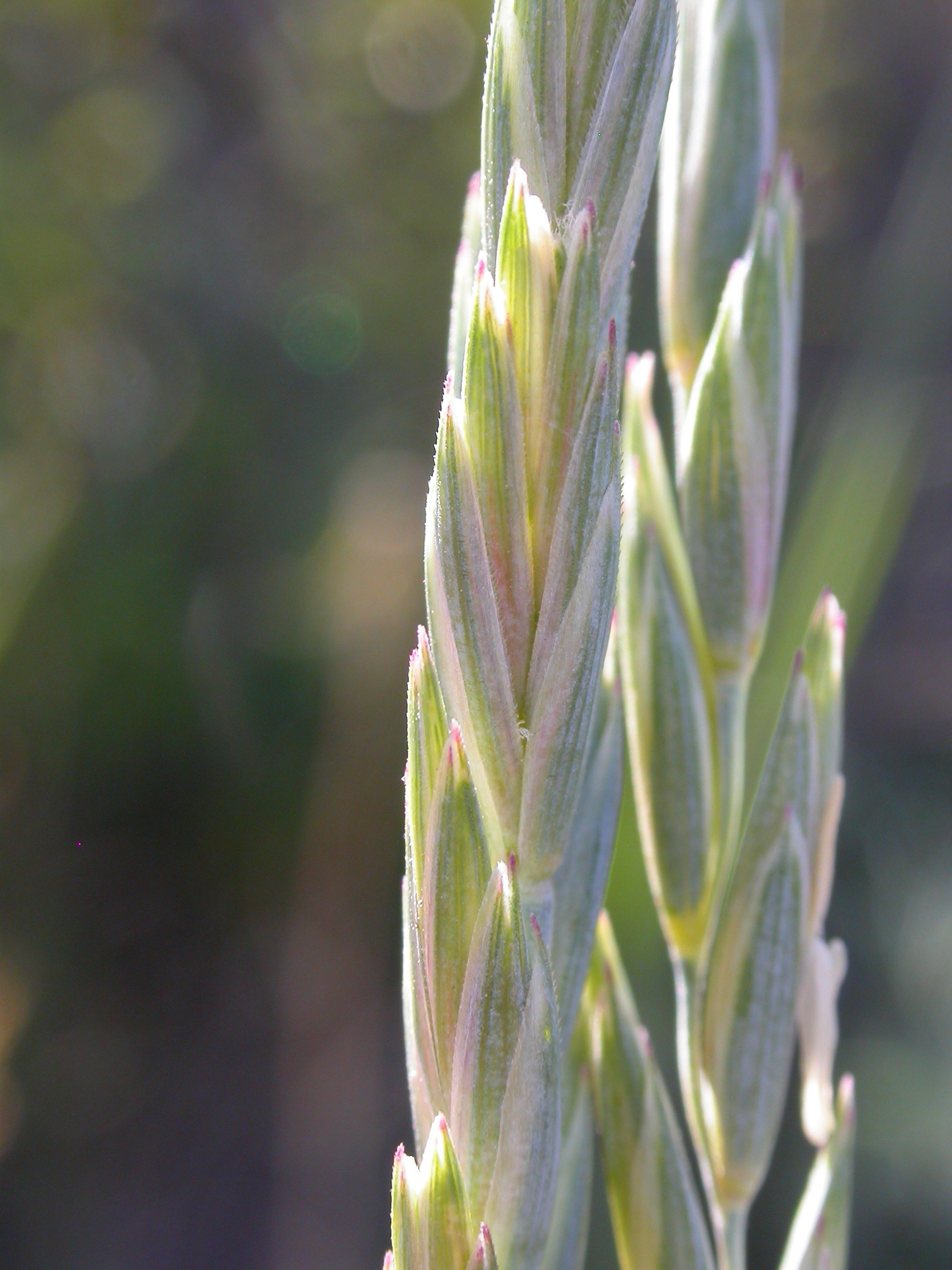
Elymus lanceolatus (syn. Agropyron dasystachyum), commonly known as Streambank Wheatgrass or Thickspike Wheatgrass, is a tough, wide-spreading native wheatgrass of the northern Great Plains and Rocky Mountains that is prized for its exceptional adaptability, strong rhizomatous root system, and valuable soil-holding properties. Unlike the bunch-forming Bluebunch Wheatgrass, Streambank Wheatgrass spreads aggressively through deep, creeping rhizomes to form a dense, continuous sod — making it one of the most effective native grasses for erosion control, streambank stabilization, and rangeland restoration throughout Montana and Wyoming.
Streambank Wheatgrass grows 1 to 3 feet tall with blue-green foliage and a narrow, upright spike similar in appearance to other wheatgrasses. It is closely related to Thickspike Wheatgrass (Elymus lanceolatus subsp. lanceolatus), and the two subspecies are sometimes difficult to distinguish. The native plant list notes that Streambank Wheatgrass is “similar to Thickspike” with “good seedling vigor” — an important practical characteristic for restoration planting, since strong seedling establishment is critical when competing with invasive annual grasses like cheatgrass on disturbed sites.
Streambank Wheatgrass is a workhorse native grass used extensively in range restoration, streambank stabilization, and revegetation throughout its range. It establishes well from seed, spreads rapidly through rhizomes to bind soil, tolerates drought after establishment, and provides good forage quality for wildlife and livestock. Its blue-green foliage, graceful seed spikes, and rhizomatous spreading habit make it attractive in mass plantings and native grassland gardens as well as functional restoration applications.
Identification
Streambank Wheatgrass is a cool-season perennial grass with strongly rhizomatous growth — the spreading, sod-forming habit is its most distinctive characteristic distinguishing it from bunchgrasses. The blue-green color of the foliage, narrow seed spike, and low growing leaves help identify it in the field.
Leaves & Stems
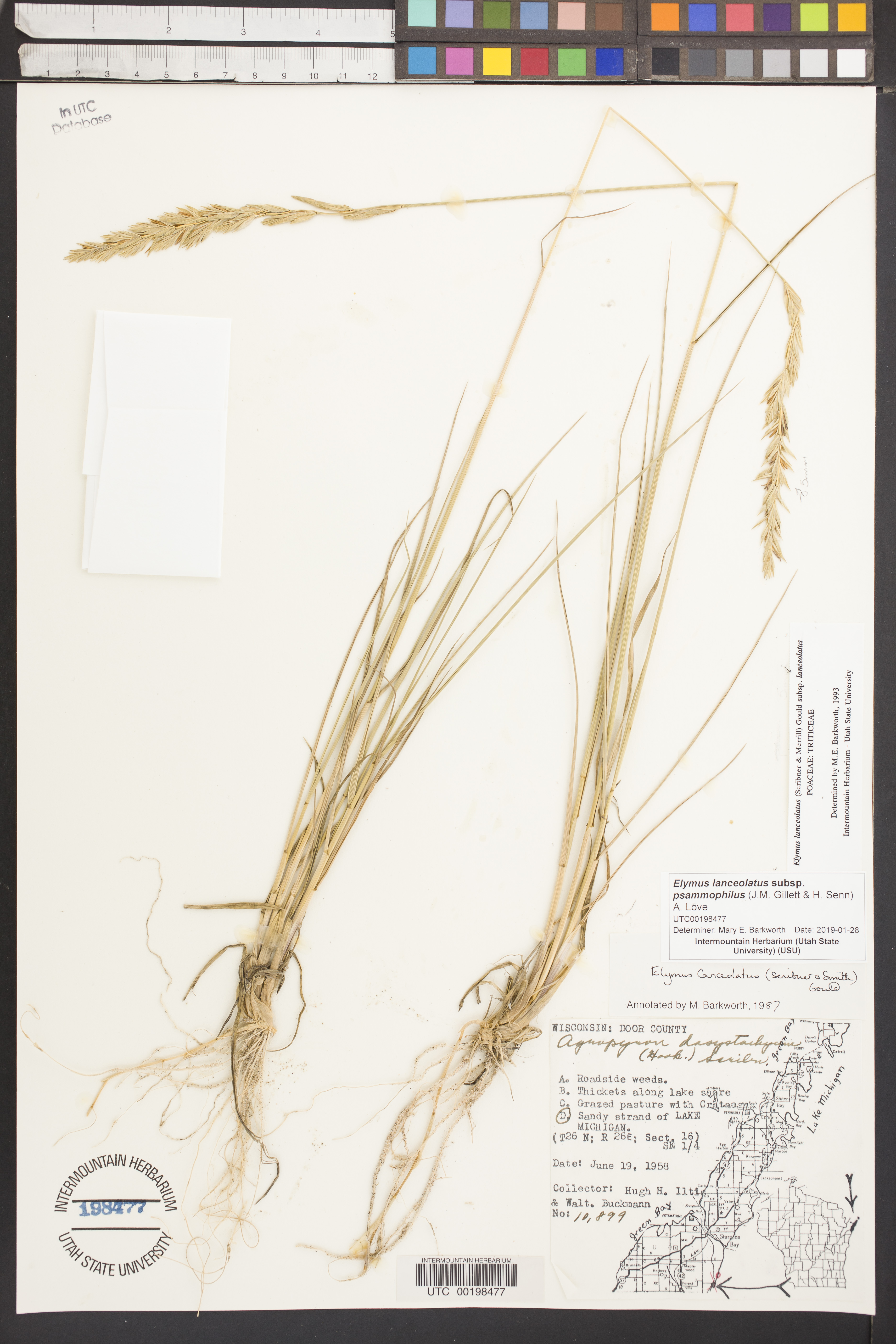
Leaf blades are flat to loosely inrolled, 4 to 10 inches long and about 1/8 to 3/16 inch wide, blue-green to gray-green in color with a somewhat waxy or glaucous surface. The upper surface of the leaf has distinct ribs (veins) that give it a textured appearance, and the surface is often slightly hairy or rough. Stems (culms) are erect, 1.5 to 3 feet tall. The plant forms a continuous sod from spreading rhizomes rather than distinct clumps, giving it a more uniform, turf-like appearance than bunchgrasses like Bluebunch Wheatgrass.
Seed Spike
The seed spike is narrow, erect, 3 to 6 inches long, with spikelets arranged closely against the zigzag rachis (central axis). Spikelets are usually awnless or with very short awns — unlike the conspicuously long-awned Bluebunch Wheatgrass. Each spikelet has 4 to 7 florets. The dense, close-set arrangement of spikelets against the rachis gives the spike a plump, “thick” appearance — hence the alternate common name “Thickspike Wheatgrass.” Spikes appear in early to mid-summer, maturing to golden tan by late summer.
Roots & Rhizomes
The most ecologically important feature of Streambank Wheatgrass is its extensive rhizome system. The creeping rhizomes extend outward from the parent plant, sending up new shoots at intervals and gradually forming a dense, interconnected mat of roots and rhizomes that binds soil exceptionally well. This spreading habit is the key to its effectiveness for erosion control and streambank stabilization — the dense mat of roots and rhizomes holds soil even during flood events that would wash away non-rhizomatous vegetation.
Quick Facts
| Scientific Name | Elymus lanceolatus (syn. Agropyron dasystachyum) |
| Family | Poaceae (Grass) |
| Plant Type | Perennial Rhizomatous Grass |
| Mature Height | 1–3 ft |
| Sun Exposure | Full Sun to Part Shade |
| Water Needs | Low to Moderate |
| Bloom Time | June – July |
| Foliage Color | Blue-green to gray-green |
| USDA Hardiness Zones | 3–8 |
Native Range
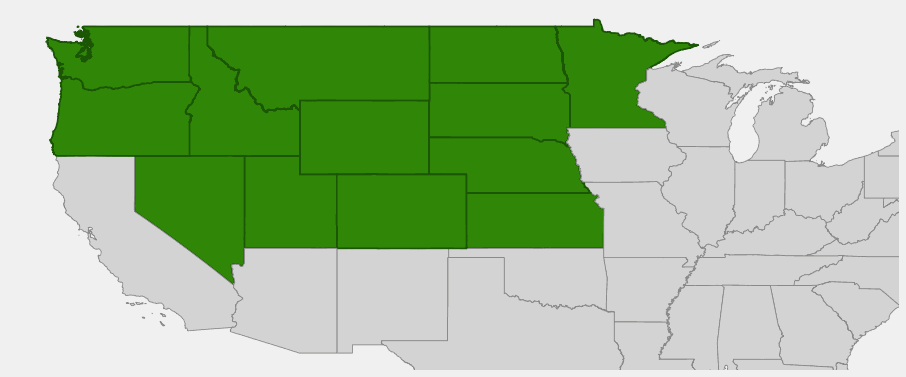
Streambank Wheatgrass has a broad native range across the western United States and Canada, extending from Alaska and the Canadian Prairie Provinces south through the Great Plains, Rocky Mountains, and Intermountain West. In the United States, it is native to Montana, Wyoming, Idaho, North Dakota, South Dakota, Colorado, Utah, Nevada, Oregon, Washington, Minnesota, Nebraska, and Kansas. It is one of the most widespread wheatgrasses in the northern Rocky Mountain and Great Plains region.
In Montana and Wyoming, Streambank Wheatgrass occupies a wide variety of habitats including streambanks, moist prairie swales, dry to moderately moist open grasslands, sagebrush steppe, roadsides, and disturbed sites. Despite its common name, it is not limited to streambanks — it grows in many upland grassland situations as well. It is particularly common in the mixed-grass prairie communities of eastern Montana and Wyoming, where it associates with western wheatgrass (Pascopyrum smithii), needle-and-thread grass (Hesperostipa comata), and various native forbs.
The species thrives across a wide range of elevations from about 2,000 to 8,000 feet in the Rocky Mountain region. It tolerates a broad range of soil textures, from sandy and gravelly soils on streambanks to clay-heavy prairie soils, and adapts to both dry and moderately moist conditions. This wide ecological tolerance, combined with strong rhizomatous spreading and good seedling vigor, makes it one of the most practical native grasses for restoration and revegetation projects throughout its range.
📋 Regional plant lists featuring Streambank Wheatgrass: Montana & Wyoming
Growing & Care Guide
Streambank Wheatgrass is a practical and adaptable native grass for restoration, erosion control, and native grassland gardens throughout Montana and Wyoming. Its combination of strong seedling vigor, spreading rhizomes, and drought tolerance makes it one of the most reliable native grasses for challenging sites.
Light
Streambank Wheatgrass thrives in full sun to light partial shade. It performs best in open, sunny grassland conditions but tolerates some shade at forest edges and along lightly shaded streambanks. Unlike many native grasses, it remains reasonably productive even with a few hours of afternoon shade — making it versatile across a range of site conditions.
Soil & Water
One of Streambank Wheatgrass’s strengths is its wide soil tolerance. It grows in sandy, gravelly, loamy, and clay soils, and adapts to both dry and moderately moist conditions. Once established, it is drought tolerant — well-suited to the dry summers of Montana and Wyoming. It performs particularly well on streambanks and moist prairie swales where moisture is more available, but it does not require wet conditions. Avoid waterlogged, poorly drained soils that promote root rot.
Planting Tips
Streambank Wheatgrass establishes well from seed — and its “good seedling vigor” (as noted in the source plant list) means it competes better with invasive weeds than some other native grasses during establishment. Seed can be sown in fall (dormant seeding) or spring. For streambank and erosion control applications, broadcast seeding at 8 to 15 lbs pure live seed per acre is typical. Container-grown plugs are available for smaller-scale plantings and transplant readily. The rhizomatous spreading means a relatively small initial planting can expand to cover a large area over several years — plan for this spread in garden applications.
Pruning & Maintenance
Streambank Wheatgrass is very low-maintenance once established. The sod-forming growth habit means it competes well against many weeds, reducing maintenance needs compared to bunchgrasses. In garden settings, mow or cut back to about 3 to 4 inches in late winter to encourage fresh spring growth. Avoid close, frequent mowing that weakens the plant. In naturalistic settings, simply leave it — the golden winter foliage and seed spikes provide off-season interest and wildlife habitat.
Landscape Uses
- Streambank and gully stabilization — spreading rhizomes bind soil exceptionally well
- Erosion control on slopes, roadsides, and disturbed sites
- Prairie and meadow restoration — good seedling vigor aids establishment against weeds
- Wildlife habitat grass — provides seed and dense cover for grassland birds
- Low-water lawns and ground cover in naturalistic settings
- Riparian restoration at stream margins and floodplain fringes
- Mine and disturbed land reclamation — tolerates poor, compacted soils
Wildlife & Ecological Value
Streambank Wheatgrass provides critical habitat structure and food resources for grassland wildlife throughout the Rocky Mountain West.
For Birds
The seeds of Streambank Wheatgrass are consumed by numerous grassland and sparrow species including horned larks, McCown’s longspurs, vesper sparrows, Savannah sparrows, and various finches. The dense sod provides important ground nesting cover — particularly valuable for Western meadowlarks, Savannah sparrows, and other ground-nesters that require concealment beneath grass canopy. The rhizomatous growth creates a continuous vegetated cover that is more protective for ground-nesting birds than scattered bunchgrasses in open areas.
For Mammals
Streambank Wheatgrass is highly palatable forage for large ungulates. Pronghorn, mule deer, elk, and domestic livestock all graze it, particularly during the cool-season growing periods in spring and fall when protein content is highest. Bison historically maintained the mixed-grass prairie communities dominated by Streambank and Western Wheatgrass throughout the Great Plains. Small mammals including voles, pocket mice, and kangaroo rats consume the seeds and use the dense cover for protection from predators. Prairie dogs and ground squirrels readily colonize areas dominated by rhizomatous wheatgrasses.
For Pollinators
Like other wind-pollinated grasses, Streambank Wheatgrass does not directly benefit pollinators through nectar or pollen. However, the dense, stable sod it creates provides bare-soil patches between stems that are used by ground-nesting native bees for burrow excavation. The structurally diverse grassland communities it anchors support the native wildflowers that pollinators depend on.
Ecosystem Role
Streambank Wheatgrass plays a critical role in soil stabilization and grassland community structure throughout its range. The deep, dense rhizome system — extending several feet into the soil — binds soil against erosion by water and wind, making it especially valuable on disturbed slopes, streambanks, and roadsides. The continuous sod reduces evaporation and moderates soil temperature, benefiting associated plants and soil organisms. As a palatable, high-quality forage grass, it supports the large ungulate populations that historically drove the ecology of the Great Plains. Its role in native seed mixes for reclamation and restoration work makes it one of the most economically and ecologically important native grasses in the Rocky Mountain and Plains states.
Cultural & Historical Uses
Streambank and Thickspike Wheatgrasses were important resources for Indigenous peoples of the northern Great Plains. The Blackfeet, Crow, Sioux, Mandan, and other Plains nations used wheatgrass seeds as food, harvested in late summer by beating the ripe spikes into baskets. The seeds were ground into flour or mixed with fat and berries to make pemmican — the high-energy preserved food that sustained Plains peoples through winter. The dense, mat-forming sod of rhizomatous wheatgrasses like Streambank Wheatgrass was also recognized as a key indicator of healthy, productive prairie land suitable for bison hunting and camp establishment.
The rhizomatous growth habit of Streambank Wheatgrass was valued by Indigenous peoples for the practical purpose of sod-house construction — the interlocking rhizomes created the dense, cohesive grass sod used to build earth-sheltered dwellings across the Plains. Early Euro-American settlers similarly used dense prairie sod — held together by wheatgrass rhizomes — as the primary building material for the famous sod houses (“soddies”) of the Great Plains frontier.
Modern use of Streambank Wheatgrass is primarily in range management, restoration ecology, and erosion control applications. The USDA Natural Resources Conservation Service (NRCS) has released several improved cultivars of Streambank Wheatgrass including ‘Sodar’, ‘Critana’, and ‘Revenue’ — selected for improved seedling vigor, establishment, and persistence in restoration plantings. It is one of the most commonly specified grasses in NRCS-guided restoration projects throughout Montana and Wyoming. Its combination of strong establishment, spreading habit, drought tolerance, and forage quality makes it an enduring workhorse of native plant restoration throughout the northern Rocky Mountain and Plains states.
Frequently Asked Questions
What is the difference between Streambank Wheatgrass and Bluebunch Wheatgrass?
The most fundamental difference is growth habit: Streambank Wheatgrass is rhizomatous and sod-forming — it spreads to create a continuous mat of grass. Bluebunch Wheatgrass is a bunchgrass that grows in distinct clumps without rhizomes. Streambank Wheatgrass is better for erosion control and situations requiring continuous ground cover; Bluebunch Wheatgrass is better for naturalistic bunchgrass prairie aesthetics and habitat that requires bare soil between plants for ground-nesting bees and other species.
Is Streambank Wheatgrass the same as Thickspike Wheatgrass?
The scientific name Elymus lanceolatus covers multiple subspecies that are sometimes treated separately. Thickspike Wheatgrass is typically Elymus lanceolatus subsp. lanceolatus, while what is commonly sold as “Streambank Wheatgrass” may include subsp. psammophilus (Sandy Streambank Wheatgrass). They are very similar in appearance and ecology; the main differences relate to habitat preference and awn development. In practice, the terms are often used interchangeably in restoration seed mixes.
Does Streambank Wheatgrass spread aggressively?
Yes — it spreads through rhizomes and will colonize adjacent areas over time. This is desirable for erosion control and habitat restoration, but it should be sited with this spreading habit in mind in garden settings. It is not invasive in the ecological sense (it is a native species that spreads within appropriate habitats), but it can overgrow smaller plants in a garden bed if not managed.
How does Streambank Wheatgrass compare to crested wheatgrass for restoration?
Streambank Wheatgrass is strongly preferred over crested wheatgrass (Agropyron cristatum) for ecological restoration because it is a native species that supports native wildlife, native pollinators, and native plant community diversity. Crested wheatgrass is an introduced species that, while useful for quick soil stabilization, creates a near-monoculture that crowds out native species and reduces biodiversity. Use native wheatgrasses for any restoration project with ecological goals.
Can Streambank Wheatgrass be used for pasture?
Yes — Streambank Wheatgrass is a palatable, nutritious forage grass that can be used in native grass pastures. It is particularly useful on sites prone to erosion where the spreading, sod-forming habit is beneficial. It tolerates moderate grazing well, but heavy continuous grazing during the growing season will weaken it. Native grass pastures combining Streambank Wheatgrass with Western Wheatgrass, Blue Grama, and native forbs produce excellent wildlife habitat while also providing good livestock forage.