Sugar Sumac (Rhus ovata)
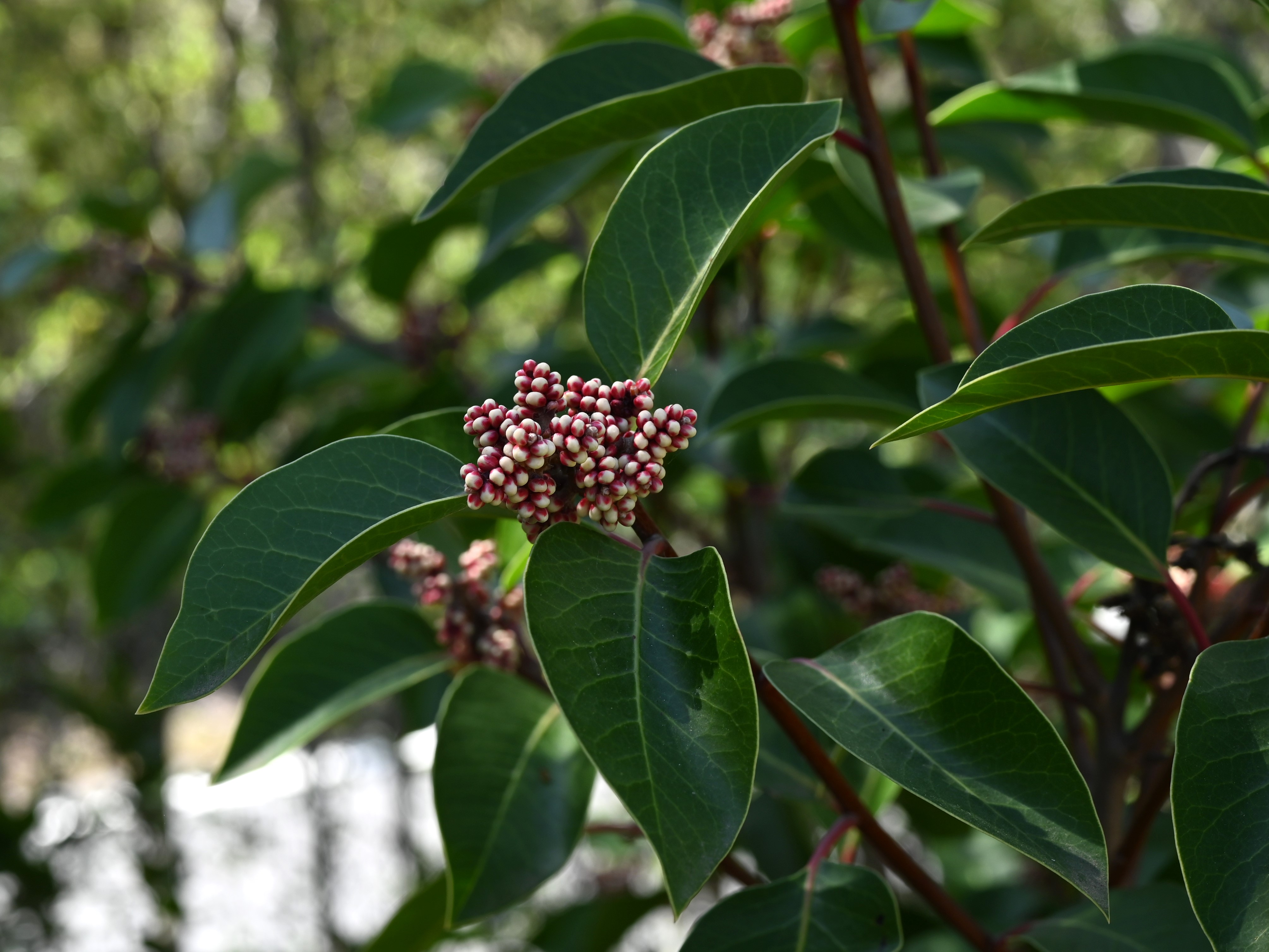
Rhus ovata, commonly known as Sugar Sumac or Sugar Bush, is a bold, handsome evergreen shrub native to the chaparral and oak woodland communities of California and Arizona. One of the largest and most striking members of the Anacardiaceae (cashew) family in the American Southwest, Sugar Sumac can grow 4 to 12 feet tall and wide, forming a dense, rounded to spreading shrub with large, leathery, oval to ovate leaves that give it a bold, tropical-looking texture quite unlike most other desert and chaparral plants. The species name ovata (“egg-shaped”) refers to the distinctive leaf shape, while “Sugar Sumac” refers to the sweet, sticky exudate that coats the reddish-hairy fruit clusters and was used as a food and beverage by Native Americans.
Sugar Sumac is a chaparral keystone species, providing food, shelter, and nesting habitat for dozens of wildlife species. The dense, impenetrable thickets it forms on rocky slopes and canyon walls are among the most important wildlife habitat structures in California and Arizona foothills. Its small, dense clusters of white to pink flowers in spring attract native bees and other pollinators, while the reddish fruit clusters that follow persist through summer and fall, providing food for birds, mammals, and desert tortoises.
For gardens, Sugar Sumac is one of the premier native evergreen shrubs available to gardeners in California and Arizona. Its year-round interest — bold foliage, spring flowers, colorful fruit, and attractive bark — combined with exceptional drought tolerance (once established) and moderate water tolerance at lower elevations (as the native plant list notes: “More water/shade needed at lower elevations”) make it an outstanding specimen or screen plant for water-wise native gardens. It is fire-resistant for a chaparral plant and has been used extensively in erosion control plantings on difficult slopes.
Identification
Sugar Sumac is a large, bold evergreen shrub with distinctive large, leathery leaves that fold slightly along the midrib. The overall impression is of a robust, tropical-looking shrub quite unlike the typical desert plant palette.
Leaves
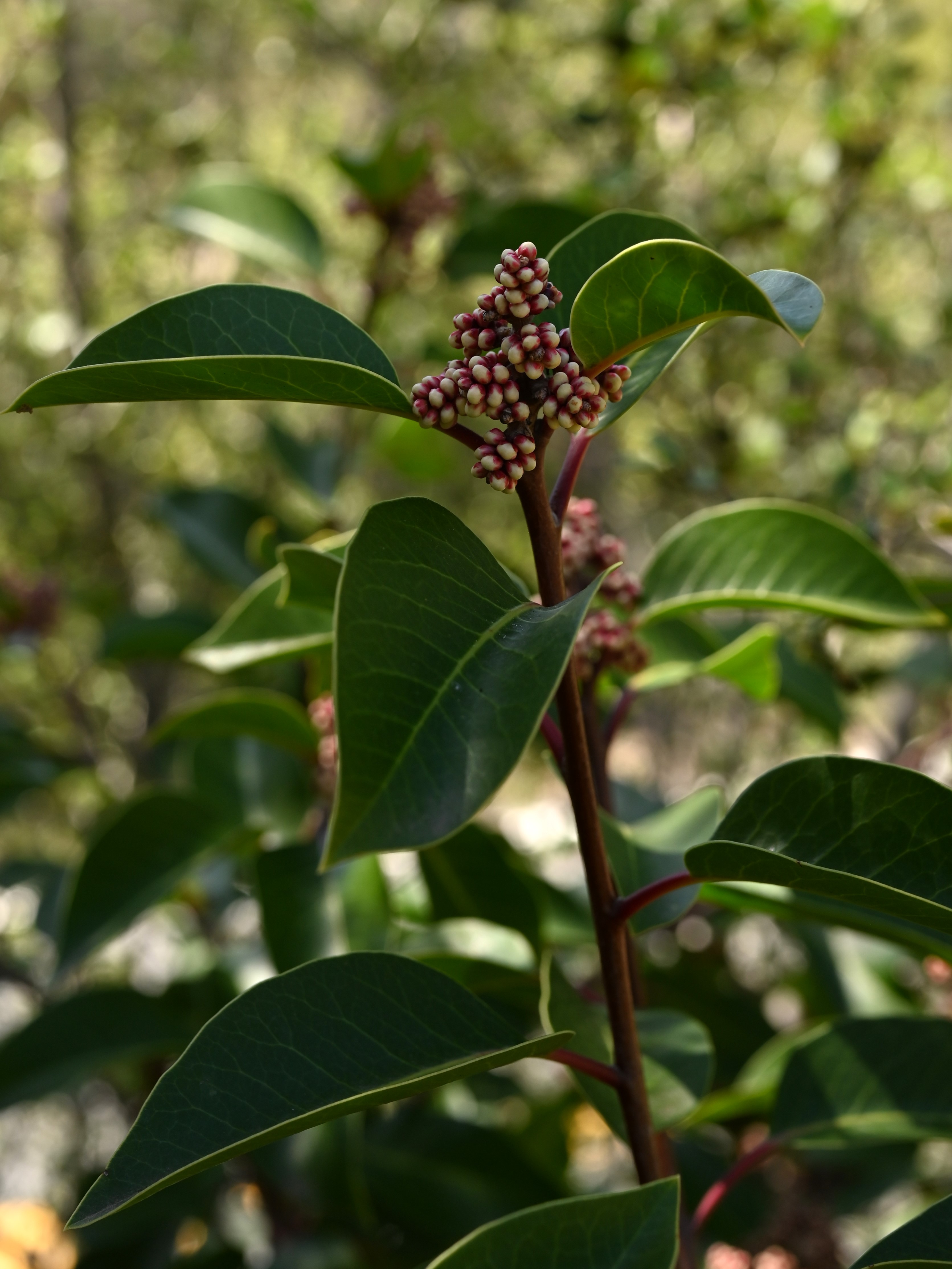
The leaves are among the most distinctive features of Sugar Sumac: large (2–4 inches long), leathery, ovate to elliptic with a pointed tip and slightly inrolled margins. The upper surface is glossy, dark green; the underside is paler and slightly hairy. The leaves fold slightly along the midrib, giving them a distinctive “folded” appearance. In shape, they resemble those of an olive or small magnolia. The leaves are evergreen and persistent, providing year-round interest. When crushed, they release a pleasant, slightly resinous scent. Autumn and winter foliage may develop reddish highlights, especially in cooler locations.
Flowers
Sugar Sumac blooms in spring (February–April), producing dense, rounded clusters (panicles) of small, 5-petaled flowers at branch tips. The flower clusters are 1–3 inches long and consist of numerous tiny blossoms that are white to pale pink, often with a slight pinkish blush at the center. The flowers have a pleasant, mild fragrance and are excellent nectar sources for native bees, butterflies, and other pollinators. Flowering typically occurs before or as new leaves emerge, making the flowers particularly conspicuous.
Fruit
The fruit clusters are ornamentally attractive: small (about ¼ inch), reddish to red-brown drupes covered with sticky, white hairs and arranged in dense clusters. The “sugar” in the common name refers to the sweet coating on these fruits — the sticky surface accumulates sugars that were licked or soaked in water by Native Americans to make a beverage or confection. The fruit clusters persist from summer through fall, providing an extended wildlife food resource and adding color and interest to the winter garden.
Bark & Stems
Young stems are reddish to reddish-brown and covered with glandular hairs. Older bark is smooth and gray to brownish-gray, developing attractive character with age. The plant sometimes develops a short, twisted trunk with multiple stems, creating a more tree-like form in sheltered locations with adequate moisture.
Quick Facts
| Scientific Name | Rhus ovata |
| Family | Anacardiaceae (Cashew/Sumac) |
| Plant Type | Evergreen Shrub (or small tree) |
| Mature Height | 10 ft |
| Sun Exposure | Full Sun to Part Shade |
| Water Needs | Low (Drought Tolerant) |
| Bloom Time | February – April |
| Flower Color | White to pale pink |
| USDA Hardiness Zones | 7–11 |
Native Range
Sugar Sumac is native to California and Arizona, with a restricted range compared to many other Southwestern native plants. In California, it occurs from the San Francisco Bay area south through the Coast Ranges and Transverse Ranges to Baja California, primarily in the chaparral and oak woodland communities below 4,000 feet elevation. In Arizona, it is found in the southeastern sky island mountain ranges (Santa Catalina, Rincon, Chiricahua, Huachuca, and Pinaleño mountains) at elevations from about 3,000 to 6,000 feet.
The species is most abundant in California, where it is a characteristic and often dominant shrub in coastal sage scrub, chaparral, and oak woodland transition zones. In Arizona, it grows in rocky canyon slopes and the lower oak woodland zone, often associated with Mexican blue oak, Arizona oak, manzanita, and mountain mahogany. The plant’s preference for rocky, well-drained slopes — particularly those with limestone, granite, or other solid rock substrates — reflects its chaparral ecology.
As noted in the plant list, Sugar Sumac “needs more water/shade at lower elevations” — in the hottest, driest parts of its range (low-elevation Arizona desert, Mojave Desert margins), the plant requires some supplemental irrigation or afternoon shade to maintain health. At higher elevations and in coastal California, it is genuinely self-sufficient on natural rainfall once established.
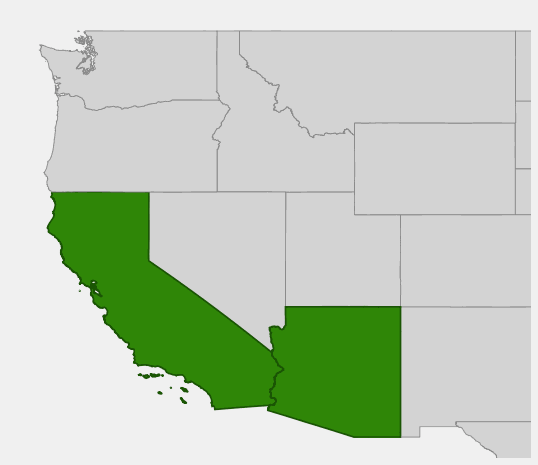
📋 Regional plant lists featuring Sugar Sumac: Arizona
Growing & Care Guide
Sugar Sumac is one of the most rewarding large evergreen shrubs for native gardens in California and Arizona. Its bold foliage, spring flowers, colorful fruit, and exceptional drought tolerance (once established) make it a multiple-season asset in the landscape.
Light
Sugar Sumac grows well in full sun to part shade. In full sun at higher elevations and in coastal California, it develops a dense, compact form and fruits most abundantly. At lower elevations in Arizona’s hot desert zones, some afternoon shade reduces heat stress and helps the plant maintain vigor through the hottest months. A location with morning sun and afternoon shade is ideal for low-desert planting in Arizona.
Soil & Water
Sugar Sumac prefers well-drained, rocky or gravelly soils — the kind found naturally on chaparral slopes. It is strongly intolerant of clay soils with poor drainage, where it will decline and eventually die from root rot. In its natural range, it survives on 10–20 inches of annual rainfall. For low-elevation Arizona gardens (below 3,000 feet), supplemental deep watering once or twice monthly during the hottest summer months helps maintain the plant’s health. Above 3,500 feet in Arizona and throughout its California range, established plants can survive on natural precipitation.
Planting Tips
Plant Sugar Sumac in fall for best establishment. Choose a permanent site with excellent drainage and room for its mature size — plants can spread 8–12 feet wide and 10+ feet tall. Dig a hole no deeper than the root ball and 2–3 times as wide. Backfill with native soil (no organic amendments needed). Mulch with gravel or decomposed granite to retain moisture and protect the root zone. Water deeply after planting and weekly during the first summer. After the first winter, reduce irrigation dramatically.
Pruning & Maintenance
Sugar Sumac generally requires minimal pruning. Remove any dead or damaged branches in late winter. The plant has a naturally attractive, rounded form. Light shaping can be done in early spring, but avoid heavy pruning — Sugar Sumac recovers slowly from significant cuts. The plant sprouts vigorously from the base after fire or severe damage, so even hard pruning won’t kill it. For use as a hedge or screen, plants can be lightly sheared annually to maintain desired height and density.
Landscape Uses
- Specimen shrub — bold foliage and attractive year-round appearance
- Privacy screen or hedge — dense, impenetrable, and evergreen
- Slope planting and erosion control — deep roots and dense canopy protect steep slopes
- Wildlife habitat — food and shelter for numerous bird and mammal species
- Fire-resistant planting — important in California and Arizona wildland-interface areas
- Foundation planting — can be limbed up into a multi-trunked small tree for architectural use
Wildlife & Ecological Value
Sugar Sumac is one of the most ecologically valuable native shrubs in California and Arizona, providing food, shelter, and nesting habitat for a remarkable diversity of wildlife species.
For Birds
The fruit of Sugar Sumac is consumed by numerous bird species, including Cedar Waxwings, American Robins, Hermit Thrushes, California Thrashers, Mockingbirds, and many others. The dense, thorny thickets created by mature plants provide excellent nesting habitat for California Thrashers, California Gnatcatchers, and various chaparral-nesting species. In Arizona, the plant supports similar bird communities in the sky island chaparral zone.
For Mammals
Mule deer and black-tailed deer browse the foliage and fruit. Coyotes, foxes, and raccoons consume the fruit. Desert tortoises eat the fallen fruit. The dense structure provides denning habitat for gray foxes, striped skunks, and other medium-sized mammals. Woodrats construct their elaborate midden-nests in the shelter of large Sugar Sumac clumps, creating refuges for numerous other small animals.
For Pollinators
The spring flowers are visited by native bees, honeybees, and various flies and beetles. The early spring bloom period, coinciding with the emergence of queen bumblebees and other spring pollinators, makes Sugar Sumac a particularly important early-season nectar source in chaparral and oak woodland habitats.
Ecosystem Role
In California chaparral, Sugar Sumac is a primary structural species, contributing to the dense, impenetrable shrub communities that define this unique plant formation. After fire, Sugar Sumac resprouts vigorously from an extensive underground root crown (burl), contributing to rapid chaparral recovery. This fire adaptation is essential in a biome where fires return every 20–60 years. The plant’s nitrogen-fixing root associates and extensive leaf litter contribute to soil development on the rocky slopes it inhabits.
Cultural & Historical Uses
Sugar Sumac has one of the most extensive ethnobotanical records of any California native shrub, reflecting its widespread use by virtually every Indigenous culture within its range. The Cahuilla, Kumeyaay, Chumash, Tongva, and other Southern California peoples harvested the sticky, sweet fruit clusters to make a lemonade-like beverage by soaking them in water — a refreshing drink that gave the plant its common name “sugar bush.” The beverage was mildly acidic and sweet, and was consumed both fresh and as a preserved concentrate.
Beyond the beverage, Sugar Sumac fruit was eaten fresh or dried and ground into a powder used to make cakes and porridges. The leaves were used medicinally — infusions treated colds, fever, and stomach ailments, and leaf poultices were applied to rashes and skin conditions. The Cahuilla used the flexible branches for basket-making, weaving them into the coiled basketry for which California peoples are renowned. The strong, hard wood was used for making tools, arrow foreshafts, and digging sticks.
Today, Sugar Sumac is gaining recognition as an outstanding native garden plant. It is more commonly available from California and Arizona native plant nurseries than it was a decade ago, and its use in restoration planting is increasing. Chaparral restoration projects, habitat corridor plantings, and slope stabilization projects throughout Southern California and the Arizona sky island region increasingly specify Sugar Sumac as a key component of native plant communities.
Frequently Asked Questions
Is Sugar Sumac related to Poison Oak or Poison Ivy?
Sugar Sumac belongs to the Anacardiaceae family, the same family as Poison Oak (Toxicodendron diversilobum) and Poison Ivy (Toxicodendron radicans). However, Sugar Sumac is not toxic — the related urushiol compound that causes dermatitis in Poison Oak and Ivy is absent or present only in trace amounts in Sugar Sumac. The plant has a long history of safe human use. Individuals with extreme sensitivities to related plants should still exercise caution initially.
Why is it called “Sugar” Sumac?
The common name refers to the sweet, sticky coating on the fruit clusters. When ripe, the red fruit drupes are covered with a sugary, slightly waxy exudate that was collected and used by Native Americans to make a sweet beverage by soaking the fruit clusters in water. This “sugar sumac lemonade” was a traditional drink throughout the plant’s California range.
How big will Sugar Sumac get?
Sugar Sumac can reach 10–15 feet tall and equally wide in optimal conditions. In dry locations or where root space is restricted, it remains smaller — often 6–8 feet. In gardens, expect mature plants to reach 8–10 feet tall and wide without regular pruning. At lower elevations in Arizona with occasional supplemental irrigation, growth may be more vigorous.
Can I grow Sugar Sumac in Phoenix?
Phoenix is at the hot, dry edge of Sugar Sumac’s comfortable range. It can be grown successfully in Phoenix with afternoon shade and supplemental deep watering (every 2–3 weeks) through summer. Plant on the east or north side of a structure to reduce afternoon heat load. Without some shade and supplemental water, the plant will likely decline in the low desert’s extreme heat.
Does Sugar Sumac spread aggressively?
Sugar Sumac spreads primarily by seed, which are distributed by birds and other wildlife. It is not considered aggressively spreading in most garden situations. The plant may occasionally sucker from roots after disturbance or damage, but this is not typically a problem in garden settings. Allow a few feet of clear space around the plant so its natural form can develop without crowding other plants.

Looking for a nursery that carries Sugar Sumac?
Browse our native plant nursery directory: Arizona