Two-Horned Calicoflower (Downingia bicornuta)
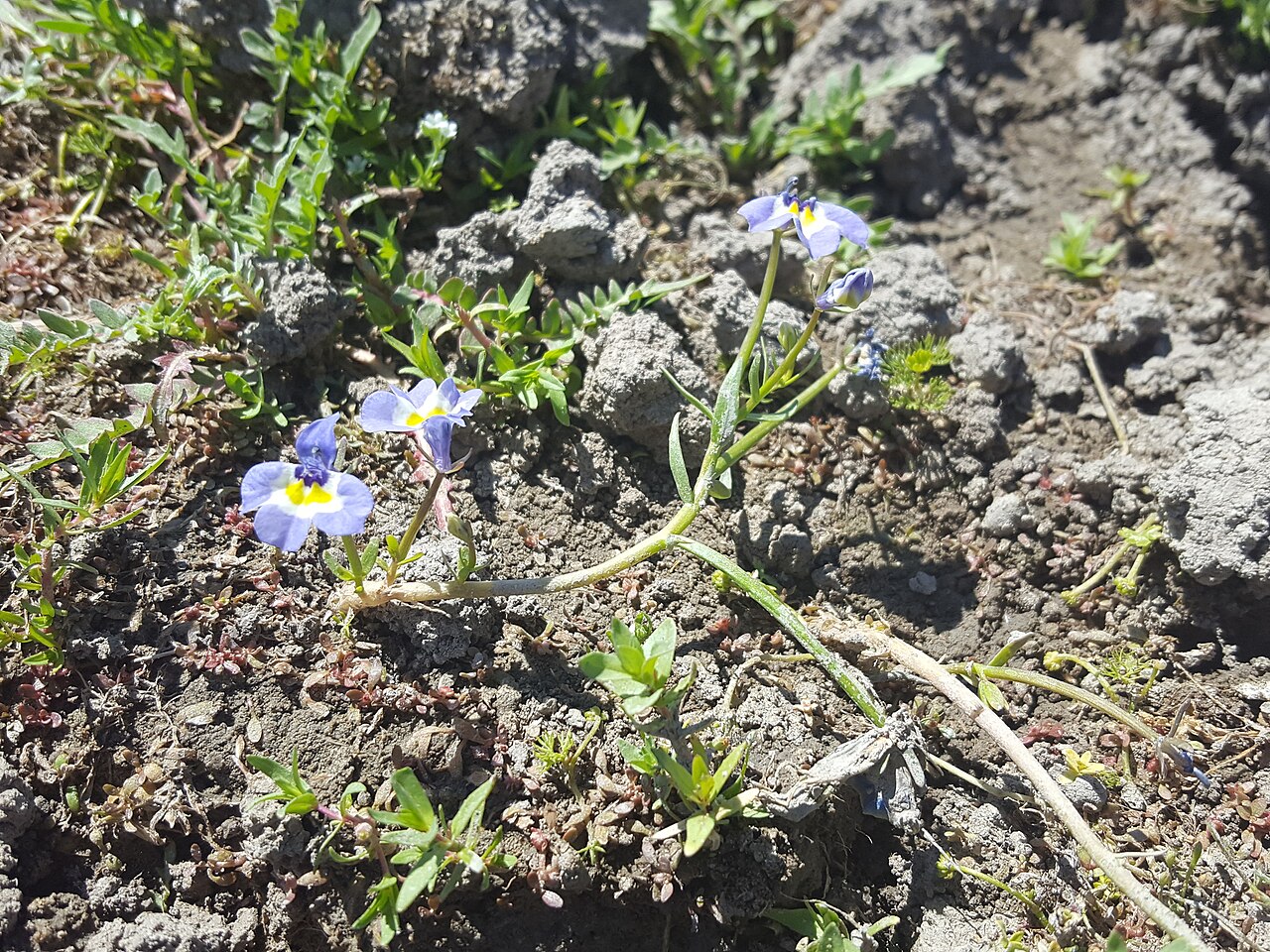
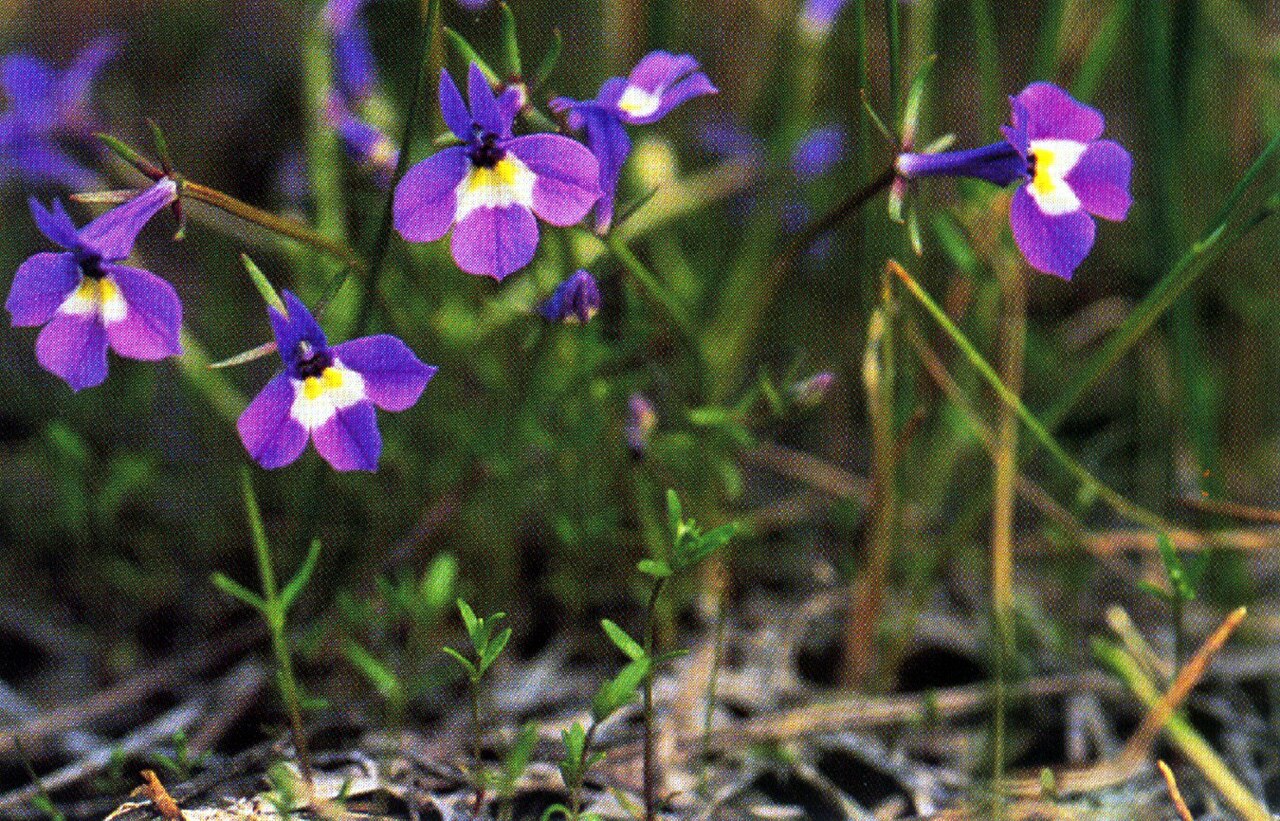
Downingia bicornuta, commonly called two-horned calicoflower or doublehorn downingia, is a small annual wildflower that belongs to the bellflower family (Campanulaceae), in the lobelia subfamily. It is a true vernal pool specialist — a plant that germinates underwater as pools dry down in spring, then flowers in a narrow ring around the shrinking edge of the pool before the ground bakes hard for summer. The flowers are tiny but strikingly patterned: violet-blue petals centered on a bright yellow patch rimmed in white, a combination that gives the whole genus its “calicoflower” nickname.
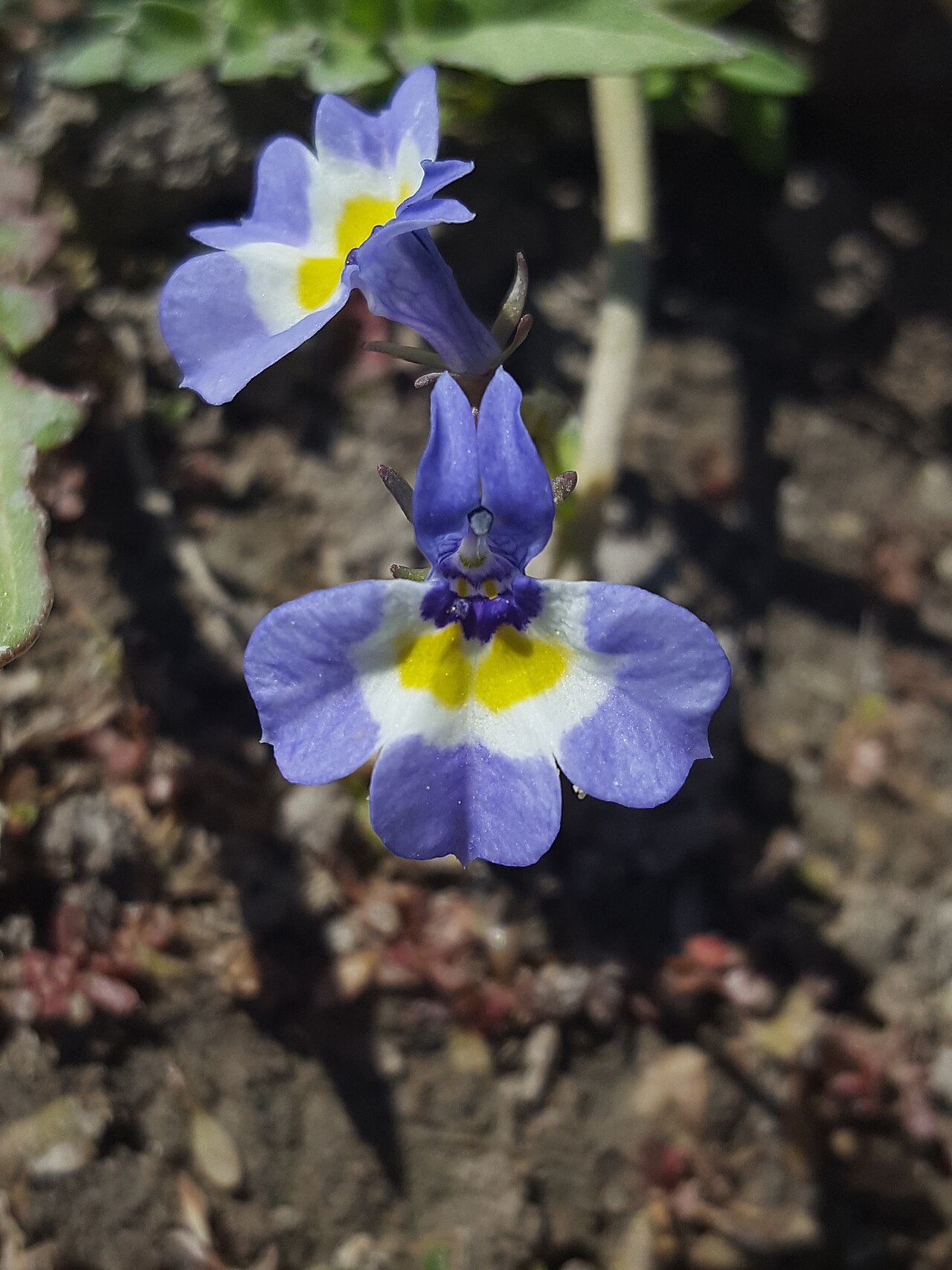
The species name bicornuta (“two-horned”) refers to a pair of slender, curved projections at the throat of the flower, visible if you look closely at the blossom from the side. These horn-like appendages are a key identification feature that separates two-horned calicoflower from the many other small-flowered Downingia species that share its vernal pool habitat, several of which grow right alongside it in the same drying mudflats.
For gardeners, two-horned calicoflower is a specialty plant for a very specific niche: a seasonally wet basin, rain garden depression, or constructed vernal pool that floods in winter and dries out completely by early summer. It is not a plant for a typical perennial bed, but in the right spot it self-sows reliably and creates a carpet of blue-and-yellow bloom each spring that few other natives can match for sheer density of flower.
Identification
Two-horned calicoflower is a low, often sprawling annual that branches freely from the base, with stems that may lie flat against the mud or rise a few inches before arching back down. Because it grows in a habitat with no competition from taller plants during its bloom window, it rarely needs to compete for height — spreading horizontally to occupy as much of the drying pool margin as possible.
Stems & Leaves
Stems are slender, often reddish where exposed to sun, and branch repeatedly to form loose mats 4 to 10 inches across. The leaves are small, narrow to oblong, alternately arranged, and sessile (without stalks) along the stem. They are easily overlooked next to the showy flowers and have no notable fall color or texture of their own — the plant’s visual interest is entirely in the bloom.
Flowers
Each flower is bilaterally symmetric (zygomorphic) and tubular at the base, 1 to 2 cm wide. Two narrow, pointed lobes point upward, while the three lower lobes fuse into a single broad landing platform marked with a central yellow blotch outlined in white — a classic “nectar guide” pattern that directs pollinating insects to the flower’s throat. The color of the lobes ranges from violet-blue to purple. At the mouth of the tube, two small, curved, horn-like projections of the fused sepals give the species its common and scientific names. Flowers open singly or in small clusters at the branch tips from April into June, depending on elevation and how long the pool holds water that year.
Fruit & Seeds
After pollination, the flower develops into a narrow, dehiscent (splitting) seed capsule 3 to 7 cm long, which releases numerous tiny seeds into the drying mud. These seeds can remain viable in the soil seed bank for years, waiting for a winter wet enough to flood the pool and trigger germination — a strategy shared by most vernal pool annuals.
Quick Facts
| Scientific Name | Downingia bicornuta |
| Family | Campanulaceae (Bellflower) |
| Plant Type | Annual Wildflower |
| Mature Height | 2–6 in (5–15 cm) |
| Mature Spread | 4–10 in (10–25 cm) |
| Growth Rate | Fast (completes life cycle in one season) |
| Sun Exposure | Full Sun |
| Water Needs | Seasonally flooded, then dry |
| Soil Type | Heavy clay or hardpan, poorly drained |
| Soil pH | Neutral to slightly alkaline |
| Bloom Time | April – June |
| Flower Color | Violet-blue with yellow and white throat |
| Fruit | Narrow dehiscent capsule, 3–7 cm |
| Deer Resistant | Yes (low palatability, short season) |
| USDA Hardiness Zones | 7–10 (grown as a self-sowing annual) |
Native Range
Two-horned calicoflower is native to the western United States, where it occurs from California north into Oregon and Idaho and east into Nevada. Within California it is most frequent in the Central Valley and the foothills ringing it, though scattered populations also occur in valleys of the Modoc Plateau and the Sierra Nevada foothills. Further north and east, it is tied to seasonally wet basins in the Columbia and Snake River plateau country of Oregon and Idaho.
The species is restricted almost entirely to vernal pools, swales, and the drying margins of shallow seasonal lakes — habitats defined by an impermeable hardpan, claypan, or volcanic substrate that traps winter and spring rainfall at the surface rather than letting it percolate away. These basins fill with water in winter, support submerged germination, and then dry completely by early-to-mid summer, leaving the cracked mud flats where two-horned calicoflower and its many “calicoflower” relatives bloom in concentric rings keyed to soil moisture.
Because vernal pool habitat has been lost to agricultural conversion and urban development across much of the Central Valley, two-horned calicoflower populations are considerably more fragmented than they once were, even though the species itself is not listed as rare. Protecting or recreating the hydrology of a seasonal wetland — rather than planting the species into an ordinary garden bed — is the only way to support it long-term.
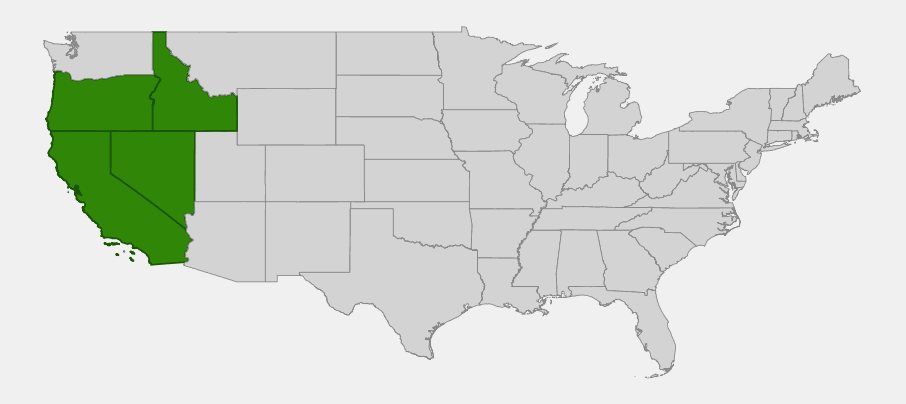
📋 Regional plant lists featuring two-horned calicoflower: California & Nevada
Growing & Care Guide
Two-horned calicoflower is not a conventional garden plant, and gardeners should approach it with the understanding that it needs a genuine seasonal-wetland cycle to persist. That said, it is an excellent and surprisingly manageable choice for anyone building a rain garden, constructed vernal pool, or naturalistic seasonal-wet depression.
Light
Full sun is required. Vernal pools are, by definition, open and unshaded basins, and the species does not persist under trees or in shaded landscape beds.
Soil & Water
The single most important factor is a soil that holds standing water through winter and early spring, then dries completely by early summer. Heavy clay, hardpan, or a lined constructed basin all work. Plants germinate as the water recedes and will not establish in soil that drains too quickly or that stays wet year-round — both extremes exclude it. Do not irrigate through summer; summer water encourages weeds and disrupts the dry dormancy the seed bank depends on.
Planting Tips
Two-horned calicoflower is almost always grown from seed sown directly onto bare, damp soil in fall, timed to germinate with the first soaking winter rains. Because the seeds are tiny, surface-sow and press them in rather than burying them. It pairs naturally with other vernal pool annuals such as goldfields and popcornflower, which bloom in overlapping but slightly different moisture zones, creating the classic ringed color pattern of a healthy vernal pool.
Pruning & Maintenance
None needed. As an annual, the plant completes its life cycle, sets seed, and dies back on its own as the basin dries for summer. Leave spent plants in place to let seed disperse naturally; avoid tilling or disturbing the seed bank in the dry months.
Propagation
By seed only. Collect capsules just as they begin to split, and store the tiny seed dry until fall sowing. No stratification is typically needed beyond the natural winter wetting the basin provides.
Landscape Uses
- Constructed or restored vernal pools — the plant’s primary habitat and best use
- Rain gardens and seasonal retention basins with a true dry summer cycle
- Vernal pool restoration and mitigation projects in the Central Valley
- Educational or demonstration wetland gardens showing seasonal wetland succession
Wildlife & Ecological Value
Despite its small size, two-horned calicoflower plays a meaningful role in the short, intense bloom cycle of a vernal pool ecosystem.
For Pollinators
The flower’s bold yellow-and-white nectar guide on a violet background is specifically shaped to attract small native bees, which are the primary pollinators of most Downingia species. Because vernal pools bloom in a compressed window when little else is flowering nearby, the dense carpets of calicoflower and its relatives provide a concentrated, reliable nectar and pollen source for specialist and generalist bees alike during a critical early-season period.
Birds & Other Wildlife
Seed-eating birds and small invertebrates forage in and around vernal pool margins where calicoflower grows, and the dense low cover it forms with other annuals helps stabilize the saturated soil surface against erosion during the wettest part of the year.
Ecosystem Role
As one of several co-occurring Downingia and other vernal pool specialist annuals, two-horned calicoflower is both an indicator species and a structural component of a globally rare habitat type. Vernal pools are now one of California’s most reduced natural communities, and the presence of a healthy, diverse calicoflower bloom is often used by botanists as a quick field indicator of a functioning, unmodified pool hydrology.
Cultural & Historical Uses
Two-horned calicoflower has no significant recorded history of use by Indigenous peoples or early settlers, unlike many larger or more conspicuous California natives. Its ephemeral size and brief bloom window in isolated wetland basins meant it attracted little attention outside of botanical collecting.
The genus Downingia was named in the 19th century for Andrew Jackson Downing, an influential American horticulturist and landscape designer, though the connection is taxonomic rather than practical — Downing himself had no direct association with California’s vernal pool flora. Botanical collectors working the Central Valley and Sierra foothills through the 1800s and 1900s documented the genus extensively, and it remains a favorite subject for California botanists studying vernal pool ecology and plant-pollinator interactions.
Today the main cultural significance of two-horned calicoflower lies in conservation and restoration work. As vernal pool habitat has shrunk, the species has become something of an emblem for the broader effort to protect California’s remaining seasonal wetlands, appearing in native plant society displays, restoration plantings, and educational programs focused on this increasingly rare habitat type.
Frequently Asked Questions
Can I grow two-horned calicoflower in a regular garden bed?
No. It requires a true seasonal wetland cycle — standing water in winter and complete dryness by summer — that an ordinary border or raised bed cannot provide. It is best suited to a constructed vernal pool, rain garden basin, or seasonal retention area.
Why is it called “two-horned”?
The name refers to a pair of small, curved, horn-like projections of the sepals at the mouth of the flower, visible from the side. This feature distinguishes Downingia bicornuta from several similar Downingia species that share the same vernal pool habitat.
Will it come back every year?
As an annual, the plant itself dies each summer, but it reliably self-sows if the basin’s wet-dry cycle is maintained. Seed can remain dormant in the soil for years, so a pool that misses a wet winter can still produce a strong bloom once rains return.
What other plants grow alongside it?
In healthy vernal pools, two-horned calicoflower typically blooms alongside goldfields, popcornflower, and other Downingia species, each occupying a slightly different band of soil moisture as the pool dries, which produces the pool’s characteristic rings of color.
Is two-horned calicoflower rare or protected?
It is not formally listed as threatened or endangered, but because it depends entirely on vernal pool habitat — one of California’s most reduced wetland types — local populations can be vulnerable wherever pools are filled, graded, or drained for development or agriculture.

Looking for a nursery that carries Two-Horned Calicoflower?
Browse our native plant nursery directory: California · Idaho · Nevada · Oregon