
Virginia Wild Rye (Elymus virginicus)
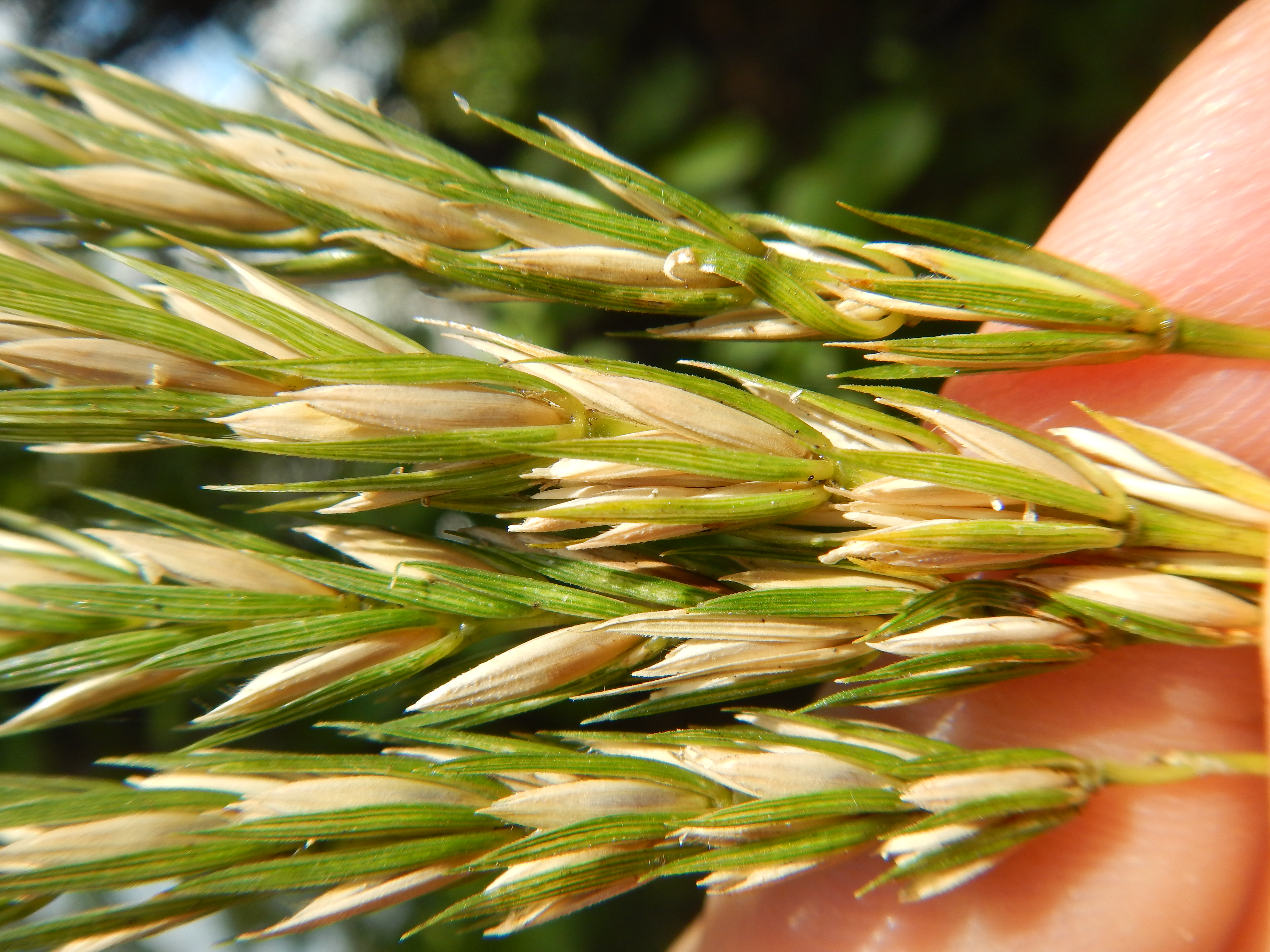
Elymus virginicus, commonly known as Virginia Wild Rye, is a cool-season native grass belonging to the Poaceae family and the tribe Triticeae — the same tribe as cultivated wheat, barley, and rye. One of the most widely distributed and ecologically valuable native grasses of eastern North America, Virginia Wild Rye is also recognized in Hawaii’s regional plant list as a functional native grass for use in appropriate landscape and restoration settings. Its most distinctive feature — as noted in its regional plant list description — is its relatively stiff, erect seed spikes, which hold the plant upright even as surrounding vegetation collapses.
Virginia Wild Rye is a shade-tolerant, clump-forming grass that thrives in the moist, partially shaded habitats of stream banks, forest margins, floodplains, and woodland edges across a vast native range spanning eastern and central North America. Unlike many native grasses that require full sun and dry to moderate conditions, Virginia Wild Rye’s preference for partial shade and moist soils makes it uniquely valuable for shaded native garden settings, riparian restorations, and woodland understory plantings where sun-loving grasses cannot succeed.
As a cool-season grass, Virginia Wild Rye grows actively during the cooler months of spring and fall, going summer-dormant in warmer climates. This growth pattern is different from warm-season grasses like Little Bluestem and Switchgrass, making Virginia Wild Rye an important complement in native garden and restoration plantings that seek year-round cover and ecological function. Its seed spikes, which persist through fall and winter, provide food for birds and visual interest in the winter landscape.
Identification
Virginia Wild Rye forms upright, loosely tufted clumps typically 2 to 3 feet tall in the vegetative state, with flowering stalks reaching up to 3 to 4 feet. The overall appearance is that of a refined, elegant grass — more delicate-looking than many prairie grasses but with distinctive, stiff, upright seed spikes that make it immediately recognizable during its summer-to-fall fruiting period. The leaves are relatively broad for a grass, flat, and somewhat drooping at the tips.
Leaves
Leaf blades are flat, 4 to 12 inches (10–30 cm) long and ¼ to ½ inch (6–12 mm) wide — relatively broad compared to many native grasses. They are soft in texture, bright green to medium green, and may droop attractively at the tips. The leaf surface has scattered fine hairs, and the base of the leaf (sheath) is smooth to slightly hairy. Auricles (small, claw-like projections at the junction of blade and sheath) are present and relatively prominent — a useful identification feature.
Seed Spikes
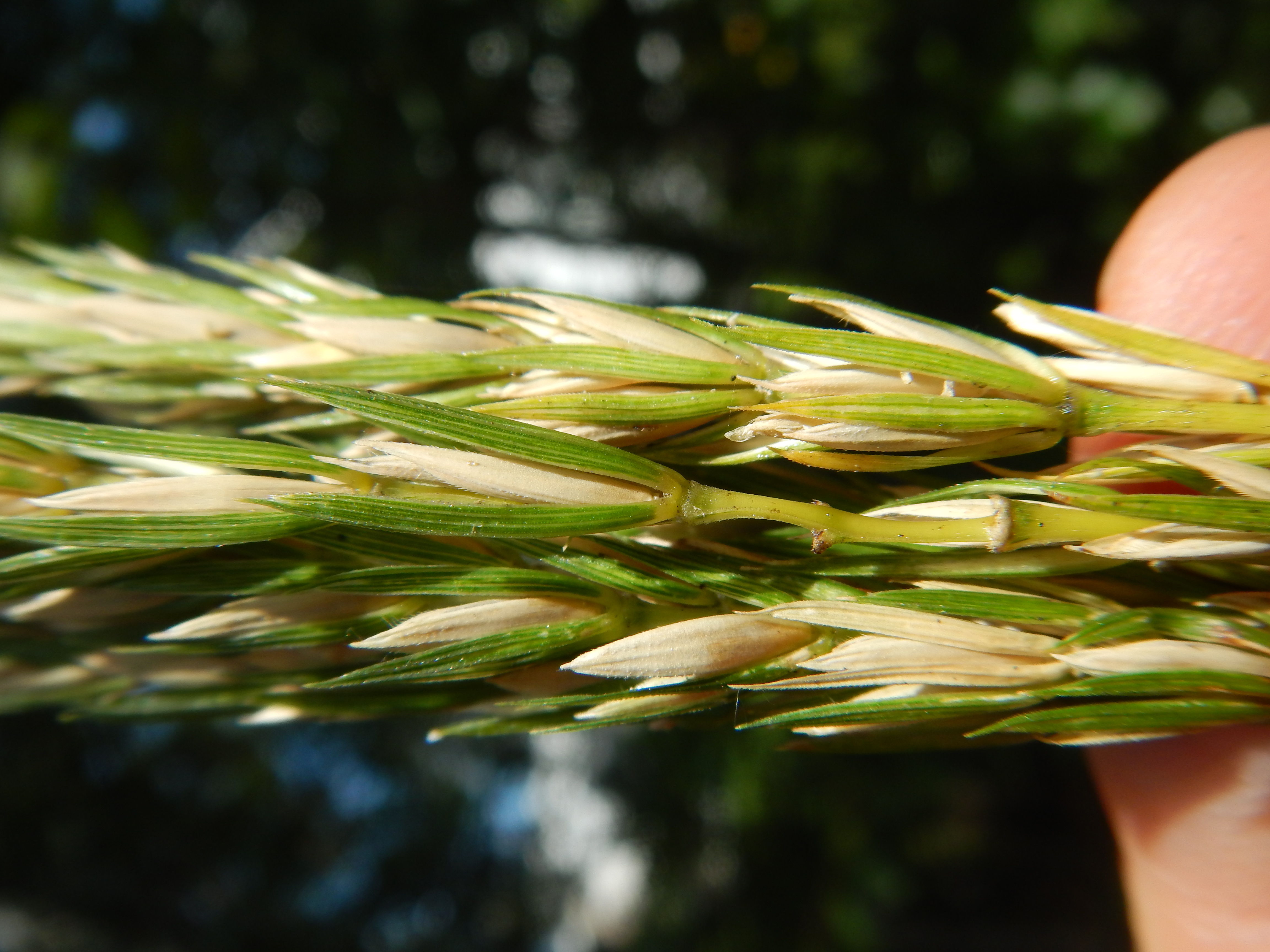
The seed spikes (spikes, not panicles) are the most distinctive and diagnostic feature of Virginia Wild Rye. They are dense, cylindrical, and — as described in its regional listing — relatively stiff and erect, holding upright on the stems rather than drooping or arching as in some related wild rye species. Each spike is 2 to 6 inches (5–15 cm) long, with paired spikelets attached at each node of the rachis (central axis). Each spikelet has prominent, awned glumes and lemmas — the awns (bristle-like projections) can be quite long, giving the spike a fringy, bristled appearance. Spikes are produced from late spring to midsummer and persist dried into winter.
Stems & Base
Stems are erect, hollow, and round in cross-section — typical grass culm structure. Nodes (joints on the stem) are often darker than the internode sections. The base of the plant forms a compact clump of fibrous roots and old leaf sheaths. Virginia Wild Rye does not spread aggressively by rhizomes, remaining as a well-behaved clump in garden settings.
Quick Facts
| Scientific Name | Elymus virginicus |
| Family | Poaceae (Grass family) — Tribe Triticeae |
| Plant Type | Native Cool-Season Bunch Grass |
| Mature Height | 3 ft (distinguished by relatively stiff, erect spikes) |
| Sun Exposure | Part Shade to Full Shade |
| Water Needs | Low to Moderate |
| Bloom / Spike Time | Late Spring – Summer (June–August) |
| Spike Color | Green, maturing to tan/gold |
| USDA Hardiness Zones | 3–9 |
Native Range
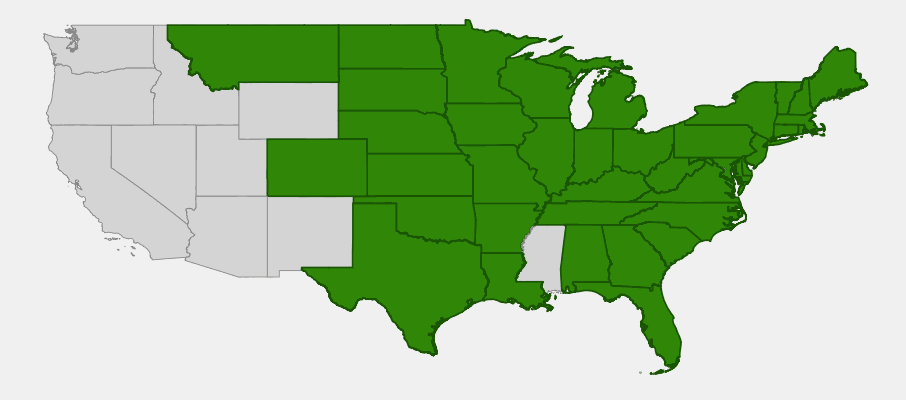
Virginia Wild Rye (Elymus virginicus) is one of the most widely distributed native grasses in North America, with a native range covering virtually all of the eastern and central United States from the Atlantic Coast to the Great Plains. It is found from southern Maine south to Florida and west to Montana, Nebraska, Kansas, Oklahoma, and Texas, occurring in virtually every state east of the Rocky Mountains. Its remarkable geographic range reflects its adaptability to diverse soil types, moisture conditions, and climate zones across the continent.
The species is most abundant and productive in moist, partially shaded habitats: stream banks, floodplain forests, woodland edges, and forest openings where soils are rich and moisture is reliable. It grows in the understory of deciduous forests and along the margins of bottomland hardwood forests where light is filtered by the canopy. This shade tolerance — unusual among grasses — allows Virginia Wild Rye to occupy ecological niches unavailable to most grass species and makes it a particularly valuable native grass for shaded landscape applications.
Virginia Wild Rye is listed in Hawaii’s regional plant resources as a functional grass. Its wide adaptability and documented performance in soil stabilization and ground cover applications have made it relevant beyond its strictly native continental US range. In managed landscape and restoration contexts in Hawaii, it can serve as a functional ground layer grass, particularly in settings that offer its preferred partial shade and moderate moisture conditions.
📋 Regional plant lists featuring Virginia Wild Rye: Hawaii
Growing & Care Guide
Virginia Wild Rye is a valuable and relatively easy-to-grow native grass for shade and partial shade garden applications. Its adaptability to low-light conditions gives it a unique role in the native garden toolkit.
Light
Virginia Wild Rye is one of the few native grasses that grows well in partial to full shade. It naturally occurs in the understory of deciduous forests and along shaded streambanks. In garden settings, it is ideal for spots that receive dappled light or morning sun with afternoon shade — conditions where most ornamental grasses fail. In deep shade, plants may grow somewhat open and lean toward available light; in partial shade, they develop the characteristic upright, tufted form with well-developed seed spikes.
Soil & Water
Virginia Wild Rye grows well in a range of soil types, from sandy loams to heavier clay soils, preferring consistently moist to slightly dry conditions. As a cool-season grass, it is most active during spring and fall; it tolerates summer heat better when provided with shade. It is not highly drought tolerant and performs best in sites with reliable soil moisture, particularly in warmer climates. Mulching with organic material helps maintain consistent moisture and moderates soil temperature. The grass does well in the moist, organic-rich soils typical of woodland garden settings.
Planting Tips
Plant in fall or early spring for best establishment as a cool-season grass. Fall planting allows root development during the cooler months before spring growth begins. Space plants 18 to 24 inches apart for a natural-looking groundcover effect, or 12 inches for a denser planting. Virginia Wild Rye integrates beautifully with woodland wildflowers — try it with Virginia Bluebells, Wild Ginger, and native ferns for a layered woodland garden floor. It also works well as a border grass along shaded pathways and garden edges.
Pruning & Maintenance
Cut back to 4–6 inches in late winter or very early spring before new cool-season growth begins. This removes old seed stalks and clears accumulated thatch. Leave plants standing through fall and winter to provide wildlife food (seed-eating birds) and visual interest. Virginia Wild Rye self-seeds modestly in suitable conditions — thin or transplant seedlings as desired. Division of established clumps every 3–4 years helps maintain vigor.
Landscape Uses
- Shaded woodland gardens — an uncommon and valuable shade-tolerant grass
- Stream bank and riparian restoration in partial shade settings
- Groundcover beneath deciduous trees where sun-loving grasses won’t grow
- Forest edge planting where woodland meets open lawn or path
- Native rain garden in partial shade locations
- Wildlife garden — seeds feed sparrows, buntings, and other birds
- Erosion control on shaded slopes and stream banks
Wildlife & Ecological Value
Virginia Wild Rye is among the most ecologically valuable native grasses for shaded woodland habitats, providing food and structural cover that complements the resources offered by sun-loving prairie grasses.
For Birds
The seeds of Virginia Wild Rye are consumed by a wide range of seed-eating songbirds, including Song Sparrows, Swamp Sparrows, Dark-eyed Juncos, American Goldfinches, and various buntings. The stiff, erect seed spikes hold the seeds elevated above ground level, making them easily accessible to foraging birds. The dense clumps also provide nesting cover for ground-nesting and low-nesting birds in woodland edge habitats.
For Mammals
White-tailed deer browse Virginia Wild Rye foliage, particularly in early spring when new growth is tender and nutritious. Small mammals, including meadow voles and white-footed mice, consume the seeds and use the dense clumps for cover. Eastern Cottontail rabbits also browse the fresh green growth.
For Pollinators
As a wind-pollinated grass, Virginia Wild Rye does not produce nectar. However, the structural habitat it provides in woodland edge settings supports diverse native bee communities that nest in the surrounding soil and utilize nearby floral resources. The grass’s presence in woodland edge communities increases overall habitat complexity and biodiversity.
Ecosystem Role
In riparian and woodland edge habitats, Virginia Wild Rye plays an important role in bank stabilization, soil building, and plant community structure. Its fibrous root system binds stream bank soils and helps prevent erosion during flood events — a particularly valuable function in the moist, often erosion-prone habitats where it naturally occurs. As a shade-tolerant grass, it fills an important ecological niche in woodland understory and edge habitats, providing the ground-layer structure that many wildlife species require but that is often lacking in shaded areas where sun-loving grasses cannot establish.
Cultural & Historical Uses
Virginia Wild Rye and related wild rye species (Elymus) were utilized by numerous Native American tribes across eastern North America. The seeds, though small and time-consuming to harvest, were gathered and used as a grain supplement — ground into flour or added to soups and stews. The Comanche, Lakota, and various eastern woodland tribes are documented as utilizing wild rye seeds as a food resource during lean periods or as part of their regular harvest of wild plant foods.
The stiff, upright stems of Virginia Wild Rye were used in basket weaving by some Native American groups in the eastern United States. The grass’s relatively long, strong culms and flexible sheath material made it a practical raw material for coiled and twined basketry traditions. Dried stems were also used as thatching material and in the construction of temporary shelters and mats.
In contemporary ecological restoration, Virginia Wild Rye has been increasingly valued as a practical grass for challenging sites — particularly shaded streambanks, woodland restoration areas, and riparian buffer plantings where few other native grasses can establish. Seed is now commercially available from native grass suppliers, and the plant features prominently in the native plant palettes for riparian restoration projects across eastern North America. Its practical value in soil stabilization, combined with its aesthetic appeal and wildlife value, has made Virginia Wild Rye one of the most widely recommended native grasses for shaded and semi-shaded landscape applications.
Frequently Asked Questions
Is Virginia Wild Rye the same as cultivated rye?
No — Virginia Wild Rye (Elymus virginicus) is a wild North American native grass, while cultivated rye (Secale cereale) is a domesticated grain crop from Central Asia. They are both in the tribe Triticeae (which includes wheat, barley, and rye), so they are distant relatives, but Virginia Wild Rye is a completely different plant from the rye grain used in rye bread and whiskey.
What makes Virginia Wild Rye different from Canada Wild Rye?
Canada Wild Rye (Elymus canadensis) and Virginia Wild Rye (Elymus virginicus) are closely related sister species, but Virginia Wild Rye is distinguished by its relatively stiff, erect seed spikes — the spikes of Canada Wild Rye are typically more nodding (drooping) and arching. Virginia Wild Rye also tends to prefer more shaded conditions and has somewhat more compact spikes than the longer, more lax spikes of Canada Wild Rye.
Can Virginia Wild Rye grow in full shade?
Virginia Wild Rye tolerates substantial shade but generally performs best in partial shade — dappled light or morning sun with afternoon shade. In deep, full shade, plants become etiolated (stretched and weak), produce fewer seed spikes, and may decline over time. Moderate shade is where it truly excels among native grasses.
Does Virginia Wild Rye self-seed aggressively?
Virginia Wild Rye self-seeds modestly in suitable conditions. In ideal shaded, moist settings, it may naturalize over time, which is desirable for woodland restoration but should be monitored in more formal garden settings. Removing seed stalks before seed maturity effectively controls self-seeding if necessary. The plant is generally well-behaved and not considered aggressively spreading.
Is Virginia Wild Rye deer resistant?
No — Virginia Wild Rye is browsed by deer, particularly in early spring when the fresh growth is tender. In high-deer-pressure areas, protective fencing may be needed for establishment. Once mature, the plant can tolerate some browsing, but repeated heavy grazing will weaken and eventually eliminate plants from a site.

Looking for a nursery that carries Virginia Wild Rye?
Browse our native plant nursery directory: Hawaii