White False Indigo (Baptisia lactea)
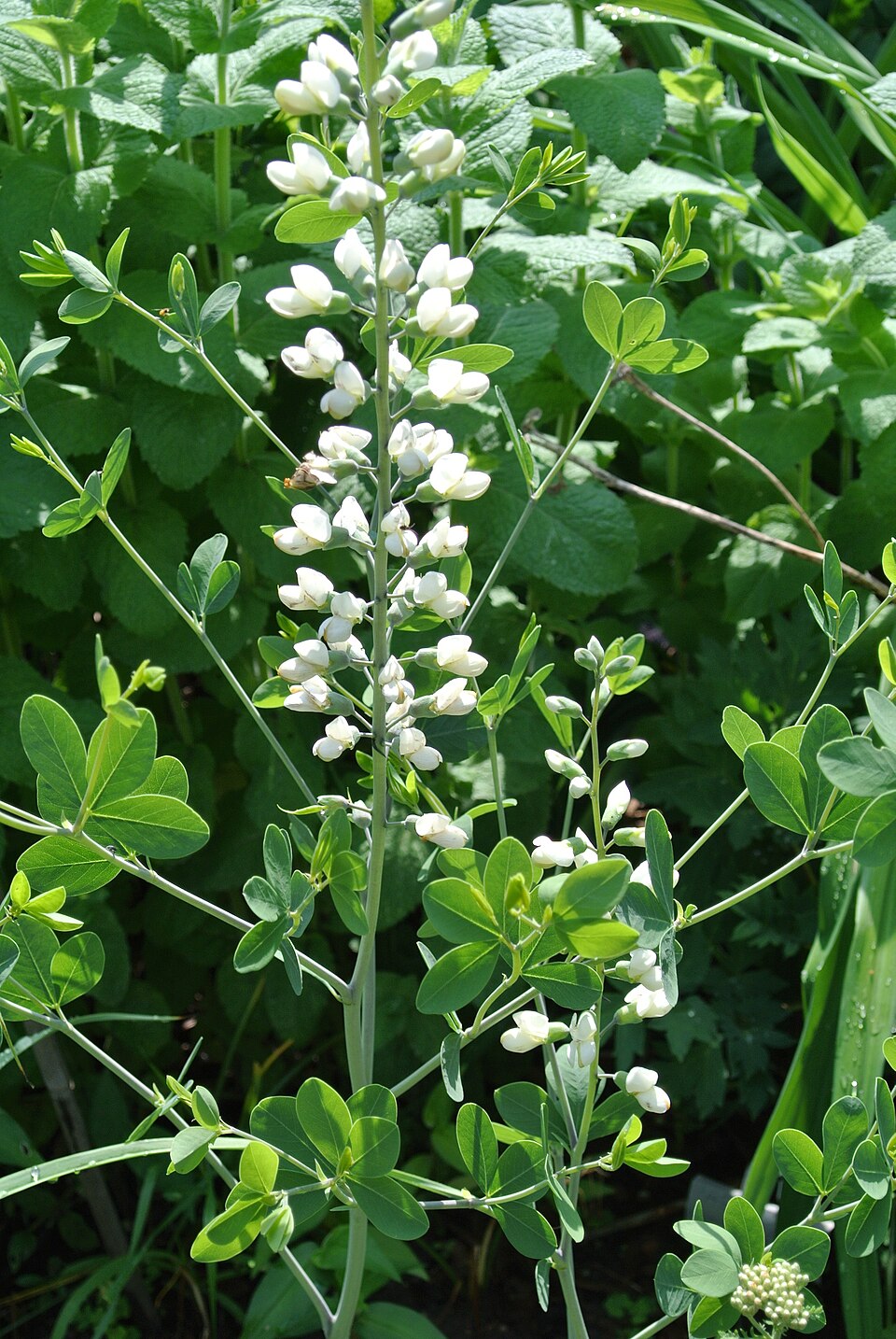
Baptisia lactea (also listed as Baptisia alba var. macrophylla), commonly known as White False Indigo or White Wild Indigo, is a bold, long-lived native perennial of the eastern prairies and open woodlands, celebrated for its rapid spring emergence, dramatic white flower stalks, and exceptional durability in the landscape. Like all members of the Baptisia genus, it is a member of the Fabaceae (legume) family — fixing nitrogen in the soil through symbiotic root bacteria — and like all Baptisia species, it has a deep, extensive root system that makes it drought-tolerant and virtually immortal once established.
White False Indigo earns its common name from the blue-green color of its foliage — distinctly blue-green, almost glaucous, reminiscent of true indigo plants — and from the fact that its leaves can be used as a substitute for true indigo (Indigofera tinctoria) in making blue dye, though with less color intensity. The “lactea” in the scientific name means “milky white,” referring to the color of the flowers. When the stalks of vivid white pea-like flowers appear in May and June, rising rapidly above the mounding foliage, the plant lives up to the second part of its common name: the floral display is genuinely vivid and dramatic.
One of the most garden-worthy of all native prairie perennials, White False Indigo combines outstanding drought tolerance, deer resistance, long bloom life, attractive seed pods, and excellent foliage texture into a package that performs year after year with virtually no maintenance. It is slow to establish from seed or small transplants, requiring 3 to 4 years to reach full flowering potential, but once established it is essentially permanent — a garden asset that improves with each passing decade.
Identification
White False Indigo forms a substantial, shrub-like mound of blue-green foliage 3 to 4 feet tall and equally wide in mature specimens. The plant is unique in that it dies back completely to the ground each winter and re-emerges in early spring, sending up its distinctive blue-green stems with remarkable speed. By the time of peak bloom in late May, the plant has already built impressive volume.
Foliage
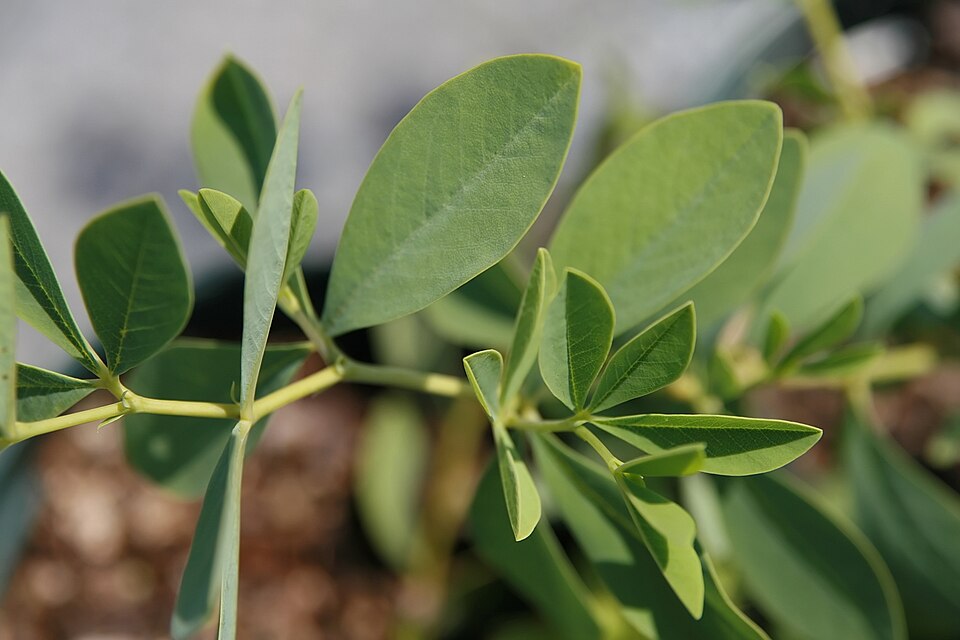
The leaves are compound, with three oval leaflets arranged palmate-fashion (like a three-leaf clover) on each leaf. Individually, the leaflets are 1 to 3 inches long, oval to obovate, and distinctly blue-green — almost gray-green — in a color that is unique and immediately eye-catching in the garden. The entire plant has this blue-green cast, including the stems, which makes it an attractive foliage plant even before and after flowering. The leaves are smooth and somewhat thick. By midsummer, the foliage expands into a large, dense mound that provides excellent structural interest as a garden backdrop.
Flowers
The flowers are classic legume blossoms — pea-shaped, approximately ½ inch long — arranged in tall, upright racemes (stalks) that rise above the foliage and can reach 12 to 18 inches in length. The flowers are pure white, occasionally with a faint creamy tint, opening from the base of the raceme upward over 2 to 3 weeks. Multiple racemes are produced by a mature plant simultaneously, creating a dramatic display of white spires above the mounding blue-green foliage. Bloom time is May to June in Indiana and Ohio.
Fruit
The seed pods are inflated, papery, black when ripe, about 1 to 2 inches long, and contain loose, rattling seeds — giving rise to the occasional use of dried Baptisia pods as rattles or noise-makers. The pods are ornamentally attractive and persist on the plant through fall and winter, providing architectural interest and food for wildlife. When dry, the seeds rattle audibly in the wind — a charming characteristic.
Quick Facts
| Scientific Name | Baptisia lactea (syn. B. alba var. macrophylla) |
| Family | Fabaceae (Legume) |
| Plant Type | Herbaceous Perennial |
| Mature Height | 3–5 ft |
| Sun Exposure | Full Sun to Part Shade |
| Water Needs | Moderate |
| Bloom Time | May – June |
| Flower Color | Pure white |
| Foliage Color | Blue-green (distinctive) |
| Deer Resistant | Yes (strongly) |
| Nitrogen Fixing | Yes (root nodules) |
| USDA Hardiness Zones | 4–9 |
Native Range
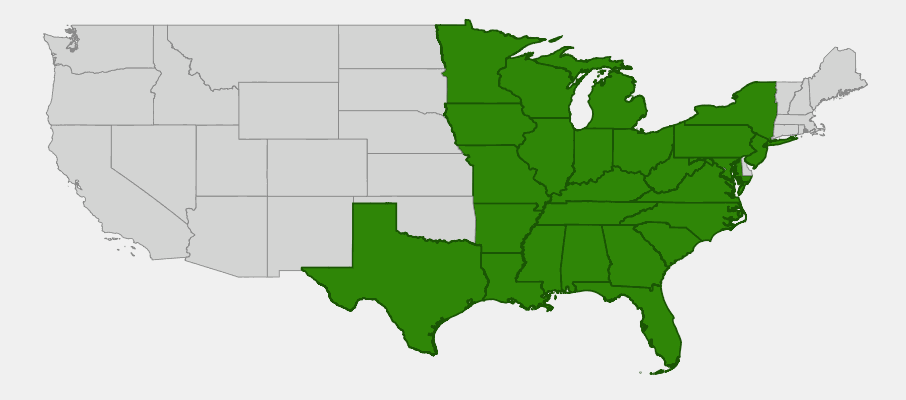
White False Indigo is native to the interior of the eastern United States, with its core range centered in the prairie states and the Ohio Valley. It is most abundant in Indiana, Ohio, Illinois, Missouri, Kansas, Iowa, Minnesota, and south to Georgia and Mississippi. It typically occurs in moist to dry prairies, open woodland clearings, and woodland edges — sites with full to part sun and moderate moisture. Its distribution broadly overlaps with the tall-grass and mixed-grass prairie zones of the interior, reflecting its adaptation to open, sunny conditions with seasonally dry summers.
In Indiana and Ohio, White False Indigo was historically associated with the prairie openings and savanna communities that dotted the presettlement landscape. With the conversion of most prairie habitat to agriculture, native populations of White False Indigo have become uncommon in the wild in both states, though it persists in prairie remnants, along railroad right-of-ways, and on steep slopes and rocky outcrops that escaped plowing. It is now far more commonly encountered as a cultivated garden plant than as a wild species in these states.
Despite its limited natural occurrence in Indiana and Ohio today, White False Indigo is ecologically well-suited to both states and is considered an appropriate native plant for garden use throughout the region. Its deep root system allows it to access moisture and nutrients from deep soil horizons, making it naturally adapted to the periodic drought conditions of the Midwest.
📋 Regional plant lists featuring White False Indigo: Indiana & Ohio
Growing & Care Guide
White False Indigo is one of the most truly low-maintenance native perennials available for Midwest gardens. Once established, it is essentially self-sufficient — drought-tolerant, deer-resistant, pest-free, and long-lived without any significant care requirements. The primary challenge is patience during the establishment period.
Light
White False Indigo performs best in full sun but tolerates light part shade (3 to 5 hours of direct sun). In full sun, it forms a dense, upright mound and produces the most abundant flower display. In part shade, plants may be more open and floppy, and flowering will be somewhat reduced. In deep shade, the plant will survive but not thrive — it is fundamentally a prairie plant adapted to open, sunny conditions.
Soil & Water
White False Indigo is remarkably adaptable to soil conditions. It grows well in average, well-drained garden soils and tolerates clay, sandy, and rocky soils that would challenge most perennials. Its nitrogen-fixing root bacteria allow it to thrive in nutrient-poor soils where other plants would fail. It does not tolerate poorly drained, waterlogged soils. Once established (after 2 to 3 years), it is quite drought-tolerant — its deep root system (reaching 6 feet or more) accesses moisture and nutrients from deep soil layers. Moderate water needs in the first 2 years; low to moderate thereafter.
Planting Tips
Plant in spring from container stock. White False Indigo has a deep taproot and resents transplanting once established — choose the permanent location carefully and plant correctly the first time. Dig a generous planting hole and avoid disturbing the roots more than necessary. Do not over-fertilize — in rich soils or with heavy fertilization, the plant may become floppy. Plant in groups of 3 to 5 for the most dramatic display. Do not move established plants; the taproot runs very deep and transplanting mature specimens almost always fails.
Pruning & Maintenance
After flowering, the seed pods are ornamentally attractive and can be left through fall and winter for interest and wildlife value. Cut the entire plant back to the ground in late fall or early spring. No division or renewal pruning is needed — unlike many perennials that decline in the center and need periodic division, White False Indigo grows stronger and more floriferous each year without intervention. It is essentially permanent once established. No fertilizer, no division, no spraying: plant it and let it grow.
Landscape Uses
- Prairie and meadow planting — a foundational prairie perennial
- Drought-tolerant border — excellent for low-water-use landscapes
- Deer-resistant planting — one of the most reliably ignored by deer
- Nitrogen-fixing companion plant — improves adjacent soil fertility
- Four-season interest: spring emergence, late spring bloom, summer foliage mound, fall seed pods, winter structure
- Pollinator garden — significant early-season bee resource
- Foundation planting in well-drained, sunny sites
Wildlife & Ecological Value
White False Indigo provides substantial ecological value, particularly for pollinators during its spring bloom period, and its seed pods support wildlife through fall and winter.
For Pollinators
Baptisia species are extremely important native bee plants. The pea-shaped flowers are adapted for bee pollination by larger bees (bumblebees in particular) that are strong enough to push open the keel petal to access the nectar. White False Indigo supports numerous native bee species including Eastern Bumblebee, Two-spotted Bumblebee, Brown-belted Bumblebee, and various specialist bees in the genera Xylocopa (carpenter bees) and Osmia. Several specialist bees in the genera Ancylandrena and Pseudopanurgus are obligate associates of Baptisia, depending on the genus as their primary pollen source. Protecting wild Baptisia populations is critical for these specialist bees.
For Birds
The dried seed pods are consumed by several bird species including American Goldfinch, Song Sparrow, and Indigo Bunting. The dense mounding foliage provides nesting cover for ground-nesting and shrub-nesting species in prairie and meadow settings.
For Invertebrates
White False Indigo serves as a larval host plant for several butterfly species, including Wild Indigo Duskywing (Erynnis baptisiae) — a species almost entirely dependent on Baptisia species for larval development. Frosted Elfin butterfly also uses Baptisia as a larval host in parts of its range. These specialist species cannot persist in landscapes that lack native Baptisia populations, making every planted clump an ecological lifeline for these butterflies.
Ecosystem Role
As a nitrogen-fixing legume, White False Indigo improves the soil for surrounding plants by converting atmospheric nitrogen into plant-available forms through its root nodule bacteria. This is particularly valuable in the often nitrogen-poor soils of restored prairie plantings. Its deep root system improves soil structure, increases water infiltration, and contributes organic matter to deep soil horizons over decades. Like other prairie legumes, it is a foundational species for the prairie ecosystem — both ecologically functional and visually spectacular.
Cultural & Historical Uses
The Baptisia genus has a long history of medicinal and utilitarian use among eastern North American indigenous peoples. Cherokee healers used preparations of Baptisia root to treat a variety of conditions, including toothache (as a mouthwash), fevers, and infections. The compounds responsible for this efficacy — quinolizidine alkaloids and isoflavones — are now known to have genuine antimicrobial and immunostimulatory activity, providing a scientific basis for these traditional applications. Baptisia extract (particularly from Baptisia tinctoria, Yellow False Indigo) was used in 19th-century American herbal medicine as an antibacterial and immune-stimulating agent, and is still used in some European herbal preparations today.
The “false indigo” common name derives from the use of Baptisia leaves as a substitute for true indigo (Indigofera tinctoria) in making blue dye. While the dye yield is inferior to true indigo, it was used by both indigenous peoples and early European-American settlers in areas where true indigo was not available. The blue-green color of the fresh leaves makes the connection to blue dye production visually intuitive. The Cherokee, Ojibwe, and other nations extracted blue dye from the plant for use in textile dyeing and body paint.
In modern horticulture, White False Indigo has become highly fashionable as part of the resurgent interest in native prairie perennials for sustainable landscaping. Its durability, deer resistance, drought tolerance, and long season of interest make it a recommended species by virtually every native plant advocacy organization in the Midwest. The bold, blue-green foliage mound functions as an outstanding structural element in garden design for four to five months of the growing season, comparable in visual weight and texture to a small shrub — a contribution that perennials with fine or narrow foliage cannot provide.
Frequently Asked Questions
Why is White False Indigo slow to establish?
White False Indigo invests heavily in its deep taproot system during the first 2 to 3 years after planting, with relatively modest above-ground growth during this period. Once the deep root system is established (typically by year 3 or 4), the plant begins producing its characteristic large mound and abundant flowering. This is normal behavior and not a sign of a problem. Do not transplant or divide during the establishment period — let the root system develop undisturbed.
Is White False Indigo toxic?
Yes, all parts of the plant contain quinolizidine alkaloids that are toxic if ingested in significant quantities, causing vomiting, diarrhea, and in severe cases more serious effects. This toxicity is one reason deer generally avoid it. The plant should not be consumed by humans or livestock. Handle with normal garden hygiene and keep away from children who might be attracted by the rattle of the seed pods.
Will White False Indigo spread aggressively?
No. Unlike some prairie natives that spread by rhizomes, White False Indigo forms a clump that expands slowly from a central crown and does not spread aggressively. It may self-seed modestly in favorable conditions but is not weedy. Its non-invasive character makes it ideal for contained garden beds and mixed perennial plantings.
What is the difference between White and Blue False Indigo?
Baptisia lactea (White False Indigo) has pure white flowers and somewhat larger, more blue-green foliage than Baptisia australis (Blue False Indigo), which has beautiful blue-violet flowers. Both are native to the Midwest and are outstanding garden perennials. Blue False Indigo (B. australis) is more commonly grown and more widely available in the nursery trade; White False Indigo is somewhat less common but equally garden-worthy. Both can be grown together for a dramatic early summer bloom combination.
How do I support the floppy stems?
In full sun and average to lean soil, White False Indigo typically stands upright without support. In richer soils or part shade, the stems can become taller and somewhat lax. Provide a grow-through support hoop in early spring before the stems exceed 12 inches, or simply allow the plant to flop slightly — in naturalistic settings, this can look attractive. Avoiding rich soil and ensuring full sun are the most effective preventive measures.