Silky Dogwood (Cornus amomum)
Cornus amomum, commonly known as Silky Dogwood, Silky Cornel, or Swamp Dogwood, is a distinctive native deciduous shrub that brings exceptional ecological value and subtle beauty to wetland edges, stream banks, and moist woodland areas throughout much of the eastern United States. This member of the Cornaceae (dogwood) family is named for the silky-soft hairs that cover the undersides of its leaves, giving them a distinctive silvery appearance that catches and reflects light beautifully in the landscape.
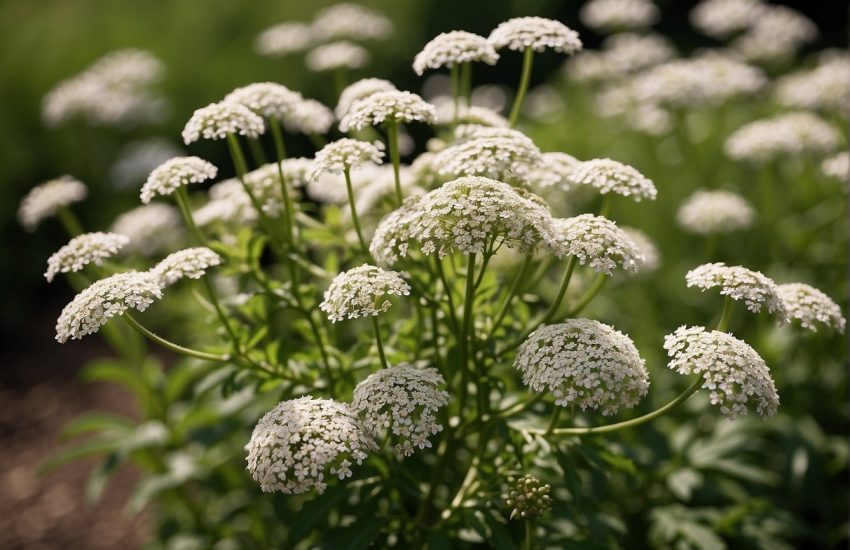
Growing naturally in consistently moist to wet soils from southern Canada to the Gulf States, Silky Dogwood forms dense thickets 6 to 10 feet tall that provide outstanding wildlife habitat and erosion control. In late spring to early summer, the shrub produces flat-topped clusters of small, creamy-white flowers that attract numerous pollinators, followed by blue-white drupes that are eagerly consumed by birds and mammals. Unlike the more familiar Flowering Dogwood with its showy bracts, Silky Dogwood’s flowers are small and numerous, creating a delicate, lacy appearance that complements rather than dominates the landscape.
This hardy and adaptable shrub is an excellent choice for rain gardens, bioswales, streamside plantings, and any area with consistently moist soil. Its tolerance of seasonal flooding, dense growth habit, and exceptional value to wildlife make it indispensable for riparian restoration projects and naturalistic landscapes throughout its extensive native range.
Identification
Silky Dogwood typically grows as a multi-stemmed shrub reaching 6 to 10 feet in height and often forming colonies through root suckering. The overall form is upright and somewhat open, with reddish-brown to gray-brown stems that become more prominent in winter after leaf drop.
Bark
Young stems are smooth and reddish-brown, becoming gray-brown with age. The bark on older stems develops shallow fissures but remains relatively smooth. In winter, the colorful stems provide landscape interest and are easy to identify among other shrubs.
Leaves
The leaves are opposite, simple, and oval to elliptical, measuring 2 to 4 inches long and 1 to 3 inches wide. The most distinctive feature is the underside of the leaves, which is covered with dense, silky white to grayish hairs that give the plant its common name. The upper leaf surface is dark green and smooth, while the underside appears silvery or grayish-white. Leaf margins are entire (smooth), and the prominent veining curves toward the leaf tip in the characteristic pattern of all dogwoods. Fall color is typically unremarkable, with leaves turning yellowish before dropping.
Flowers & Fruit
Flowers appear from May through June in flat-topped terminal clusters (cymes) that are 2 to 3 inches across. Each individual flower is small — about ¼ inch in diameter — with four creamy-white petals. Unlike Flowering Dogwood, these are true flowers without the large, showy white bracts. The overall effect is delicate and understated, with the numerous small flowers creating a lacy, cream-colored display that attracts various pollinators.
The fruit ripens in late summer to early fall as small, round drupes about ¼ inch in diameter. The berries are initially white or pale blue, becoming darker blue to blue-white at maturity. They are borne in loose clusters and are readily consumed by birds, often being completely stripped from the plant by early fall.
Habitat & Growth Form
Silky Dogwood naturally forms dense thickets in moist to wet areas, often growing alongside other moisture-loving shrubs like elderberry, ninebark, and willow species. The plant spreads by root suckers, creating colonies that provide excellent erosion control along stream banks and in wetland edges.
Quick Facts
| Scientific Name | Cornus amomum |
| Family | Cornaceae (Dogwood) |
| Plant Type | Deciduous Shrub |
| Mature Height | 6–10 ft |
| Sun Exposure | Part Shade to Full Shade |
| Water Needs | Moderate to High |
| Bloom Time | May – June |
| Flower Color | Creamy White |
| USDA Hardiness Zones | 4–8 |
Native Range
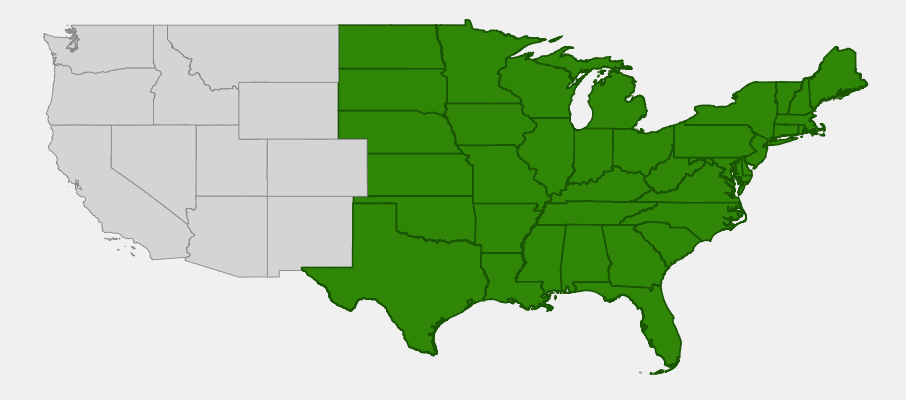
Silky Dogwood has an extensive native range across eastern and central North America, naturally occurring from southern Canada south to the Gulf of Mexico and from the Atlantic Coast west to the Great Plains. This wide distribution demonstrates the species’ remarkable adaptability to diverse climatic conditions, though it consistently requires access to moisture throughout its range.
The species is most abundant in the Great Lakes region and the eastern deciduous forests, where it thrives in the consistently moist soils of stream corridors, pond edges, and forested wetlands. It extends southward through the Appalachian Mountains and into the coastal plain, where it can be found in bottomland hardwood forests and along the edges of rivers and streams.
In the western portions of its range, Silky Dogwood follows river systems and occurs primarily in riparian corridors where moisture levels remain adequate. The species shows remarkable ecological flexibility, growing from near sea level in coastal areas to moderate elevations in mountainous terrain, always associated with reliable moisture sources.
📋 Regional plant lists featuring Silky Dogwood: North Carolina & South Carolina
Growing & Care Guide
Silky Dogwood is an excellent choice for challenging wet sites where many other shrubs struggle. Its natural preference for moist to wet soils and tolerance of seasonal flooding make it invaluable for rain gardens, bioswales, and streamside plantings.
Light
This dogwood performs best in partial shade to full shade, making it ideal for understory plantings and areas that receive limited direct sunlight. While it can tolerate some morning sun, it prefers protection from hot afternoon sun, especially in warmer climates. In deep shade, growth may be more open, but the plant will still flower and fruit reliably.
Soil & Water
Silky Dogwood requires consistently moist to wet soil and will not thrive in dry conditions. It naturally grows in heavy clay, loam, and even sandy soils as long as moisture levels remain high. The plant tolerates seasonal flooding and brief periods of standing water, making it excellent for areas with poor drainage or regular inundation. Soil pH is not critical — the species grows well in slightly acidic to neutral conditions.
Planting Tips
Plant container stock in spring or fall when temperatures are moderate. Choose the wettest, most poorly-drained area of your property for best results. Space plants 6–8 feet apart if creating a screen or hedge, or plant singly in smaller gardens where the spreading habit can be managed. Mulch around newly planted specimens to retain moisture, though established plants rarely need supplemental watering in appropriate sites.
Pruning & Maintenance
Silky Dogwood requires minimal pruning. Remove dead, damaged, or crossing branches in late winter. If a more compact form is desired, prune immediately after flowering to avoid removing flower buds for the following year. The plant naturally spreads by root suckers — remove these regularly if you want to prevent colony formation. Older colonies can be renovated by cutting all stems to 6 inches in late winter; new growth will emerge vigorously from the root system.
Landscape Uses
Silky Dogwood excels in challenging wet sites:
- Rain gardens and bioswales for stormwater management
- Riparian restoration along streams, ponds, and wetlands
- Erosion control on slopes and banks with seepage
- Wildlife habitat creation in wet areas
- Privacy screening in moist, shaded locations
- Naturalized plantings in low-lying, wet areas
- Foundation plantings near downspouts and drainage areas
Wildlife & Ecological Value
Silky Dogwood provides exceptional ecological value, supporting wildlife through multiple seasons and playing a crucial role in riparian and wetland ecosystems.
For Birds
The blue-white berries are consumed by over 40 species of birds, including Wood Ducks, Wild Turkeys, Northern Cardinals, American Robins, Cedar Waxwings, and various vireos, thrushes, and woodpeckers. The dense, thicket-forming growth habit provides excellent nesting sites for shrubland birds such as Gray Catbirds, Brown Thrashers, and American Goldfinches. The shrub’s preference for wetland edges makes it particularly valuable for waterfowl and other water-associated bird species.
For Mammals
White-tailed deer browse the twigs and leaves, while various small mammals including chipmunks, squirrels, and mice consume the berries. Bears occasionally eat the fruit where ranges overlap. The dense thicket growth provides excellent cover for rabbits, ground-dwelling small mammals, and serves as corridor habitat connecting other natural areas.
For Pollinators
The small, creamy-white flowers attract a variety of native pollinators including native bees, beneficial wasps, flies, and small butterflies. While individual flowers are not particularly showy, the abundant clusters provide significant nectar resources during the late spring and early summer bloom period when many wetland-associated pollinators are most active.
Ecosystem Role
Silky Dogwood plays a critical role in riparian and wetland ecosystems by helping stabilize stream banks and wetland edges with its extensive root system. The plant’s ability to form dense colonies creates important habitat structure in these sensitive areas. Its leaf litter decomposes relatively quickly, contributing nutrients to the soil and supporting the complex food webs of wetland environments. As a native understory species, it helps maintain the structural diversity that supports healthy ecosystem function.
Cultural & Historical Uses
Silky Dogwood, like other native dogwood species, has been used by Indigenous peoples across its range for various practical and medicinal purposes. Different tribal groups developed distinct uses for the plant, taking advantage of its reliable presence in wetland areas and its useful properties.
The inner bark was used by some Native American groups to create fiber for cordage and basketry. The straight, flexible stems were valued for making arrows, tool handles, and small implements. Cherokee and other southeastern tribes used dogwood bark medicinally, typically as an astringent for treating diarrhea, fever, and skin conditions, though specific traditional uses of Silky Dogwood versus other dogwood species are not always clearly distinguished in historical records.
Early European settlers learned many uses for native dogwoods from Indigenous peoples. The bitter, astringent bark was used in folk medicine as a substitute for quinine during times when the imported medicine was unavailable. The bark was typically harvested in spring when the sap was rising, then dried and prepared as teas or tinctures.
In modern times, Silky Dogwood is primarily valued for its ecological and landscape functions rather than utilitarian uses. Wildlife managers and restoration specialists recognize it as one of the most important native shrubs for riparian habitat creation and wetland restoration projects. Its ability to quickly establish dense, erosion-controlling colonies makes it invaluable for stream bank stabilization and constructed wetland projects.
Frequently Asked Questions
How can I tell Silky Dogwood apart from other dogwood species?
The silky, grayish-white hairs on the leaf undersides are the key identifying feature — run your finger along the back of a leaf and you’ll feel the soft, silky texture. The flat-topped flower clusters and blue-white berries also distinguish it from Flowering Dogwood, which has large white bracts and red berries.
Will Silky Dogwood grow in dry soil?
No. This species requires consistently moist to wet soil and will not establish or thrive in well-drained or dry conditions. If you need a dogwood for dry sites, consider Rough-leaved Dogwood (Cornus drummondii) or Flowering Dogwood instead.
How fast does Silky Dogwood grow?
It’s a moderate to fast grower, typically adding 1–2 feet per year under favorable conditions. Growth is fastest in the first few years after planting, and the plant will begin spreading by root suckers within 2–3 years if conditions are suitable.
Can I control the spreading habit?
Yes. Regular removal of root suckers will keep the plant as a single shrub rather than allowing it to form colonies. However, in appropriate sites like rain gardens or naturalized areas, the spreading habit is actually beneficial for erosion control and wildlife habitat.
Does Silky Dogwood have good fall color?
No, fall color is generally unremarkable — leaves typically turn yellowish before dropping. This species is grown primarily for its ecological value, flowers, berries, and ability to thrive in challenging wet conditions rather than for ornamental fall display.

Looking for a nursery that carries Silky Dogwood?
Browse our native plant nursery directory: North Carolina · South Carolina