Carolina Hemlock (Tsuga caroliniana)
Tsuga caroliniana, commonly known as Carolina Hemlock or Carolina Hemlock-spruce, is a rare and exceptionally beautiful coniferous tree native to the high-elevation forests of the southern Appalachian Mountains. This distinctive member of the Pinaceae (pine) family represents one of North America’s most geographically restricted conifers, found naturally only in scattered populations along rocky ridges, cliff faces, and cool, moist gorges from southwestern Virginia to northern Georgia. With its graceful pyramidal form, lustrous dark green foliage, and remarkable tolerance for challenging growing conditions, Carolina Hemlock stands as one of the most elegant and resilient evergreen trees in the eastern United States.
Distinguished from its more common relative, Eastern Hemlock (Tsuga canadensis), by its spirally arranged needles rather than flattened sprays, Carolina Hemlock creates a distinctly different visual texture that has made it highly prized by horticulturists and landscape designers. The needles radiate from all sides of the twigs, giving branches a full, bottle-brush appearance that provides exceptional density and screening value. Small, pendant cones add ornamental interest, hanging gracefully from branch tips like tiny brown ornaments throughout much of the year.
Despite its limited natural range and small wild populations, Carolina Hemlock has proven remarkably adaptable in cultivation, thriving in a wider variety of conditions than its native habitat might suggest. Its exceptional tolerance for both heat and cold, combined with good resistance to urban pollution and the hemlock woolly adelgid that threatens other hemlock species, makes it an increasingly valuable tree for sustainable landscaping throughout much of the eastern United States. For gardeners seeking a distinctive evergreen with exceptional wildlife value and year-round beauty, Carolina Hemlock offers unmatched elegance and ecological benefits.
Identification
Carolina Hemlock typically grows as a medium to large evergreen tree, reaching 30 to 70 feet tall with a trunk diameter of 1 to 3 feet at maturity. In optimal conditions, exceptional specimens can reach heights of over 100 feet. The tree maintains a distinctly pyramidal form when young, often becoming more open and irregular with age, especially when growing in challenging rocky sites. The crown is typically dense and symmetrical, with slightly drooping branches that create an elegant, graceful silhouette.
Bark
The bark of young Carolina Hemlocks is smooth and gray-brown, becoming deeply furrowed with age into narrow, scaly ridges separated by reddish-brown furrows. Mature bark develops a distinctive plated appearance with flat, scaly plates that can be quite thick on old trees. The inner bark is reddish-brown and contains significant amounts of tannins, which were historically used for leather tanning. The bark pattern helps distinguish Carolina Hemlock from Eastern Hemlock, which has more regularly furrowed bark.
Needles
The most distinctive feature of Carolina Hemlock is its needle arrangement. Unlike Eastern Hemlock, which has flattened sprays of needles, Carolina Hemlock needles radiate from all sides of the twigs in a spiral pattern, creating a distinctive bottle-brush or cylindrical appearance. Individual needles are ½ to ¾ inch long, flat, and linear with rounded tips. They are glossy dark green above with two distinct white stomatal bands beneath, creating an attractive two-toned effect when branches move in the wind.
The needles are attached to twigs by small petioles (stalks) and leave distinctive raised scars when they fall, creating a bumpy texture on older twigs. Fresh needles have a pleasant, mildly resinous fragrance when crushed, and they persist on the tree for 3-6 years before dropping naturally.
Cones & Seeds
Carolina Hemlock produces both male and female cones on the same tree (monoecious). Male cones are small, yellowish, and inconspicuous, releasing pollen in late spring. Female cones are much more ornamental — small (¾ to 1¼ inches long), egg-shaped, and pendant, hanging from branch tips on short stalks. Young cones are green or purplish, maturing to brown over a single growing season.
The mature cones open in fall to release small, winged seeds that are dispersed by wind. Each cone typically contains 20-40 seeds. The empty cone shells often persist on trees through winter, adding textural interest to the winter landscape. Good seed years occur every 3-4 years, with lighter production in intervening years.
Winter Identification
Carolina Hemlock is easily distinguished in winter by its evergreen nature, spiral needle arrangement, and the presence of small pendant cones. The overall pyramidal form and slightly drooping branch tips create a distinctive silhouette that remains attractive throughout the winter months. Snow often clings beautifully to the dense foliage, creating spectacular winter displays.
Quick Facts
| Scientific Name | Tsuga caroliniana |
| Family | Pinaceae (Pine) |
| Plant Type | Evergreen Coniferous Tree |
| Mature Height | 30–70 ft |
| Sun Exposure | Full Sun to Full Shade |
| Water Needs | Moderate |
| Bloom Time | April – May (cones) |
| Flower Color | Yellowish (male cones) |
| USDA Hardiness Zones | 4–7 |
Native Range
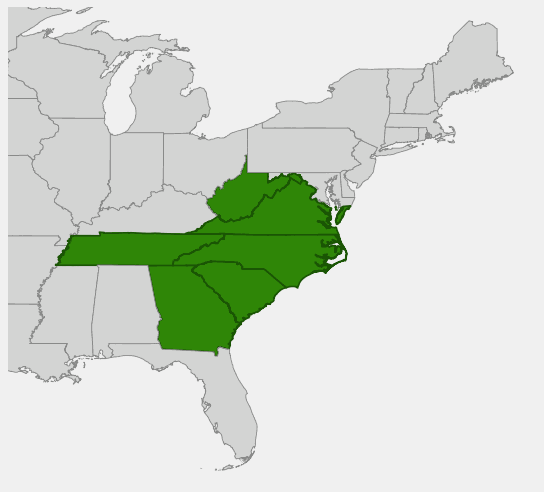
Carolina Hemlock has one of the most restricted natural distributions of any North American conifer, occurring only in scattered populations throughout the southern Appalachian Mountains. Its native range extends from southwestern Virginia south through western North Carolina, eastern Tennessee, northwestern South Carolina, and northern Georgia, with a few isolated populations in western Virginia and West Virginia. This limited distribution encompasses an area of only about 250 miles north to south, making it one of the most geographically restricted tree species in eastern North America.
Within this range, Carolina Hemlock typically grows on rocky ridges, cliff faces, and steep slopes at elevations between 2,000 and 4,500 feet, though it can occasionally be found as low as 1,200 feet in cool, protected gorges. The species shows a strong preference for north- and east-facing slopes where it receives protection from hot afternoon sun and benefits from cooler, more consistent moisture conditions. It often grows in association with other Appalachian specialty species including Rhododendron maximum, Mountain Laurel (Kalmia latifolia), and various oak species adapted to challenging mountain conditions.
The fragmented nature of Carolina Hemlock populations reflects both its specific habitat requirements and the geological history of the southern Appalachians. Many populations are small and isolated, making the species vulnerable to local extinction from natural disasters, climate change, or human disturbance. Conservation efforts have focused on protecting existing populations and establishing seed collections to preserve the genetic diversity of this remarkable tree.
📋 Regional plant lists featuring Carolina Hemlock: North Carolina & South Carolina
Growing & Care Guide
Despite its reputation as a specialized mountain species, Carolina Hemlock is surprisingly adaptable in cultivation and can thrive in a much wider range of conditions than its limited natural habitat suggests. The key to success is providing good drainage and avoiding excessively hot, dry conditions.
Light
Carolina Hemlock is exceptionally versatile in its light requirements, growing well in everything from full sun to full shade. In full sun, it develops a denser, more compact form with excellent needle color, while in shade it becomes more open and may grow taller. This flexibility makes it valuable for a wide range of landscape situations. In hot southern climates, some afternoon shade is beneficial to prevent heat stress, especially when young.
Soil & Water
The most critical requirement for Carolina Hemlock is well-draining soil. The species is remarkably tolerant of different soil types, from sandy loams to clay, as long as drainage is adequate. It performs best in slightly acidic to neutral soils (pH 5.5-7.0) but can adapt to a wider range. Once established, Carolina Hemlock shows good drought tolerance, though consistent moderate moisture produces the best growth. Avoid waterlogged soils, which can lead to root rot and decline.
Planting Tips
Plant Carolina Hemlock in spring or fall when temperatures are moderate. Choose a location with morning sun and some protection from hot afternoon winds in warmer climates. Space trees according to their intended use — 15-20 feet apart for screening, or give specimen trees 25-30 feet to develop their full natural form. When planting, dig a hole twice as wide as the root ball but no deeper, and backfill with native soil. Water thoroughly and maintain consistent moisture through the first growing season.
Pruning & Maintenance
Carolina Hemlock requires minimal pruning to maintain its naturally attractive form. Remove dead, damaged, or crossing branches in late winter or early spring. Light shearing can be done if formal shapes are desired, but the natural form is generally preferable. The tree is naturally self-pruning of lower branches as it matures. Mulch around the base with 2-3 inches of organic material to conserve moisture and suppress weeds, but keep mulch away from the trunk base.
Landscape Uses
Carolina Hemlock’s unique characteristics make it valuable for many landscape applications:
- Specimen tree — exceptional year-round beauty and distinctive form
- Evergreen screen — dense growth provides excellent privacy
- Windbreak — excellent wind resistance and cold tolerance
- Slope stabilization — deep roots help prevent erosion
- Wildlife habitat — provides year-round cover and food for birds
- Cool, shaded areas — excellent screening for patios and outdoor spaces
- Urban landscapes — good pollution tolerance for city conditions
- Rock gardens — naturalistic plantings among boulders and outcrops
Wildlife & Ecological Value
Carolina Hemlock provides exceptional habitat value, supporting numerous wildlife species throughout the year with its dense evergreen canopy, seed production, and structural diversity.
For Birds
The dense, evergreen foliage of Carolina Hemlock provides critical winter shelter for numerous bird species, including chickadees, nuthatches, kinglets, and various finches. The small seeds are consumed by Pine Siskins, American Goldfinches, Dark-eyed Juncos, and various sparrow species. Red Squirrels cache the seeds for winter food, and the dense branching structure provides excellent nesting sites for birds ranging from small songbirds to occasional raptors. The tree’s thick foliage offers thermal protection during harsh winter weather, making it particularly valuable in mountain environments.
For Mammals
White-tailed Deer browse Carolina Hemlock foliage, particularly younger growth, though they generally prefer other food sources when available. Red Squirrels and Flying Squirrels consume the seeds and may nest in the dense foliage. Black Bears occasionally climb larger specimens to access bird nests or escape danger. The thick canopy provides shelter for various small mammals during extreme weather events.
For Pollinators
While Carolina Hemlock is wind-pollinated and does not produce nectar, the abundant pollen released by male cones in spring provides a food source for various beneficial insects. The tree’s foliage also hosts several species of moth caterpillars, including those of the Hemlock Looper and various geometrid moths, which in turn support insectivorous birds and other beneficial predators.
Ecosystem Role
As an evergreen species in predominantly deciduous mountain forests, Carolina Hemlock plays a unique ecological role by providing year-round structure and microhabitat diversity. Its deep taproot and extensive lateral root system help stabilize steep slopes and prevent erosion. The tree’s dense canopy moderates temperature and moisture conditions beneath it, creating favorable microclimates for shade-tolerant plants, fungi, and soil organisms. In its native mountain ecosystems, Carolina Hemlock often serves as a keystone species, supporting biodiversity in harsh, rocky habitats where few other large trees can survive.
Cultural & Historical Uses
While less extensively utilized than some other native trees due to its limited range and small populations, Carolina Hemlock has played important roles in the cultural history of the southern Appalachian region. Cherokee and other Indigenous peoples of the region used various parts of the tree for medicinal and practical purposes, though specific traditional uses are less well-documented than those of more widespread species.
The bark of Carolina Hemlock, like that of other hemlocks, contains high levels of tannins and was historically used by European settlers and their descendants for tanning leather. However, the species’ limited distribution and small tree size made it less commercially important than Eastern Hemlock for this purpose. Some mountain communities used the inner bark as an emergency food source during harsh winters, though this required careful preparation to remove bitter compounds.
The wood of Carolina Hemlock is similar to that of other hemlocks — light, soft, and somewhat brittle, making it suitable for construction lumber, pulpwood, and rough carpentry when available. However, the species’ rarity and conservation value mean that commercial harvesting is now strongly discouraged. Historically, local mountain residents occasionally used Carolina Hemlock lumber for cabin construction, barn siding, and other utilitarian purposes where its weather resistance was valued.
In recent decades, Carolina Hemlock has gained recognition primarily for its horticultural value and conservation significance. The species has become increasingly popular in native plant gardening and sustainable landscaping, particularly as awareness of its adaptability and pest resistance has grown. Conservation organizations and botanical institutions have established seed collection and propagation programs to preserve the genetic diversity of wild populations and promote wider cultivation of this remarkable tree.
Frequently Asked Questions
How can I tell Carolina Hemlock from Eastern Hemlock?
The easiest way to distinguish them is by needle arrangement: Carolina Hemlock needles radiate from all sides of the twigs in a spiral pattern (giving branches a bottle-brush appearance), while Eastern Hemlock needles are arranged in flattened sprays. Carolina Hemlock also tends to have a more formal, symmetrical growth pattern.
Is Carolina Hemlock resistant to hemlock woolly adelgid?
Carolina Hemlock shows significantly better resistance to hemlock woolly adelgid than Eastern Hemlock, though it is not completely immune. This relative resistance, combined with its other valuable characteristics, makes it an excellent choice for areas where adelgid pressure is a concern.
How fast does Carolina Hemlock grow?
Carolina Hemlock is a moderate grower, typically adding 12-18 inches per year under good conditions. Growth is fastest in the first 20-30 years, then slows as the tree matures. In challenging sites similar to its native habitat, growth may be slower but the trees tend to be longer-lived.
Can I grow Carolina Hemlock outside its native range?
Yes! Carolina Hemlock is surprisingly adaptable and can be grown successfully well outside its natural range. It has proven hardy in USDA zones 4-7 and sometimes zone 8 with adequate moisture. The key is providing good drainage and some protection from extreme heat in warmer climates.
Where can I buy Carolina Hemlock trees?
While not as widely available as common evergreens, Carolina Hemlock can be found at some specialty native plant nurseries, particularly those serving the southeastern United States. Many nurseries can special-order the tree if they don’t stock it regularly.

Looking for a nursery that carries Carolina Hemlock?
Browse our native plant nursery directory: North Carolina · South Carolina