Canada Anemone (Anemone canadensis)
Anemone canadensis, commonly known as Canada Anemone, Meadow Anemone, or Windflower, is a charming native perennial that brings delicate beauty to prairies, meadows, and woodland edges throughout much of northern North America. This member of the Ranunculaceae (buttercup) family is beloved by gardeners for its pure white, cup-shaped flowers that seem to glow against the backdrop of deeply divided, palmate foliage. The common name “windflower” reflects the plant’s graceful movement in even gentle breezes, as the slender stems sway and dance with natural elegance.
Blooming from late spring through early summer, Canada Anemone produces solitary white flowers that are typically 1 to 2 inches across, with five rounded petals surrounding a cluster of bright yellow stamens. Each flower is held on a slender, leafless stalk that rises above the basal foliage, creating an airy, delicate appearance despite the plant’s sturdy constitution. The deeply divided leaves form attractive mounds of fresh green foliage that remains appealing throughout the growing season, even after the flowering period ends.
This adaptable wildflower thrives in a variety of conditions, from moist prairie swales to drier upland sites, making it an excellent choice for naturalized landscapes, rain gardens, and native plant borders. Canada Anemone spreads slowly by underground rhizomes to form colonies over time, making it ideal for naturalizing in appropriate settings while remaining well-behaved in most garden situations. Its early blooming period provides crucial nectar for emerging spring pollinators, while its moderate height and refined appearance make it suitable for more formal native plant gardens.
Identification
Canada Anemone is a low-growing perennial that typically reaches 1 to 2 feet in height, though it can occasionally grow taller in ideal conditions. The plant forms colonies through underground rhizomes, creating attractive drifts over time.
Leaves
The leaves are one of Canada Anemone’s most distinctive features. They are deeply divided into 3 to 5 segments (palmate), with each segment further divided or toothed, creating an intricate, lacy appearance. The leaves are arranged alternately along the stem and also form basal clusters. Each leaf is typically 2 to 4 inches across, bright green in color, and has a somewhat thin texture that allows light to filter through, creating attractive patterns of light and shadow.
The leaf segments are lance-shaped with pointed tips and serrated margins. The overall effect is delicate and fern-like, providing excellent textural contrast when planted with broader-leaved companions. In fall, the foliage may turn yellowish before dying back to the ground, though in mild climates some basal leaves may persist into winter.
Flowers
The flowers are the plant’s crowning glory — pure white, five-petaled blossoms that are 1 to 2 inches across. Each flower is solitary, borne on a slender, leafless stalk (peduncle) that rises above the foliage. The petals are broadly oval and slightly overlapping, creating a cup or saucer shape. The center of each flower features a prominent cluster of bright yellow stamens and pistils that creates a striking contrast against the white petals.
Flowers appear from late May through July, depending on latitude and local conditions. Each bloom lasts for about a week, but plants typically produce flowers in succession over a period of several weeks. The flowers have no fragrance but are highly attractive to a variety of pollinators, particularly small bees and beneficial flies.
Seeds
After flowering, Canada Anemone produces clusters of small, woolly fruits called achenes. These are arranged in spherical heads that persist on the plant into summer. Each achene is tipped with a short, plume-like style that aids in wind dispersal. The seed heads are not particularly ornamental but may provide some interest in naturalized settings.
Quick Facts
| Scientific Name | Anemone canadensis |
| Family | Ranunculaceae (Buttercup) |
| Plant Type | Perennial Herb |
| Mature Height | 1–2 ft |
| Sun Exposure | Full Sun to Part Shade |
| Water Needs | Moderate |
| Bloom Time | May – July |
| Flower Color | White |
| USDA Hardiness Zones | 2–6 |
Native Range
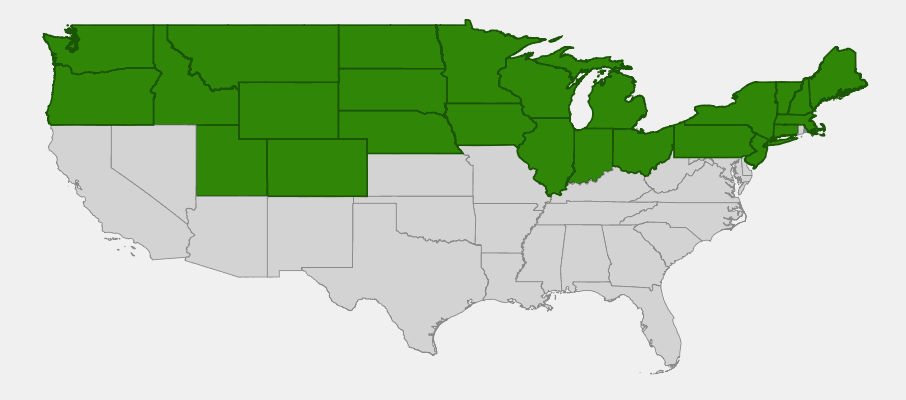
Canada Anemone has a broad native range across northern North America, extending from the prairie provinces of Canada south through the northern United States. The species is found from southeastern Alaska east to Labrador and Newfoundland, and south to Colorado, Nebraska, Ohio, and New Jersey. This extensive range reflects the plant’s adaptability to diverse climatic conditions and its ability to thrive in both continental and maritime climates.
Within its native range, Canada Anemone typically inhabits moist to moderately dry prairies, meadows, open woodlands, and woodland edges. It is commonly found in prairie swales, along streams and pond margins, and in areas that receive seasonal moisture. The species demonstrates considerable ecological flexibility, growing in both calcareous and acidic soils, and tolerating a range of moisture conditions from consistently moist to seasonally dry.
In prairie ecosystems, Canada Anemone often grows in association with native grasses like Big Bluestem and Little Bluestem, as well as other wildflowers such as Wild Bergamot, Purple Prairie Clover, and Lead Plant. In more wooded settings, it may be found with Wild Ginger, Bloodroot, and other spring ephemeral wildflowers. The species’ early blooming period makes it particularly valuable in plant communities where it provides nectar when few other flowers are available.
📋 Regional plant lists featuring Canada Anemone: North Dakota, South Dakota & Western Minnesota
Growing & Care Guide
Canada Anemone is an excellent choice for gardeners seeking an easy-care native perennial that provides early season blooms and attractive foliage. Once established, it requires minimal maintenance and adapts to a range of growing conditions.
Light
Canada Anemone grows well in full sun to partial shade, showing good adaptability to varying light conditions. In full sun, plants tend to be more compact and flower more profusely, while in partial shade they may grow slightly taller and have more lush foliage. The species tolerates deeper shade but flowering may be reduced. For optimal performance, provide morning sun with some afternoon protection in hotter climates.
Soil & Water
This adaptable wildflower thrives in moderately moist, well-drained soils but shows considerable tolerance for both wetter and drier conditions once established. It performs well in loamy soils but also tolerates clay and sandy soils. The species prefers neutral to slightly alkaline soil pH but adapts to mildly acidic conditions. While drought-tolerant once established, Canada Anemone benefits from consistent moisture during its spring growing and flowering period.
Planting Tips
Canada Anemone can be grown from seed or divisions. Seeds require cold stratification and should be sown in fall for spring germination, or stratified in the refrigerator for 60-90 days before spring planting. Division of established clumps in early spring or fall is the most reliable propagation method. Space plants 12-18 inches apart, keeping in mind that they will slowly spread to form colonies.
Pruning & Maintenance
Canada Anemone requires very little maintenance. After flowering, seed heads can be removed if desired to prevent self-seeding, though many gardeners prefer to leave them for wildlife. The foliage remains attractive through summer and can be left standing until it yellows in fall. Cut back to ground level in late fall or early spring before new growth emerges.
Landscape Uses
Canada Anemone’s delicate appearance and adaptable nature make it suitable for many garden applications:
- Native plant borders — provides early season color and textural interest
- Woodland gardens — excellent for naturalizing in lightly shaded areas
- Prairie plantings — authentic component of northern prairie ecosystems
- Ground cover — slowly colonizes to form attractive drifts
- Rain gardens — tolerates seasonal moisture fluctuations
- Rock gardens — suitable for informal rocky areas with adequate moisture
- Cottage gardens — charming addition to informal, naturalistic plantings
Wildlife & Ecological Value
Canada Anemone provides valuable early-season resources for native wildlife, particularly pollinators emerging from winter dormancy.
For Birds
While not a major seed source, Canada Anemone’s small achenes may be consumed by some seed-eating birds. More importantly, the plant provides nesting materials and the colonies offer protective cover for ground-nesting species. The relatively open growth habit creates good foraging areas for insectivorous birds seeking the small insects that visit the flowers.
For Mammals
Small mammals may occasionally browse Canada Anemone foliage, though like most members of the buttercup family, it contains compounds that make it somewhat unpalatable to most herbivores. This characteristic actually makes it deer-resistant and a good choice for gardens with browsing pressure. The root systems provide habitat for soil-dwelling invertebrates that support the broader food web.
For Pollinators
Canada Anemone is most valuable for its early blooming period, when it provides crucial nectar for spring-emerging native bees, including mining bees, sweat bees, and small carpenter bees. The flowers also attract beneficial flies, small beetles, and other early-season pollinators. The bright yellow stamens are particularly attractive to pollen-collecting insects, and the open flower structure makes pollen easily accessible.
Ecosystem Role
As a component of prairie and woodland edge communities, Canada Anemone helps create habitat diversity and supports the complex web of relationships that define healthy native plant communities. Its ability to slowly colonize through underground rhizomes helps stabilize soil and create microhabitat for other small plants and invertebrates. The early flowering period provides temporal diversity in nectar availability, crucial for supporting pollinator populations through the full growing season.
Cultural & Historical Uses
Canada Anemone has a modest but interesting history of human use, primarily among Indigenous peoples of North America who utilized the plant for various medicinal purposes.
Several Native American tribes, including the Chippewa and other Great Lakes region peoples, used Canada Anemone medicinally. The plant was typically prepared as a tea or poultice to treat wounds, particularly cuts and sores. Some tribes used it for treating headaches and general pain relief. The Chippewa specifically used the root tea for lung problems and as a general tonic. However, like many plants in the buttercup family, Canada Anemone contains potentially toxic compounds, and traditional preparation methods likely reduced these risks through specific processing techniques.
The plant’s common name “windflower” reflects its delicate, graceful appearance and the way the flowers and foliage move in gentle breezes. This poetic association has made it popular in wildflower gardens and naturalistic landscapes, where its ephemeral beauty embodies the fleeting nature of spring bloom seasons. European settlers adopted some Indigenous uses but generally considered it more of an ornamental wildflower than a medicinal plant.
In modern times, Canada Anemone is valued primarily for its ecological benefits and ornamental qualities. It has become increasingly popular in native plant gardening and prairie restoration projects, where its early blooms and spreading habit make it valuable for establishing naturalistic plantings. The plant represents the subtle beauty of North American wildflowers and serves as an excellent introduction to native gardening for those seeking less dramatic but equally rewarding species.
Frequently Asked Questions
Is Canada Anemone invasive or aggressive in the garden?
Canada Anemone spreads slowly by underground rhizomes to form colonies over time, but it is not considered aggressive or invasive. The spread is gradual and easily managed. In fact, many gardeners appreciate its ability to naturalize and fill in areas over several years.
How long do the flowers last?
Individual flowers last about a week, but the plant produces blooms in succession over a period of 3-4 weeks in late spring to early summer. The entire flowering period typically lasts from late May through June, depending on climate and growing conditions.
Can Canada Anemone be grown from seed?
Yes, but the seeds require cold stratification to germinate properly. Either sow seeds outdoors in fall for natural winter stratification, or stratify in the refrigerator for 60-90 days before spring planting. Division of established plants is generally more reliable and faster.
Is Canada Anemone toxic?
Like many plants in the buttercup family, Canada Anemone contains compounds that can be irritating if ingested in large quantities. It should not be consumed, and some people may experience skin irritation from handling the plant. It is generally avoided by deer and rabbits due to these compounds.
What companions pair well with Canada Anemone?
Canada Anemone combines beautifully with other prairie and woodland edge plants such as Wild Bergamot, Purple Prairie Clover, Little Bluestem, Wild Ginger, and Bloodroot. Its delicate white flowers provide excellent contrast to purple or yellow blooms, and its fine-textured foliage complements broader-leaved plants.

Looking for a nursery that carries Canada Anemone?
Browse our native plant nursery directory: North Dakota · South Dakota · Minnesota