
Shrubby Cinquefoil (Potentilla fruticosa)
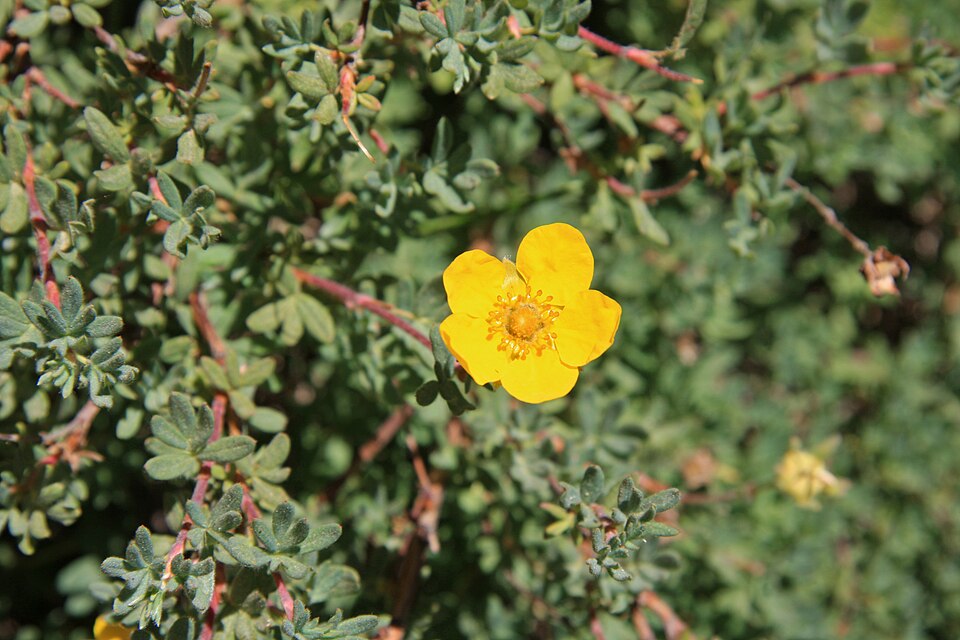
Potentilla fruticosa (syn. Dasiphora fruticosa), commonly known as Shrubby Cinquefoil, is a charming native deciduous shrub that brings months of bright yellow blooms to gardens across much of North America. This member of the Rosaceae (rose) family is beloved for its exceptional hardiness, drought tolerance, and remarkably long flowering season — from late spring through early fall, the compact shrub is covered in cheerful buttercup-like flowers that never fail to brighten the landscape.
Growing naturally in a wide range of habitats from alpine meadows to prairie grasslands, Shrubby Cinquefoil typically reaches 2 to 4 feet in both height and width, forming a dense, rounded mound of fine-textured dark green foliage. The plant’s adaptability to harsh conditions — including poor soils, drought, extreme cold, and high altitudes — makes it one of the most reliable and low-maintenance native shrubs available for challenging growing sites.
Beyond its ornamental value, Shrubby Cinquefoil provides important ecological benefits, supporting numerous pollinator species throughout its extended bloom period and offering seeds for birds in fall and winter. Its dense growth habit provides nesting cover for small birds, while its ability to thrive in disturbed soils makes it valuable for erosion control and habitat restoration projects across its extensive native range.
Identification
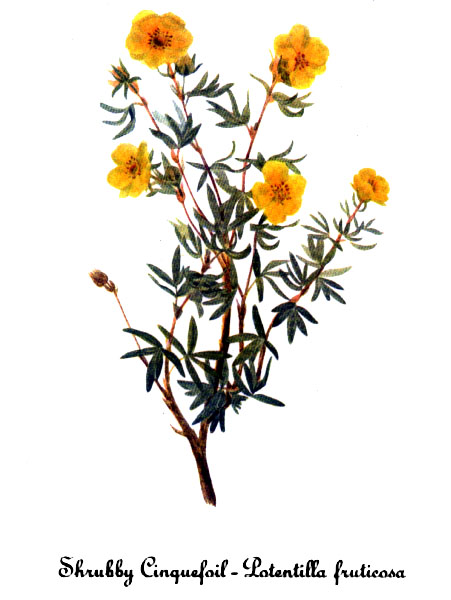
Shrubby Cinquefoil is easily recognized by its combination of bright yellow flowers, distinctive compound leaves, and low, spreading growth habit. The species typically grows 2 to 4 feet (0.6–1.2 m) tall with a similar spread, forming a dense, rounded shrub with numerous branching stems that become increasingly woody with age.
Bark
Young stems are green to reddish-brown and somewhat hairy, becoming gray-brown and fibrous as they mature. The bark on older stems develops a characteristic shredding texture, peeling in thin, papery strips that give the plant an attractive winter appearance even after leaves have dropped.
Leaves
The leaves are pinnately compound, consisting of 5 to 7 small leaflets arranged in a palmate pattern — the distinctive “five-finger” arrangement that gives cinquefoils their name. Each leaflet is narrow, elliptical, and about ½ to ¾ inch (1–2 cm) long, with smooth edges and a dark green color that remains attractive throughout the growing season. The leaves are alternate and densely arranged along the stems, creating a fine-textured, almost feathery appearance.
Flowers
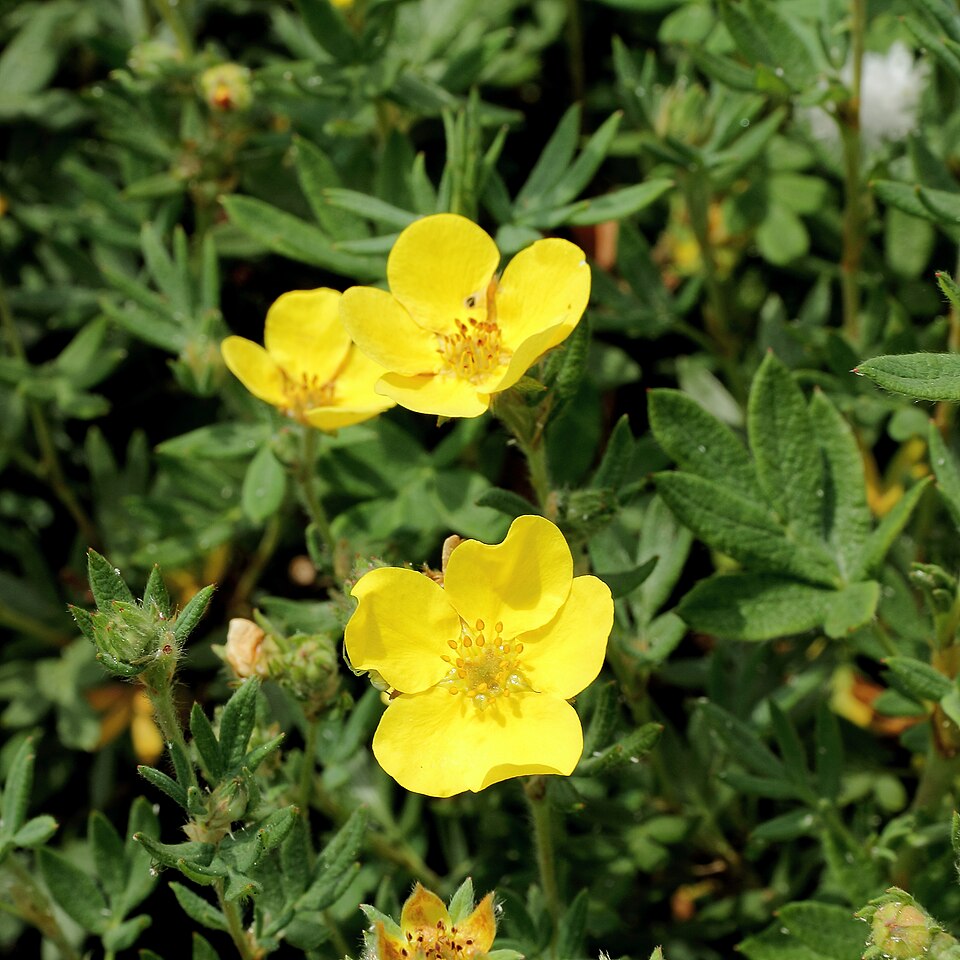
The flowers are the plant’s crowning glory — bright golden-yellow, five-petaled blooms that closely resemble miniature wild roses or buttercups. Each flower is about ¾ to 1 inch (2–2.5 cm) across, with rounded petals surrounding a center of numerous bright yellow stamens. Flowers appear individually or in small clusters at the tips of stems and continue blooming from June through September, making this one of the longest-flowering native shrubs.
Fruit
The flowers are followed by small, dry, hairy seed clusters that persist into winter. These inconspicuous but important fruits provide food for birds and small mammals, while the seeds are dispersed by wind and wildlife to colonize new areas.
Quick Facts
| Scientific Name | Potentilla fruticosa (syn. Dasiphora fruticosa) |
| Family | Rosaceae (Rose) |
| Plant Type | Deciduous Shrub |
| Mature Height | 4 ft |
| Sun Exposure | Full Sun |
| Water Needs | Moderate |
| Bloom Time | June – September |
| Flower Color | Bright yellow |
| USDA Hardiness Zones | 2–7 |
Native Range
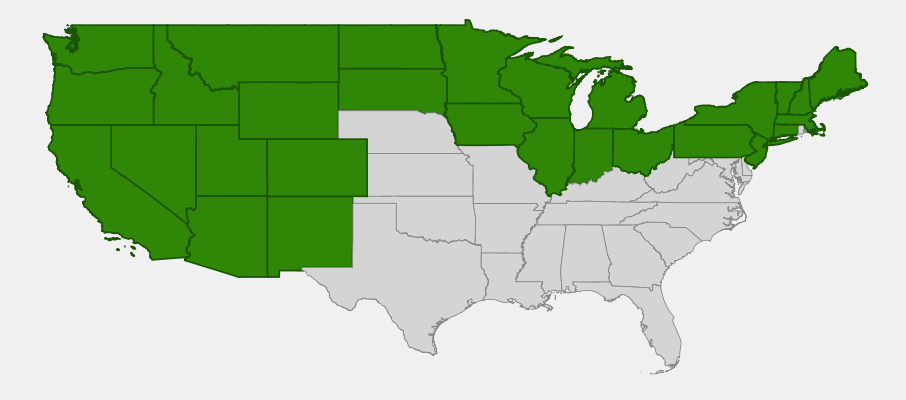
Shrubby Cinquefoil has one of the most extensive native ranges of any North American shrub, spanning much of Alaska, Canada, and the northern United States, with populations extending south in mountainous areas to New Mexico and California. This remarkable distribution — from near sea level in northern regions to over 11,000 feet elevation in the Rockies — reflects the species’ extraordinary adaptability to diverse climates and growing conditions.
The species thrives in a wide variety of natural habitats, including alpine meadows, montane grasslands, prairie margins, streamside areas, and open woodlands. In northern regions, it grows at relatively low elevations, while in warmer climates it is typically restricted to higher elevations where cooler temperatures prevail. This elevation-latitude relationship demonstrates the plant’s preference for cooler growing conditions.
Throughout its range, Shrubby Cinquefoil serves as an important early successional species, often colonizing disturbed areas and helping to stabilize soil while providing habitat for wildlife. Its extensive root system and ability to spread by underground stems make it particularly valuable for erosion control on slopes and in areas recovering from disturbance.
📋 Regional plant lists featuring Shrubby Cinquefoil: North Dakota, South Dakota & Western Minnesota
Growing & Care Guide
Shrubby Cinquefoil is among the most reliable and low-maintenance native shrubs, thriving in conditions that challenge many other plants. Its exceptional hardiness, drought tolerance, and adaptability make it an excellent choice for gardeners seeking a long-blooming, trouble-free addition to their landscape.
Light
Shrubby Cinquefoil performs best in full sun, where it produces the most abundant flowers and maintains its compact, dense growth habit. While it tolerates partial shade, flowering decreases significantly in shadier locations, and plants tend to become more open and leggy. For maximum bloom production, provide at least 6 hours of direct sunlight daily.
Soil & Water
One of the plant’s greatest assets is its tolerance of poor, rocky, or sandy soils where many other shrubs struggle. It thrives in well-drained soils of almost any type, including clay, loam, and sandy soils, with a pH range from acidic to alkaline (5.0–8.0). Once established, Shrubby Cinquefoil is remarkably drought-tolerant, though it benefits from occasional deep watering during extended dry periods to maintain peak flowering.
Planting Tips
Plant Shrubby Cinquefoil in spring or fall when temperatures are moderate. Choose a location with good drainage — the plant is sensitive to wet, poorly-drained soils, especially in winter. Space plants 3–4 feet apart for mass plantings or hedges. Container-grown plants establish quickly and often bloom the first season after planting.
Pruning & Maintenance
Minimal pruning is required, though the plant benefits from light shaping in late fall or early spring before new growth begins. Remove dead or damaged wood as needed, and consider cutting back by one-third every few years to maintain vigorous growth and abundant flowering. Avoid heavy pruning during the growing season, as this removes flower buds and reduces bloom production.
Landscape Uses
Shrubby Cinquefoil’s versatility makes it valuable in numerous garden applications:
- Rock gardens — thrives in well-drained, rocky conditions
- Xeriscaping — excellent drought-tolerant foundation plant
- Borders and hedges — compact size perfect for low formal or informal hedging
- Slope stabilization — extensive root system prevents erosion
- Prairie gardens — complements native grasses and wildflowers
- Wildlife gardens — long bloom period supports pollinators
- Cold-climate gardens — exceptional hardiness to zone 2
Wildlife & Ecological Value
Shrubby Cinquefoil provides exceptional ecological value throughout its growing season, supporting a diverse array of wildlife from early summer through late fall when many other native plants have finished blooming.
For Pollinators
The extended flowering period makes Shrubby Cinquefoil one of the most valuable native plants for supporting pollinator populations. The bright yellow flowers attract numerous native bee species, including leafcutter bees, mason bees, and sweat bees, as well as beneficial wasps and hover flies. Butterflies, particularly small whites and coppers, visit regularly for nectar, while the long bloom season provides consistent resources when other flowers are scarce.
For Birds
While not a major food source, the seeds provide supplemental nutrition for finches and sparrows during fall and winter. More importantly, the dense, twiggy growth habit creates excellent nesting habitat for small songbirds, including goldfinches, song sparrows, and various warbler species. The shrub’s low, compact form provides protective cover near ground level.
For Small Mammals
Ground squirrels, chipmunks, and mice occasionally consume the seeds, while the dense branching provides shelter and protection for small mammals. In harsh winter climates, the persistent woody structure provides crucial microhabitat protection during extreme weather events.
Ecosystem Role
As a pioneer species, Shrubby Cinquefoil plays an important role in ecosystem recovery following disturbance. Its ability to establish quickly in poor soils helps stabilize disturbed areas while creating conditions favorable for other native plants. The plant’s extensive root system improves soil structure and helps prevent erosion on slopes and exposed sites. In alpine and prairie ecosystems, it serves as an important component of plant communities that support specialized wildlife adapted to harsh conditions.
Cultural & Historical Uses
Shrubby Cinquefoil has a rich history of use by Indigenous peoples across its vast native range, with different tribes utilizing the plant for both medicinal and practical purposes. The astringent properties of the leaves and bark made it valuable for treating various ailments, while the durable woody stems found use in traditional crafts and tools.
Many northern Indigenous groups, including various First Nations peoples, used Shrubby Cinquefoil as a medicinal tea for digestive issues and as a wash for skin problems. The high tannin content in the leaves and bark provided astringent properties useful for treating minor wounds and inflammation. The plant’s reliability and abundance made it an important backup resource during harsh winters when other medicinal plants were unavailable.
The tough, flexible branches were occasionally used in basketry and for making small implements, though the plant’s primary value was medicinal rather than structural. In some regions, the dried leaves were mixed with other plants to create smoking mixtures for ceremonial purposes.
European settlers were slower to adopt Shrubby Cinquefoil compared to other native medicinals, possibly due to the abundance of other rose family plants with similar properties. However, by the late 1800s, it had gained recognition in folk medicine as a treatment for diarrhea and external wounds, taking advantage of its astringent tannins.
In modern times, Shrubby Cinquefoil has found its greatest cultural significance as an ornamental plant, widely cultivated for its exceptional hardiness and long flowering season. It remains one of the most reliable flowering shrubs for cold climates, bringing a touch of bright color to gardens in regions where few other flowering plants can survive the harsh conditions.
Frequently Asked Questions
How long does Shrubby Cinquefoil bloom?
Shrubby Cinquefoil has one of the longest flowering seasons of any native shrub, typically blooming from June through September, and sometimes into October in mild years. Individual flowers last several days, but new buds continue forming throughout the growing season, ensuring continuous color for 3–4 months.
Is Shrubby Cinquefoil deer resistant?
Yes, Shrubby Cinquefoil is generally considered deer resistant. The somewhat bitter taste and texture of the foliage make it unappealing to deer, though in areas with heavy deer pressure and limited food sources, no plant is completely deer-proof.
Can Shrubby Cinquefoil survive extreme cold?
Absolutely — this is one of the most cold-hardy flowering shrubs available, surviving temperatures as low as -40°F (-40°C) in zone 2. Its natural range extends well into northern Canada and Alaska, making it ideal for harsh northern climates where many other flowering shrubs cannot survive.
Does Shrubby Cinquefoil spread or stay in one place?
Shrubby Cinquefoil forms a clumping shrub that gradually increases in size through new growth from the crown, but it is not aggressive or invasive. It may occasionally produce new plants from seed or very short underground stems, but it maintains a well-defined shape and doesn’t spread rapidly like some other native shrubs.
What’s the difference between Potentilla fruticosa and Dasiphora fruticosa?
These are the same plant — botanists reclassified Shrubby Cinquefoil from the genus Potentilla to Dasiphora based on genetic studies, but both names are still commonly used. Most nurseries still use Potentilla fruticosa, while scientific literature increasingly uses Dasiphora fruticosa. Either name is correct.

Looking for a nursery that carries Shrubby Cinquefoil?
Browse our native plant nursery directory: North Dakota · South Dakota · Minnesota