Silver Maple (Acer saccharinum)
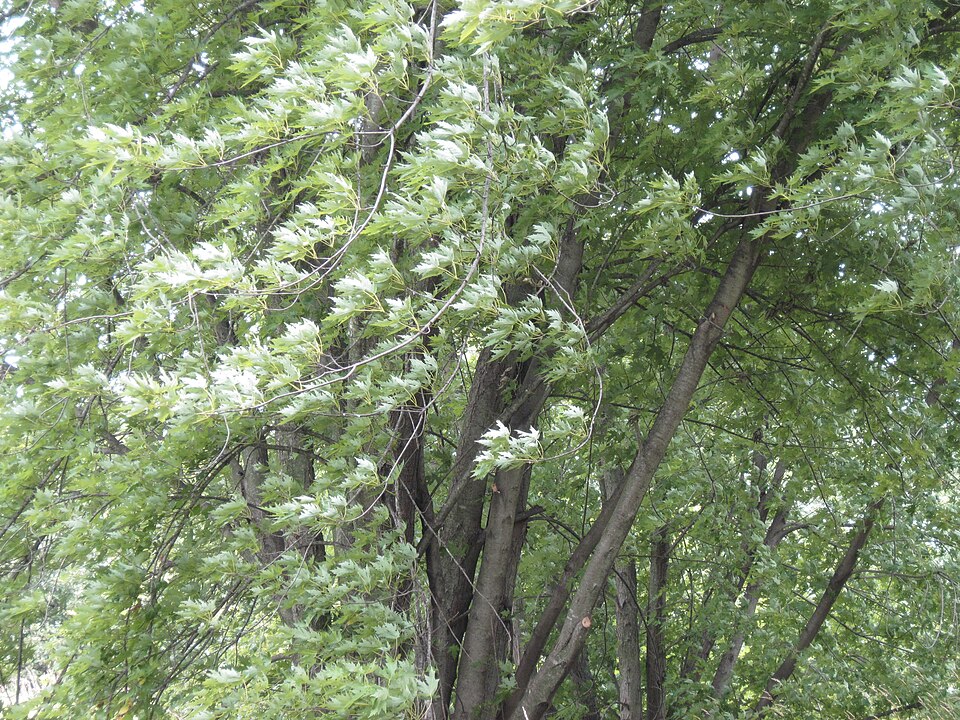
Acer saccharinum, the Silver Maple, is one of the most abundant and fastest-growing native maples in the eastern United States — a magnificent large tree of river bottomlands, floodplains, and lakeshores that offers ecological value, fall color, and remarkable adaptability to wet, difficult sites. The species name saccharinum refers to the sweetness of the sap, though Silver Maple’s sap has a much lower sugar concentration than its famous cousin the Sugar Maple (Acer saccharum). The common name “silver” comes from the striking silvery-white undersides of the deeply lobed leaves, which flash brilliantly in the wind, creating a shimmering effect that is one of this tree’s most memorable features.
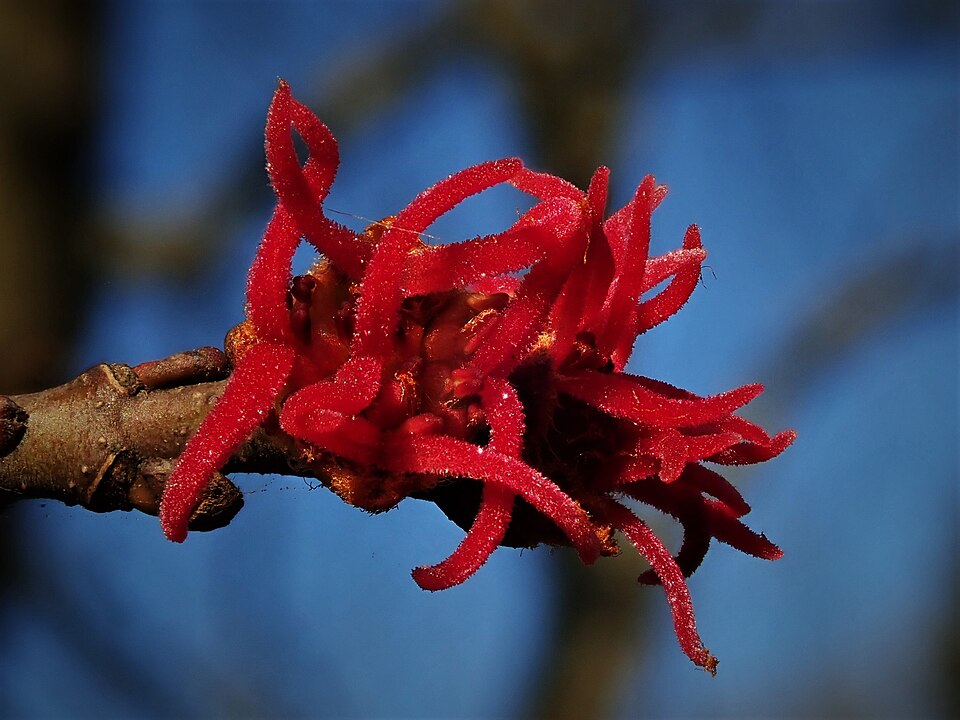
Silver Maple is among the earliest trees to bloom in eastern North America, producing small but numerous red and yellow flowers in late winter to early spring — often the first native tree bloom of the year. These early flowers are a critical nectar and pollen source for emerging insects, particularly queen bumblebees that need sustenance before spring wildflowers appear. Combined with the tree’s ability to support hundreds of caterpillar species and provide abundant seed for wildlife, Silver Maple’s ecological contributions begin before any other native tree has broken dormancy.
In New York, Pennsylvania, and New Jersey, Silver Maple is a native component of river corridors, floodplain forests, and wet woodland edges. Its fast growth, tolerance of wet soils, and early flowering make it particularly valuable for riparian restoration and wildlife gardens near water features. The lace-like, deeply cut leaves with their distinctive silver-white undersides add year-round ornamental interest that distinguishes this tree from all other native maples.
Identification
Silver Maple is a large, fast-growing deciduous tree, typically reaching 50–80 feet tall at maturity with a broad, irregular crown of somewhat pendulous branches. Old-growth specimens can exceed 100 feet. The crown is typically wider than it is tall, creating a broad, arching canopy. Silver Maple grows faster than virtually any other native maple — often adding 3–7 feet of height per year in optimal conditions.
Bark
The bark of young Silver Maples is smooth and silvery-gray. With age, the bark becomes increasingly rough, furrowed, and platy — separating into long, irregular scales that curve away from the trunk at their ends, giving mature trees a shaggy, attractive appearance. The overall bark color of older trees ranges from grayish-brown to nearly dark gray. This platy, peeling bark character distinguishes mature Silver Maple from the smoother, more uniformly ridged bark of Red Maple.
Leaves
The leaves are deeply 5-lobed and opposite on the stem, with sinuses (spaces between the lobes) that cut more than halfway to the midrib — deeper than any other eastern maple. Each lobe is irregularly toothed. The upper surface is bright, pale green; the underside is brilliantly white-silvery, covered in fine hairs that catch the light. This silvery underside is the most distinctive identification feature — on even a slight breeze, the leaves flip to reveal their white undersides, creating a shimmering, two-tone effect that gives the tree its common name. Fall color is typically yellow with some orange and red tones, variable but rarely the spectacular red of Red Maple.
Flowers & Seeds
Silver Maple blooms in late winter or very early spring (February–March) before the leaves emerge, making it one of the earliest-flowering native trees. The small, clustered flowers are red to yellowish-red — they lack petals but are quite pretty when viewed up close, and from a distance give bare winter branches a warm, reddish hue. The seeds (samaras or “helicopters”) are among the largest of any native maple, with wings 1.5–2 inches long, and they ripen in early to mid-spring — among the earliest tree seeds to mature, well before most other species drop their seed.
Quick Facts
| Scientific Name | Acer saccharinum |
| Family | Sapindaceae (Soapberry) |
| Plant Type | Deciduous Tree |
| Mature Height | 5–100 ft (typically 50–80 ft) |
| Sun Exposure | Full Sun to Part Shade |
| Water Needs | Moderate to High |
| Bloom Time | February – March |
| Flower Color | Red to yellowish-red (tiny, clustered) |
| USDA Hardiness Zones | 3–9 |
Native Range
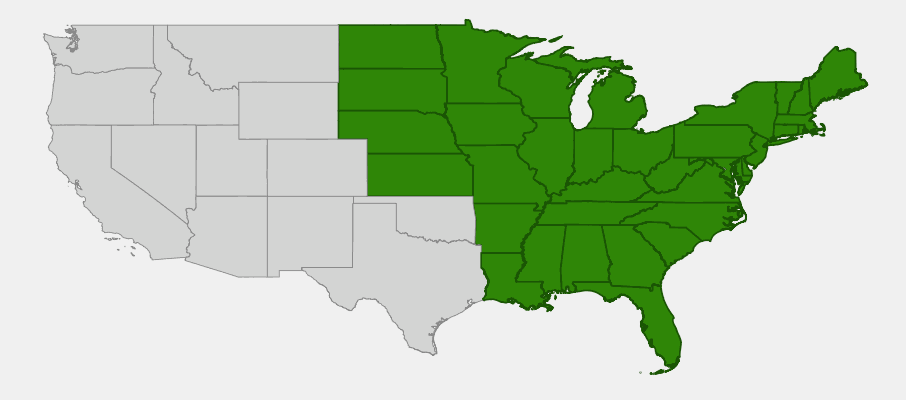
Silver Maple has one of the broadest ranges of any native maple, naturally occurring from Maine and southern Ontario south to Florida and west to Nebraska, Kansas, and eastern Oklahoma. It is most common and most abundant in the river valleys and floodplains of the Ohio River basin, the Mississippi River drainage, and the Great Lakes region, where it is a dominant component of bottomland hardwood forests.
In New York, Pennsylvania, and New Jersey, Silver Maple is a native component of major river corridors — the Delaware, Susquehanna, Hudson, and their tributaries — where it grows on floodplain terraces, streambanks, and seasonally flooded bottomlands. It is less common as a naturally occurring species in the uplands of these states, where Red Maple more often takes the dominant maple role, but in low-lying, wet areas Silver Maple is the more common large canopy tree.
The species is highly adaptable and has naturalized far beyond its original native range through planting and natural seed dispersal. Its early-maturing seeds, which ripen in spring and germinate immediately, allow it to colonize disturbed moist areas with exceptional speed. In the wild, it is a pioneer of floodplain disturbance, rapidly occupying bare soil after floods and establishing the canopy framework of the maturing floodplain forest.
📋 Regional plant lists featuring Silver Maple: New York, Pennsylvania & New Jersey
Growing & Care Guide
Silver Maple is one of the easiest large native trees to establish and grow, particularly in moist to wet sites. Its fast growth is exceptional, but its brittleness in ice storms and wind requires thoughtful siting to minimize storm damage risk.
Light
Silver Maple thrives in full sun to part shade. Maximum growth occurs in full sun with adequate moisture. In partial shade, growth is adequate and the tree remains healthy, though the crown may be less full. Avoid planting in dense shade of established woodland, where Silver Maple will grow weakly and never develop into a significant landscape specimen. An open, sunny location near a water feature, rain garden, or wet low spot is ideal.
Soil & Water
Silver Maple is highly adaptable to soil conditions, tolerating wet, seasonally flooded, poorly drained, and even compacted soils that would stress or kill many other large trees. It is one of the best native trees for persistently wet or poorly drained sites. Conversely, established trees show moderate drought tolerance once the root system is established and can reach existing soil moisture. It adapts to a wide range of soil pH. The main soil requirement is adequate moisture — avoid very dry, sandy, or gravelly soils.
Planting Tips
Plant in spring or fall. Silver Maple transplants very easily and begins growing vigorously the first season. Plant at least 15–20 feet from pavement, foundations, and utility lines — the wide root system can lift pavement and the large crown requires significant space. As with Black Willow, roots will seek out water pipes. For best storm resistance, select planting sites sheltered from prevailing winds or allow the tree to develop a single, strong central leader rather than a wide-spreading, multi-forked crown. Prune co-dominant leaders (two competing main stems) early to reduce the risk of large storm damage.
Pruning & Maintenance
The wood of Silver Maple is relatively brittle compared to other native maples, making it prone to branch failure in ice storms, heavy snow, and strong winds. Regular inspection and removal of dead, damaged, or poorly attached branches reduces storm damage risk. Avoid pruning in spring (February–April) when sap flow is greatest. Summer or winter pruning is preferred. Prune to maintain a single dominant trunk and well-spaced, strong lateral branches. Never top Silver Maple — this creates multiple weak sprouts and dramatically shortens the tree’s healthy lifespan.
Landscape Uses
- Large shade tree for spacious properties with adequate moisture
- Riparian and streamside plantings — its natural habitat
- Wet, low-lying sites where other large trees struggle
- Wildlife habitat anchor supporting insects, birds, and mammals
- Floodplain restoration as a founding canopy species
- Early spring interest with its late-winter flower display
- Fall color with attractive yellow to orange-red autumn foliage
Wildlife & Ecological Value
Silver Maple’s combination of early bloom, prolific seeding, and support for hundreds of insect species makes it one of the most ecologically productive native trees of the eastern riparian forest.
For Birds
The early-maturing winged seeds (samaras) of Silver Maple ripen in April–May and are consumed by Evening Grosbeaks, Purple Finches, and various sparrows. The large, early seeds are particularly critical for seed-eating birds that have exhausted winter food supplies. Cavity-nesting birds including Wood Ducks, Barred Owls, Screech Owls, and Eastern Bluebirds use cavities in mature Silver Maples. Baltimore Orioles and other neotropical migrants nest in the outer, drooping branches.
For Mammals
The large samaras are consumed by squirrels, chipmunks, and deer. The abundant early seeds are one of the most important spring food sources for squirrels emerging from winter food shortages. Beavers harvest Silver Maple extensively for dam construction and food. White-tailed Deer browse the foliage, and rabbits and voles consume the bark of young trees in winter — a potential problem for newly planted specimens that may need wire protection their first winter.
For Pollinators
Silver Maple is among the most important early-season pollen sources for native bees and other pollinators. Blooming in February and March — before nearly any other native plant — it provides critical sustenance for queen bumblebees emerging from winter dormancy and early-season native bees. The flowers are visited by Mason bees, mining bees, and many other species. Silver Maple also supports an estimated 280+ species of Lepidoptera (caterpillars and moths) — an enormous ecological contribution to the insect food web.
Ecosystem Role
In floodplain forest communities, Silver Maple plays a critical role as both a pioneer (rapidly colonizing disturbed floodplains) and a persistent canopy component. Its early seed rain germinates quickly on moist soil, reestablishing woody cover after floods and disturbance. The leaf litter, which decomposes relatively quickly, enriches floodplain soils. Large, old Silver Maples with cavities and dead branches provide structural complexity that supports cavity-nesting birds, bats, and invertebrate communities in riparian forests.
Cultural & Historical Uses
Silver Maple has a long history of use by Indigenous peoples throughout its range. The Cherokee, Iroquois, and other nations used the inner bark to make a tea for treating coughs and as a general tonic. The sap, though less sweet than Sugar Maple, was tapped and boiled to produce a lower-grade maple syrup. Some tribes used the wood for furniture, boxes, and tools. The Iroquois reportedly used silver maple bark tea in purification ceremonies and as a blood tonic.
European settlers utilized Silver Maple’s exceptional growth rate for establishing windbreaks, hedgerows, and shade trees around homesteads far more quickly than slower-growing oaks and hickories could provide. The wood, though soft and prone to splitting, was used for furniture, boxes, cooperage, and fuel. Its fast growth made it valuable for pulpwood production in the paper industry. In the 19th century, massive Silver Maples along river corridors were harvested for their timber, particularly in the Ohio and Mississippi River valleys where they reached enormous dimensions.
Today, Silver Maple faces something of a paradox in the landscape: it is both one of the most planted street and lawn trees in the Northeast and one of the most frequently criticized for brittleness and aggressive roots. Nevertheless, in appropriate settings — near water, in floodplains, in naturalistic wildlife gardens — it is an exceptional native tree that fully justifies its place in the eastern landscape. Its early bloom, fast growth, and high wildlife value ensure its ecological importance long into the future.
Frequently Asked Questions
Is Silver Maple different from Red Maple?
Yes — they are related but distinct species. Silver Maple (Acer saccharinum) has more deeply lobed leaves with brilliant silver-white undersides, blooms slightly earlier, and grows in wetter habitats. Red Maple (Acer rubrum) has less deeply cut leaves with slightly silvery (not brilliantly white) undersides, and has superior fall red color. Both are excellent native trees; Red Maple has slightly better storm resistance.
Will Silver Maple damage my foundation or sewer lines?
Like all maples, Silver Maple has wide-spreading roots that seek moisture. Plant at least 15–20 feet from foundations, sewer lines, and water mains. In open lawn or riparian settings far from infrastructure, roots pose no concern.
Why does Silver Maple bloom so early?
Silver Maple is evolutionarily adapted to flower before leaves emerge — wind pollination is more effective without leaves blocking pollen movement. The early bloom time also reduces competition with other wind-pollinated trees. The early-maturing seeds that follow are among the first to fall in spring, germinating immediately on still-moist floodplain soil before summer drought begins.
Is Silver Maple a good tree for a rain garden?
Yes — it is one of the best large native trees for rain gardens and bioswales. Its tolerance of both periodic flooding and dry periods between rain events matches the typical wet-dry cycle of a rain garden perfectly.
Does Silver Maple have good fall color?
Fall color is variable — typically yellow to orange-yellow, sometimes with red tones. It is generally less spectacular than Sugar Maple or Red Maple but still attractive, particularly when the leaves flip in the wind to show the silver undersides during senescence.

Looking for a nursery that carries Silver Maple?
Browse our native plant nursery directory: New York · Pennsylvania