Curlleaf Mountain Mahogany (Cercocarpus ledifolius)
Cercocarpus ledifolius, commonly known as Curlleaf Mountain Mahogany, is one of the most ecologically important and iconic shrubs of the arid mountain ranges of the American West. Despite its common name, it is not related to true mahoganies (Meliaceae) but belongs to the rose family (Rosaceae). The “mahogany” moniker refers to the plant’s hard, heavy, reddish-brown wood — one of the densest woods produced by any North American shrub, historically used by Indigenous peoples and early settlers for tool handles, bows, and fuel.
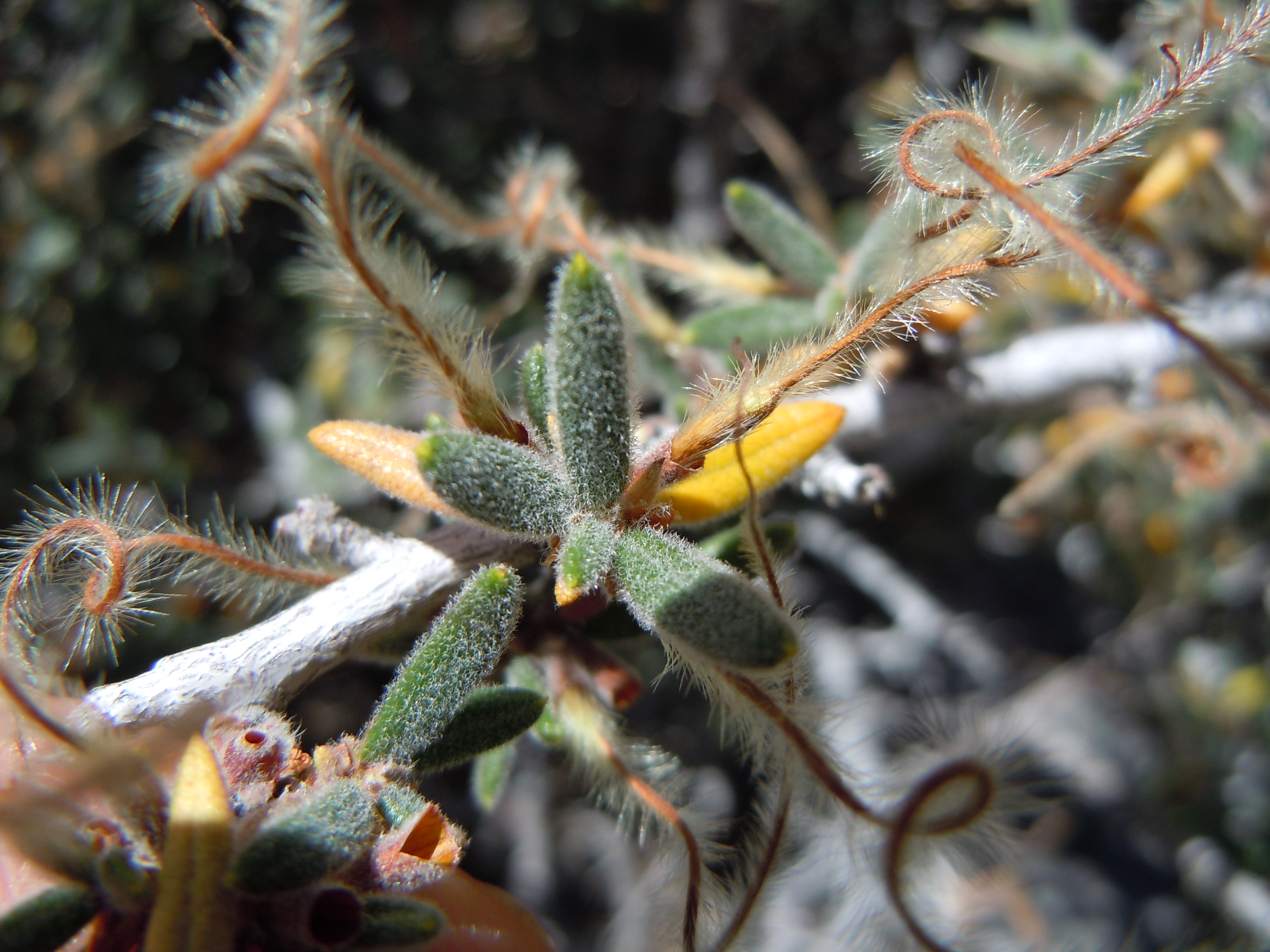
Curlleaf Mountain Mahogany is an evergreen shrub or small tree that grows 4 to 20 feet tall in its natural habitat, forming dense, wind-sculpted thickets on dry rocky slopes and mountain ridges throughout the Great Basin, Rocky Mountains, and adjacent ranges. Its most distinctive features are its small, leathery, inward-curling (revolute) leaves — the “curlleaf” of its common name — and its spectacular feathery seed tails, which are white, silky, and up to 3 inches long, giving autumn plants a glittering, frosted appearance in slanted sunlight. In Montana and Wyoming, it is a defining shrub of dry, rocky foothills and lower mountain slopes, particularly on south- and west-facing exposures.
From a wildlife and ecological perspective, Curlleaf Mountain Mahogany is extraordinarily important. It provides critical winter browse for mule deer and elk across millions of acres of western mountain ranges — in some areas, it constitutes the majority of the winter diet for these ungulates. It is also a significant food source for bighorn sheep, pronghorn, and small mammals. Its nitrogen-fixing root associations with the actinobacterium Frankia allow it to thrive in nutrient-poor soils and improve soil fertility over time, making it a keystone shrub in its ecosystems.
Identification
Curlleaf Mountain Mahogany grows as an evergreen large shrub or small tree, typically reaching 4 to 8 feet (1.2–2.4 m) in cultivation and garden settings, though wild plants on favorable sites can reach 20 to 30 feet (6–9 m) or more with trunk diameters exceeding 12 inches. The crown is dense and irregular, with stiff, spreading branches. In exposed ridge-top situations, plants are typically low and wind-pruned; in more protected canyon positions, they can develop a more tree-like form. The bark is gray to reddish-brown, becoming furrowed and scaly on older stems.
Leaves
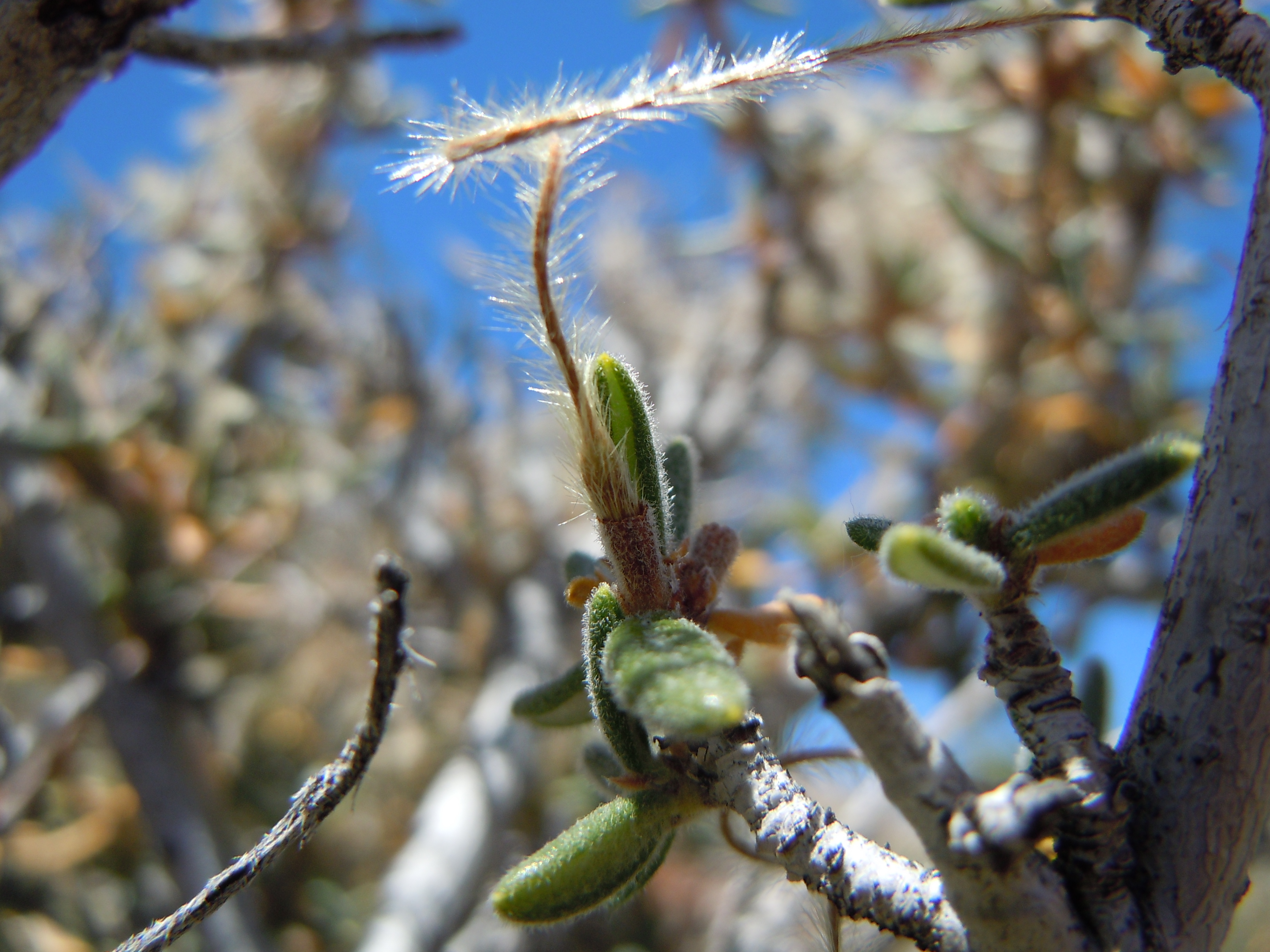
The leaves are the most distinctive identification feature: small (½ to 1 inch / 1–2.5 cm long), narrowly elliptical to oblong, thick, leathery, and evergreen. Their margins are notably revolute — rolled strongly downward and inward — which is the defining characteristic behind the common name “curlleaf.” The upper surface is dark green and resinous (often sticky to the touch); the underside is densely white-woolly with fine hairs. This combination of inrolled margins and woolly undersides dramatically reduces water loss through transpiration, making Curlleaf Mountain Mahogany highly drought-adapted. The leaves are arranged alternately and often clustered at short-shoot spur ends, creating a brushy appearance.
Flowers
The flowers are small, tubular, and yellowish-white, lacking petals. They emerge from short shoots in spring (April–June), typically appearing before or with new growth. Each flower is 5-petaled but the petals are reduced to tiny scales; the 15–25 stamens are the most visible feature. While individually inconspicuous, the flowers are produced in sufficient numbers to be fragrant and attract pollinators. Curlleaf Mountain Mahogany is wind-pollinated as well as insect-pollinated.
Fruit & Seed Plumes
The fruit is a single-seeded achene tipped with a spectacular, spirally twisted, feathery awn (tail) that can reach 1.5 to 3 inches (4–8 cm) in length. These silky, white seed plumes are the plant’s most visually striking feature — in late summer and autumn, heavily seeding plants appear frosted or silvery from a distance. The twisted awn functions as a hygroscopic drill: as moisture changes, the tail coils and uncoils, corkscrewing the pointed seed into soil crevices. This elegant dispersal mechanism allows seeds to plant themselves in rocky soils.
Quick Facts
| Scientific Name | Cercocarpus ledifolius |
| Family | Rosaceae (Rose family) |
| Plant Type | Evergreen Shrub / Small Tree |
| Mature Height | 4–8 ft (garden); up to 20 ft (wild) |
| Sun Exposure | Part Shade to Full Sun |
| Water Needs | Low (Drought Tolerant) |
| Bloom Time | April – June |
| Flower Color | Yellowish-white (small, tubular) |
| Ornamental Feature | Silvery, feathery seed plumes in fall |
| USDA Hardiness Zones | 4–9 |
Native Range
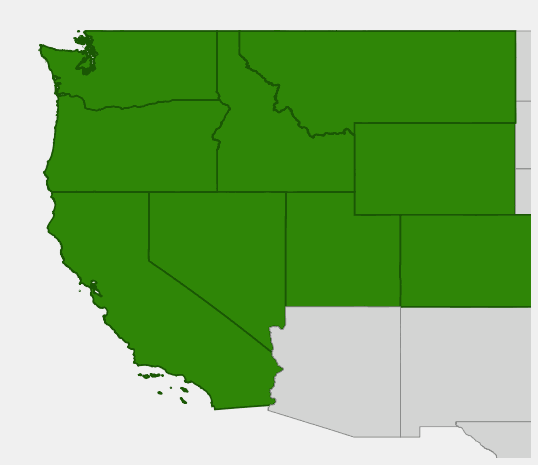
Curlleaf Mountain Mahogany is native to the mountains and foothills of the Great Basin, Rocky Mountains, and adjacent ranges, ranging from Montana and Wyoming south through Nevada, Utah, Colorado, Arizona, and New Mexico, and west through Idaho, Oregon, and California. It is most abundant and ecologically dominant in the Great Basin ranges — the Sierra Nevada, Ruby Mountains, Snake River Plains highlands, and the mountain ranges of Nevada and Utah — where it often forms pure stands or codominates with sagebrush and pinyon-juniper communities.
In Montana and Wyoming, Curlleaf Mountain Mahogany occurs primarily on south- and west-facing rocky slopes in the foothills and lower mountain zones, often between 4,500 and 9,000 feet elevation. It is a characteristic plant of the upper sagebrush zone and the lower edge of coniferous forest, occupying the transitional belt where precipitation is too low for dense forest but too high for pure sagebrush steppe. It is particularly important in mountain ranges with significant mule deer and elk winter range, where its persistent green foliage provides critical nutrition through the winter months.
Curlleaf Mountain Mahogany is notably slow-growing and long-lived: individual plants can reach ages of 500 to over 1,300 years, making some of the larger specimens among the oldest living plants in the western mountains. Its persistence and longevity make it an important structural component of its ecosystems, providing decades or centuries of consistent cover, browse, and seed production for wildlife.
📋 Regional plant lists featuring Curlleaf Mountain Mahogany: Montana & Wyoming
Growing & Care Guide
Curlleaf Mountain Mahogany is a rugged, long-lived shrub that rewards patient gardeners with decades of beauty, wildlife value, and ecological function. It is well-suited to dry, rocky landscapes in the western United States and requires minimal care once established.
Light
Curlleaf Mountain Mahogany grows naturally in both full sun and partial shade, though it is most vigorous and productive in full to partial sun exposures. In its native habitat, it is often found on south- and west-facing slopes that receive intense afternoon sun — conditions that would stress many other shrubs. In garden settings, it performs well in at least 4–6 hours of direct sun daily. Light afternoon shade in hot, low-elevation gardens can be beneficial, but heavy shade produces weak, open growth.
Soil & Water
This shrub is highly drought-tolerant once established and thrives in the lean, rocky, or gravelly soils typical of western mountain slopes. It grows in sandy loams, stony soils, and decomposed granite — virtually any well-drained substrate. Rich, moist garden soils can promote excessive growth and reduce the plant’s characteristic dense, compact form. During the establishment period (first 2–3 years), water deeply once every 2–3 weeks in summer. After establishment, rainfall in most of its native range provides sufficient moisture, though supplemental deep irrigation every 3–4 weeks during drought periods benefits the plant.
Planting Tips
Plant Curlleaf Mountain Mahogany from container stock in spring or fall. It is slow to establish from seed (germination requires cold stratification) and is generally more practical to purchase nursery-grown plants. Dig a hole twice as wide as the root ball but no deeper; backfill with native soil without amendments. Mulch lightly around the base, keeping mulch away from the stem to prevent rot. Allow 6–8 feet of spacing for mature development, or plant closer (3–4 feet) for use as a wildlife screen or informal hedge.
Pruning & Maintenance
Curlleaf Mountain Mahogany requires virtually no pruning and resents heavy cutting. Remove dead branches as needed in late winter. If plants become too large, light thinning of interior branches can improve air circulation, but avoid major pruning cuts. The plant’s slow growth rate means that mistakes take years to correct. This species is exceptional for low-maintenance landscapes — once established, it essentially cares for itself.
Landscape Uses
- Dry, rocky slopes — a natural fit for challenging west-facing exposures
- Wildlife screening and hedges — dense, evergreen growth provides year-round cover
- Deer and elk browse garden — critical winter forage for large ungulates
- Erosion control — deep root system stabilizes steep slopes
- Low-water landscapes — thrives in xeriscape settings with minimal irrigation
- Specimen shrub — the spectacular fall seed plumes provide striking seasonal interest
Wildlife & Ecological Value
Few shrubs in the American West match Curlleaf Mountain Mahogany for wildlife importance, particularly as a winter food source for large ungulates.
For Mammals
Curlleaf Mountain Mahogany is perhaps the most important winter browse plant for mule deer across the Great Basin and Rocky Mountain region. In many areas, deer winter ranges are defined by the presence of Mountain Mahogany thickets — the evergreen, highly nutritious foliage provides critical calories and protein during the season of greatest stress. Elk also browse the plant heavily in winter, and bighorn sheep and pronghorn utilize it as well. Small mammals including cottontail rabbits, jackrabbits, and ground squirrels eat the seeds and young shoots.
For Birds
The dense, thorny growth of Curlleaf Mountain Mahogany provides excellent nesting habitat for a variety of shrub-nesting birds including Black-headed Grosbeaks, Green-tailed Towhees, Brewer’s Sparrows, and Sage Thrashers. The seeds, with their feathery plumes, are consumed by finches, juncos, and sparrows. The shrub’s structure — dense inner branches, thorny twigs — makes it a secure refuge from predators for small birds seeking cover.
For Pollinators
Despite the small size of the flowers, Curlleaf Mountain Mahogany is an early-season nectar source for native bees emerging in spring when few other shrubs are blooming. The flowers attract small native bees, especially mining bees and sweat bees that are active in early spring at the elevations where Mountain Mahogany grows.
Ecosystem Role
Curlleaf Mountain Mahogany plays a dual ecosystem role as both a nitrogen-fixer and a carbon sink. Its root associations with Frankia bacteria fix atmospheric nitrogen, improving soil fertility in the typically nutrient-poor soils of rocky mountain slopes. The plant’s enormous longevity — individual shrubs can live for more than 1,000 years — means that established individuals accumulate carbon over centuries. The dense, persistent thickets also moderate soil temperatures, reduce erosion, and provide structural diversity in otherwise open habitats.
Cultural & Historical Uses
The wood of Curlleaf Mountain Mahogany is extraordinarily dense — one of the hardest and heaviest woods produced by any North American shrub or small tree. It sinks in water rather than floating, a property that made it highly valued by Indigenous peoples. The Shoshone, Paiute, Bannock, and other Great Basin tribes used the dense, hard wood for tool handles, digging sticks, bows, and saddle frames. The wood burns hot and long, making it an excellent fuel, and traditional peoples relied on it for firewood in areas where larger trees were scarce.
Medicinally, various Indigenous groups used decoctions of the bark and leaves to treat a range of ailments. The Navajo used bark tea for stomach disorders. Other groups used poultices of the leaves for skin problems and bruises. The seeds, while not commonly eaten due to their small size and effort required for collection, were occasionally used as food in lean times.
Early Euro-American settlers in the Great Basin and Rocky Mountain region likewise valued Curlleaf Mountain Mahogany’s hard wood, using it for fence posts, tool handles, and fuel. Sheepherders carved trail markers and camp artifacts from the wood. Today, the plant is recognized as a keystone species in western ecology and is widely used in rangeland restoration, wildlife habitat improvement projects, and xeriscape plantings throughout the Intermountain West.
Frequently Asked Questions
Why is it called Mountain Mahogany if it’s not a real mahogany?
The name refers to the wood’s color and hardness, which resembles true mahogany (Meliaceae family), not its taxonomic relationship. Curlleaf Mountain Mahogany is actually in the rose family (Rosaceae), making it a relative of roses, apples, and cherries — not tropical mahogany trees. The common name stuck because western settlers were struck by the density and reddish color of the wood.
How old can Curlleaf Mountain Mahogany get?
Very old indeed — documented specimens have been aged at 1,300+ years, making them among the oldest shrubs in North America. Even typical specimens in good habitat commonly reach 300–500 years. Its slow growth rate and dense wood make it nearly immune to decay, allowing it to persist for centuries in dry mountain environments.
Does Curlleaf Mountain Mahogany need supplemental water?
Once established (after 2–3 years), it is highly drought-tolerant and generally does not need supplemental irrigation in regions with 10 or more inches of annual precipitation. During establishment, water deeply every 2–3 weeks in summer. In very dry urban or garden settings, monthly deep watering in summer maintains vigor without causing the problems (weak growth, root rot) that excessive irrigation causes.
Is it deer-resistant?
Quite the opposite — deer, elk, and other ungulates actively seek out Curlleaf Mountain Mahogany, especially in winter when it provides critical browse. If deer pressure is a concern in your garden, protect young plants with wire cages until they are well-established and large enough to tolerate browsing without being killed. Mature, established plants can sustain significant browsing without long-term harm.
What are those feathery tails on the seeds?
Those are the awns — elongated, hygroscopic (moisture-sensitive) structures that help disperse and plant the seeds. The twisting motion of the awn as it cycles between wet and dry conditions literally screws the pointed seed tip into soil crevices, a remarkable self-planting mechanism. In late summer and fall, plants covered in silvery seed plumes are one of the most spectacular sights in western mountain shrublands.