Smooth Blue Aster (Symphyotrichum laeve)
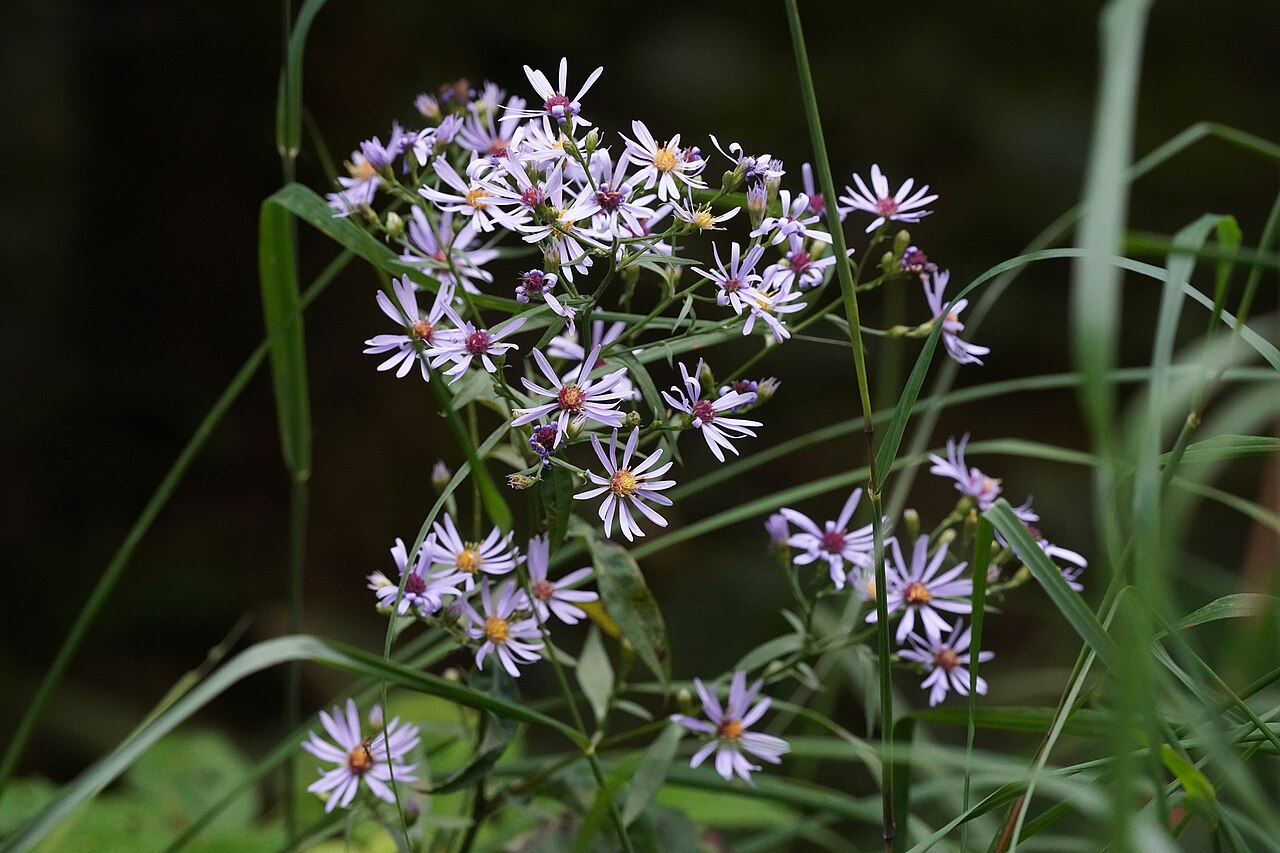
Symphyotrichum laeve (syn. Aster laevis), commonly known as Smooth Blue Aster, is one of the most beautiful and ecologically valuable native wildflowers of the northern Great Plains and Rocky Mountain region — a striking, fall-blooming perennial that delivers a spectacular display of lavender-blue to purple daisy-like flowers precisely when most of the prairie’s other wildflowers have finished for the season. Its smooth (laeve = smooth, in Latin), blue-green, somewhat waxy stems and leaves give it a distinctive, polished appearance unlike the hairy or rough-textured stems of many asters, making it elegant throughout the growing season, not just when in bloom.
As a late-season bloomer, Smooth Blue Aster fills a critical ecological niche in prairie and meadow ecosystems: it blooms from late August through October, providing nectar and pollen to monarchs, bees, and other late-season pollinators that need energy for their fall migrations or winter preparations, long after the early-season wildflowers have gone to seed. For this reason, it is often called a “cornerstone” species in pollinator gardens and wildlife plantings — planting Smooth Blue Aster alongside early-season bloomers ensures that the nectar bar stays open all season, from first frost to last.
Beyond its pollinator value, Smooth Blue Aster is a genuinely adaptable and easy-to-grow native wildflower for gardens in the northern Rocky Mountain and Great Plains region. It tolerates a remarkable range of conditions — from full sun prairie plantings to the light shade of open woodland edges, from dry, rocky hillsides to moderately moist meadows. Planted in masses, it creates breathtaking drifts of blue and lavender in the fall landscape; planted as a single specimen, it adds a graceful, airy texture with its branching stems and cloud of small flowers. Its seeds are also a late-season food source for birds preparing for winter, and its clumping growth provides cover for ground-dwelling animals through the fall and winter months.
Identification
Smooth Blue Aster is a clump-forming, upright herbaceous perennial growing 1.5 to 3 feet tall from a fibrous root system with short rhizomes. The most diagnostic identification feature is in the name: the stems and leaves are distinctly smooth (glabrous) and often waxy or blue-green, with a slight glaucous (powdery) bloom. This lack of hairiness immediately distinguishes it from the many rough-stemmed, hairy asters that occur in the same habitats.
Leaves
The basal and lower stem leaves are large (3 to 5 inches long), spatula to lance-shaped, with clasping bases that wrap partially around the smooth stem. The upper leaves are progressively smaller, lance-shaped to linear, and strongly clasping — the clasping bases of the upper leaves create distinctive ear-like lobes (auricles) on either side of the stem, a reliable identification feature. The leaf surface is smooth, sometimes slightly waxy, and dark blue-green to medium green. Leaf margins are finely toothed or entire. The entire plant has a crisp, polished look that distinguishes it from the softer-textured asters.
Flowers
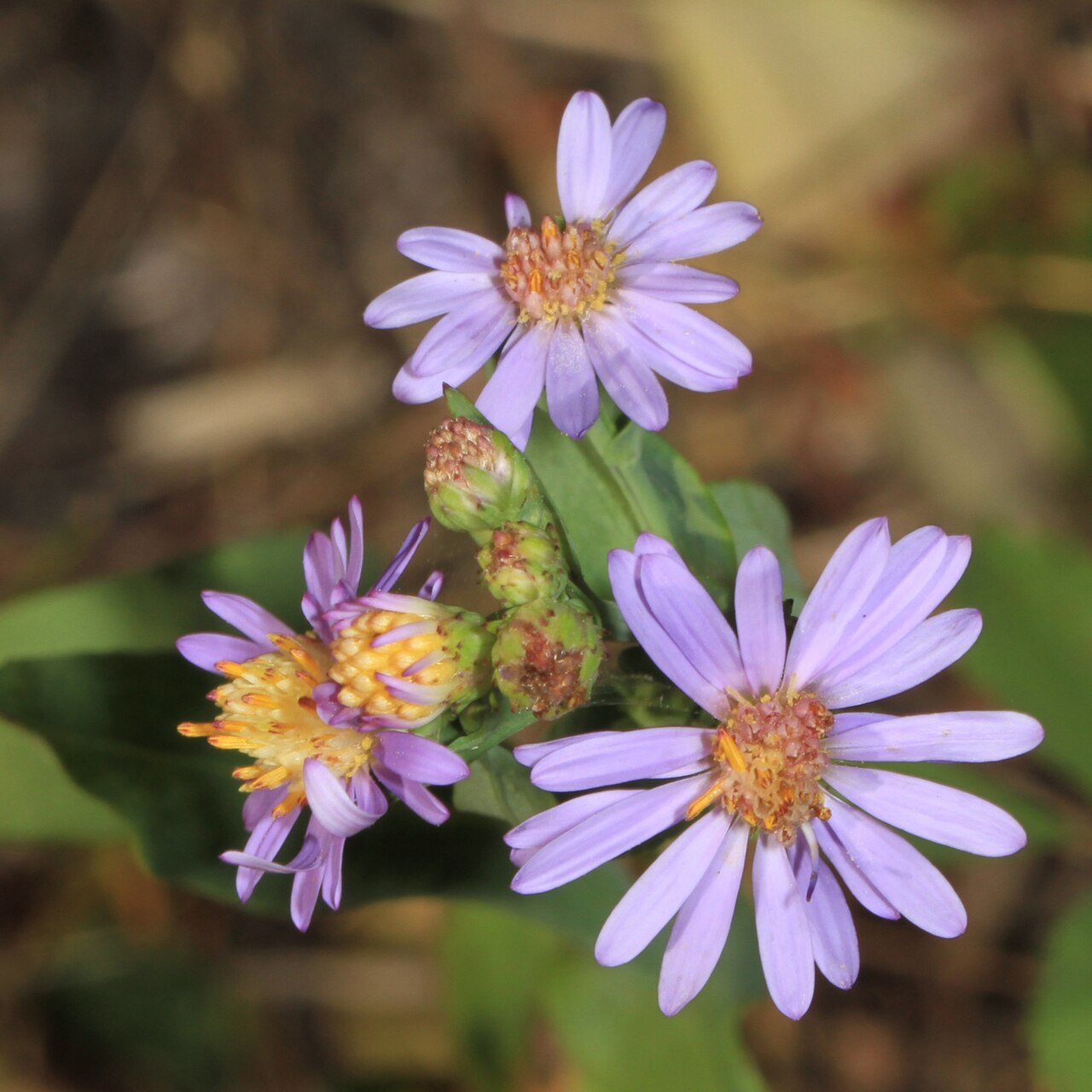
The flower heads are 0.75 to 1.25 inches across, with 15 to 30 ray florets in shades of lavender, blue-purple, or occasionally white, surrounding a central disk of yellow tubular florets that turn reddish-purple as they age. The flowers are borne in open, branching clusters (panicles) at the top of the plant, creating an airy, cloud-like floral display in fall. Blooming typically begins in late August in Montana and Wyoming, continuing through September and into October. The involucre (the cup of modified leaves beneath each flower head) has distinctive graduated, appressed bracts with a darker green midrib — another reliable identification feature.
Seeds
After flowering, Smooth Blue Aster produces small achenes topped with a pappus of fluffy, whitish hairs (the “parachute” for wind dispersal). The mature seed heads persist into winter as whitish, fluffy masses that catch the light attractively and gradually disperse seeds through fall and winter winds. The seed heads provide a modest amount of food for small seed-eating birds and sparrows that forage through dried prairie vegetation in the winter months.
Quick Facts
| Scientific Name | Symphyotrichum laeve (syn. Aster laevis) |
| Family | Asteraceae (Daisy / Composite) |
| Plant Type | Herbaceous Perennial Wildflower |
| Mature Height | 2–3 ft |
| Sun Exposure | Full Sun to Part Shade |
| Water Needs | Moderate |
| Bloom Time | Late August – October (fall bloomer) |
| Flower Color | Lavender-blue to blue-purple; yellow centers |
| USDA Hardiness Zones | 3–8 |
Native Range
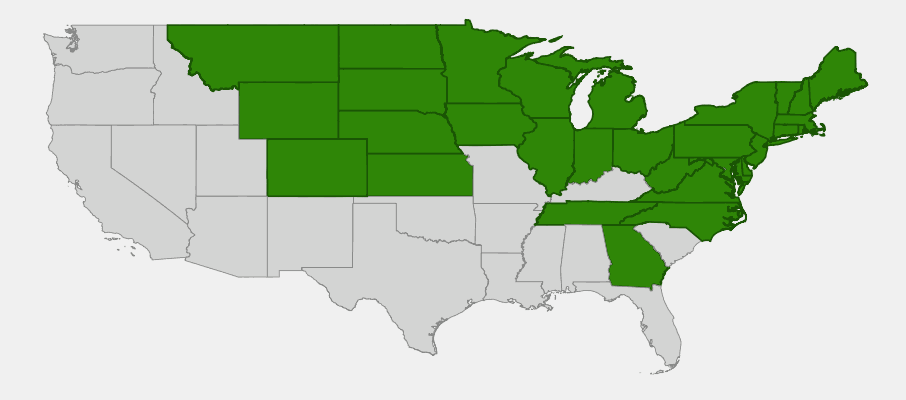
Smooth Blue Aster is widely distributed across temperate North America, ranging from the Great Plains and Rocky Mountain foothills east across the northern and central United States to the Atlantic Coast. Its western range includes Montana, Wyoming, Colorado, the Dakotas, Nebraska, and Kansas; to the east it extends through the Midwest and into New England and the Mid-Atlantic states. The species is most abundant in the northern portion of its range, with the largest populations in the Great Lakes states, New England, and the northern Great Plains.
Within the Great Plains and northern Rocky Mountain region, Smooth Blue Aster occurs in a variety of open, dry to moderately moist habitats, including native prairies, mountain meadows, open woodland edges, forest clearings, and roadsides. It is most common at low to moderate elevations, typically below 7,500 feet in Montana and Wyoming. It occurs on well-drained to moderately moist soils across a range of textures, from sandy loams to clay-loams, and is notably adaptable to disturbed and managed grassland habitats.
In Montana and Wyoming, Smooth Blue Aster is a characteristic component of native mixed-grass prairie communities and foothills meadows, often occurring alongside other late-season bloomers such as goldenrods (Solidago spp.), other asters, and ironweeds. Its occurrence in Montana and Wyoming represents the western edge of its broader North American distribution, and the populations in this region are often somewhat more compact and drought-adapted than those in the moister eastern portion of the range. It is one of the most reliably identifiable and appreciated native wildflowers of the late-season native plant garden in the region.
📋 Regional plant lists featuring Smooth Blue Aster: Montana & Wyoming
Growing & Care Guide
Smooth Blue Aster is one of the most satisfying native wildflowers to grow in a prairie or meadow garden — adaptable, reliable, and spectacular in its fall blooming season. It is significantly easier to grow than many asters, being tolerant of a wide range of conditions from dry to moderately moist and from full sun to part shade. Once established, it requires little attention and will bloom faithfully every fall for many years, gradually expanding into graceful clumps over time.
Light
Smooth Blue Aster thrives in full sun to part shade — one of its great practical virtues. In full sun with adequate moisture, it produces the densest, most flower-laden plants with the most intense blue-purple color. In part shade (3 to 5 hours of direct sun), it grows a bit taller and more open but still blooms well. It tolerates the dappled shade under open-canopy trees and at the edge of woodland plantings, making it valuable in transitional zones between sunny garden beds and shaded areas.
Soil & Water
Smooth Blue Aster is adaptable to a range of well-drained soils — from sandy loams to clay-loams — and tolerates average to slightly dry conditions once established. It performs best with moderate, consistent moisture through the growing season, particularly during the summer months leading up to its fall bloom period. In dry years, supplemental irrigation in July and August can significantly improve bloom quality. Avoid waterlogged soils, which can cause root rot. In the northern Rockies, its natural moisture preferences are well-matched with the summer precipitation patterns of Montana and Wyoming.
Planting Tips
Plant Smooth Blue Aster from container stock in spring or fall, or start from seed. Seeds can be sown directly in fall for natural cold stratification, or cold-stratified (30–60 days at 35°F) and sown indoors in late winter for spring transplanting. Seed germination is usually good (60–80% with proper stratification). Space plants 18 to 24 inches apart to allow for natural clumping and air circulation. In mass plantings, it can be planted more closely for immediate impact. The plant spreads slowly by rhizomes to form attractive clumps that can be divided in spring every 3 to 4 years to maintain vigor.
Pruning & Maintenance
To create a more compact, bushy plant with more flowers, cut stems back by one-third in early June (the “Chelsea Chop” technique used by prairie gardeners). This delays blooming slightly but greatly increases branching and flower production. If left unpruned, Smooth Blue Aster blooms on tall, somewhat floppy stems that benefit from a stake or neighboring plants for support in exposed sites. Leave the seed heads through fall and winter for birds, and cut back in late winter or early spring. Division every 3 to 4 years in spring keeps older clumps vigorous.
Landscape Uses
- Prairie and meadow gardens — one of the most important fall-blooming wildflowers for northern Great Plains plantings
- Pollinator gardens — essential late-season nectar source for monarchs, native bees, and butterflies
- Mixed border — excellent as a mid-to-back-of-border plant with summer green foliage transitioning to fall flowers
- Naturalized woodland edge — tolerates light shade at the interface of sun and shade plantings
- Cut flower garden — branches of blue aster are beautiful in late-season floral arrangements
- Wildlife planting — provides nectar for migrating monarchs and late pollinators, seeds for fall birds
Wildlife & Ecological Value
Smooth Blue Aster is a cornerstone species for late-season pollinators and migrating wildlife, providing critical resources at the end of the growing season when most other wildflowers have finished blooming.
For Pollinators
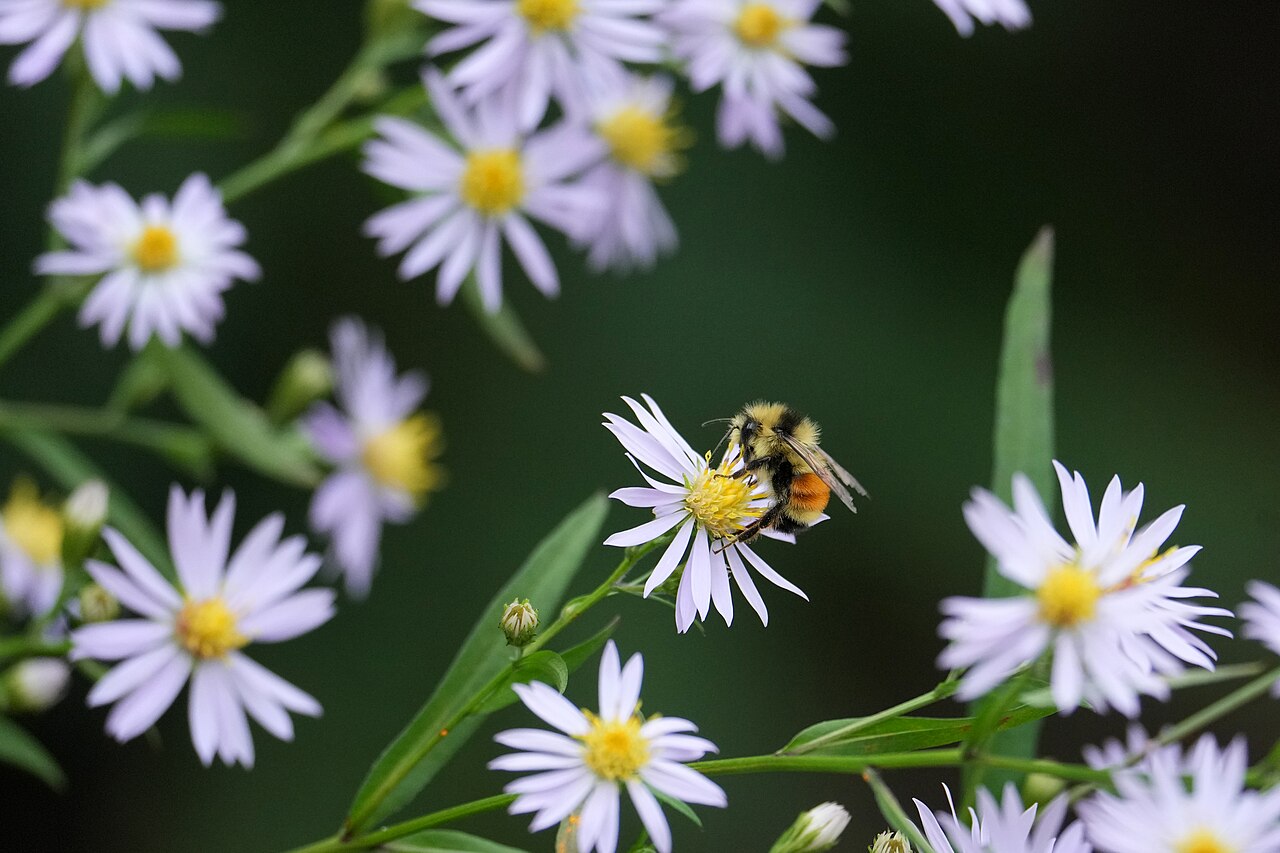
The fall blooming season of Smooth Blue Aster makes it one of the most ecologically critical native wildflowers for pollinators in the northern Great Plains and Rocky Mountain region. Monarch butterflies — making their fall migration from the northern prairies to their Mexican wintering grounds — depend heavily on fall-blooming asters and goldenrods for the nectar needed to build fat reserves for the journey. Various bumble bee species (including the vulnerable Rusty Patched Bumble Bee) need late-season nectar to raise their final fall brood and for overwintering queens. Native sweat bees, mining bees, and specialist aster bees visit the flowers heavily. The yellow central disk of Smooth Blue Aster is particularly attractive to a wide range of insect pollinators because of its accessible, relatively flat structure and abundant nectar.
For Birds
The fluffy seed heads of Smooth Blue Aster, while not as nutritionally dense as those of sunflowers or coneflowers, are harvested by American Goldfinches, Pine Siskins, House Finches, and various sparrows as a late-season food source. The upright, dried stems provide perching sites for small birds. The dense clumps of the plant create cover at ground level for ground-foraging birds such as Juncos, White-throated Sparrows, and other wintering sparrows that forage through the dried prairie vegetation in search of invertebrates and fallen seeds.
Ecosystem Role
As a late-season bloomer, Smooth Blue Aster fills a critical temporal niche in the prairie ecosystem — extending the nectar and pollen calendar into October and providing food for the last wave of migrating pollinators and birds preparing for winter. Its clumping, rhizomatous growth form builds soil organic matter and creates the structural heterogeneity at the soil surface that supports diverse invertebrate communities. As a native aster, it supports specialist native bee species in the genus Andrena and Lasioglossum that forage exclusively or primarily on aster family plants, and whose populations are closely linked to the abundance of native asters in the landscape.
Cultural & Historical Uses
Asters, including Smooth Blue Aster, hold significant place in the ethnobotanical traditions of many Indigenous peoples of North America. The Blackfoot people used preparations of asters (genus Symphyotrichum and related genera) for various medicinal purposes, including as a stimulant, for respiratory problems, and as a wash for skin conditions. Several Great Plains nations used aster preparations to treat headaches, fevers, and nervous system complaints. The flowers were also used for making yellow dye (the ray petals produce yellow-green dyes with appropriate mordants) and for adorning hair, clothing, and ceremonial objects.
The genus name Symphyotrichum reflects a complex taxonomic history. Smooth Blue Aster was originally described by Carl Linnaeus in 1753 as Aster laevis (smooth aster), and it remained in the genus Aster for over 200 years. In the 1990s and 2000s, molecular studies revolutionized understanding of the aster family, demonstrating that the old “Aster” genus was polyphyletic — containing plants from several distinct evolutionary lineages. North American asters were reclassified into numerous new genera, with most prairie and woodland asters placed in Symphyotrichum, while the name Aster was reserved for European and Asian species. Despite the scientific name change, the common names “smooth aster” and “smooth blue aster” remain in common use.
In the contemporary native plant movement, Smooth Blue Aster has become one of the most celebrated and sought-after wildflowers for prairie and meadow gardens. Its extraordinary late-season bloom period, ease of culture, attractive blue-green foliage, adaptability to both sun and part shade, and critical role for monarchs and other late-season pollinators have elevated it to “must-have” status in sustainable landscape design throughout the northern United States and Canada. It is now included in virtually every prairie and meadow seed mix for the northern Great Plains region, and it is one of the most widely available native wildflowers from native plant nurseries throughout Montana and Wyoming.
Frequently Asked Questions
How do I tell Smooth Blue Aster apart from other asters?
The smooth, somewhat waxy, blue-green stems and leaves (without the hairiness of most asters), combined with the strongly clasping upper leaves with prominent auricles (ear-like lobes where the leaf wraps around the stem), are the key identification features. The smooth stems can be felt easily by running your hand along the stem — unlike most other asters, you will feel no roughness or bristles. The blue-lavender to blue-purple ray flowers are also characteristically rich in color compared to many pale-flowered asters.
When does Smooth Blue Aster bloom in Montana and Wyoming?
In Montana and Wyoming, Smooth Blue Aster typically begins blooming in late August to early September, with peak bloom in mid-September. Bloom continues until the first hard frost, typically in late September to October, depending on elevation and year. It is one of the last native wildflowers to bloom before fall frost, making it particularly valuable for late-season pollinators.
Do I need to divide Smooth Blue Aster?
Division every 3 to 4 years is recommended to maintain vigor and control the size of established clumps, but it is not strictly necessary. If plants become very large or the center of the clump starts to die out, dividing in early spring (when new growth is just emerging) rejuvenates them dramatically. Division is also the fastest and most reliable way to increase your supply of plants for expanding a planting.
Is Smooth Blue Aster deer resistant?
Smooth Blue Aster is moderately deer resistant — less palatable than many garden plants but not completely ignored by deer in areas with heavy deer pressure. If deer are a serious problem in your garden, the smooth stems (lacking the aromatic or sticky surface of many deer-deterrent plants) may not be sufficient protection, and physical barriers or deer repellents may be needed for young plants.
Can I grow Smooth Blue Aster from seed?
Yes — Smooth Blue Aster grows well from seed that has been cold-stratified (3 months at 35°F in moist peat). Sow in fall directly in the garden for natural stratification, or start indoors in late winter and transplant after the last frost. Seedlings may not bloom until their second year. You can also collect seed from established plants in fall after the fluffy seed heads have matured, dry them, and sow the following spring after stratification.