Dotted Gayfeather (Liatris punctata)
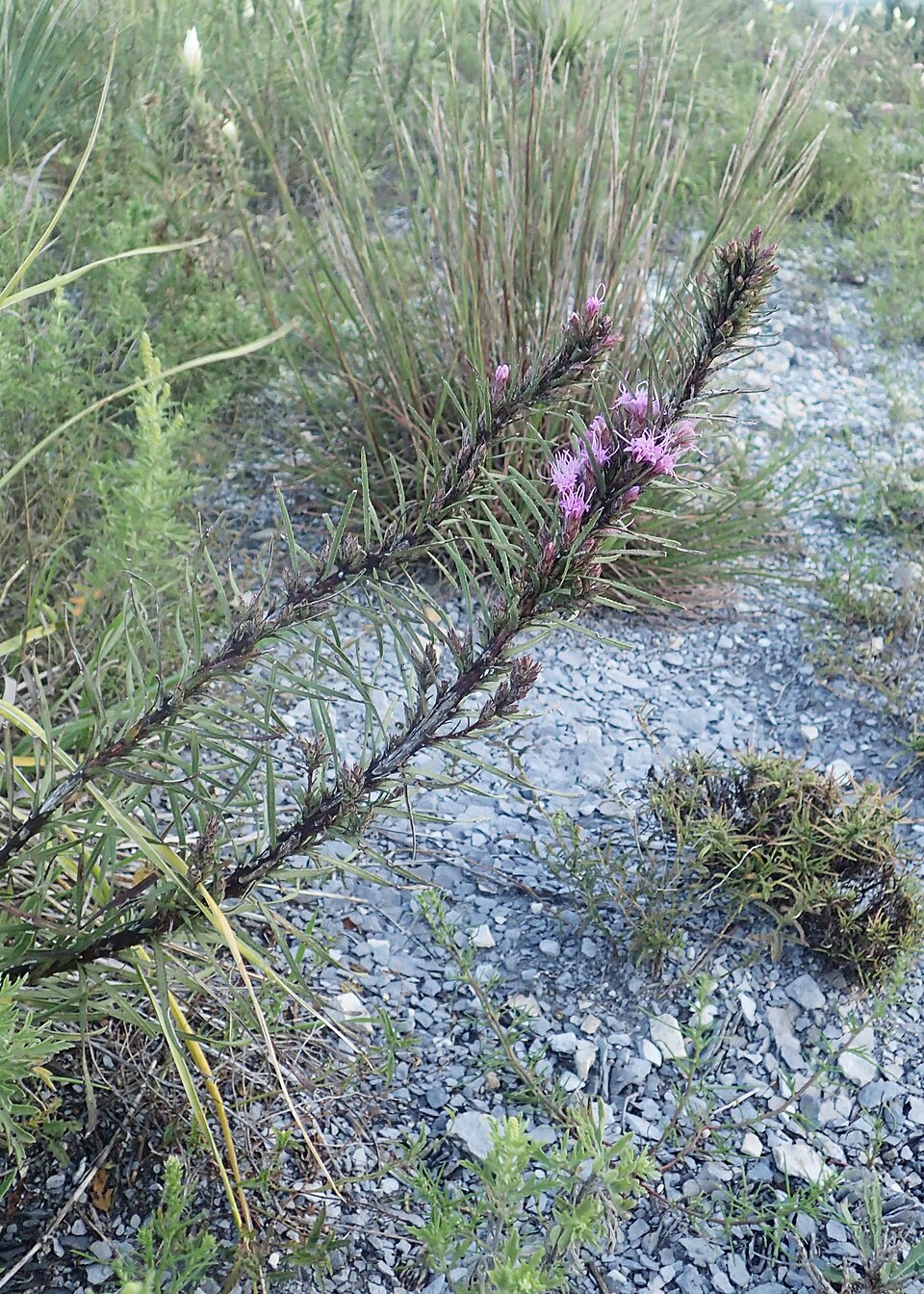
Liatris punctata, commonly known as Dotted Gayfeather or Dotted Blazing Star, is one of the most drought-tolerant and ecologically valuable wildflowers of the shortgrass and mixed-grass prairies of the Great Plains and Rocky Mountain foothills. Rising from the dry prairie like vivid purple exclamation points in late summer and fall, Dotted Gayfeather’s brilliant magenta-purple flower spikes are a defining feature of the western tallgrass and mixed-grass prairie landscape from August through October.
The name “punctata” (Latin for dotted or spotted) refers to the tiny resin dots visible on the leaves when held up to light — a distinctive feature that helps identify this species from other Liatris. Like all gayfeathers, Dotted Gayfeather blooms from the top of its spike downward — an unusual trait that gives the flower head a distinctive appearance as the uppermost florets open first while lower buds remain tightly closed. This bottom-up bloom progression extends the flower’s visual impact over several weeks in late summer.
What makes Dotted Gayfeather particularly remarkable among prairie plants is its extraordinary resilience. Its massive underground corm (a starchy, bulb-like structure) can weigh several pounds in mature specimens and stores enough energy to allow the plant to survive drought, fire, and heavy grazing year after year. This deep energy reserve means even if the above-ground portions are completely destroyed, Dotted Gayfeather can resprout vigorously. In prairie garden design, this resilience translates to a plant that thrives in the most challenging, droughty conditions where other wildflowers struggle.
Identification
Dotted Gayfeather grows as an erect, unbranched perennial forb arising from a deep, starchy corm. Plants typically reach 1–2 feet (30–60 cm) in height, though exceptional specimens in favorable conditions can reach 3 feet. Multiple stems typically arise from the same corm, creating a small clump over time. The plant has a distinctive upright, wand-like appearance when in bloom.
Leaves
The leaves are narrow, linear, and grass-like — ⅛ to ¼ inch (3–6 mm) wide and 3–5 inches (7–12 cm) long. They are numerous and crowded on the stem, giving the plant a dense, somewhat bristly appearance. When fresh leaves are held to the light, tiny transparent resin dots are visible — this is the “punctata” (dotted) characteristic that gives the species its name. Leaves are alternate on the stem, decreasing in size upward. They are firm, somewhat stiff, and olive-green in color. The basal leaves are the longest and remain green through much of the growing season.
Flowers
The flowers are clustered in dense, cylindrical spikes at the top of the stem, typically 4–12 inches long in full bloom. Each tiny floret is a tubular disc flower — there are no ray petals (no “petals” radiating outward like typical daisies). Each floret is vivid rose-purple to magenta-purple, with long, feathery style branches extending beyond the floret that give the spike a fluffy, soft appearance. Blooms open from the top of the spike downward over several weeks, from August through October. The brilliant purple color is highly attractive to pollinators and is visible from a considerable distance across open prairie.
Underground Corm
The large underground corm is the most remarkable structural feature of Dotted Gayfeather. Unlike a bulb (which is made of modified leaves) or a tuber (swollen stem tissue), a corm is a swollen stem base surrounded by papery coverings. In Dotted Gayfeather, the corm can reach 3–4 inches in diameter and penetrate 1–3 feet underground, giving the plant extraordinary drought and fire resilience. In old, established plants, corms can weigh several pounds. This energy storage organ is what allows the plant to thrive in the extreme conditions of the shortgrass prairie.
Quick Facts
| Scientific Name | Liatris punctata |
| Family | Asteraceae (Daisy/Composite family) |
| Plant Type | Perennial Wildflower / Forb |
| Mature Height | 1–2 ft |
| Sun Exposure | Full Sun |
| Water Needs | Low (Drought Tolerant) |
| Bloom Time | August – October |
| Flower Color | Rose-purple to magenta |
| Underground Structure | Deep starchy corm (bulb-like energy storage) |
| Soil Type | Sandy to clay; well-drained; tolerates poor soils |
| USDA Hardiness Zones | 3–9 |
Native Range
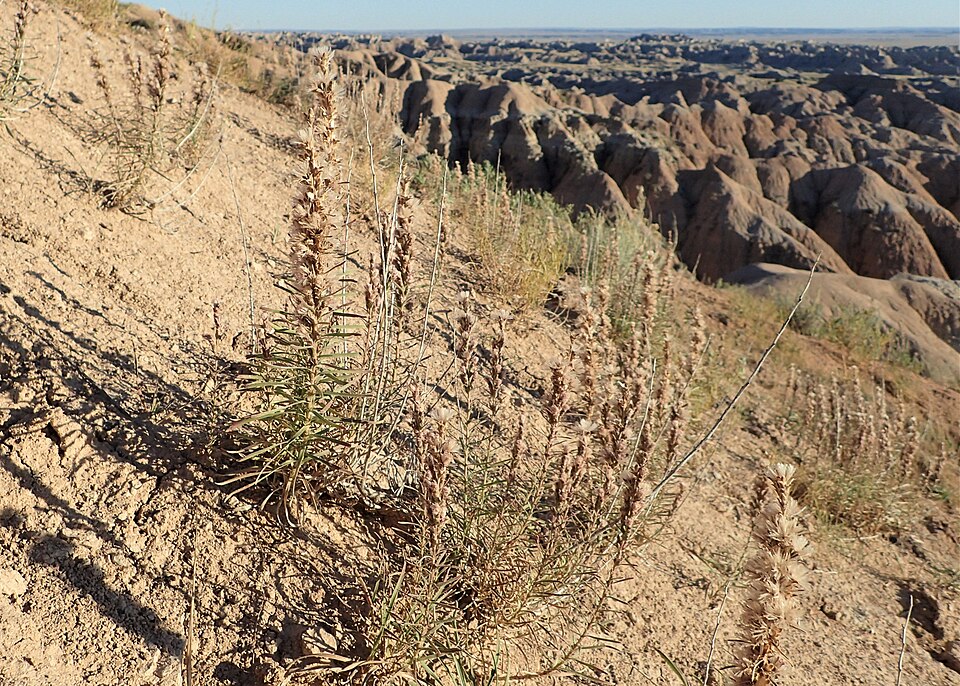
Dotted Gayfeather is native to the central Great Plains and Rocky Mountain foothills, with a range centered on the dry, shortgrass and mixed-grass prairies of the interior West. Its core range extends from Montana and Wyoming south through Colorado, New Mexico, and Texas, and east through the Dakotas, Nebraska, Kansas, Oklahoma, Minnesota, Iowa, and Missouri. Of all the gayfeather species, Dotted Gayfeather is the most drought-tolerant, which explains its dominance in the driest, most continental portions of the Great Plains.
In Montana and Wyoming, Dotted Gayfeather is found on dry grasslands, rocky prairies, and open hillsides in the eastern plains and foothills regions. It is most abundant on dry, well-drained soils with southern or western exposure, where summer drought stress is most severe. In these habitats, it often grows with Blue Grama (Bouteloua gracilis), Western Wheatgrass (Pascopyrum smithii), Prickly Pear Cactus (Opuntia polyacantha), and other drought-adapted prairie plants.
This species is notable for its ability to grow in areas with annual precipitation as low as 10–12 inches — among the most arid conditions tolerated by any eastern North American wildflower. Its range largely corresponds to areas where the shortgrass prairie transitions to the semi-arid Great Basin, reflecting its exceptional tolerance of heat and drought. Populations are typically scattered rather than dense, with individual plants spaced 3–6 feet apart across dry prairie landscapes.
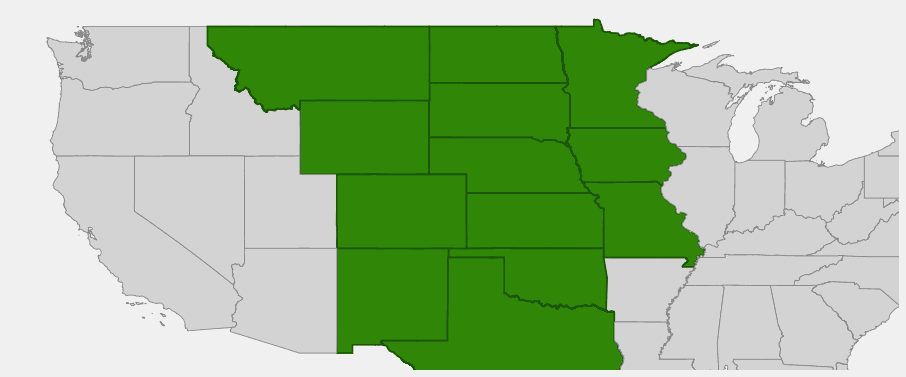
📋 Regional plant lists featuring Dotted Gayfeather: Montana & Wyoming
Growing & Care Guide
Dotted Gayfeather is an ideal plant for gardeners who want spectacular late-summer color with minimal effort and water. Its deep corm makes it extraordinarily resilient once established, and it thrives in the same hot, dry conditions where many other wildflowers fail. The key to success with Dotted Gayfeather is excellent drainage and full sun — give it those two things and it will reward you with reliable late-summer beauty for decades.
Light
Dotted Gayfeather requires full sun — at least 6–8 hours of direct sunlight daily — for optimal flowering and plant health. In partial shade, flowering is reduced and plants become weak and floppy. Plant it in the sunniest, most open location in your garden for best results. It is perfectly adapted to unshaded prairie conditions with no afternoon shade relief, and even thrives in reflected heat from south-facing walls or rock outcroppings.
Soil & Water
Well-drained soil is essential — Dotted Gayfeather will rot in poorly drained or consistently wet soil. It grows naturally in sandy, gravelly, or clay loam soils with excellent drainage. Amend heavy clay soils with grit or sand before planting. Once established (after the second growing season), Dotted Gayfeather needs no supplemental irrigation in its native range. During establishment, water deeply but infrequently — once per week at most. The deep corm, once established, allows the plant to access water far below the surface during drought. Avoid overwatering: this is the most common cause of Dotted Gayfeather failure in gardens.
Planting Tips
Plant container-grown Dotted Gayfeather in spring or early fall. Position the crown at or just above soil level. For seed propagation, sow fresh seeds in fall directly in the planting site or in containers kept outdoors over winter (they need cold stratification). Expect slow establishment — the plant spends its first year or two building its massive underground corm before producing substantial above-ground growth. Do not disturb established plants, as the deep corm dislikes being moved. Space plants 18–24 inches apart in garden settings.
Pruning & Maintenance
Leave spent flower heads through winter — they dry to attractive tan seedheads and provide winter bird food. Birds will pick the seeds from the dried heads through fall and winter. Cut plants back to the ground in early spring before new growth emerges. Divide clumps only when absolutely necessary, as established corms dislike disturbance. Dotted Gayfeather is extremely resistant to pests and disease, and requires no pesticide or fungicide applications.
Landscape Uses
Dotted Gayfeather excels in:
- Dry prairie gardens — a natural partner for Blue Grama, Buffalo Grass, and other shortgrass prairie species
- Xeriscape and rock gardens — thrives in hot, dry, rocky conditions
- Mixed wildflower borders — provides spectacular late-summer purple color
- Butterfly gardens — an exceptional nectar source for migrating monarchs and swallowtails
- Roadsides and slopes — drought-tolerant and low-maintenance once established
- Native plant restorations — keystone species for shortgrass prairie restoration
Wildlife & Ecological Value
Dotted Gayfeather’s late-season bloom timing (August–October) makes it one of the most ecologically valuable wildflowers in the Great Plains, providing critical nectar at a time when many other wildflowers have already finished blooming. Its role as a late-season pollinator resource is particularly important as monarch butterfly migration peaks in September and October.
For Birds
The dried seed heads of Dotted Gayfeather are eagerly consumed by American Goldfinches, Pine Siskins, and various sparrows and finches through fall and winter. Because the plant is upright and the seeds are held above snow level, they remain accessible to birds even after significant snowfall — a critical winter food source in prairie habitats. Grassland birds also use the dense clumps for nesting cover during the breeding season.
For Mammals
The deep, starchy corms of Dotted Gayfeather are consumed by Prairie Dogs and various burrowing rodents, which are willing to dig for the energy-rich storage organ. White-tailed Deer, Mule Deer, and Pronghorn all browse the foliage to varying degrees. The corm’s ability to resprout after browsing or grazing ensures the plant’s persistence in heavily grazed landscapes — making it an important food source for wildlife even under grazing pressure.
For Pollinators
Dotted Gayfeather is one of the premier late-season pollinator plants of the Great Plains. Monarch Butterflies are among its most important and well-known visitors, fueling up on nectar during their southward migration to Mexico in September and October. Painted Ladies, Swallowtails, and many native bee species are also frequent visitors. Several specialist native bee species depend on Liatris as a primary pollen source. The long, tubular florets also attract hummingbirds, particularly Ruby-throated and Broad-tailed Hummingbirds during fall migration.
Ecosystem Role
As a deep-rooted prairie perennial, Dotted Gayfeather contributes significantly to soil health and stability. Its massive corm and associated fine roots create extensive channels in the soil that improve water infiltration and prevent erosion. The plant is fire-adapted and resprouts vigorously after prairie fires, contributing to prairie succession and the maintenance of open grassland habitat. Its bloom timing fills a critical ecological niche in the late-season prairie ecosystem, supporting the final wave of pollinator activity before winter sets in.
Cultural & Historical Uses
Dotted Gayfeather has a rich history of use by Indigenous peoples of the Great Plains. The large, starchy corm was used medicinally and occasionally as a food source. Several Plains tribes used the corm in preparations to treat sore throats, laryngitis, and respiratory ailments — the corm was chewed, made into a tea, or applied as a poultice. The Comanche and other tribes reportedly ate the raw or cooked corm as an emergency food source during times of scarcity, though it was not a primary food plant.
Plains tribes also used various Liatris species ceremonially. Among the Lakota, certain species of blazing star were considered spiritually significant plants associated with vision quests and healing ceremonies. The vivid purple flowers may have contributed to the plant’s ceremonial significance, as purple and violet were considered spiritually powerful colors by many Plains cultures.
In early European-American botanical exploration, Dotted Gayfeather was collected and described as one of the characteristic wildflowers of the Great Plains. John Charles Frémont, during his explorations of the 1840s, documented the abundance of gayfeather in the dry prairies of the central plains. The plant attracted considerable interest from European botanists and horticulturalists, who appreciated its late-season flowering and drought tolerance.
Today, Dotted Gayfeather is increasingly recognized as an important landscape plant for water-wise western gardens and is grown commercially by native plant nurseries throughout the Great Plains and Rocky Mountain regions. Its extraordinary drought tolerance, showy late-season flowers, and minimal maintenance requirements make it one of the most desirable native wildflowers for sustainable western landscaping.
Frequently Asked Questions
How is Dotted Gayfeather different from other Liatris species?
Dotted Gayfeather (Liatris punctata) is distinguished by its tiny resin dots on the leaves (visible with backlighting), its shorter stature (1–2 ft vs. 3–5 ft for some species), and its extreme drought tolerance. It is the gayfeather of the shortgrass prairie — far more arid-adapted than Eastern species like Liatris spicata (Blazing Star) or Liatris aspera (Rough Blazing Star).
How long does it take for Dotted Gayfeather to bloom from seed?
Dotted Gayfeather grown from seed typically does not bloom until its second or third year — the plant spends its first season or two building its underground corm. Container-grown transplants will often bloom in their first season if they have a well-developed corm at time of planting. Patience is essential with this plant, but it is well worth the wait.
Can I move an established Dotted Gayfeather?
Moving established Dotted Gayfeather is not recommended. The deep corm is difficult to dig without damage, and the plant resents root disturbance. If you must transplant, do so in early spring before new growth begins, dig deeply (at least 18 inches) to get the entire corm, and expect a setback of 1–2 years before the plant fully recovers. It’s much better to plant it correctly in the first place.
Why is my Dotted Gayfeather not blooming?
The most common reasons for poor or no flowering are: insufficient sun (needs full sun), overly wet or poorly drained soil, overcrowding by taller plants, or the plant is still young and building its corm. Make sure it has full sun, excellent drainage, and adequate space, and give it time — established corms produce more and more flowering stems each year.
Is Dotted Gayfeather deer resistant?
Dotted Gayfeather has moderate deer resistance — deer will browse it when other food sources are scarce, but it is not a preferred deer food. In areas with very high deer pressure, some protection may be needed during establishment. The plant’s deep corm ensures survival even after heavy browsing, and it will resprout vigorously from the corm even if stripped to the ground.