Beardtongue (Penstemon digitalis)
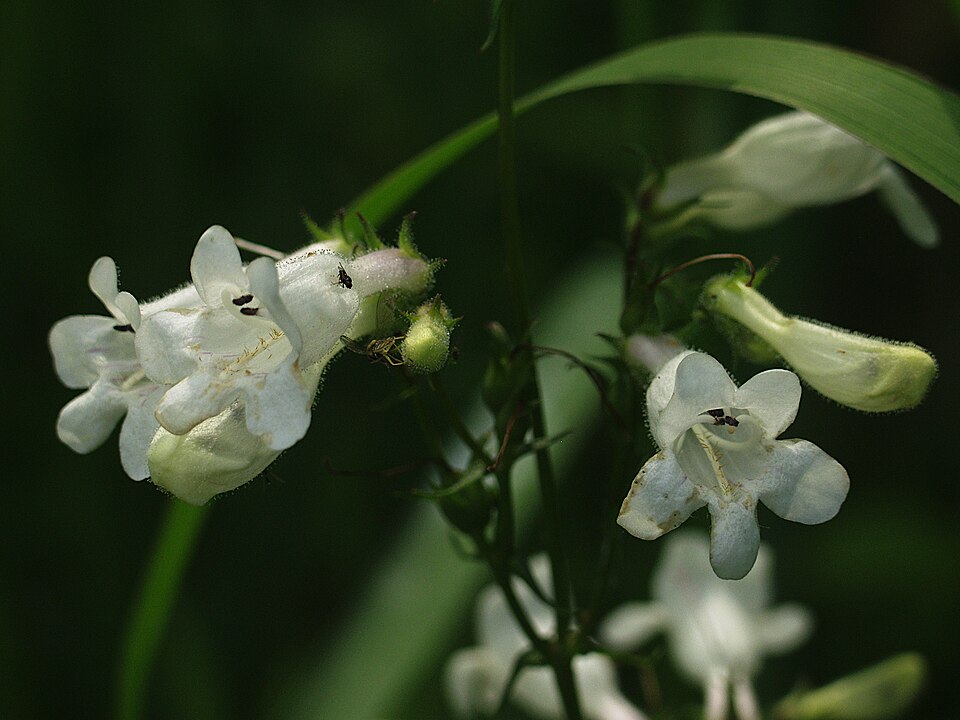
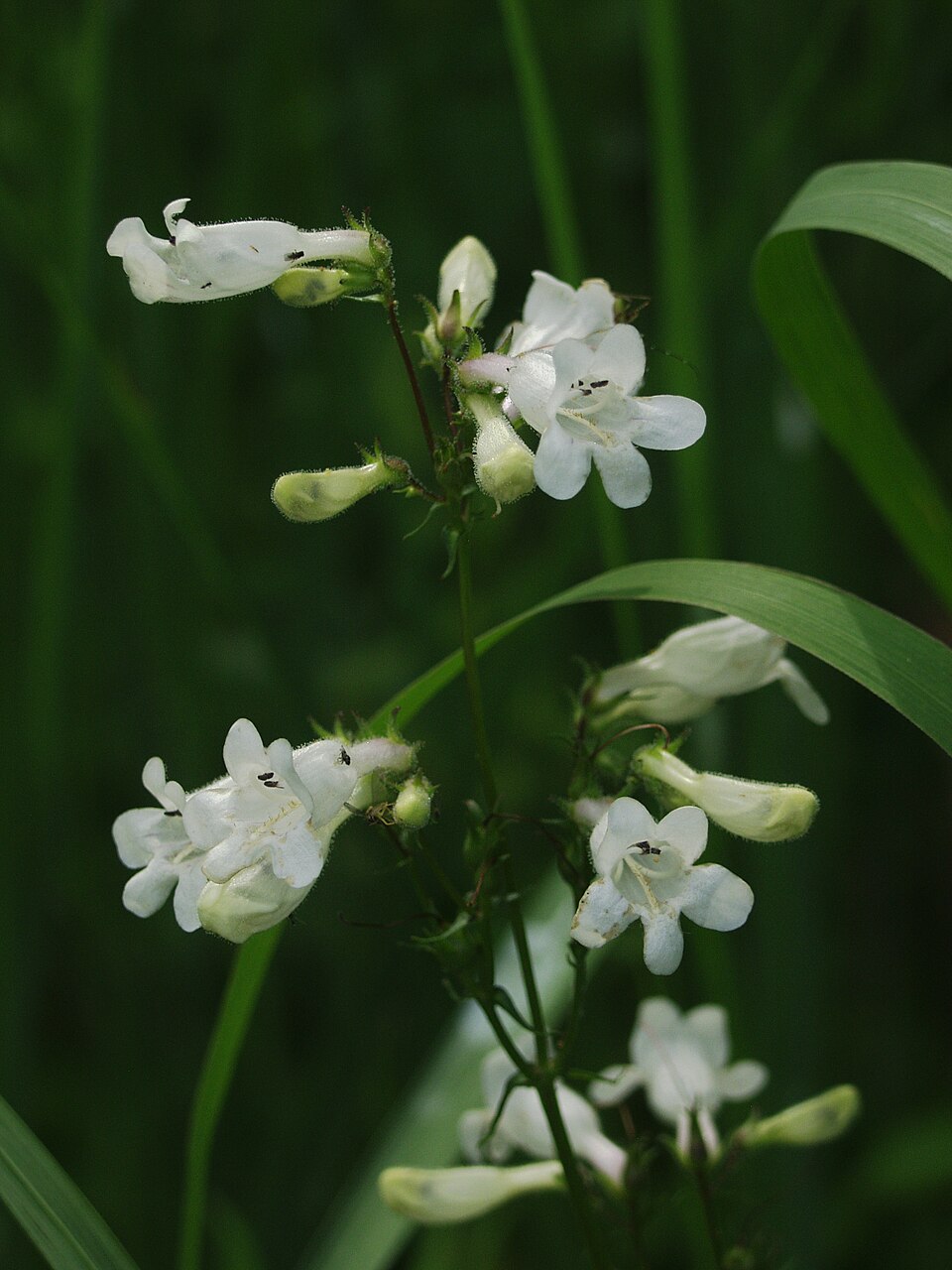
Penstemon digitalis, commonly known as Beardtongue or Foxglove Beardtongue, is one of the most garden-worthy native wildflowers of eastern and central North America. Its tall, graceful spires of pure white tubular flowers rise 2 to 5 feet above bold, dark green foliage from late spring into midsummer, creating a stunning vertical accent in prairie gardens, meadow plantings, and mixed perennial borders. The common name “beardtongue” refers to a distinctive feature of the flower: a sterile, hairy stamen (the “tongue”) that protrudes from the flower tube, one of the hallmarks of the Penstemon genus.
Native to a broad swath of central and eastern North America — from the Great Plains through the Midwest and into New England — Penstemon digitalis is highly adaptable, tolerating everything from full sun to part shade and wet to moderately dry soils. This versatility, combined with its long bloom period (June into midsummer), vigorous growth, and exceptional value for native pollinators, has made it one of the most widely planted native perennials in the region. The cultivar ‘Husker Red,’ which features dramatic wine-red foliage, has won numerous horticultural awards and introduced millions of gardeners to native penstemons.
In the landscape, Beardtongue fills a valuable niche as a tall, white-blooming perennial for sunny to lightly shaded sites with moist to average soil. Its dramatic flower spikes attract hummingbirds, bumblebees, and specialist native bees, while its seeds feed birds through late summer. It self-seeds readily in appropriate conditions, naturalizing over time into impressive drifts that evolve with the garden.
Identification
Beardtongue grows as a clump-forming herbaceous perennial from a short, woody crown. In spring, a rosette of basal leaves appears; flowering stems arise in late May, reaching 2 to 5 feet (60–150 cm) in height by June. The plant may be short-lived (3–5 years) but self-seeds prolifically, maintaining long-term populations without replanting. It is one of the tallest native penstemons in eastern North America.
Leaves
The leaves are opposite, smooth to slightly waxy, and dark, glossy green — a rich color that provides attractive contrast to the white flowers. Basal leaves are larger, oval to lance-shaped, with a rounded or clasping base and finely toothed margins, typically 4 to 7 inches long. Stem leaves are smaller, lance-shaped, and clasp the stem at their base. In some plants and in cool weather, the foliage may develop attractive reddish to bronze tones, particularly on the undersides. The cultivar ‘Husker Red’ has dramatically wine-red foliage throughout the season.
Flowers
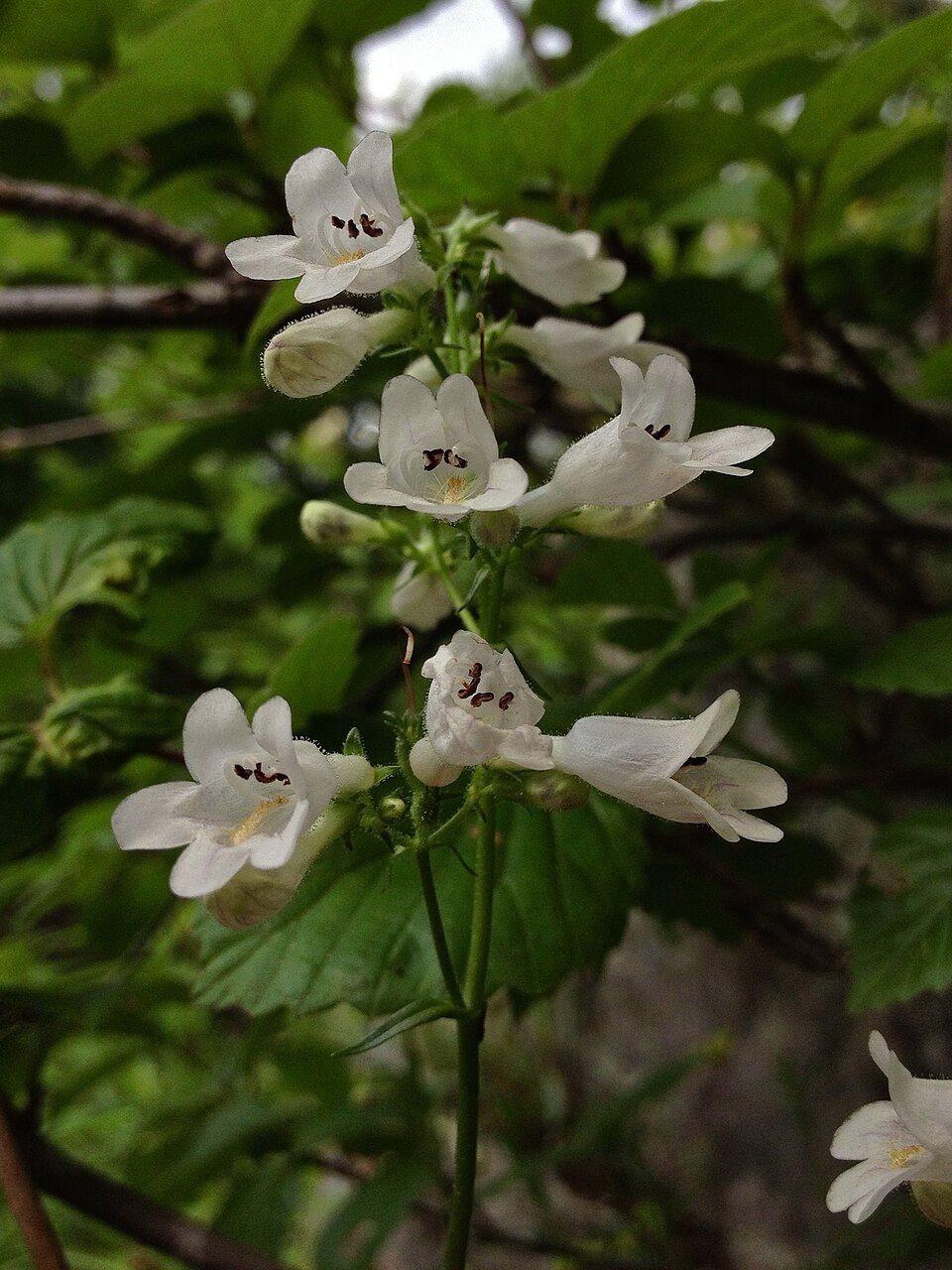
The flowers are the showpiece — tubular, white to pale lavender-white, about ¾ to 1¼ inches (2–3 cm) long, with two slightly reflexed upper lobes and three spreading lower lobes forming a classic foxglove-like shape. Fine purple guidelines (nectar guides) are often visible inside the tube, directing pollinators toward the nectar. The distinctive “beardtongue” — a sterile stamen (staminode) covered in golden hairs — protrudes from each flower tube. Flowers are arranged in branched, upright panicles (thyrses) on each stem, with dozens to hundreds of flowers per stem. Bloom period is typically June through early July, with individual flowers lasting about a week.
Seeds & Fruit
After flowering, the plant produces small, dry, two-chambered seed capsules (about ½ inch long) containing numerous tiny, dark brown seeds. The capsules split open at maturity in late summer, releasing seeds that are dispersed by wind and gravity. Self-seeding is generous, and seedlings establish readily in open soil around parent plants. The spent seed heads are attractive in the winter garden and provide food for birds.
Quick Facts
| Scientific Name | Penstemon digitalis |
| Family | Plantaginaceae (Plantain) |
| Plant Type | Herbaceous Perennial |
| Mature Height | 2–5 ft |
| Sun Exposure | Full Sun to Part Shade |
| Water Needs | Moderate |
| Bloom Time | June – July |
| Flower Color | White to pale lavender-white |
| Foliage | Dark glossy green (reddish in cool weather) |
| Self-Seeds | Yes, readily |
| USDA Hardiness Zones | 3–8 |
Native Range
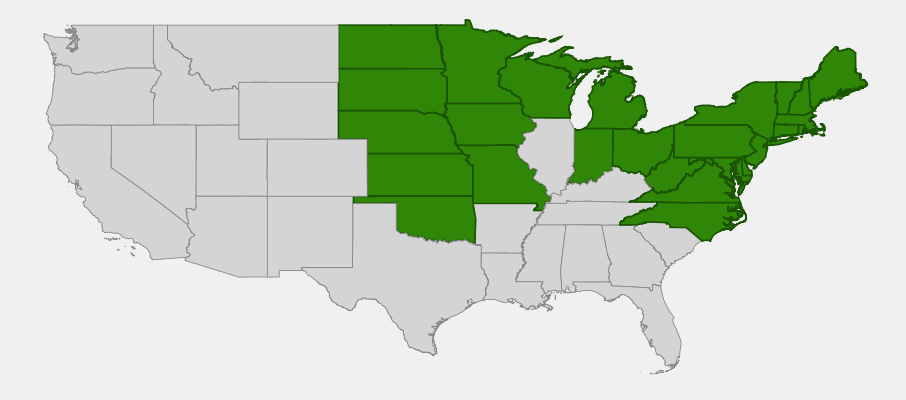
Penstemon digitalis is native to a broad swath of eastern and central North America, extending from the Atlantic coast westward to the Great Plains. Its range stretches from southern Maine, New Hampshire, Vermont, Massachusetts, Rhode Island, and Connecticut south through the Mid-Atlantic states (New York, New Jersey, Pennsylvania, Delaware, Maryland, Virginia, West Virginia, North Carolina), through the Midwest (Ohio, Indiana, Michigan, Wisconsin, Minnesota, Iowa, Missouri, Illinois), and into the central plains states (Kansas, Nebraska, Oklahoma, South Dakota, North Dakota). It is one of the most geographically widespread native penstemons in eastern North America.
Within this range, Beardtongue typically grows in open, disturbed habitats — roadsides, prairies, old fields, woodland edges, meadows, and streambank margins. It thrives in the transitional zone between open grasslands and woodland edges, where it receives adequate sunlight but some protection from desiccating winds. In Michigan, Wisconsin, and Minnesota, it is a common prairie remnant species found in both dry and mesic prairie communities.
Because of its adaptability and prolific self-seeding, Penstemon digitalis has also naturalized somewhat beyond its native range, and it is commonly cultivated throughout the northeastern and midwestern states. When shopping for plants, look for locally sourced seed from regional ecotypes to best support local pollinator populations and maintain regional genetic diversity.
📋 Regional plant lists featuring Beardtongue: Michigan, Minnesota & Wisconsin
Growing & Care Guide
Beardtongue is among the easiest native perennials to establish and maintain, making it an excellent choice for gardeners transitioning to native plants. It is adaptable, long-blooming, and reliably self-seeding — once established in a suitable location, it tends to maintain itself with minimal intervention.
Light
Beardtongue grows best in full sun to part shade (4–8+ hours of direct sun). In full sun, plants grow stockier and bloom most profusely. In part shade, they tend to be taller and somewhat more open in habit. Avoid deep shade, where plants will be spindly and bloom poorly. Morning sun with afternoon shade is acceptable, particularly in warmer climates at the southern end of its range.
Soil & Water
One of Beardtongue’s most valuable traits is its soil adaptability. It thrives in average, moist to moderately dry soils and tolerates periodic wet conditions. It does not require rich soil — in fact, overly fertile, amended soils can cause floppy growth. Neutral to slightly acidic pH (5.5–7.0) is best. Once established, it has good drought tolerance and typically requires no supplemental irrigation in the Midwest and Northeast. Excellent drainage prevents crown rot over winter.
Planting Tips
Plant in spring or early fall. Space plants 18–24 inches apart for individual specimens, or 12 inches apart for a mass planting that will fill in quickly via self-seeding. Avoid planting too deeply — the crown should be at or just at the soil surface. Mulch lightly (1–2 inches) to retain moisture and suppress weeds, keeping mulch away from the crown. Direct-seeding is also effective: sow in fall for spring germination, pressing seed lightly into moist soil without covering (seeds need light to germinate).
Pruning & Maintenance
After the main bloom period (July), cut flowering stems back by one-third to encourage a light rebloom or neat basal foliage. Leave some stems standing for self-seeding if you want the plant to naturalize. The basal rosette remains attractive and semi-evergreen through winter in milder years. Divide clumps every 3–4 years in spring to maintain vigor. This is also a short-lived perennial — expect individual plants to live 3–5 years, but self-seeded offspring will perpetuate the planting indefinitely.
Landscape Uses
- Prairie and meadow plantings — excellent native meadow companion
- Mixed perennial borders — tall white flowers provide vertical accent
- Rain gardens — tolerates periodic wet conditions
- Woodland edges — performs well in dappled shade
- Naturalistic landscapes — self-seeds to create naturalized drifts
- Pollinator gardens — exceptional bee and hummingbird plant
- Cut flowers — beautiful in fresh arrangements
Wildlife & Ecological Value
Beardtongue is an outstanding pollinator plant, with floral structure precisely adapted for bee and hummingbird pollination.
For Birds
Ruby-throated Hummingbirds are among the most frequent visitors to Beardtongue flowers — the tubular white flowers are ideally shaped for hummingbird pollination, and the June bloom period coincides with peak hummingbird activity in the Midwest and Northeast. American Goldfinches and other seed-eating birds consume the small seeds from the persistent capsules in late summer and fall. The upright seed heads provide important late-season seed resources as gardeners often remove spent flower stems.
For Pollinators
Beardtongue is a specialist bee plant — its tubular flowers are sized and shaped specifically for bees that are large enough to access the nectar while making contact with the anthers. Long-tongued bumblebees (especially Bombus griseocollis and Bombus impatiens) are primary pollinators. Mason bees, leafcutter bees, and specialist penstemon bees (Osmia spp.) also visit regularly. Hummingbird Clearwing moths (Hemaris thysbe) probe the flowers for nectar. The long bloom period (4–6 weeks) makes it a sustained nectar source during the critical early-summer period.
For Mammals
White-tailed Deer occasionally browse young foliage, but Beardtongue is generally considered moderately deer-resistant. Rabbits may nibble young plants in spring. The plant’s prolific self-seeding helps it recover quickly from any grazing pressure.
Ecosystem Role
As a native prairie and meadow perennial, Beardtongue contributes to the structural diversity of grassland communities. Its deep fibrous roots improve soil porosity and water infiltration. In disturbed habitats, it functions as an early successional species that provides habitat structure and food resources while slower-growing prairie perennials establish. Its long-lived seed bank helps restore native plant communities following disturbance.
Cultural & Historical Uses
Various Indigenous peoples throughout the eastern and central United States used Penstemon digitalis and related native penstemons medicinally. The Cherokee used preparations made from the roots and leaves to treat toothaches and headaches, and as a component in medicine bundles. The Ojibwe and related Algonquian peoples used penstemon roots in various medicinal preparations, including as part of compound medicines for digestive complaints and fever. Because Penstemon digitalis occupies a broad geographic range overlapping with many cultural groups, its uses were diverse and locally specific.
Foxglove Beardtongue gets part of its common name from the resemblance of its flowers to those of the European Foxglove (Digitalis purpurea) — the species epithet digitalis reflects this similarity. Unlike true foxglove, however, Penstemon digitalis contains no cardiac glycosides and is not known to be toxic to humans or animals in typical quantities. The plant is edible — young leaves can be eaten raw or cooked, and the flowers are edible as garnishes — though it is not commonly used as food today.
In modern horticulture, Beardtongue has become one of the most important and commercially available native perennials in the eastern United States. The 2009 Perennial Plant of the Year award, given to ‘Husker Red’ by the Perennial Plant Association, dramatically increased its popularity and availability in the nursery trade. Today, it is widely planted in both residential and commercial landscape projects, rain garden installations, and native plant restoration efforts from Maine to Texas.
Frequently Asked Questions
Is Beardtongue a perennial or annual?
Beardtongue (Penstemon digitalis) is a herbaceous perennial — it dies back to the ground each winter and re-emerges in spring. However, individual plants tend to be relatively short-lived (3–5 years), and the plant maintains itself in the garden primarily through prolific self-seeding. In practice, once established, it naturalizes and persists indefinitely without replanting.
What is ‘Husker Red’ Beardtongue?
‘Husker Red’ is a cultivated variety of Penstemon digitalis selected for its dramatic wine-red to burgundy foliage, which contrasts beautifully with the white flowers. It was developed at the University of Nebraska, hence the name “Husker” (Nebraska Cornhuskers). It was named Perennial Plant of the Year in 1996 and remains one of the most popular native cultivars available. Note that insects may not distinguish cultivars from straight species — both support pollinators effectively.
Will Beardtongue spread aggressively?
Beardtongue self-seeds readily but is not considered invasive. In a garden context, it naturalizes gradually, filling in gaps and forming attractive drifts over several seasons. Unwanted seedlings are easy to remove when small, and deadheading spent flowers before seeds mature will limit spreading if desired. In the right conditions (sunny, open soil), it can become abundant.
When does Beardtongue bloom?
In Michigan, Minnesota, and Wisconsin, Beardtongue typically blooms from early to mid June through early July, with peak bloom in mid June. The bloom period for individual plants lasts about 4–6 weeks. In warmer climates (Zones 6–8), blooming may begin in late May. The long-blooming pure white flowers are a landmark feature of the early summer native plant garden.
Is Beardtongue deer-resistant?
Penstemon digitalis is considered moderately deer-resistant. White-tailed deer may occasionally browse the foliage, particularly in spring when other food is scarce, but the plant is generally not a deer favorite. In areas with very high deer pressure, some protection for young transplants may be needed until plants are well established.