Illinois Rose (Rosa setigera)
Rosa setigera, commonly known as Illinois Rose, Climbing Prairie Rose, or Michigan Rose, is a remarkable native shrub rose that holds the distinction of being the only native climbing rose species in North America. A member of the Rosaceae family, it earned both its common name and its role as the state flower of Iowa by virtue of its wide natural distribution across the eastern and central United States and its exceptional beauty — producing large, fragrant, soft pink flowers with contrasting golden-yellow centers that bloom magnificently in July, making it one of the last roses to flower in its native range.
Unlike most roses, which have upright or arching stems of modest length, Illinois Rose produces extremely long, flexible canes — sometimes reaching 15 feet or more — that scramble through other shrubs and small trees, effectively climbing by hooking its curved thorns into nearby vegetation. In the wild, this gives it a naturalistic, layered quality as it weaves through shrubby thickets and forest edges, festooning its support plants with garlands of pink blooms in early summer. The flowers are 2 to 3 inches across, lightly fragrant, and borne in clusters of 3 to 7, creating a spectacular floral display that rivals any ornamental rose. The trifoliate leaves — with three leaflets rather than the five or seven leaflets of most roses — are another distinctive feature that aids identification.
For gardeners in Michigan, Minnesota, and Wisconsin, Illinois Rose offers the beauty of a native flowering shrub with excellent wildlife value, exceptional hardiness, and very low maintenance requirements. Its drought tolerance after establishment, resistance to many common rose diseases, and the profusion of small red hips it produces in autumn for wildlife make it a far more ecologically sound choice than non-native ornamental roses in naturalized or wildlife-focused garden settings.
Identification
Illinois Rose is a large, scrambling deciduous shrub that can behave like a vining or climbing plant when support is available. Its most distinctive combination of features — trifoliate leaves (3 leaflets), late-season pink blooms in July, and its ability to grow very long canes — make it readily distinguishable from other native roses.
Leaves
The leaves of Illinois Rose are unusual for a rose in having only 3 leaflets (trifoliate) rather than the 5 or 7 leaflets typical of most other native and cultivated roses. Each leaflet is 1 to 3 inches long, ovate to elliptic, with serrated margins and a smooth to slightly hairy texture. Leaves are bright green in summer, turning attractive shades of red, orange, and purple in autumn before dropping. The trifoliate leaves are the single most reliable field identification feature for this species.
Flowers & Fruit
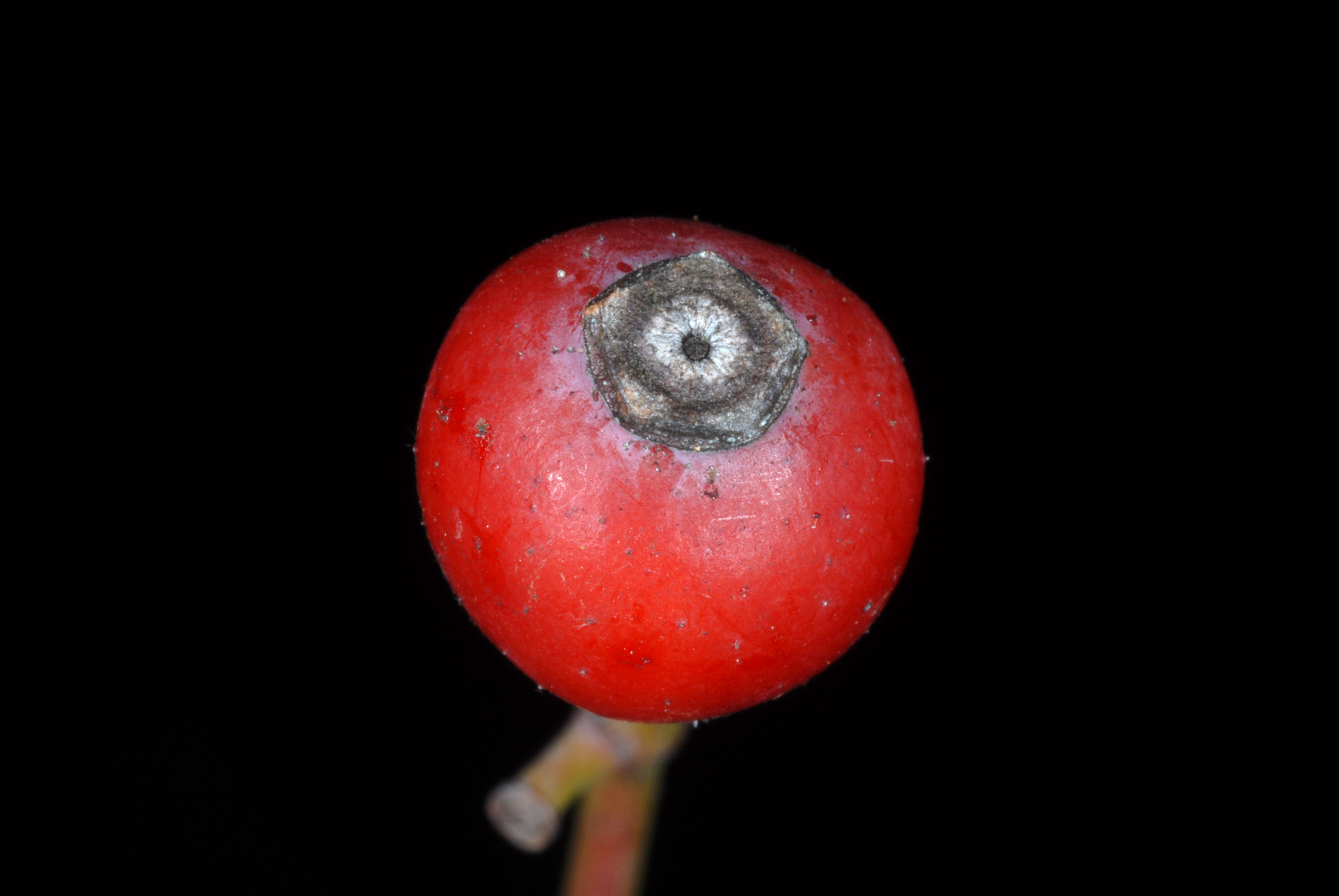
Flowers are 1.5 to 2.5 inches across, single (5 petals), soft pink to rose-pink, with a large cluster of bright golden-yellow stamens at the center. They are lightly fragrant and borne in clusters of 3 to 7 at the tips of new growth. Bloom time is July — notably later than most wild roses, which bloom in June. The petals are slightly wavy and fade to a paler pink or near-white as they age. After blooming, small round to oval red rose hips (about ½ inch) develop and persist through winter, providing a valuable food source for wildlife.
Stems & Thorns
Illinois Rose is distinctive for producing very long, arching to scrambling canes — 6 to 15 feet or more in length — that are armed with curved, hooked thorns that help the plant catch onto and climb through neighboring shrubs and trees. The canes are initially green and somewhat flexible, becoming woody and tan to reddish-brown with age. The hooked thorns (technically prickles) are the mechanism by which the plant climbs — it is not a true vine but uses other plants as support scaffolding.
Quick Facts
| Scientific Name | Rosa setigera |
| Family | Rosaceae (Rose) |
| Plant Type | Deciduous Climbing / Scrambling Shrub |
| Mature Height | 2–6 ft (canes to 15 ft) |
| Sun Exposure | Full Sun |
| Water Needs | Moderate to Low (Drought Tolerant once established) |
| Bloom Time | July (latest-blooming native rose) |
| Flower Color | Soft pink with yellow center |
| Fruit | Small red rose hips (wildlife value) |
| USDA Hardiness Zones | 4–9 |
Native Range
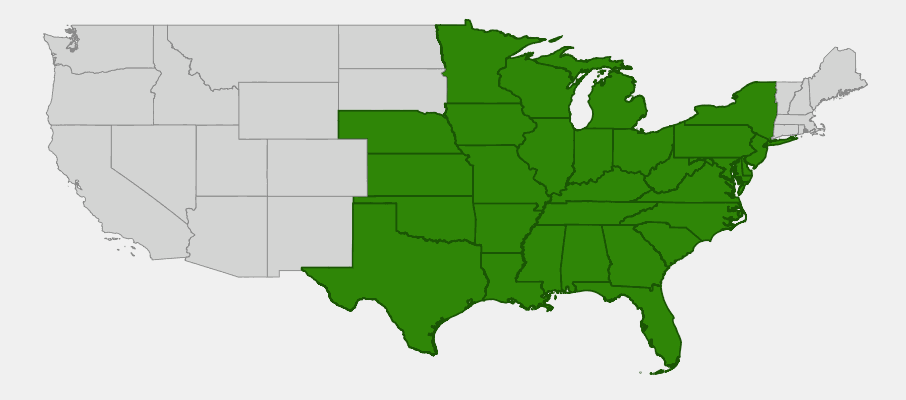
Illinois Rose is native to a broad swath of eastern and central North America, from the Atlantic Coast westward through the Midwest and into the eastern Great Plains. Its range extends from southern Ontario and Quebec in Canada south through the eastern states to Florida and west to Nebraska and Kansas. It is one of the more common native wild roses of the eastern United States, found in a wide variety of edge habitats throughout its range.
In the Upper Midwest, Illinois Rose occurs naturally in Michigan, Wisconsin, and Minnesota, where it grows at prairie margins, along forest edges, in thickets, and along roadsides and fence rows. It prefers well-drained to moderately dry soils in full sun, and is particularly characteristic of shrubby areas at the transition between forest and open land — exactly the kind of habitat that once covered vast areas of the Great Lakes region as prairie-oak savanna.
The species has also naturalized beyond its native range in some areas, particularly in the northeastern states where it has escaped from cultivation. It is an ancestor of several important cultivated climbing roses developed in the early 20th century, including the popular ‘American Pillar’ and ‘Baltimore Belle’ rose cultivars, which inherited Illinois Rose’s hardiness, disease resistance, and late blooming habit from their native parent.
📋 Regional plant lists featuring Illinois Rose: Michigan, Minnesota & Wisconsin
Growing & Care Guide
Illinois Rose is a vigorous, adaptable, and relatively easy-to-grow native rose that thrives with minimal care once established. Unlike many cultivated roses, it requires no spraying, special fertilization, or winter protection in its native hardiness range.
Light
Full sun is essential for best flowering — Illinois Rose needs at least 6 hours of direct sunlight per day, and more is better. In shadier sites, it produces fewer flowers, grows more open and rangy, and may be more susceptible to fungal diseases. Plant it on a sunny fence, wall, or trellis, or let it scramble through an existing shrub mass in full sun.
Soil & Water
Illinois Rose adapts to a wide range of soil conditions and is notably drought tolerant once established. It grows well in average to dry, well-drained soils — from sandy loam to clay loam — and tolerates poor soils better than most ornamental roses. Avoid consistently wet or waterlogged conditions. Moderate watering during the first growing season aids establishment; after that, irrigation is rarely needed except during extended drought. It does not require the regular fertilization that cultivated roses need.
Planting Tips
Plant Illinois Rose in spring or fall, giving it a support structure — a fence, trellis, arbor, or large shrub — to grow through. Alternatively, allow it to mound or sprawl as a large shrub hedge; without support, it forms a dense, arching thicket 4–6 feet tall and wide. Space plants 5–8 feet apart if creating a hedge or screen. Plant in the back of borders where its long canes have room to spread without encroaching on smaller plants.
Pruning & Maintenance
Illinois Rose blooms on second-year wood (old wood), so prune after flowering rather than in spring to avoid removing the current year’s buds. Remove dead or damaged canes in late winter. Renewal pruning — removing the oldest canes to the ground every 3–4 years — keeps the plant vigorous and prevents the center from becoming a dense, dead thicket. Wear sturdy gloves; the hooked thorns are effective at snagging clothing and skin. Illinois Rose is largely disease-resistant compared to hybrid garden roses, though black spot and powdery mildew may occur in crowded or humid conditions; improve air circulation rather than spraying.
Landscape Uses
- Fence and trellis coverage — the long canes quickly cover structures with fragrant blooms
- Wildlife hedgerows — dense thorny growth creates excellent nesting cover
- Prairie edges and savanna plantings — natural habitat equivalent
- Bank stabilization — vigorous root system controls erosion on slopes
- Natural screening — impenetrable when planted in rows
- Butterfly and pollinator gardens — blooms attract native bees and butterflies
Wildlife & Ecological Value
Illinois Rose provides exceptional wildlife value across all seasons, making it one of the most ecologically productive native shrubs for the Great Lakes region.
For Pollinators
The large, open flowers of Illinois Rose are accessible to a wide variety of native pollinators, including bumble bees, native mining bees, sweat bees, and specialist rose bees. The abundant golden stamens provide pollen (Illinois Rose produces little nectar, like most wild roses, relying on pollen as the primary pollinator reward). The July bloom time fills a mid-summer pollinator nectar gap when many spring wildflowers have finished and late-summer wildflowers have not yet started.
For Birds
The small red rose hips that develop after flowering persist through winter and are consumed by over 20 species of birds, including Cedar Waxwings, American Robins, Hermit Thrushes, Gray Catbirds, and various sparrows. The dense, thorny canes provide some of the best nesting habitat available to small birds — the thorns deter predators, making Illinois Rose thickets highly sought-after nest sites for Yellow Warblers, Northern Cardinals, and Song Sparrows.
For Mammals
White-tailed deer browse Illinois Rose foliage and twigs, though the thorny canes provide some protection. Cottontail rabbits use dense rose thickets as critical escape cover and consume bark and twigs in winter. Mice and voles consume the hips in winter.
Ecosystem Role
Illinois Rose is a foundational shrub species of the shrubby-thicket and forest-edge community, providing shelter, food, and nesting habitat for a diverse community of species. Its thicket-forming habit creates dense, impenetrable stands that serve as ecological anchors in disturbed landscapes, harboring a rich understory community of invertebrates, small mammals, and ground-nesting birds. Its long canes tie the vegetation layers together, creating structural complexity that increases overall habitat quality.
Cultural & Historical Uses
Native Americans across Illinois Rose’s range used various parts of the plant medicinally. The Ojibwe used a decoction of the roots as a treatment for eye ailments, and the berries (hips) were consumed as food — raw, dried, or cooked into preserves — throughout the eastern tribes. Rose hips are exceptionally high in Vitamin C, and Indigenous peoples who relied on Illinois Rose hips during winter months benefited significantly from their nutritional content. The leaves were also brewed into medicinal teas for treating various ailments including stomach disorders and fevers.
Illinois Rose played an important role in the development of American horticulture. The 19th-century American rose breeder Samuel Feast used it to develop ‘Baltimore Belle’ (1843) and other early American climbing rose cultivars that combined the native species’ extraordinary hardiness and disease resistance with improved flower color and form. These hybrids were important in the era before modern disease-resistant cultivars, as they could survive harsh midwestern winters without protection — something that their European climbing rose relatives could not do.
The species became a popular ornamental plant in 19th and early 20th century American gardens, valued for its ability to cover fences and trellises with fragrant blooms in climates too harsh for most European roses. It experienced a decline in popularity with the rise of modern hybrid teas and floribundas in the mid-20th century, but has seen a resurgence of interest among native plant enthusiasts and ecological gardeners who appreciate both its beauty and its ecological value. The movement to replace invasive non-native shrubs like Multiflora Rose (Rosa multiflora) with native alternatives has further elevated Illinois Rose’s profile as the responsible native choice for gardeners wanting a flowering rose in the landscape.
Frequently Asked Questions
How is Illinois Rose different from invasive Multiflora Rose?
Illinois Rose (Rosa setigera) is a native species with 3-leaflet (trifoliate) leaves, large pink blooms in July, and a controlled growth habit. Invasive Multiflora Rose (Rosa multiflora) has 5–9 leaflets, small white flowers in May–June, and spreads aggressively from prolific seed production, covering vast areas. The trifoliate leaves of Illinois Rose are the easiest field distinction.
Does Illinois Rose need winter protection in Zone 4?
Illinois Rose is generally hardy to Zone 4 without special protection, making it suitable for most of Michigan, Minnesota, and Wisconsin. In the coldest parts of Zone 4, some cane tip dieback may occur in severe winters, but the plant typically rebounds vigorously from the base. No wrapping or mulching of the canes is necessary.
Will Illinois Rose climb a trellis?
Illinois Rose will not truly twine or grip a trellis with tendrils — it is not a true vine. Instead, it uses its hooked thorns to catch onto support structures. Tie the long canes to a fence or trellis with flexible garden ties, weaving them through openings to provide support. With training, it can effectively cover fences, arbors, and structures.
How big will Illinois Rose get?
Without support, Illinois Rose forms a dense mounding shrub 4–6 feet tall and equally wide. With support and long canes trained horizontally, it can cover a fence or trellis 10–15 feet across. It is not a small plant — give it plenty of room.
Is Illinois Rose fragrant?
Illinois Rose has a light, pleasant fragrance, though not as intensely perfumed as many cultivated roses. The scent is most noticeable on warm, still mornings. Rose hips are not fragrant but are visually ornamental in autumn and winter.