Wreath Goldenrod (Solidago caesia)
Solidago caesia, commonly known as Wreath Goldenrod or Bluestem Goldenrod, is one of the most distinctive and shade-tolerant goldenrods in North America — standing apart from the typical image of goldenrod as a sun-loving meadow plant. Unlike most of its relatives that demand open, sunny habitats, Wreath Goldenrod is native to the woodland understory, growing in dappled to moderate shade beneath deciduous forest canopies where few other flowering perennials can produce a worthwhile display in autumn.
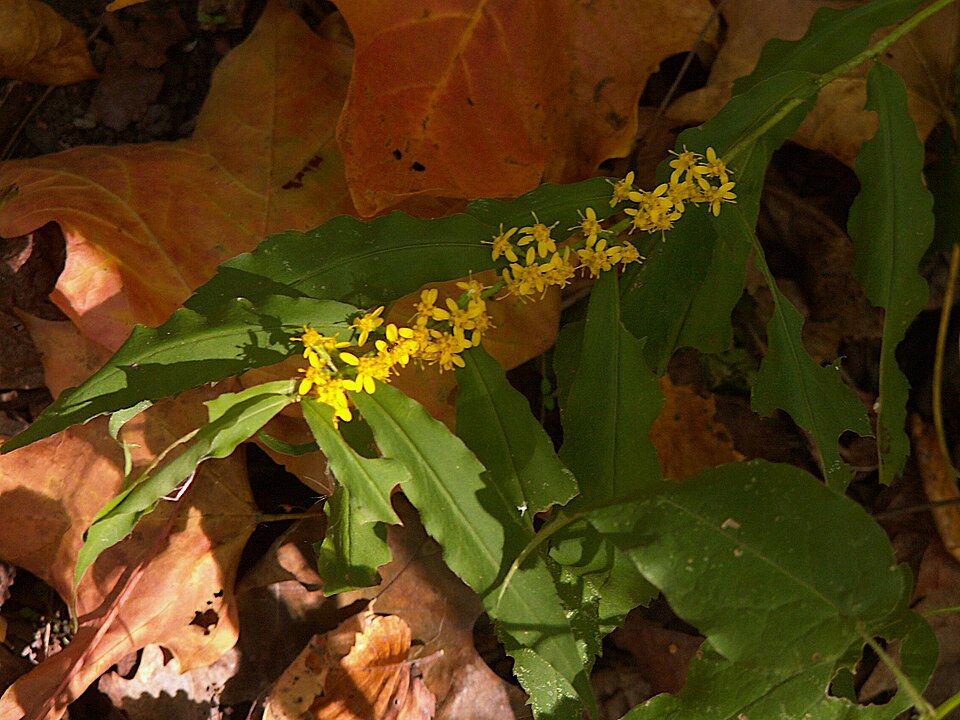
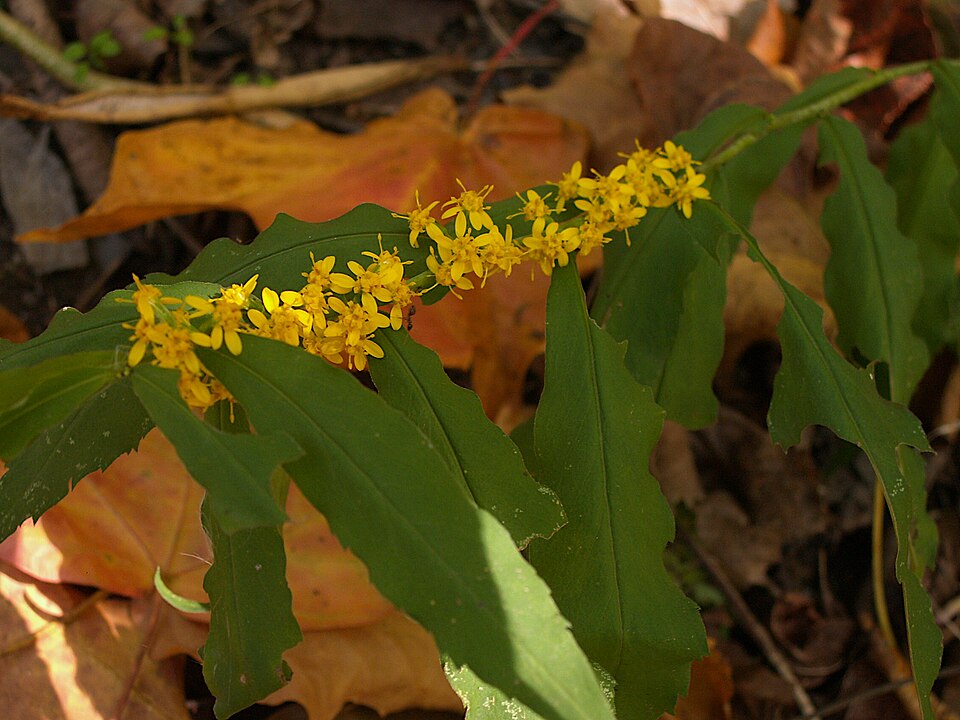
The source of the common name “Wreath Goldenrod” is immediately apparent when you see the plant in bloom: rather than producing the typical arching plume of flowers at the stem tip characteristic of most goldenrods, Wreath Goldenrod produces small, dense clusters of yellow flowers directly from the leaf axils along the entire length of its graceful, arching stems. The effect is of a spiral wreath of yellow flowers winding around each stem — hence the charming common name. The blue-green to glaucous stem color gives the plant its alternative name, Bluestem Goldenrod.
A member of the Asteraceae family, Wreath Goldenrod grows 1 to 3 feet tall in the moist to moderately dry understory and woodland margins of eastern North America. In Kentucky and Tennessee, it blooms in September and October — one of the last wildflowers of autumn — providing a critical late-season nectar source for migrating monarch butterflies, native bees, and other pollinators preparing for winter. Its tolerance of shade makes it an extraordinarily valuable plant for the challenging conditions of the shaded native garden.
Identification
Wreath Goldenrod is one of the most distinctive goldenrods in eastern North America and relatively easy to identify based on its axillary flower arrangement, glaucous stems, and woodland habitat. It differs from all common goldenrods in having flowers along the stem rather than in terminal plumes.
Stems
The stems are a key identification feature: they are smooth, slender, and covered with a distinctive blue-green to glaucous (whitish-gray) waxy bloom — the feature that gives the plant its alternative name, Bluestem Goldenrod. The stems are usually slightly arching rather than rigidly upright, giving the plant a graceful, flowing habit. Stems typically grow 1 to 3 feet tall, emerging from a basal rosette of leaves. The smooth, glaucous stems distinguish this species from many other goldenrods that have hairy stems.
Leaves
The leaves are alternate, lance-shaped to elliptic, 2 to 4 inches long, with sharply serrated margins. They are dark green above, somewhat paler below, and smooth (lacking the hairiness of many goldenrod species). The leaves decrease in size from the base upward. An important identification feature: the leaves are sessile (without petioles) and clasp the stem slightly at their bases. The teeth on the leaf margins are sharp and regular. In autumn, the leaves often develop attractive yellow coloration as they senesce after the flowers.
Flowers
The distinctive flower arrangement is the plant’s most diagnostic feature — small clusters of yellow flower heads (each cluster about ½ inch across) emerge directly from the axils of the leaves along the stem, rather than in a terminal plume. Each individual flower head contains 3–5 ray flowers and 3–6 disk flowers. When in full bloom, the entire length of each stem is decorated with these axillary clusters, creating the wreath-like appearance that gives the plant its common name. Bloom time is September–October in Kentucky and Tennessee.
Quick Facts
| Scientific Name | Solidago caesia |
| Family | Asteraceae (Daisy / Composite) |
| Plant Type | Herbaceous Perennial |
| Mature Height | 1–3 ft |
| Sun Exposure | Part Shade to Full Shade |
| Water Needs | Moderate |
| Bloom Time | September – October (late season) |
| Flower Color | Golden yellow; axillary (wreath-like) clusters |
| Stem Color | Blue-green to glaucous (Bluestem Goldenrod) |
| Deer Resistant | Moderately (generally avoided by deer) |
| USDA Hardiness Zones | 4–8 |
Native Range
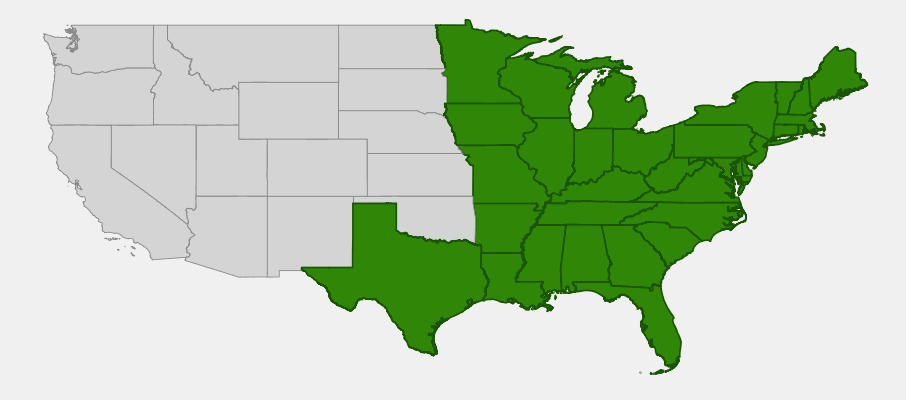
Wreath Goldenrod is native to eastern North America, with a range extending from southern Maine and southern Quebec westward through the Great Lakes states to Minnesota and Iowa, and southward through the entire eastern United States to Florida, Louisiana, and Texas. It is widely distributed throughout the eastern deciduous forest biome, though its preference for shaded woodland understory makes it less visible than the sun-loving meadow goldenrods that are more prominently associated with the genus Solidago.
In Kentucky and Tennessee, Wreath Goldenrod is native throughout both states, occurring in moist to dry deciduous forest understories, along woodland paths, in shaded ravines, and at the edges of mature forests. It is particularly common in the mixed mesophytic forests of the Cumberland Plateau and the rich hardwood forests of the central Kentucky Bluegrass region and Middle Tennessee basin. Its occurrence in woodland habitats distinguishes it from the more common goldenrods found in open fields and roadsides.
The species shows some ecological overlap with its close relative Zigzag Goldenrod (Solidago flexicaulis), which also grows in shaded woodland understory. However, Zigzag Goldenrod has a distinctly zigzag stem pattern and winged petioles (leaf stalks), while Wreath Goldenrod has smooth, straight to gently arching glaucous stems and sessile leaves.
📋 Regional plant lists featuring Wreath Goldenrod: Kentucky & Tennessee
Growing & Care Guide
Wreath Goldenrod is a rewarding and relatively easy-care native perennial for shaded gardens, providing late-season color at a time when most shade garden plants have finished blooming. Its tolerance of a wider range of light conditions than most goldenrods makes it uniquely useful.
Light
Wreath Goldenrod is one of the most shade-tolerant goldenrods and performs well in part shade to full shade — the conditions found in the deciduous forest understory where it naturally grows. It will also grow in full sun if moisture is adequate, but part shade is generally recommended in the hot summers of Kentucky and Tennessee to prevent wilting. A site with morning sun and afternoon shade is ideal for maximum flowering while maintaining plant health through the summer months.
Soil & Water
This species grows in moist to moderately dry, well-drained soil with a slightly acidic to neutral pH. It is moderately drought-tolerant once established but performs best with consistent moisture, especially during the summer months leading up to its fall bloom period. Rich, humus-y woodland soil amended with organic matter produces the most vigorous plants. Unlike many goldenrods, it does not spread aggressively through rhizomes in woodland conditions, making it a well-behaved addition to the shaded garden.
Planting Tips
Plant in fall or spring in a shaded to partially shaded location. Space plants 18–24 inches apart for a natural, spreading colony effect. Wreath Goldenrod works beautifully as an autumn-blooming understory layer beneath deciduous trees and shrubs, providing late-season color when spring and summer shade garden plants have finished. It combines particularly well with ferns, wild gingers, and spring-blooming woodland wildflowers that complete their display before the goldenrod reaches its peak.
Pruning & Maintenance
No pruning is required. Allow seed heads to stand through winter for bird food and winter structural interest. Cut plants back to a few inches from the ground in late winter before new growth begins. Division every 3–4 years helps maintain vigor; divide in spring when new shoots are just emerging. This plant requires very little fertilization — in average woodland soil it thrives without amendment.
Landscape Uses
- Shade gardens — one of the few goldenrods that thrives in shade, providing fall color where few plants bloom
- Woodland understory — naturalizes beautifully beneath deciduous trees alongside ferns and wildflowers
- Late-season pollinator gardens — critical fall nectar source for migrating monarchs and native bees
- Naturalistic borders — the graceful arching stems and axillary flowers add unique texture
- Rain garden margins — adapts well to the moderately moist conditions at rain garden edges
- Four-season interest — attractive foliage through summer, flowers in fall, seed heads in winter
Wildlife & Ecological Value
Wreath Goldenrod is an ecologically significant late-season wildflower, providing critical resources for wildlife at the pivotal time of early fall when many species are preparing for migration or winter.
For Birds
The seeds of Wreath Goldenrod are consumed by a variety of small songbirds including American Goldfinches, White-throated Sparrows, Dark-eyed Juncos, and Pine Siskins during fall and winter. The plant’s woodland habitat setting means that it is also particularly valuable for forest-interior bird species that rely on the insects attracted to goldenrod flowers — including warblers actively feeding during fall migration. The insect diversity supported by goldenrod flowers is itself a major wildlife food resource.
For Mammals
White-tailed deer occasionally browse goldenrod foliage, but Wreath Goldenrod’s woodland habitat and somewhat bitter foliage make it less palatable than many plants. Small mammals including field mice and voles may gather seeds. The plant’s compact, clumping form provides minimal structural cover for large mammals but contributes to the habitat complexity of the woodland floor.
For Pollinators
Wreath Goldenrod is a crucial late-season nectar source for pollinators preparing for winter. Monarch butterflies rely heavily on goldenrod nectar during their fall migration through Kentucky and Tennessee — the October timing of Wreath Goldenrod’s bloom in shaded habitats makes it a particularly valuable stop for monarchs moving along woodland corridors. Native bees including bumblebee queens (which need abundant late-season nectar to provision winter nests), sweat bees, and numerous other species visit the flowers in abundance. Goldenrods collectively support over 100 native bee species.
Ecosystem Role
As one of the few goldenrods adapted to woodland understory conditions, Wreath Goldenrod fills a unique ecological niche as a late-season flowering plant in the forest interior. Solidago species are known to support extraordinary insect diversity — research has documented hundreds of insect species associated with native goldenrods, including many specialist relationships with native bees and caterpillars of native moths and butterflies. By bringing this ecological productivity into shaded garden and woodland settings, Wreath Goldenrod extends the wildlife value of native plantings into habitats that are often underserved by flowering plants in late summer and fall.
Cultural & Historical Uses
The genus Solidago (goldenrod) has a rich history of use by North American Indigenous peoples, and Wreath Goldenrod was used similarly to other goldenrod species by native nations of the eastern woodlands. The Cherokee used preparations from goldenrod species for treating wounds, fevers, toothache, and skin conditions. The Iroquois used goldenrod in ceremonial contexts and as a general tonic. Several nations used goldenrod leaves as a tea substitute, and the plant was a component of traditional “love medicine” preparations in some cultural traditions.
European settlers brought goldenrod to Europe, where it became a valuable medicinal herb known as “Solidago” or “Woundwort” in traditional herbal medicine. It was widely used as an anti-inflammatory, diuretic, and wound-healing agent. The famous herbalist Nicholas Culpeper praised goldenrod highly in the 17th century. Goldenrod tea made from dried flowers and leaves remains a popular herbal preparation in Europe today.
Goldenrod’s reputation in North America has long been unfairly marred by its association with hay fever — though goldenrods are entirely innocent of this charge. Ragweed (Ambrosia species), which blooms at the same time as goldenrod and produces abundant wind-borne pollen, is the actual cause of late-summer hay fever. Goldenrod’s heavy, sticky pollen is insect-carried and does not travel by wind. Educating gardeners about this fundamental misconception is one of the most important contributions that native plant advocates can make to the rehabilitation of these ecologically priceless wildflowers.
Frequently Asked Questions
Does Wreath Goldenrod cause hay fever?
No — this is a persistent myth. Goldenrods (Solidago species) produce heavy, sticky, insect-carried pollen that does not travel by wind and therefore cannot cause hay fever. The actual culprit is Ragweed (Ambrosia species), which blooms at the same time and has tiny, wind-borne pollen grains that can travel miles. Goldenrod is entirely safe for allergy sufferers to handle and grow — in fact, it is an excellent choice for gardens, providing stunning fall color and exceptional ecological value without any allergy risk.
Is Wreath Goldenrod different from common goldenrod?
Yes — Wreath Goldenrod is distinctly different from the common meadow goldenrods such as Canada Goldenrod (S. canadensis) or Tall Goldenrod (S. altissima) that grow in open fields and roadsides. Wreath Goldenrod is a woodland species that grows in shade, has a more compact form (1–3 feet vs. 3–6+ feet), and produces its flowers in axillary clusters along the stems rather than in terminal plumes. It is also much less aggressive and does not spread invasively like some meadow goldenrods can in disturbed soils.
Will Wreath Goldenrod spread aggressively in my garden?
No — Wreath Goldenrod is well-behaved compared to some meadow goldenrods. In woodland garden conditions (shade, humus-y soil), it spreads modestly through short rhizomes and self-seeding, forming pleasant, natural-looking colonies without taking over. In sunnier, more disturbed conditions it may spread somewhat more vigorously, but it is not considered invasive in native plant gardens. Division every few years helps maintain vigor and control spread.
What goldenrods are native to Kentucky and Tennessee besides Wreath Goldenrod?
Kentucky and Tennessee are home to numerous native goldenrod species, reflecting the region’s botanical richness. Other notable natives include Stiff Goldenrod (S. rigida), Showy Goldenrod (S. speciosa), Gray Goldenrod (S. nemoralis), Zigzag Goldenrod (S. flexicaulis), Sweet Goldenrod (S. odora), and several others. Each occupies a somewhat different ecological niche in terms of moisture, light, and soil preferences, allowing a knowledgeable gardener to feature goldenrods in nearly every area of the native garden.
When is the best time to plant Wreath Goldenrod?
Fall planting (September–October) is ideal for Wreath Goldenrod — it allows the plant to establish roots through the mild fall and winter weather before facing its first summer. Spring planting also works well, planted as container stock. Avoid planting in the heat of summer. Once planted, keep the plant consistently moist for the first growing season while it establishes its root system.