Coral Honeysuckle (Lonicera sempervirens)
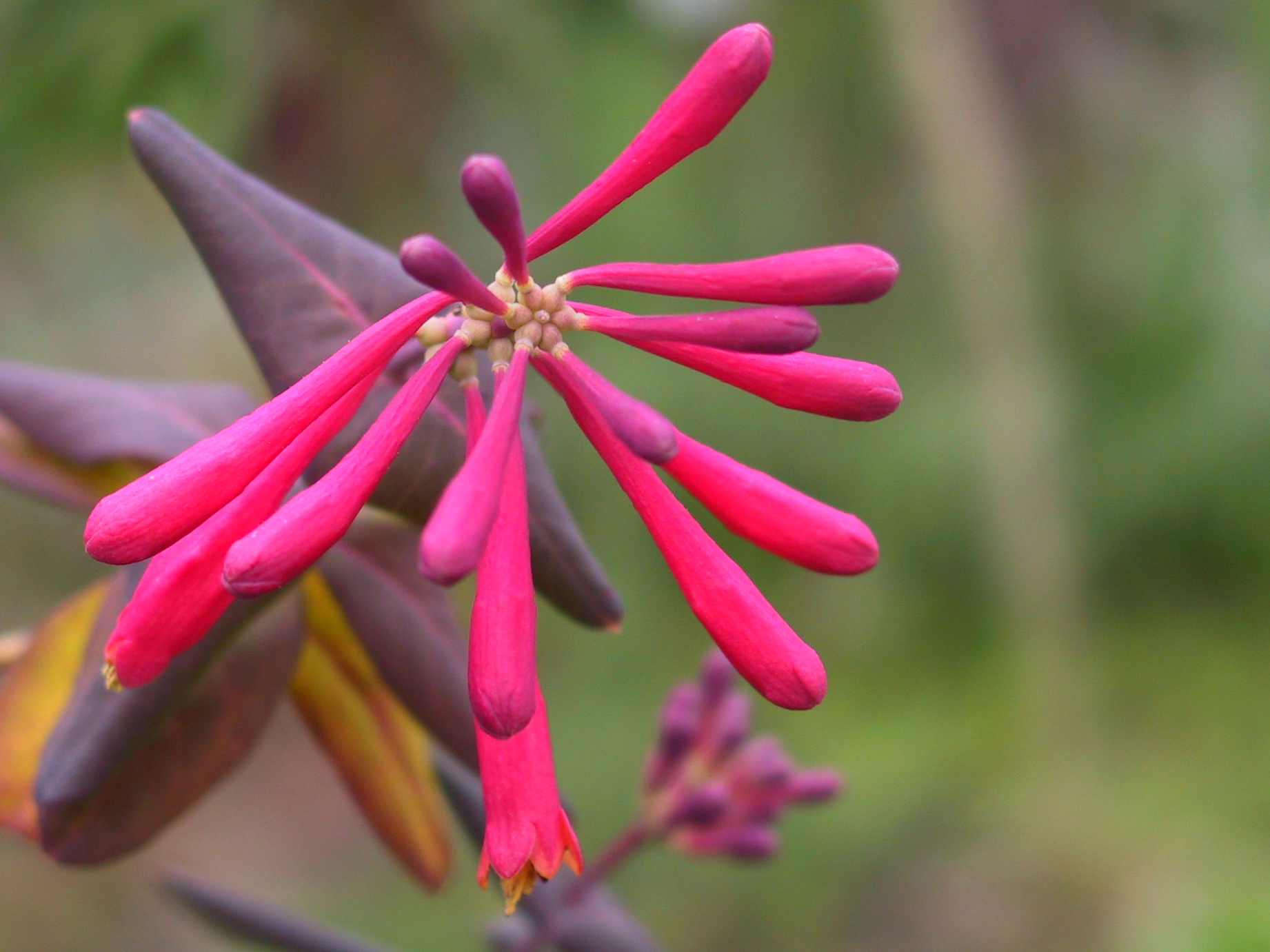
Lonicera sempervirens, widely known as Coral Honeysuckle or Trumpet Honeysuckle, is arguably the finest native vine for the eastern and southeastern United States. This semi-evergreen to evergreen twining vine produces masses of slender, coral-red trumpet-shaped flowers with golden-yellow interiors from late spring through fall — and sometimes into winter in mild climates. The blooms are irresistible to Ruby-throated Hummingbirds, which are perfectly sized to access the long, narrow nectar tubes, and their late-season berries feed dozens of bird species through winter.
Unlike its invasive Asian cousin, Japanese Honeysuckle (Lonicera japonica), Coral Honeysuckle is a well-behaved, non-aggressive vine that works with, rather than against, its garden companions. It climbs by twining, reaching 15 to 25 feet in length, but is easily managed with light annual pruning. The foliage is attractive year-round in warmer climates — a glaucous (blue-green) color above with a contrasting pale silver-green below, and the uppermost pairs of leaves are perfoliate, fused at the base so that the stem appears to pass through them, creating a distinctive appearance unique to this species.
Coral Honeysuckle is found naturally from Connecticut and Nebraska south to Florida and Texas, growing along forest edges, in thickets, and at woodland margins where it scrambles up shrubs and trees. Its exceptional combination of year-round interest, wildlife value, adaptability, and non-invasive behavior makes it one of the most recommended native vines across its entire range — a plant that should be in every garden in the eastern United States.
Identification
Coral Honeysuckle is a twining woody vine that climbs counterclockwise around supports, reaching 15 to 25 feet in length. It is semi-evergreen in Zone 6 and fully evergreen in Zones 7–9. The vine lacks tendrils and climbs by twining its main stems around supports — it needs something to wrap around, such as a trellis, fence wire, or shrub branches.
Leaves
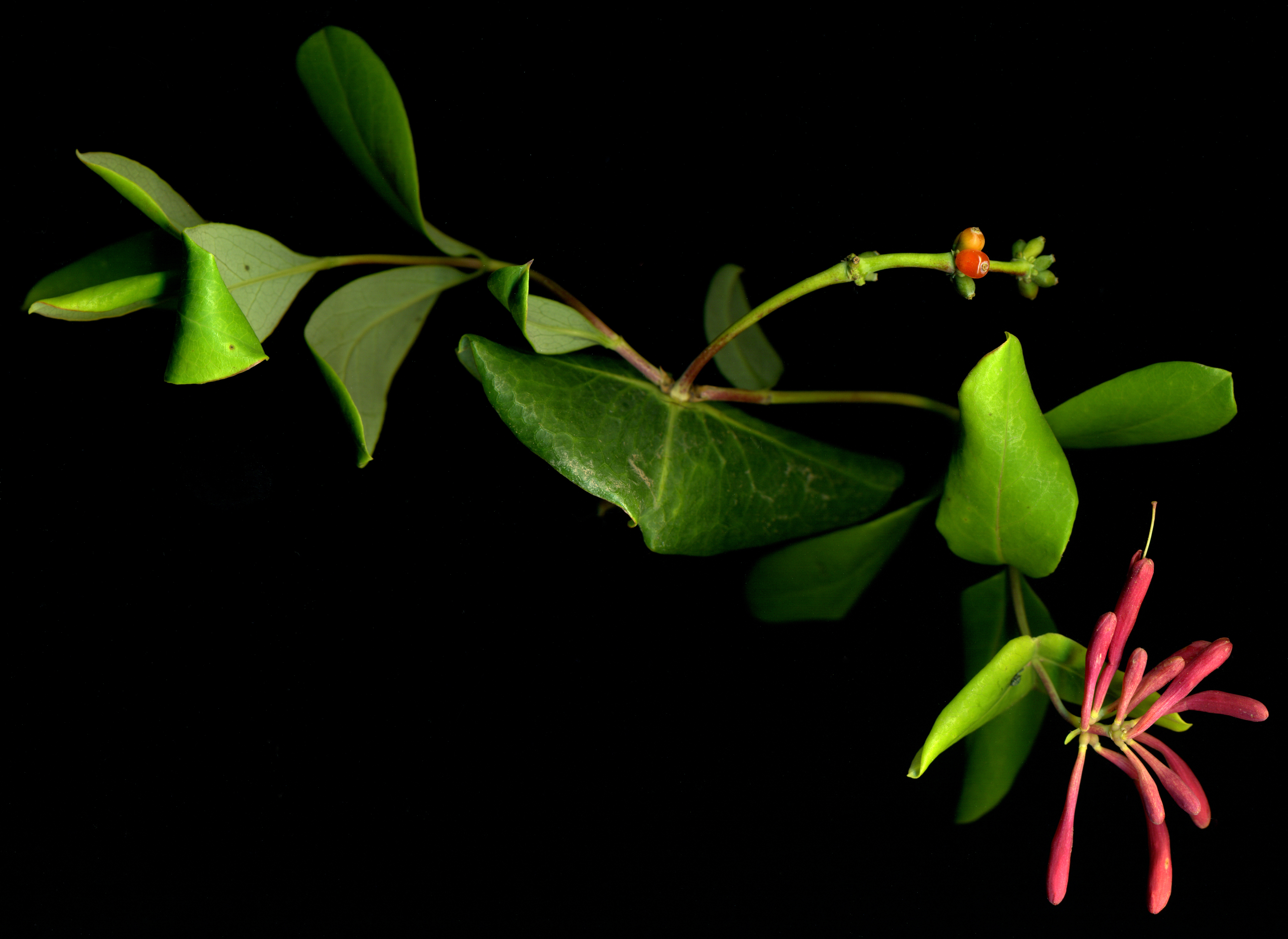
The leaves are opposite, simple, elliptic to oblong, 1½ to 3 inches long, and distinctively two-toned: the upper surface is a rich blue-green (glaucous), while the underside is silvery gray-green to nearly white. The most distinctive leaf feature occurs near the ends of the branches: the uppermost one or two pairs of leaves are perfoliate — fused at their bases so that the stem appears to pass through a single circular leaf. This perfoliate leaf arrangement is a key diagnostic feature for identifying Coral Honeysuckle versus other honeysuckles. Leaves are persistent through winter in zones 7 and warmer.
Flowers
The flowers are the showstopper — slender, tubular trumpets 1½ to 2 inches long, carried in whorled clusters at the branch tips. Each flower is coral-red to orange-red on the outside with a bright yellow interior. The five petals are fused into a tube for most of their length, flaring only slightly at the tip into a narrow two-lipped opening — perfectly shaped for hummingbird pollinators. The stamens and style project slightly beyond the flower tip. Unlike Japanese Honeysuckle, Coral Honeysuckle has no fragrance; its pollinator is the hummingbird, which navigates by sight rather than smell.
The primary bloom period is April through June, but sporadic reblooming continues throughout summer and into fall — sometimes year-round in the warmest parts of its range. The combination of prolonged flowering and hummingbird attraction makes this an indispensable plant for wildlife gardens.
Fruit
The fruit is a small, glossy, bright red berry, about ¼ inch in diameter, carried in clusters at the branch tips where the flowers were. Berries ripen from late summer through fall and persist well into winter. They are eagerly consumed by American Robins, Cedar Waxwings, Hermit Thrushes, Gray Catbirds, and numerous other frugivorous birds. The berries are not considered safe for human consumption.
Quick Facts
| Scientific Name | Lonicera sempervirens |
| Family | Caprifoliaceae (Honeysuckle family) |
| Plant Type | Semi-evergreen to evergreen twining vine |
| Mature Height | 15–25 ft |
| Sun Exposure | Full Sun to Part Shade |
| Water Needs | Moderate |
| Bloom Time | April – September (sporadic reblooming) |
| Flower Color | Coral-red outside, yellow inside |
| USDA Hardiness Zones | 4–9 |
Native Range
Coral Honeysuckle is native to the eastern half of North America, from southern Maine and Connecticut south through the entire Atlantic coastal plain and Gulf Coast to Florida and Texas, extending west to Nebraska and Kansas. It is most abundant in the Southeast, where it grows naturally along forest edges, in thickets, and at woodland margins from sea level to moderate elevations in the Appalachians. In New England, it reaches its northern range limit in Connecticut, Massachusetts, and Rhode Island.
Throughout its range, Coral Honeysuckle grows in ecotone habitats — the transitional edges between forest and open areas. It thrives at woodland margins, along fence rows, and in shrubby thickets where it can climb into the canopy of shrubs and small trees. It tolerates a wide variety of soil conditions across its range, from the moist lowlands of the Gulf Coastal Plain to the drier upland forests of the Appalachian foothills.
The species name sempervirens means “always green” in Latin, reflecting its evergreen habit in the warmer portions of its range. In the northeastern part of its range, including New England, the vine is semi-evergreen, retaining some foliage through mild winters but losing it in severe cold. This flexibility in foliage retention across its broad climatic range reflects Coral Honeysuckle’s adaptability.
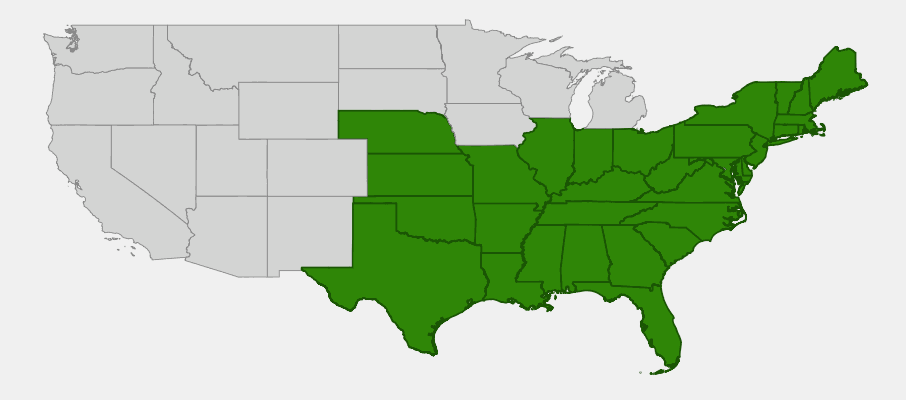
📋 Regional plant lists featuring Coral Honeysuckle: Southeastern U.S.
Growing & Care Guide
Coral Honeysuckle is one of the most rewarding native vines to grow — it establishes quickly, flowers abundantly, and requires minimal care once it finds its spot. It is considerably easier to grow than its reputation might suggest.
Light
Coral Honeysuckle blooms most prolifically in full sun — at least 6 hours of direct sunlight daily produces the densest flower clusters and most vigorous growth. It also grows well in light to moderate part shade (3–6 hours of sun), though flowering is reduced in shadier conditions. In deep shade, it will survive but rarely flowers well. For best hummingbird attraction, position the vine where its flowers can be seen from a distance and where the birds have open flight paths to the blooms.
Soil & Water
One of Coral Honeysuckle’s greatest virtues is its adaptability to varied soils. It grows in average garden soil, clay, loam, sandy soil, and even somewhat rocky conditions. It prefers moderate moisture but is surprisingly drought-tolerant once established. Avoid consistently waterlogged soil, which can lead to root rot. In the first growing season, water regularly to encourage root establishment; after that, established plants typically need only occasional watering during prolonged dry spells.
Planting Tips
Plant Coral Honeysuckle near a sturdy trellis, fence, arbor, or large shrub that it can twine around. Give it a support at least 6 feet tall — it will climb to 25 feet given the opportunity. Plant in spring or fall from container stock. Dig the planting hole twice as wide as the container and amend poor soils with compost. Water thoroughly at planting and keep evenly moist through the first growing season. Do not over-fertilize — excess nitrogen promotes leafy growth at the expense of flowers.
Pruning & Maintenance
Annual light pruning in early spring encourages bushier growth and more flowers. Remove dead or tangled branches and cut back any wayward shoots. Heavier renovation pruning (cutting back by one-third to one-half) can rejuvenate an overgrown vine and is best done in late winter before new growth emerges. Unlike Japanese Honeysuckle, Coral Honeysuckle does not spread aggressively and rarely needs serious restraint. It does not root from nodes touching the ground, so it won’t colonize new areas the way invasive honeysuckles do.
Landscape Uses
- Trellis or arbor — the classic use; creates a spectacular flowering curtain
- Fence coverage — excellent for wildlife-friendly fence lines
- Hummingbird gardens — the premier native vine for attracting Ruby-throated Hummingbirds
- Mailbox or lamp post — makes an attractive twining specimen on vertical structures
- Native hedge — planted along chain-link fencing provides privacy and wildlife habitat
- Ground cover on slopes — without support, sprawls attractively over banks
Wildlife & Ecological Value
Coral Honeysuckle delivers exceptional wildlife value across multiple seasons, making it one of the most ecologically productive vines for eastern gardens.
For Birds
The relationship between Coral Honeysuckle and the Ruby-throated Hummingbird is a textbook example of coevolution. The flower’s long, narrow red tube evolved precisely for hummingbird pollination: the bird’s long bill fits perfectly into the tube to reach nectar, and its forehead picks up pollen from the projecting stamens, transferring it to the next flower visited. The vine’s bright red color is visible to hummingbirds (which have red-sensitive vision) but relatively inconspicuous to insects, reducing competition for the nectar. The red berries that follow are consumed by dozens of bird species, including American Robins, Cedar Waxwings, Hermit Thrushes, and Gray Catbirds. The dense twining stems provide excellent nesting sites for songbirds.
For Pollinators
While Coral Honeysuckle is primarily hummingbird-pollinated, various long-tongued bees, including bumblebees, can access the nectar by approaching from the front of the flower. Several sphinx moths (hummingbird moths) are also important pollinators, hovering and feeding like the birds they mimic. The flowers produce abundant nectar throughout their long bloom season, providing a consistent food source for wildlife.
For Mammals
White-tailed Deer occasionally browse the foliage and young stems, though mature established vines are generally not seriously damaged. Small mammals including chipmunks and squirrels consume the berries.
Ecosystem Role
In forest edge and hedgerow habitats, Coral Honeysuckle fills the vertical niche at the shrub-tree interface, creating structural complexity that supports diverse wildlife communities. Its long bloom season bridges the gap between spring-flowering trees and late-summer forbs, providing continuous nectar for hummingbirds and other wildlife through the growing season.
Cultural & Historical Uses
Coral Honeysuckle has been cultivated as an ornamental vine for over 300 years. It was introduced to European horticulture in the early 1600s, and was one of the first American native plants to be grown in English gardens. It appears in Thomas Jefferson’s garden records at Monticello, and was a fixture of early American ornamental gardens throughout the colonial period.
Various Indigenous nations of the eastern woodlands used different honeysuckle species medicinally, though Lonicera sempervirens was less prominent in ethnobotanical records than some related species. The Cherokee used preparations from the plant as a treatment for bee stings and skin irritations. In folk medicine, a tea from the leaves was reportedly used as a mild diuretic and for treating coughs and fevers, though these uses were not as widespread or well-documented as for some other native plants.
The berries of Coral Honeysuckle are toxic to humans in significant quantities — they contain saponins that cause gastrointestinal distress. Despite this, they are a valuable food source for birds that can process these compounds safely. This represents a fascinating example of directed toxicity in plant evolution — the berries are poisonous to humans and most mammals, but birds are unaffected, ensuring that seeds are dispersed by the appropriate animal vectors while being protected from seed predators.
In contemporary horticulture, Coral Honeysuckle is widely promoted as a beautiful, non-invasive alternative to Japanese Honeysuckle, which has become one of the most damaging invasive vines in eastern North America. Nurseries, conservation organizations, and native plant societies consistently recommend it as a top-tier native vine for southeastern gardens, and it has received the Royal Horticultural Society’s Award of Garden Merit.
Frequently Asked Questions
Is Coral Honeysuckle invasive?
No — unlike Japanese Honeysuckle (Lonicera japonica), Coral Honeysuckle is a well-behaved native vine. It does not root from stem nodes touching the ground, does not spread aggressively by seed, and is easily controlled with annual pruning. It is recommended as a beautiful replacement for invasive honeysuckles.
Does Coral Honeysuckle attract hummingbirds?
Yes — it is one of the best native plants in eastern North America for attracting Ruby-throated Hummingbirds. The red trumpet flowers were evolutionarily designed for hummingbird pollination. A well-established vine in full sun will have hummingbirds visiting regularly from spring through fall migration.
Does Coral Honeysuckle smell like Japanese Honeysuckle?
No — Coral Honeysuckle has little to no fragrance. It is pollinated by hummingbirds, which navigate by sight rather than smell, so the flowers have no need for scent. If you’re looking for a fragrant native vine, consider Carolina Jessamine (Gelsemium sempervirens) or Passiflora species.
How fast does Coral Honeysuckle grow?
It’s a moderately fast grower — expect 6–10 feet of growth in its first full season once established, and rapid fill-in over the first 2–3 years. It can reach its full height of 15–25 feet within 3–5 years. Growth is faster in full sun with adequate moisture.
Can Coral Honeysuckle grow in containers?
Yes, in a large container with a trellis or obelisk. Use a large pot (at least 15–20 gallons) with good drainage, and water more frequently than in-ground plantings. Container plants may be slightly less vigorous than in-ground plants but still flower well and attract hummingbirds.

Looking for a nursery that carries Coral Honeysuckle?
Browse our native plant nursery directory: Virginia · North Carolina · Georgia