Meadow Beauty (Rhexia virginica)
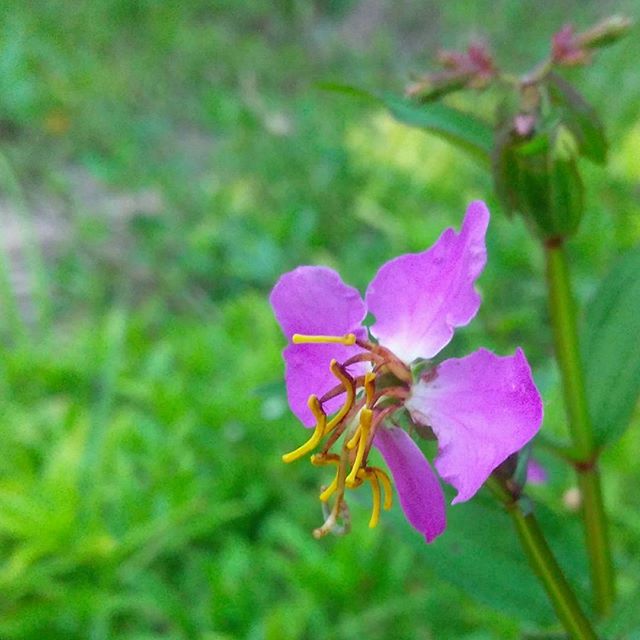
Rhexia virginica, commonly known as Meadow Beauty or Virginia Meadow Beauty, is a jewel of the eastern wetland meadow — a native wildflower that stops observers in their tracks with its brilliant pink flowers and distinctive architecture. The four broad, bright pink petals surround a cluster of dramatically curved, bright yellow anthers, creating one of the most visually striking flowers of any native plant in the eastern United States. It blooms from July through September, providing a burst of late-summer color at a time when many other native plants have finished flowering.
Meadow Beauty is a member of the Melastomataceae — the Meadow Beauty family — a primarily tropical and subtropical family with relatively few representatives in temperate North America. The genus Rhexia contains about a dozen species, most found in the southeastern United States, making it a distinctly American genus. Rhexia virginica is the most widespread of these, ranging from Maine to Florida and west to the Plains states, but it is most abundant in the wet, sandy coastal plain soils of the southeastern United States.
What makes Meadow Beauty truly special for gardeners and naturalists is its combination of beauty, ecological value, and the fascinating habitats it calls home. It grows in bog edges, wet meadows, pitcher plant seeps, and damp sandy flats — places where many plants cannot survive the acidic, nutrient-poor, waterlogged conditions. Meadow Beauty not only survives in these challenging environments; it thrives, becoming a dominant and defining species of some of the most botanically rich habitats in eastern North America.
Identification
Meadow Beauty is a low to medium-height herbaceous perennial, typically 8 to 24 inches tall, with distinctive square stems, bright pink flowers, and unusual urn-shaped seed capsules. It spreads by underground rhizomes to form loose colonies.
Stems & Leaves
The stems are notably four-angled (square in cross-section) — a diagnostic feature of the Melastomataceae family. Stems are often reddish and bear fine hairs. The leaves are opposite, ovate to elliptic, 1 to 2½ inches long, with three prominent parallel veins running from base to tip (a characteristic of the family). The leaf surface is typically green above, paler below, with fine hairs on both surfaces. Leaf margins are finely toothed with bristle-tipped teeth.
Flowers
The flowers are stunning — 4-petaled, 1 to 1½ inches across, and a brilliant magenta-pink to purple-pink color. The four broad, fan-shaped petals are somewhat asymmetrical — wider toward their tips. The flower center features 8 dramatically curved, bright yellow anthers (stamens) on reddish filaments, arranged in a loose arc around a single elongated style. This combination of hot pink petals and contrasting yellow-and-red stamens is visually arresting. Flowers open in the morning and drop their petals by afternoon, a characteristic of the family.
Fruit
The seed capsule is one of the most distinctive features of the genus: a small urn or jug-shaped structure with a constricted “neck” below a rim-like calyx — looking remarkably like a miniature water pitcher or vase. These urn-shaped capsules are 4-5 mm in diameter, turn from green to brown, and persist through winter, giving dried arrangements an unusual character. The tiny seeds inside are scattered when the capsules are disturbed.
Quick Facts
| Scientific Name | Rhexia virginica |
| Family | Melastomataceae (Meadow Beauty family) |
| Plant Type | Herbaceous perennial wildflower |
| Mature Height | 8–24 in |
| Sun Exposure | Full Sun |
| Water Needs | Moderate to High |
| Bloom Time | July – September |
| Flower Color | Bright pink to magenta with yellow anthers |
| USDA Hardiness Zones | 5–9 |
Native Range
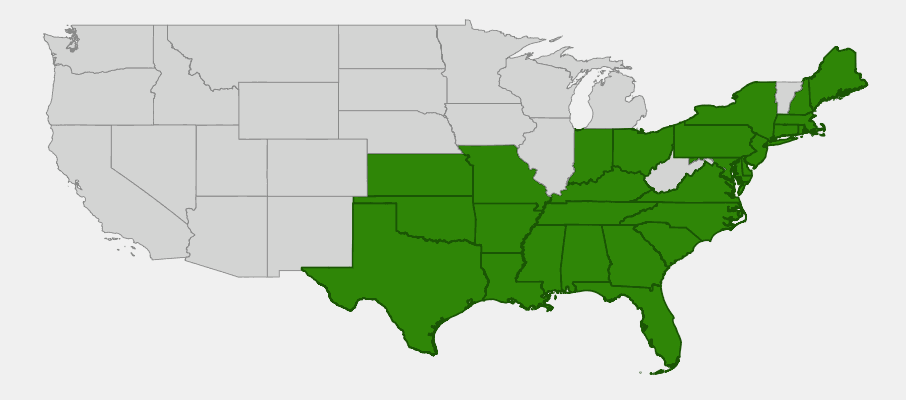
Meadow Beauty is native to a broad swath of the eastern United States, ranging from Maine south along the Atlantic coastal plain to Florida, then west along the Gulf Coast to Texas, and northward through the Mississippi Valley to Indiana, Ohio, and Missouri. It is most abundant in the southeastern coastal plain states where wet, sandy, acidic soils are common — particularly in Virginia, the Carolinas, Georgia, and Florida.
The species reaches the northern edge of its range in New England, where it occurs in Connecticut, Massachusetts, and Rhode Island in coastal plain bog edges, cranberry bogs, and wet sandy meadows. In these northern states, it is considered uncommon to rare at the regional level, associated with the same globally imperiled sandplain and coastal plain wetland communities that support numerous other rare plant species.
Throughout its range, Meadow Beauty is a strong ecological indicator of high-quality, minimally disturbed wetland habitats. It is particularly characteristic of Atlantic White Cedar swamps, coastal plain ponds, cranberry bogs, and pine savanna seeps — habitats that support some of the highest native plant diversity in the eastern United States.
📋 Regional plant lists featuring Meadow Beauty: Southeastern U.S.
Growing & Care Guide
Meadow Beauty is a specialist plant that rewards gardeners willing to provide its specific needs: full sun, wet or consistently moist acidic soil, and minimal competition. It is not a plant for typical garden beds, but in the right spot it is spectacular and essentially care-free.
Light
Full sun is essential. Meadow Beauty grows in exposed wet meadows, bog edges, and pitcher plant savannas — open, sun-drenched habitats with no overhead canopy. Even moderate shade significantly reduces flowering and plant vigor. Give it the sunniest spot in your garden.
Soil & Water
The critical requirement is consistently moist to wet, acidic (pH 4.5–6.0), low-nutrient soil. Meadow Beauty is adapted to the nutrient-poor, highly acidic soils of bogs, fens, and coastal plain wetlands. It does not tolerate enriched garden soil — too many nutrients encourage aggressive weedy plants that outcompete it. Sandy, peaty, or mucky wet soils are ideal. In gardens, it performs well at rain garden wet zones, pond margins, or in bog garden containers with sphagnum moss and peat. Keep the soil consistently moist — it will not tolerate summer drought.
Planting Tips
Plant Meadow Beauty in spring from container stock. Choose a wet, sunny, acidic site and avoid amending the soil with compost or fertilizer. If you’re establishing a bog garden, use a mix of peat moss, sand, and a small amount of native topsoil. Space plants 12–18 inches apart; they’ll slowly spread by rhizomes. Water regularly until established, then maintain consistent soil moisture.
Pruning & Maintenance
Meadow Beauty requires minimal care in appropriate conditions. The urn-shaped seed capsules are attractive in fall and winter — leave them for visual interest and wildlife. Cut back dead stems in early spring before new growth begins. Avoid fertilizing and do not over-mulch, as these conditions favor weedy competition. Weed carefully around young plants until they’re established.
Landscape Uses
- Bog garden — stunning companion to pitcher plants, sundews, and sphagnum
- Rain garden wet zone — perfect for the saturated areas that challenge most plants
- Coastal plain pond edges — its natural habitat in New England
- Container bog garden — very effective in a submerged tub or half-barrel with acidic mix
- Native meadow — spectacular late-summer color in moist, sandy meadow plantings
Wildlife & Ecological Value
Meadow Beauty provides significant ecological value, particularly for specialist pollinators and as an indicator and component of globally imperiled wetland plant communities.
For Pollinators — Buzz Pollination
Meadow Beauty’s flowers use a fascinating pollination mechanism called buzz pollination (sonication). The pollen is contained within tubular anthers that only release their pollen when vibrated at a specific frequency — the frequency produced by bumblebee flight muscles when the bee “buzzes” or vibrates its body while grasping the flower. This mechanism is estimated to be used by approximately 8% of flowering plant species worldwide and ensures that pollen is delivered to the most effective pollinators. Common Eastern Bumblebees (Bombus impatiens) and other bumblebee species are the primary pollinators.
For Birds
The tiny seeds of Meadow Beauty are consumed by sparrows and other granivorous birds. The plant’s presence in bog and wet meadow communities contributes to the overall insect diversity that supports insectivorous wetland birds.
Ecosystem Role
Meadow Beauty is a characteristic species of some of the most ecologically significant and threatened habitats in eastern North America — the coastal plain ponds, sandplain grasslands, and Atlantic White Cedar swamps of New England, and the longleaf pine savannas and Carolina bays of the Southeast. In these habitats, it is often associated with dozens of other rare and uncommon plant species. Its presence signals habitat quality and contributes to the mosaic of species that sustain diverse wetland communities.
Cultural & Historical Uses
Meadow Beauty’s cultural history is relatively modest compared to more widespread native plants, but it holds significance in the traditions of several southeastern Indigenous nations. The Cherokee used root preparations of related Rhexia species for various medicinal purposes, including treatments for stomachaches and as an ingredient in multi-herb formulas. The plant’s urn-shaped seed capsules were noted by early European botanical explorers as unusual and distinctive — the French botanist Antoine de Jussieu included the genus in his foundational classification of flowering plants in the early 19th century.
Early American botanical writers like William Bartram, who traveled extensively through the southeastern United States in the 1770s, described the beauty of Rhexia species growing in boggy coastal plain habitats. Bartram’s descriptions of the pink-flowered meadow beauties growing alongside pitcher plants, sundews, and other carnivorous plants in the longleaf pine savannas helped introduce these unique American landscapes to European audiences and sparked scientific and horticultural interest in North American native plants.
Today, Meadow Beauty’s primary significance is ecological — as an indicator of high-quality, undisturbed wetland habitats and as a component of the rare sandplain and coastal plain wetland communities that are among the most threatened ecosystems in New England. Conservation organizations actively monitor populations of Rhexia virginica in Massachusetts, Connecticut, and Rhode Island as part of broader assessments of coastal plain ecosystem health and integrity.
Frequently Asked Questions
Why do Meadow Beauty flowers only last one day?
Meadow Beauty flowers open in the morning and typically drop their four petals by afternoon — the petals last less than a full day. This is characteristic of the Melastomataceae family. However, because plants produce multiple flowers over an extended period (July–September), and because the clumping habit means many flowers open simultaneously, the overall display is long-lasting and impressive even though individual flowers are ephemeral.
Can I grow Meadow Beauty in a regular garden?
It’s challenging but possible if you can create the right microhabitat. The keys are: full sun, consistently moist to wet soil, and acidic pH (4.5–6.0). Raised bog containers with peat-sand mix and consistent watering can work well. Regular garden soil that has been enriched with compost is generally unsuitable — the nutrients encourage weedy competition that overwhelms Meadow Beauty.
What are the urn-shaped things on Meadow Beauty after it flowers?
Those are the seed capsules — one of the most distinctive features of the plant. Each urn-shaped capsule contains dozens of tiny seeds. The capsules are sometimes called “pitchers” or “urns” and give the genus its old common name “Deergrass” (though this name is rarely used today). They persist attractively through fall and winter on the dried stems.
Is Meadow Beauty related to carnivorous plants?
No — Meadow Beauty is not carnivorous and is not closely related to pitcher plants, sundews, or other carnivorous plants. However, it often grows in the same habitats as these fascinating plants because it shares their tolerance for acidic, nutrient-poor, wet conditions. In coastal plain bogs and pitcher plant savannas, Meadow Beauty is a common companion to Sarracenia pitcher plants, Drosera sundews, and other carnivorous species.
Is Meadow Beauty rare in New England?
It is uncommon to rare in Connecticut, Massachusetts, and Rhode Island, where it occurs at the northern edge of its range in coastal plain bog and sandplain habitats. These habitats are globally imperiled due to development, fire suppression, and hydrological alteration. Populations of Meadow Beauty in New England warrant protection as components of these rare ecosystems.

Looking for a nursery that carries Meadow Beauty?
Browse our native plant nursery directory: Virginia · North Carolina · Georgia