Slender Blue Flag Iris (Iris prismatica)
Iris prismatica, known as Slender Blue Flag Iris or Slender Blue Iris, is the elegant, graceful counterpart to its more robust relative, the Larger Blue Flag Iris. Where Iris versicolor announces itself with bold clumps and large flowers, Iris prismatica weaves through wet meadows and shrub swamp margins on slender, arching stems that dance in the breeze, bearing delicate blue-violet flowers above grass-like foliage in late spring and early summer. Its refined, airy character brings a completely different aesthetic to wetland garden plantings.
The species epithet prismatica refers to the prismatic, angular cross-section of the seed capsule — one of its distinguishing features from the more common Blue Flag Iris. This species is more narrowly distributed than Iris versicolor, occurring primarily along the Atlantic coastal plain from Maine to Georgia, with scattered inland populations in Tennessee and the Appalachian piedmont. It is considered uncommon to rare throughout much of its range, and in New England — where it occurs in Connecticut, Massachusetts, and Rhode Island — it is associated with the rare and threatened coastal plain wetland communities of the region.
For gardeners seeking a refined, naturalistic quality in moist garden plantings, Slender Blue Flag Iris is a compelling choice. Its grass-like foliage integrates beautifully with sedges, rushes, and other fine-textured wetland plants, while its blue-violet flowers provide the same visual impact as larger irises in a more delicate package. It is also a valuable pollinator plant and contributes to the ecological diversity of wet garden spaces.
Identification
Slender Blue Flag Iris is readily distinguished from Larger Blue Flag Iris (Iris versicolor) by its noticeably more slender, grass-like habit. The leaves are much narrower, the stems are more delicate, and the plant’s overall form is lighter and more graceful. It typically grows 1 to 3 feet tall.
Leaves
The leaves are the key distinguishing feature: they are narrow — only ¼ to ½ inch wide (compared to ½ to 1 inch for Iris versicolor) — and grass-like in texture and appearance. They are linear, flat, bluish-green, and arise in the characteristic equitant fan arrangement of irises. In vegetative form, Slender Blue Flag can easily be mistaken for a grass, sedge, or rush in wet meadow habitats. The leaves reach 1 to 2 feet in length.
Flowers
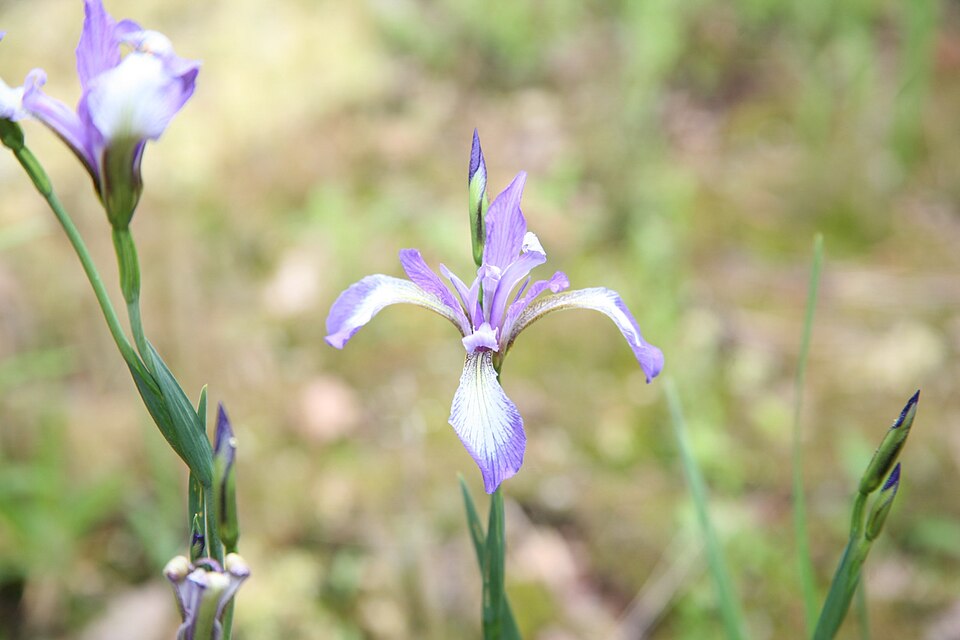
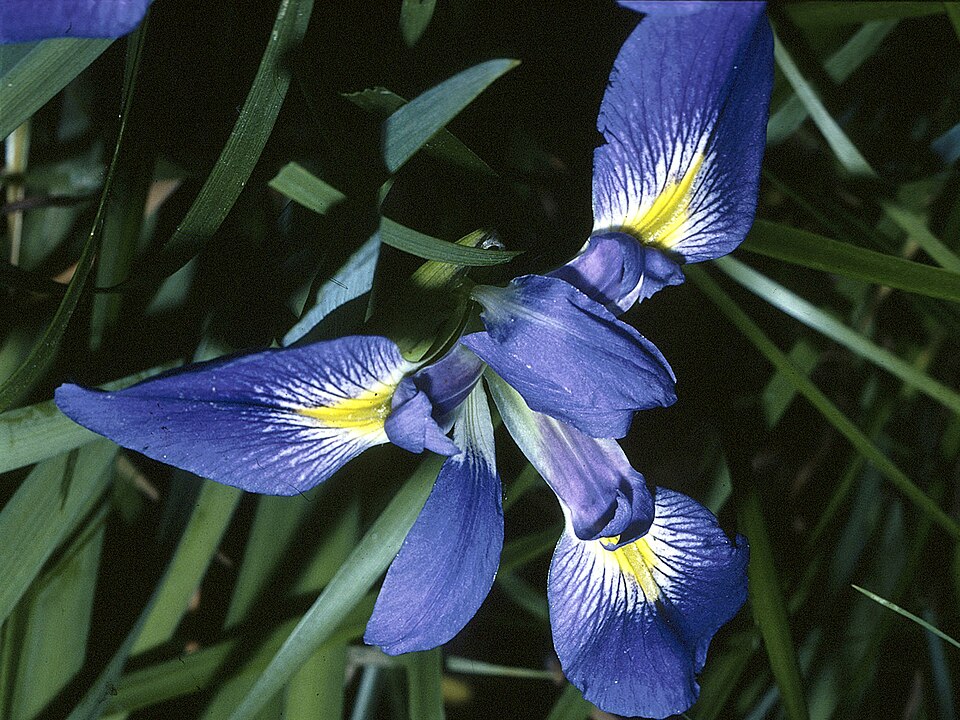
The flowers are similar to Larger Blue Flag Iris in color and structure but borne on more slender, often branched scapes that may nod or arch gracefully under the weight of the blooms. Each flower is 2 to 3 inches across — somewhat smaller than Iris versicolor. The falls (lower tepals) are violet-blue with a prominent white and yellow signal patch at the base, surrounded by fine dark veining. The standards (upper tepals) are violet to blue-violet and somewhat smaller and more erect. Flowering occurs in May and June, roughly concurrent with Larger Blue Flag Iris.
Fruit & Seeds
The seed capsule is the feature that gives the species its name: prismatica refers to the distinctly three-angled (prismatic) capsule, which is more sharply triangular in cross-section than the rounded capsule of Iris versicolor. This is the most reliable botanical character for separating the two species when not in flower. The capsules ripen in late summer and split to release seeds that float on water, dispersing in wet habitats.
Quick Facts
| Scientific Name | Iris prismatica |
| Family | Iridaceae (Iris family) |
| Plant Type | Herbaceous perennial; rhizomatous wetland wildflower |
| Mature Height | 1–3 ft |
| Sun Exposure | Full Sun to Part Shade |
| Water Needs | Moderate to High |
| Bloom Time | May – June |
| Flower Color | Violet-blue with yellow and white signal patch on falls |
| USDA Hardiness Zones | 4–8 |
Native Range
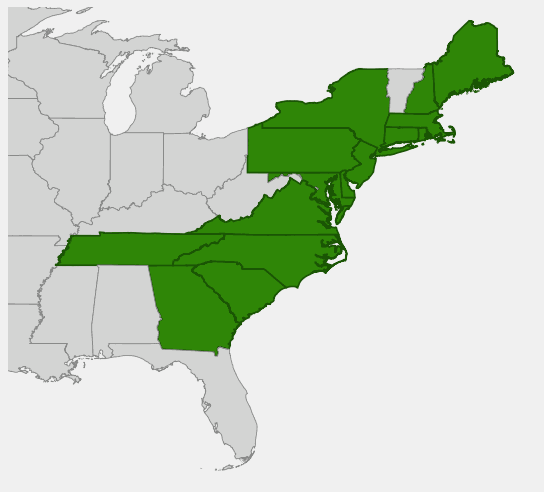
Slender Blue Flag Iris has a primarily coastal distribution in the eastern United States, following the Atlantic coastal plain from southern Maine south to Georgia, with a significant inland extension into Tennessee and scattered Appalachian populations. Unlike the Larger Blue Flag Iris which ranges broadly across northeastern and north-central states, Iris prismatica is closely tied to the coastal plain and its characteristic wet meadow and swamp edge habitats.
In New England — Connecticut, Massachusetts, and Rhode Island — Slender Blue Flag Iris is found in freshwater wet meadows, shrub swamp margins, and coastal plain wetlands. It is generally less common than Iris versicolor in this region and is considered a species of conservation concern in some New England states. Its presence is often associated with high-quality, minimally disturbed coastal plain wetland communities.
Southward, the species becomes more common along the Atlantic coastal plain through New Jersey, Delaware, Maryland, and Virginia, where it grows in wet meadows and marshes associated with coastal plain streams and seeps. In North and South Carolina and Georgia, it extends into coastal flatwoods and wet savannas. The inland Tennessee populations represent a distinct component of the species’ range associated with the Eastern Highland Rim physiographic province.
📋 Regional plant lists featuring Slender Blue Flag Iris: Southeastern U.S.
Growing & Care Guide
Slender Blue Flag Iris shares cultural requirements with Larger Blue Flag Iris but has a more refined, graceful character that suits slightly different garden applications — particularly in naturalistic moist meadow and stream-edge plantings.
Light
Slender Blue Flag Iris grows well in full sun to part shade. It flowers most prolifically in full sun but tolerates light dappled shade, particularly in afternoon. In nature, it often grows at the edges of shrub swamps where it receives good morning sun but partial shade from surrounding shrubs. This adaptability makes it useful in a wider range of garden sites than strictly full-sun plants.
Soil & Water
Like all flag irises, this species requires consistently moist to wet soil. It prefers fertile, organic-rich wetland soil but adapts to a range of moist conditions. It grows well in circumneutral to slightly acidic soil (pH 5.5–7.0) — less demanding about extreme acidity than Meadow Beauty. At rain garden edges, along streams, at pond margins, and in wet meadow plantings, it thrives. Avoid dry or well-drained garden soils. The plant can grow in shallow water but also thrives in consistently moist soil that is never deeply or permanently flooded.
Planting Tips
Plant from container stock in spring or fall, setting rhizomes just at or slightly below the soil surface. Space plants 12–18 inches apart — they spread more slowly and form less dense clumps than Larger Blue Flag Iris. The slender, grass-like habit makes Slender Blue Flag Iris an excellent companion for sedges, rushes, and other fine-textured wetland plants. Combine with Blue Vervain, Swamp Milkweed, and Marsh Fern for an attractive and ecologically rich moist planting.
Pruning & Maintenance
Minimal maintenance is required. Remove spent flower stalks and cut back dead foliage in early spring. Divide overgrown clumps in late summer or early fall every 3–5 years to maintain vigor. Because this species spreads more slowly than Iris versicolor, it rarely needs aggressive management. Watch for iris borers and treat promptly if found.
Landscape Uses
- Rain garden wet zone — perfect for consistently moist low areas
- Pond and stream margins — the slender habit creates a naturalistic, airy edge planting
- Moist meadow gardens — weaves beautifully among sedges and rushes
- Shrub border edges — the grass-like foliage integrates naturally at shrub swamp margins
- Butterfly and pollinator gardens — supports bumblebees and other native bees
- Restoration plantings — excellent for coastal plain wetland restoration
Wildlife & Ecological Value
Slender Blue Flag Iris offers similar ecological value to Larger Blue Flag Iris, supporting pollinators, providing wetland structure, and contributing to the diversity of wet meadow and shrub swamp communities.
For Pollinators
The flowers are pollinated primarily by bumblebees (Bombus species), which are large enough to access the nectar and transfer pollen effectively between the anthers and stigmas of the iris flower’s complex architecture. The yellow and white signal patch on the falls functions as a nectar guide. Various other large native bees also visit the flowers. The bloom period in May–June is important for early-active bumblebee queens building their first colonies of the season.
For Birds
The seed capsules produce seeds consumed by waterfowl and other wetland birds in fall and winter. The slender, grass-like foliage and clumping growth provide cover for ground-nesting and wetland birds in open wet meadow communities. The structural diversity this plant adds to wetland edges supports songbird foraging and nesting behavior.
For Butterflies
Several wetland-associated butterfly species use the wet meadow and shrub swamp habitats where Slender Blue Flag Iris grows. The Black Dash Skipper and other wet meadow specialists breed in the sedge and rush communities where this iris is a companion plant, and the open wet meadow habitat supports a high diversity of wetland butterflies overall.
Ecosystem Role
In the coastal plain wetland communities where Slender Blue Flag Iris is most abundant, it plays a structural role as a medium-height forb that bridges the gap between low ground cover plants and taller shrubs. Its rhizomes help stabilize wet soil edges, and its seasonal growth and decomposition cycle contributes organic matter to the wetland system. Its presence as a relatively uncommon, specialist species contributes to the overall botanical diversity and ecological integrity of coastal plain wetlands.
Cultural & Historical Uses
Slender Blue Flag Iris has a more modest cultural history than its more common relatives, but it is part of the broader tradition of iris use in eastern North American Indigenous cultures. Like Larger Blue Flag Iris, all parts of Iris prismatica should be considered potentially toxic — the irisin glycosides present in native irises are emetic and cathartic. Indigenous medicinal uses of related iris species include preparations for liver and skin conditions, but these were typically applied by trained practitioners with knowledge of the appropriate dosages and preparations.
As an ornamental plant, Slender Blue Flag Iris has been cultivated in native plant gardens since the late 19th century, primarily in the Mid-Atlantic region where it is more common. It appeared in early catalogs of native plants for American gardens and was recommended for moist garden edges and naturalistic water garden plantings. However, it never achieved the widespread cultivation of Larger Blue Flag Iris, in part because it is less showy in mass plantings and more demanding about specific soil and moisture conditions.
In contemporary conservation, Slender Blue Flag Iris receives attention as a species of concern in several northeastern states. It is tracked by natural heritage programs in New England and the Mid-Atlantic region and is considered a quality indicator for coastal plain wetland habitats. Its presence in a plant survey signals that a site has the right combination of hydrology, soil chemistry, and ecological integrity to support this narrow specialist — a valuable indicator for conservation assessment and wetland restoration planning.
Frequently Asked Questions
How is Slender Blue Flag Iris different from Larger Blue Flag Iris?
The most obvious differences are in leaf width and plant habit. Slender Blue Flag has much narrower, grass-like leaves (¼–½ inch wide vs. ½–1 inch wide) and a more slender, graceful form overall. The flowers are somewhat smaller. The seed capsule is the most reliable botanical distinction: prismatic (sharply three-angled) in Iris prismatica vs. more rounded in Iris versicolor. Both species grow in similar wet habitats but Iris prismatica has a more restricted, primarily coastal plain distribution.
Is Slender Blue Flag Iris rare?
It is uncommon to rare in parts of its range, particularly in New England where it occurs at the northern edge of its distribution. It is tracked as a species of conservation concern in several northeastern states. In the Mid-Atlantic region it is somewhat more common but is still a species of high-quality, minimally disturbed wetland habitats.
Can Slender Blue Flag Iris hybridize with Larger Blue Flag Iris?
Yes — where their ranges overlap, the two species can hybridize, producing intermediate forms. Hybrid plants can make identification challenging in the field. Botanists often rely on the seed capsule shape (prismatic vs. rounded) as the most reliable character in populations where both species grow nearby.
Does Slender Blue Flag Iris grow in salt marsh?
No — it is a freshwater wetland species and does not tolerate salinity. The coastal distribution of Iris prismatica refers to its association with the Atlantic coastal plain physiographic province, not coastal salt marshes. It grows in freshwater wet meadows, seeps, and stream margins in the coastal plain region.
Can I grow Slender Blue Flag Iris in a container water garden?
Yes, in a large container with heavy soil, either just at or slightly below the water surface. Use an aquatic planting basket in a tub garden or water feature. Keep the soil consistently moist to wet. Container-grown plants may be slightly smaller than in-ground plants but will flower well in full sun.

Looking for a nursery that carries Slender Blue Flag Iris?
Browse our native plant nursery directory: Virginia · North Carolina · Georgia