Starry Campion (Silene stellata)
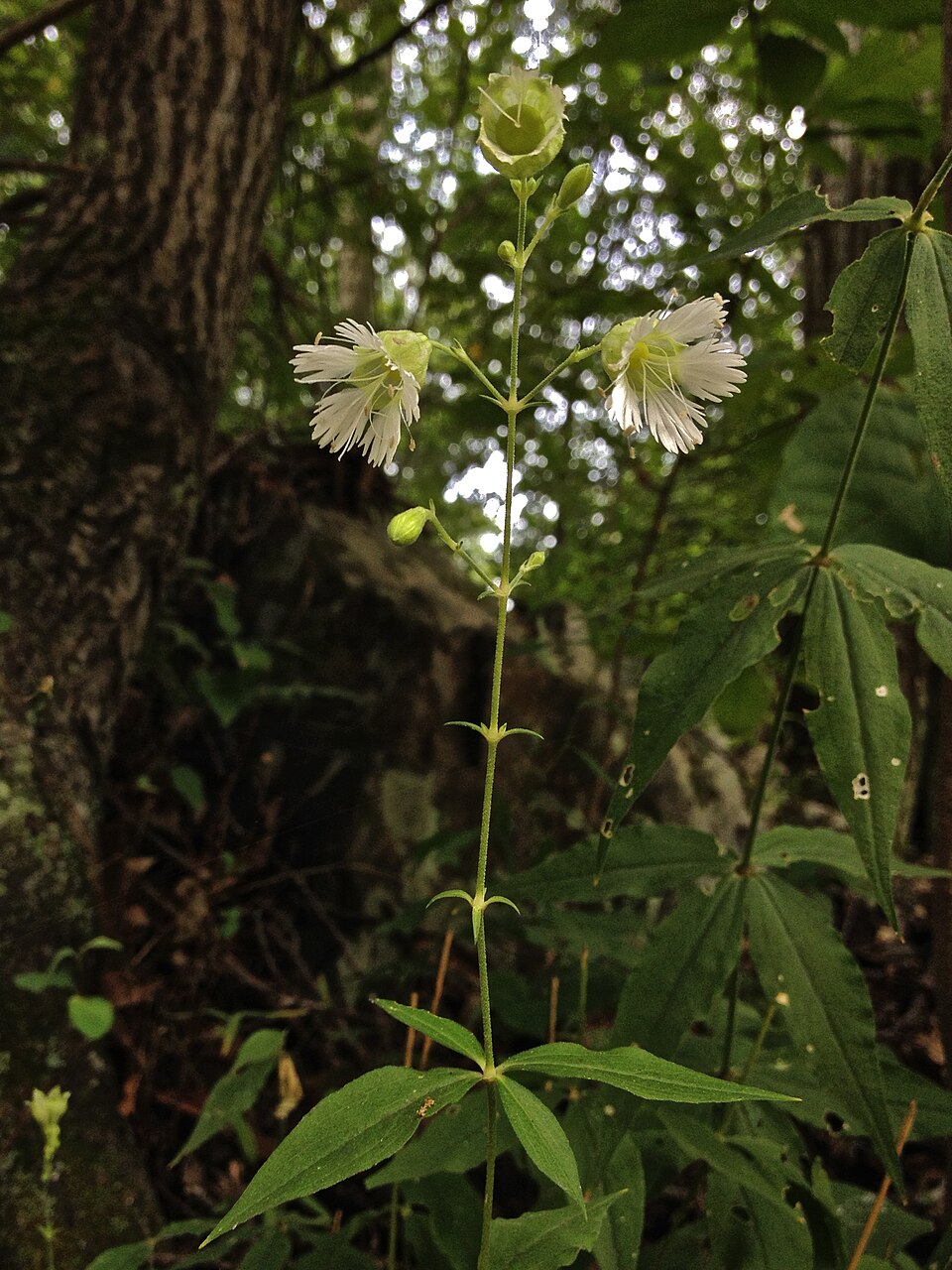
Silene stellata, commonly known as Starry Campion or Widowsfrill, is a tall, elegant wildflower of eastern woodlands and forest edges that earns its name from the extraordinary beauty of its flowers. Each white blossom bears five petals that are so deeply fringed — cut into numerous slender segments — that each petal resembles a delicate snowflake or tiny star burst. In late summer, when shaded woodland gardens often lack flowering interest, Starry Campion illuminates the understory with its airy white blooms on tall, wiry stems rising 2 to 3 feet above whorled leaves.
This member of the Pink family (Caryophyllaceae) is related to carnations, dianthus, and the familiar garden catchflies, but Silene stellata has a distinctive beauty all its own — less showy than its cultivated relatives, but possessed of a wild, intricate grace that rewards close examination. The species name stellata means “star-shaped,” a reference to the fringed petals. The alternate common name “Widowsfrill” reflects the lacy, ruffled appearance of the flowers.
Starry Campion is a plant of rich, moist-to-dry upland woods — forests of oak, hickory, and maple in the eastern United States from New England south to the Gulf Coast. It is one of relatively few native wildflowers that blooms prolifically in the dappled shade of summer woodlands, filling a seasonal niche when spring ephemerals have gone dormant and fall asters have not yet begun. It is also an important plant ecologically, serving as a host plant for several specialized moths that feed exclusively on the Silene genus.
Identification
Starry Campion is a tall, loosely branched perennial herb, typically 2 to 3 feet tall with a distinctive whorled leaf arrangement and showy fringed flowers. It forms clumps that expand slowly from the base.
Stems & Leaves
The stems are erect to loosely ascending, 2 to 3 feet tall, and covered in fine, soft white hairs — giving them a somewhat velvety texture. One of the most distinctive vegetative features of Starry Campion is its leaf arrangement: the leaves are arranged in whorls of four at each node (rather than the opposite pairs typical of most plants). The leaves are ovate to lance-shaped, 2 to 4 inches long and 1 to 2 inches wide, with a pointed tip and prominent midrib. They are slightly hairy above and below.
Flowers
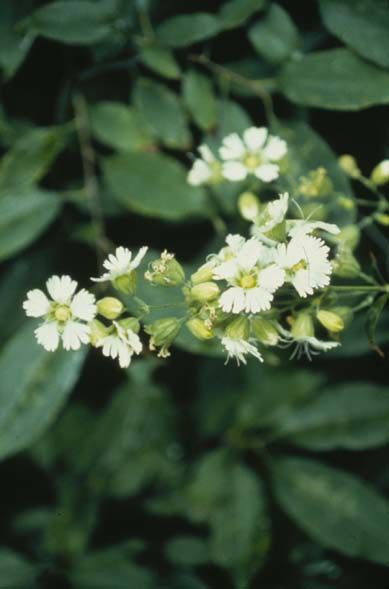
The flowers are the defining feature — and one of the most intricate of any native wildflower. Each flower is about ¾ to 1 inch across, with a tubular, inflated calyx (sepals fused into a purplish-striped bladder) from which the five white petals emerge. Each petal is deeply fringed — cut ⅓ to ½ of its length into numerous fine thread-like segments — creating a delicate, lacey appearance. In bud, the petals are rolled into a tight coil within the calyx. The flowers are held in loose, airy panicles at the stem tips. Bloom period is July through September.
Fruit & Seeds
The fruit is a small, ovoid capsule enclosed within the persistent, papery, inflated calyx. The capsule splits at the apex to release numerous tiny, dark seeds when mature. The persistent inflated calyces remain attractive on the dried stems through fall and winter.
Quick Facts
| Scientific Name | Silene stellata |
| Family | Caryophyllaceae (Pink family) |
| Plant Type | Herbaceous perennial wildflower |
| Mature Height | 2–3 ft |
| Sun Exposure | Part Shade to Full Shade |
| Water Needs | Moderate |
| Bloom Time | July – September |
| Flower Color | White, deeply fringed petals |
| USDA Hardiness Zones | 4–8 |
Native Range
Starry Campion has a broad range across the eastern and central United States, from the New England coastal plain south to Florida and west through the Mississippi Valley to Nebraska and Kansas. It is most abundant in the mixed mesophytic forests and oak-hickory woodlands of the central Appalachians, the Cumberland Plateau, and the Ozark Plateau, where it can be a locally common component of shaded forest-edge communities.
In New England — Connecticut, Massachusetts, and Rhode Island — Starry Campion occurs at the northeastern edge of its range. It is found in upland woods, rocky wooded slopes, and shaded road cuts. In these northern states it is relatively uncommon and is associated with the richer, more base-rich upland forest soils of the region rather than the sandy coastal plain habitats.
Throughout its range, Starry Campion is a characteristic species of the summer-blooming wildflower community in deciduous forests. Its bloom period in July–September corresponds with a season when relatively few other native woodland wildflowers are flowering, making it ecologically valuable as a late-summer resource for woodland pollinators and as a visual anchor for naturalistic shade garden designs.
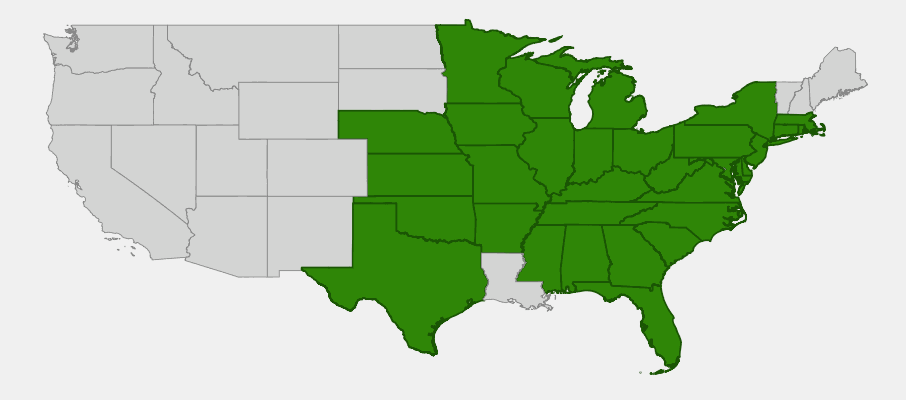
📋 Regional plant lists featuring Starry Campion: Southeastern U.S.
Growing & Care Guide
Starry Campion is an excellent, underused native plant for shaded gardens. It adapts well to typical garden conditions in the right light environment and requires little care once established.
Light
Partial shade to full shade is ideal — Starry Campion is a true woodland plant that grows best in the dappled light of a deciduous forest understory or the shade of garden trees. It tolerates a range of shade conditions from light morning sun with afternoon shade to fairly deep shade. In too much sun, particularly in hotter climates, it may wilt during afternoon heat. It is most useful for the challenging shaded areas where many garden plants refuse to bloom in summer.
Soil & Water
Starry Campion grows in average to moderately fertile, well-drained to moderately moist soils with neutral to slightly acidic pH (5.5–7.0). It grows naturally in both upland mesic forests and drier rocky woodland soils, so it adapts to a wider range of moisture conditions than many woodland wildflowers. Avoid waterlogged soil. In garden settings, average woodland garden soil with some organic matter is ideal. Once established, it is moderately drought-tolerant and generally needs no supplemental watering in average years.
Planting Tips
Plant from container stock in spring or fall in a shaded garden bed with well-drained, moderately fertile soil. Space plants 18–24 inches apart. Water in well and maintain moisture through the first growing season. Starry Campion tends to grow slowly at first but becomes more robust after 2–3 years once the root system is established. It self-seeds modestly in good conditions — allow some seed to ripen and fall in place for natural spread through a woodland garden.
Pruning & Maintenance
Deadhead after bloom if you want to prevent seeding, but allow some seed capsules to ripen for natural establishment. Cut back to the ground after frost in fall. The dried seed capsules and stems have some winter interest. Plants are generally free of serious pests and diseases. Powdery mildew can occasionally affect the foliage in very humid conditions — improve air circulation by not overcrowding plants.
Landscape Uses
- Woodland garden — the classic use; provides late-summer white flowers in shade
- Shaded border — fills the gap between spring ephemerals and fall asters in shaded beds
- Native shade garden — pairs beautifully with Black Cohosh, Wild Blue Phlox, and Solomon’s Seal
- Naturalized woodland edge — self-seeds gently in good conditions
- Moon garden — the white flowers glow in low evening light under trees
- Cut flower — the airy, fringed flowers make beautiful additions to wildflower arrangements
Wildlife & Ecological Value
Starry Campion is most notable ecologically for its role as a host plant for specialist moths and as a late-summer nectar source in woodland habitats.
For Moths — Specialist Host Plant
The genus Silene is the exclusive larval host for several specialized moth species. The Campion Moth (Hadena ectypa) and related species in the tribe Hadenini lay their eggs specifically on Silene flowers, and the caterpillars feed on the developing seeds within the capsules — a feeding strategy called “seed predation” or “florivory.” This tight mutualism between Silene species and seed-feeding moths is a fascinating example of coevolution; the moths are simultaneously pollinators (the adults visit flowers for nectar and inadvertently transfer pollen) and seed predators (the larvae consume some of the seeds). The plant produces more seeds than the moth consumes, maintaining the ecological balance.
For Pollinators
The flowers of Starry Campion are visited by various noctuid moths, sphinx moths (hawkmoths), and bumblebees for nectar. The tubular calyx and extended floral tube restrict nectar access to long-tongued or long-proboscid visitors, reducing competition from short-tongued insects. The fragrant evening blooms particularly attract sphinx moths, making Starry Campion a valuable plant for evening-pollinator gardens.
For Birds
The tiny seeds are consumed by small finches and sparrows in late summer and fall. The tall stems and dried seed capsules provide foraging perches and visual structure in woodland garden settings.
Ecosystem Role
In deciduous forest understory communities, Starry Campion fills an important temporal niche — blooming in midsummer to early fall when few other native woodland forbs are in flower. This provides a resource bridge for woodland pollinators between the spring wildflower flush and fall-blooming goldenrods and asters. Its role as host plant for specialist moths contributes to the woodland insect community that underlies the entire food web.
Cultural & Historical Uses
Starry Campion was used medicinally by several Indigenous nations of eastern North America. The Cherokee used root preparations for treating various ailments including stomachaches and as a component of formulas for treating respiratory conditions. Other eastern woodland nations used preparations from the plant as mild sedatives and for treating skin conditions. The sticky, glandular stems of campion plants generally (a characteristic of the genus) were noted by Indigenous peoples and early botanists as a trap for small insects — the English common name “catchfly” for many Silene species refers to this sticky-stem characteristic, though Silene stellata is less notably sticky than some relatives.
European botanists were quick to collect and describe Starry Campion following colonial exploration of eastern North America, drawn by the distinctive fringed petals that set it apart from all European members of the genus. The Swedish botanist Pehr Kalm, who traveled through North America in 1748–1751 and reported his observations to Linnaeus, described the wildflowers of the eastern forest understory including plants in the campion family. Linnaeus formally described Silene stellata in 1753 based on collections from colonial America.
In 19th century American horticulture, Starry Campion was occasionally grown in gardens for its ornamental value, particularly in wildflower garden designs promoted by early American naturalists like Asa Gray and Charles Sargent who advocated for the planting of native species in cultivated landscapes. It remained a specialty plant used primarily by botanical enthusiasts, however, and never achieved wide commercial cultivation. Today, it is increasingly available from native plant nurseries and is valued by contemporary shade gardeners seeking unusual and ecologically significant plants for summer woodland interest.
Frequently Asked Questions
Why are Starry Campion’s flowers so unusual?
The deeply fringed petals are one of the most distinctive features in the entire genus Silene and in the Pink family generally. Each petal is cut at least one-third of the way to its base into numerous thread-like segments. The biological function of this fringed structure is not fully understood — it may help guide pollinators toward the nectar tube, may provide a landing platform, or may be related to the specific pollination requirements of nocturnal moth pollinators.
Does Starry Campion spread aggressively?
No — it self-seeds modestly in good conditions but is not aggressive. In a woodland garden, it will slowly establish a small naturalized colony over several years, but it does not spread in the invasive manner of some other native plants. It’s a polite, well-mannered wildflower that coexists well with other woodland natives.
Can Starry Campion grow in full sun?
It prefers shade to part shade and can decline in direct afternoon sun, particularly in hot summer conditions. In cooler climates (northern New England, at elevation), it may tolerate more sun. In the Southeast and Mid-Atlantic, stick with shaded or part-shaded sites for best results.
When does Starry Campion bloom in New England?
In New England (Connecticut, Massachusetts, Rhode Island), expect bloom from approximately mid-July through early September, with peak bloom in July and August. The timing varies somewhat with local climate and site conditions.
What are “campion moths” and why do they matter?
Campion moths (genus Hadena) are specialized moths whose larvae feed inside the developing seed capsules of Silene species. While this means the larvae consume some seeds, the adult moths also pollinate the flowers as they feed on nectar, and the plant produces far more seeds than the moths consume. This mutualistic-parasitic relationship is a compelling example of the complex ecological relationships that evolved between native plants and their specialist insects over millions of years — relationships that are lost when native plants are replaced by non-native ornamentals.

Looking for a nursery that carries Starry Campion?
Browse our native plant nursery directory: Virginia · North Carolina · Georgia