Balsam Fir (Abies balsamea)
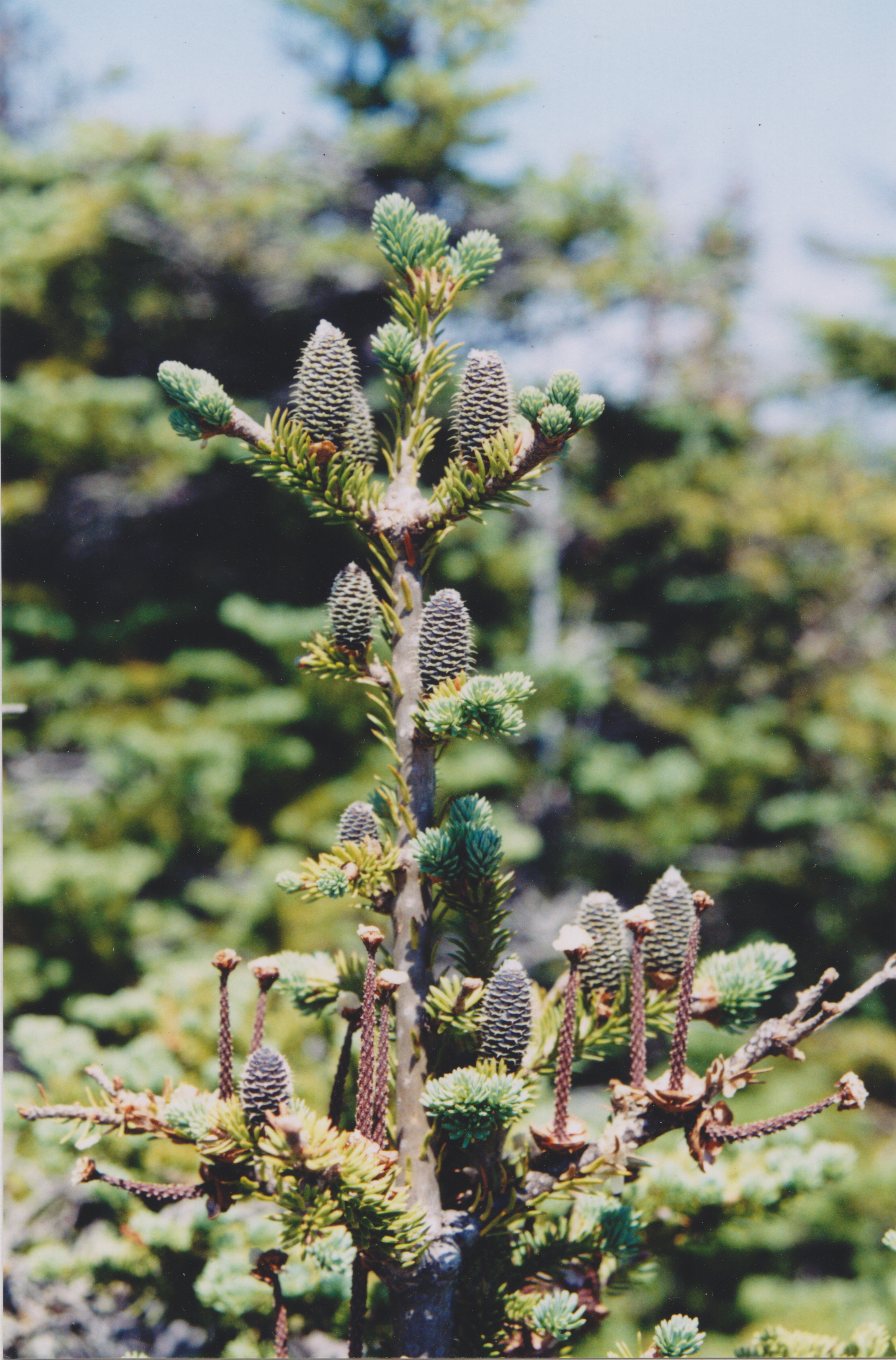
Abies balsamea, commonly known as Balsam Fir, is a quintessential evergreen conifer of northeastern North America and a defining symbol of the northern boreal forest. This medium-to-large tree, reaching up to 75 feet tall, is instantly recognizable by its pyramidal shape, dark glossy-green needles with silvery white undersides, and distinctively aromatic resin that gives the species its common name. Native to a vast swath of the northeastern United States and Canada, Balsam Fir thrives in cool, moist climates and is a critical component of the Acadian forest ecosystem shared by Maine, New Hampshire, Vermont, and the Canadian Maritimes.
Balsam Fir is perhaps best known in popular culture as the quintessential Christmas tree — its symmetrical form, deep green color, excellent needle retention, and intoxicating piney fragrance have made it the most beloved Christmas tree species in North America for generations. Beyond its holiday fame, this tree provides exceptional ecological value in its native landscape. Its dense, layered branches offer critical thermal cover and nesting habitat for birds and mammals throughout the harsh northern winters, while its seeds provide high-energy food for crossbills, nuthatches, and chickadees. The resin blisters on the smooth gray bark produce “Canada Balsam,” a transparent mounting medium used historically in optical instruments and microscopy.
In the landscape, Balsam Fir functions magnificently as a specimen tree, screen planting, or windbreak in cool northern climates. It performs best in moist, well-drained acidic soils and tolerates partial shade, making it a suitable understory or forest-edge planting in New England gardens. Its compact habit in youth expands into a stately, broadly conical crown at maturity. Though it does not fare well in hot, dry urban settings — preferring the cool moisture of the north — in appropriate conditions it is a supremely graceful and ecologically rewarding addition to any native plant garden.
Identification
Balsam Fir is a medium to large evergreen tree, typically reaching 40–75 feet (12–23 m) in height with a trunk diameter of 1–2 feet (30–60 cm). Young trees have a sharply conical, symmetrical crown; older trees develop a more irregular, sometimes flat-topped or club-shaped crown as the lower branches die in heavy shade. The species is distinguished from other northeastern conifers by its flat, aromatic needles with characteristic white stomatal bands on the underside, and by its erect cones that disintegrate on the tree rather than falling intact.
Bark
On young trees and branches, the bark is smooth, thin, and grayish-brown, characteristically dotted with prominent resin blisters. These blisters contain a fragrant, transparent to whitish resin known as “Canada Balsam” — which was historically used as a transparent cement in optical instruments and microscopy due to its remarkable clarity and refractive index close to glass. On older trunks, the bark becomes rougher and scaly, breaking into reddish-brown or grayish plates. The bark remains relatively thin throughout the tree’s life, offering limited fire resistance.
Leaves
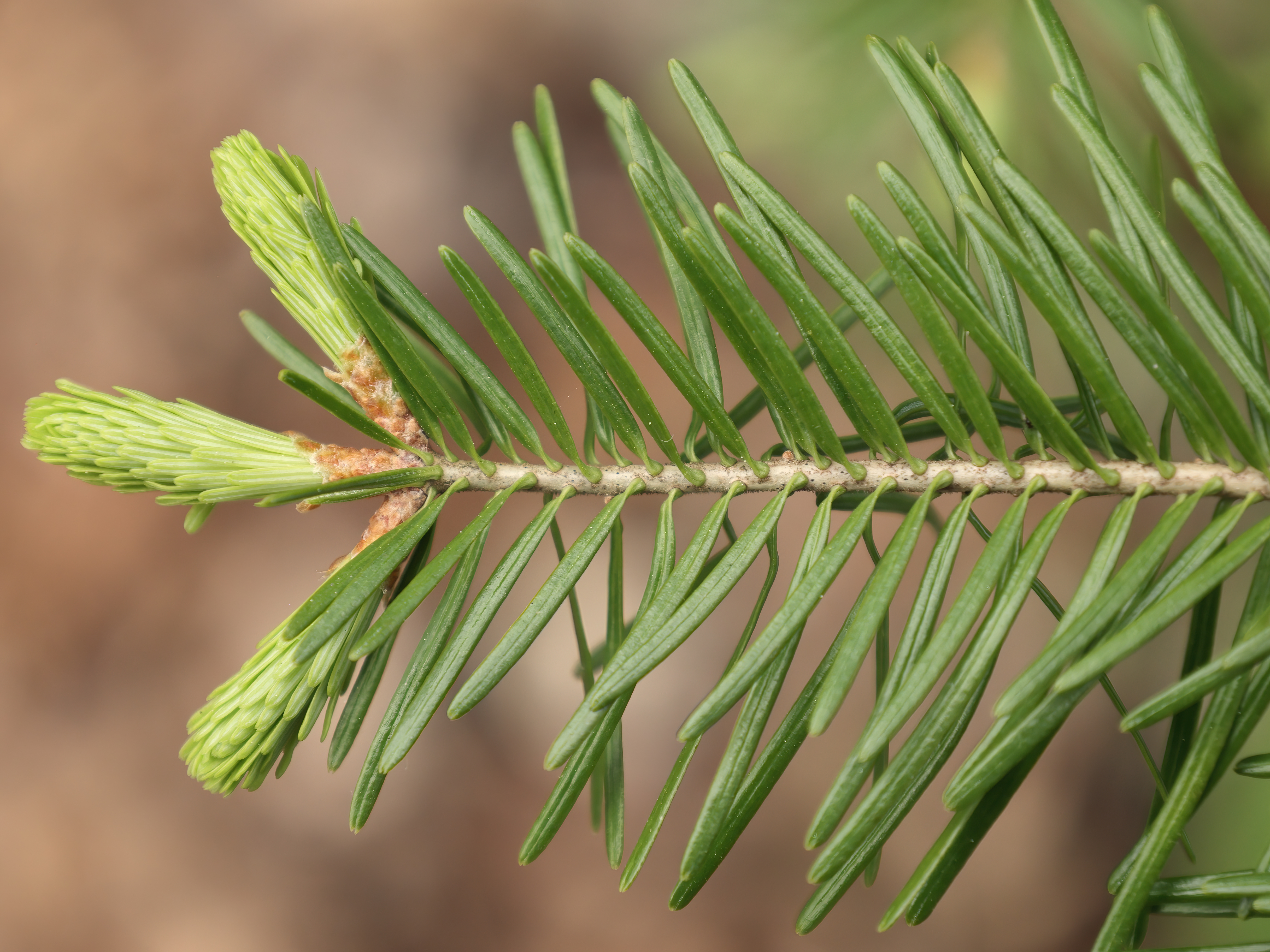
The needles are flat, 3/4 to 1 1/4 inches (2–3 cm) long, and arranged in a flat, comb-like pattern along the branches. Each needle is rounded at the tip (not sharp), with a dark, shiny green upper surface and two distinct narrow white stomatal bands on the underside — giving the branch undersides a striking silvery-white appearance. The needles are strongly aromatic when crushed, releasing the characteristic “Christmas tree” scent due to volatile terpenes including bornyl acetate and tricyclene. Needles persist on branches for 6–10 years before dropping.
Cones & Seeds
One of Balsam Fir’s most distinctive features is its cones. Unlike most conifers, the cones are erect (pointing upward) on the branches, rather than pendulous. They are cylindrical, 2–4 inches (5–10 cm) long, and begin green before ripening to dark purple-brown in late summer. The cones disintegrate on the tree while still attached — the scales and seeds fall separately, leaving only the erect central cone axis (strigil) standing on the branch. Seeds are small, winged, and produced in substantial quantities every 2–4 years. This unusual cone behavior is shared only with other true firs (Abies species).
Quick Facts
| Scientific Name | Abies balsamea |
| Family | Pinaceae (Pine family) |
| Plant Type | Evergreen Coniferous Tree |
| Mature Height | 75 ft |
| Sun Exposure | Full Sun to Part Shade |
| Water Needs | Moderate |
| Soil Type | Moist, well-drained, acidic; loamy or sandy |
| Soil pH | 4.5–6.0 (acidic) |
| Bloom Time | May – June (pollen shed) |
| Cone Color | Green ripening to dark purple-brown |
| Needle Color | Dark green above, silvery-white below |
| Wildlife Value | Very High — seeds, cover for birds and mammals |
| USDA Hardiness Zones | 3–5 |
Native Range
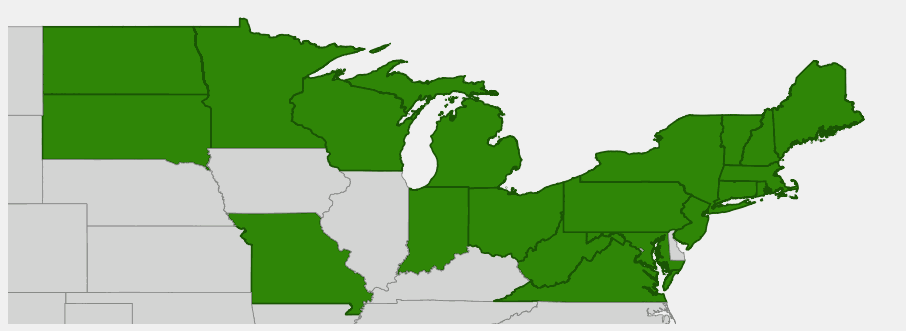
Balsam Fir is native to a broad sweep of northeastern and north-central North America, from the Atlantic coast of Newfoundland and Labrador westward through Quebec and Ontario to Manitoba and Saskatchewan, and south into the northeastern United States. In New England, Balsam Fir is abundant throughout Maine, New Hampshire, and Vermont — particularly at higher elevations and in the northern portions of these states — and extends south into western Massachusetts and northern Connecticut at suitable high-elevation sites. It is the dominant species of the sub-alpine forest zone in the White Mountains of New Hampshire and the Green Mountains of Vermont.
The species reaches its southernmost extent in the Appalachian Mountains of West Virginia, where isolated populations persist at high elevations in refugial habitats. In the upper Midwest, Balsam Fir is abundant across Michigan, Wisconsin, and Minnesota, forming extensive boreal forests alongside Black Spruce, White Spruce, and Tamarack. Its range largely coincides with the Canadian Shield and areas with cool, moist, continental or maritime climates that experience cold winters and relatively cool, humid summers.
Within its range, Balsam Fir is a seral species — it establishes quickly after disturbance (fire, wind, logging) but is gradually replaced by longer-lived species like Sugar Maple, Yellow Birch, and White Spruce in late succession. It is highly susceptible to spruce budworm infestations, which periodically cause widespread mortality across large portions of its boreal range and play a significant ecological role in forest dynamics.
📋 Regional plant lists featuring Balsam Fir: New England
Growing & Care Guide
Balsam Fir is a rewarding tree to grow in northern landscapes when sited appropriately. Its key requirement is a cool, moist climate — it does not perform well in hot, dry summers or in warm southern climates. Given the right conditions, it is a low-maintenance, long-lived tree that provides year-round structure and beauty.
Light
Balsam Fir grows best in full sun to partial shade. Young seedlings are moderately shade-tolerant and establish well beneath an open forest canopy, but mature trees perform best with access to full sun for much of the day. In deep shade, growth slows considerably and trees may become sparse and asymmetrical. In hot, sun-exposed sites without adequate moisture, the tree may struggle — a partially shaded location with moist soil is often ideal for gardens outside of its northernmost range.
Soil & Water
Balsam Fir prefers cool, moist, acidic soils (pH 4.5–6.0) — conditions typical of the northern forest floors it naturally inhabits. It thrives in loamy or sandy loam soils with good drainage, though it tolerates brief periods of wet conditions and can grow in boggy areas. Consistent soil moisture is essential, particularly during the establishment period. Mulching with shredded bark or leaf litter helps maintain soil moisture and cool root temperatures. Drought stress accelerates browning of interior needles and increases susceptibility to bark beetles and budworm.
Planting Tips
Plant Balsam Fir in spring or early fall. Container-grown or balled-and-burlapped stock transplants well. Choose a site with protection from drying southwest winds, which can cause winterburn on exposed needles. Space trees 12–20 feet apart for naturalistic plantings or windbreaks; give specimen trees ample room — 15–20 feet — to develop their full pyramidal form. Avoid planting in low-lying frost pockets or sites with heavy clay soil. In warmer parts of its range (Zone 5), plant on north or east-facing slopes to minimize heat stress.
Pruning & Maintenance
Balsam Fir requires minimal pruning. Remove dead or diseased branches at any time. To maintain a more formal shape, lightly shear new growth (candles) in late spring, but avoid cutting into old wood, which will not regenerate. The tree is naturally symmetrical and requires little corrective pruning. Watch for woolly adelgid (a small aphid-like insect) on young shoots, and for spruce budworm on needles — particularly in areas where budworm outbreaks are active. Healthy, well-sited trees are generally more resistant to pests.
Landscape Uses
Balsam Fir is versatile in the northern landscape:
- Specimen tree — superb year-round focal point in northern gardens
- Christmas tree production — the premier species for plantations in New England and the upper Midwest
- Windbreak or screen — dense year-round foliage provides excellent privacy and wind protection
- Wildlife planting — exceptional bird cover and seed source; essential for crossbills and siskins
- Forest restoration — key component of boreal and Acadian forest restoration projects
- Sub-alpine gardens — excellent for high-elevation mountain landscapes
- Bog and streamside planting — tolerates moist, acidic conditions near water
Wildlife & Ecological Value
Balsam Fir is a foundational species in northern forest ecosystems, providing critical habitat structure, food, and thermal cover for a remarkable diversity of wildlife throughout all seasons.
For Birds
The small, winged seeds of Balsam Fir are a primary food source for several irruptive winter finches that depend on conifer seeds: Red Crossbills and White-winged Crossbills use their specialized bills to extract seeds from partially disintegrated cones, and are closely tied to cone crop cycles. Pine Siskins, Common Redpolls, and American Goldfinches also consume the seeds. In summer, the dense needle canopy provides nesting habitat for an array of boreal species including Blackburnian Warblers, Bay-breasted Warblers, Yellow-rumped Warblers, and various vireos and flycatchers. Winter-resident species like Black-capped Chickadees, Red-breasted Nuthatches, and Brown Creepers use the bark and branches year-round for foraging and roosting cover.
For Mammals
Balsam Fir’s dense layered branches provide critical thermal cover for White-tailed Deer, moose, and snowshoe hares during severe northern winters — studies have shown deer survival rates increase significantly in stands with dense Balsam Fir cover. Snowshoe hares browse heavily on young Balsam Fir seedlings and are a keystone prey species in boreal ecosystems. Canada Lynx — which are closely tied to hare populations — rely on Balsam Fir forests for hunting cover. Porcupines eat the bark and buds during winter, sometimes causing significant damage to individual trees. Red squirrels cache the seeds extensively, playing an important role in seed dispersal.
For Pollinators
Like other conifers, Balsam Fir is wind-pollinated and does not produce nectar-bearing flowers. However, the tree contributes indirectly to pollinator habitat by providing structural diversity in the forest canopy, supporting the plant understory that does produce pollen and nectar. The resin from bark blisters is collected by some bee species for nest construction materials.
Ecosystem Role
Balsam Fir is a keystone species in the boreal and Acadian forest ecosystems of northeastern North America. As a major component of the sub-alpine forest zone in New England, it defines the character and species composition of mountain forests above 2,500 feet elevation. Its rapid regeneration after disturbance — fire, wind, logging — makes it an important pioneer in forest succession. The spruce budworm — which feeds preferentially on Balsam Fir — drives landscape-scale forest dynamics, creating pulses of mortality and regeneration that maintain the age-class diversity critical for many boreal species. Balsam Fir needle litter, while slow to decompose, contributes to the distinctive acidic humus layer of northern forest soils.
Cultural & Historical Uses
Balsam Fir has a long and rich history of human use, particularly among the Indigenous peoples of the northeastern woodlands. The Abenaki, Wabanaki, Penobscot, and other Algonquian nations used virtually every part of the tree. The fragrant resin from bark blisters was applied as a topical treatment for wounds, skin irritations, and respiratory ailments — acting as an antiseptic and soothing agent. The resin was also chewed for its pleasant taste and applied to canoe seams as a waterproofing agent. Balsam Fir boughs were used to make fragrant sleeping mats that repelled insects, and the inner bark was consumed as an emergency food during times of scarcity.
European settlers and later commercial interests recognized the value of “Canada Balsam” — the transparent, amber-colored resin from bark blisters — which became an important material in the optical and microscopy industries during the 19th and early 20th centuries. Its refractive index is nearly identical to glass, making it an ideal adhesive for cementing together optical lenses and mounting microscope slides. Its use in microscopy was largely replaced by synthetic resins after World War II, but Canada Balsam remains available and is still preferred by some conservationists for its historical properties.
The Christmas tree industry transformed the cultural significance of Balsam Fir in the 20th century. By the 1950s, Balsam Fir had become the dominant Christmas tree species in the northeastern United States and eastern Canada, a position it has largely maintained despite competition from plantation-grown Scotch Pine and Fraser Fir. The needles are still harvested commercially to produce fragrant “balsam pillows” and sachets. The wood is soft and used primarily for pulpwood and lumber in lower-grade applications, though it has been used locally for light construction, boxes, and crates. The tree’s ecological value in forest ecosystems and its beloved cultural status as a Christmas tree together make it one of the most significant native trees of the Northeast.
Frequently Asked Questions
Why does Balsam Fir smell so good?
The characteristic “Christmas tree” fragrance comes from volatile aromatic compounds — primarily bornyl acetate, camphene, and tricyclene — concentrated in the needles and resin blisters of the bark. The scent is released when needles are crushed or when bark blisters are ruptured. This fragrance has led to the commercial harvesting of Balsam Fir needles for potpourri, sachets, and pillows.
How is Balsam Fir different from other firs?
Balsam Fir is the only fir native to northeastern North America. It can be distinguished from Fraser Fir (a close relative native to Appalachian mountains) by its slightly larger needles and less compact cones. From spruces, Balsam Fir is distinguished by its flat needles (spruce needles are square in cross-section and can be rolled between fingers), rounded needle tips, and erect cones that disintegrate on the tree.
Can Balsam Fir grow in Zone 6?
Balsam Fir is rated hardy to Zone 3, but performs best in Zones 3–5. In Zone 6, it typically struggles with summer heat and drought stress, especially in exposed sites. If you are in Zone 6 and want to try it, choose a north-facing slope, provide consistent moisture, and mulch heavily. Fraser Fir (Abies fraseri) is a better choice for Zone 6 gardens.
Does Balsam Fir have any pests or diseases?
The most significant pest is the spruce budworm (Choristoneura fumiferana), which periodically devastates Balsam Fir forests across the boreal region. Individual landscape trees are also susceptible to balsam woolly adelgid, which can kill trees within a few years of infestation. Root rots (particularly Armillaria) can be an issue in poorly drained soils. Healthy, well-sited trees in appropriate climates are generally more resistant to all of these problems.
How long does Balsam Fir live?
In the wild, Balsam Fir typically lives 80–150 years, making it relatively short-lived compared to longer-lived boreal species like White Spruce. The short lifespan is partly due to its susceptibility to the spruce budworm and root rots. In landscape settings with good care and appropriate siting, trees can live longer. It is a relatively fast-growing conifer, adding 1–2 feet per year in favorable conditions.

Looking for a nursery that carries Balsam Fir?
Browse our native plant nursery directory: Maine · New Hampshire · Vermont · Connecticut